
Editorial Article
Two Mills, One Eighth of the World, and a Price Set Somewhere Else
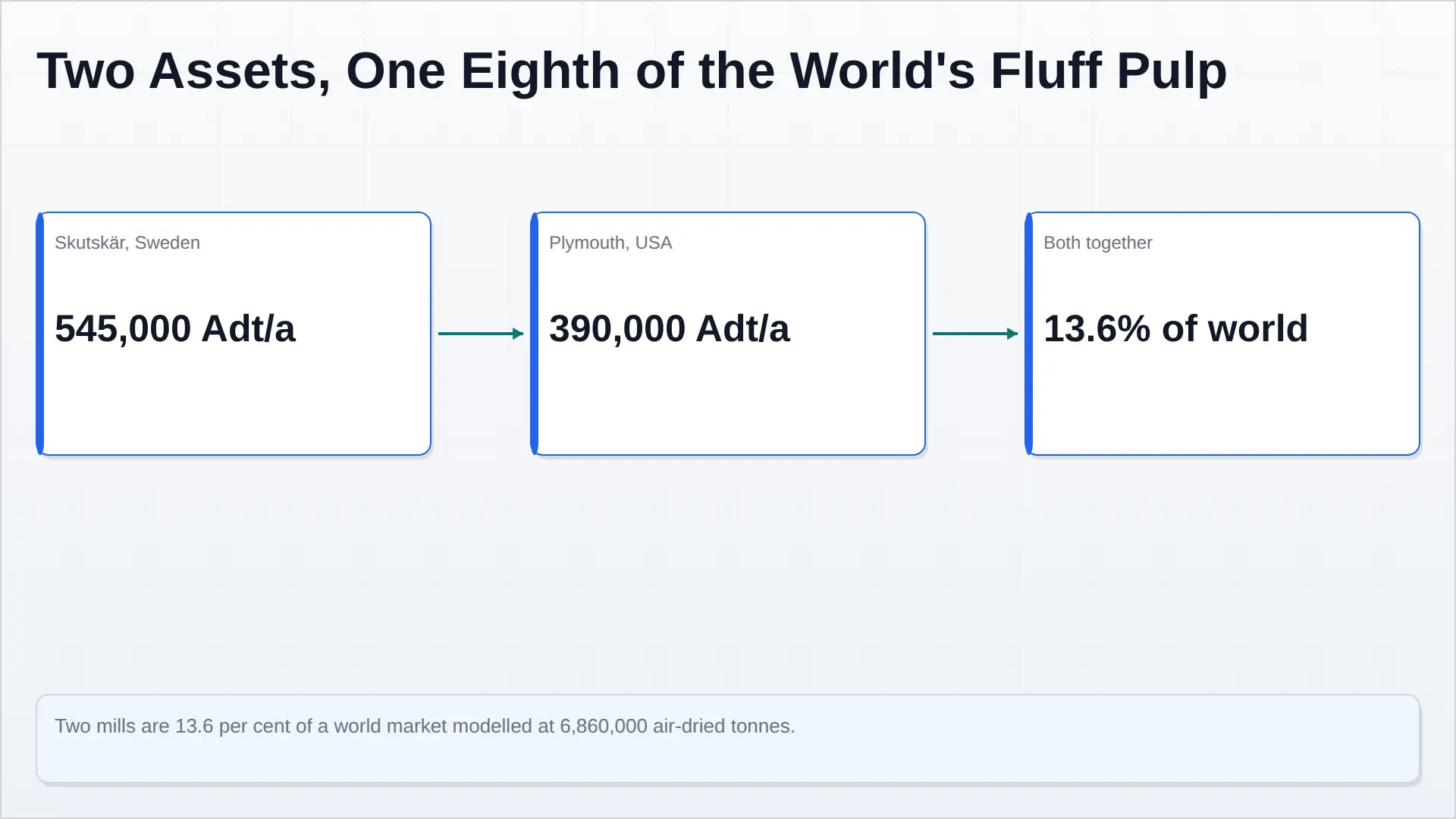
Two mills hold 935,000 air-dried tonnes of fluff pulp capacity: Stora Enso’s Skutskär in Sweden at 545,000 Adt/a, Europe’s largest, and Domtar’s Plymouth in North Carolina at 390,000. Against a world market modelled at 6,860,000 tonnes, that is 13.6 per cent of the world in two assets.
In most commodity pulp grades that would be a footnote. In this one it is decisive, because the number of mills able to make a hygiene-grade fluff at specification is small, and the capital required to convert a paper mill into one is a project rather than a tweak. And yet concentration is not what moves the price. Something less visible is.
Concentration is real. Optionality is the mechanism.
Most fluff mills are swing mills: the same fibre line can run paper-grade softwood kraft instead. A mill does not ask whether fluff covers its cost. It asks whether fluff beats the alternative it could be making that month.
That question has nothing to do with hygiene demand. When packaging and board grades earn more per tonne of fibre, fluff supply tightens without a single tonne of capacity closing — and the price required to keep a swing mill on the fluff grade is set by the packaging market. This is why a market with thirteen per cent of its capacity in two mills still prices like a market with a marginal producer, and why the fluff pulp report models price at 1.73 per cent a year from an anchor that is a paper grade rather than a hygiene specification.
The public map of who can actually make the grade
For a market this consequential, the producer list is unusually well documented — and the reason is certification. Third-party ecolabelling names producing mills grade by grade: the Nordic Swan pulp and fluff declaration portal, and the EU Ecolabel EU Pulps list maintained under Commission Decision (EU) 2023/1809.
That compliance is also a moat. It is a fixed cost per grade, and it advantages the large multi-mill producer with a technical team over the single-mill operator. The mills that appear on those registers have accepted an inspection regime smaller producers have not. It is, incidentally, why the public record of who makes fluff pulp is better than for most commodity grades.
| Producer | Fluff assets | Verified detail |
|---|---|---|
| Stora Enso | Skutskär, Sweden — NaturaFluff | Largest fluff producer in Europe, 545,000 Adt/a of coniferous pulp; ECF, TCF and non-bleached grades; reels available |
| Domtar | Plymouth, North Carolina; Ashdown, Arkansas | Plymouth 390,000 air dry metric tonnes; Ashdown untreated, softened and semi-treated grades |
| SCA | Östrand, Sweden | Star Fluff Pulp; separate CTMP and NBSK lines at the same site |
| Klabin | Puma, Brazil | PineFluff bleached softwood kraft fluff alongside PineCel NBSK |
| UPM | RaumaCell, Finland | BioBright and BioBrown fluff and airlaid grades, including TCF and treated variants |
| Södra | Värö, Mönsterås, Mörrum, Sweden | Multiple inspected fluff grades across three mills |
| ENCE | Navia, Spain | LEAFF (ENCE Fluff) |
| GCF US Holdings | Franklin and New Bern, North Carolina; Port Wentworth, Georgia | SuperSoft grades including treated and air variants across three US sites |
Grade range is the actual product
A single mill now offers ECF, TCF and non-bleached variants, treated and untreated, softened and semi-treated, in bale and in reel. That is not a marketing list. A diaper core, an adult brief core and an airlaid napkin need genuinely different fibre properties — length, coarseness, brightness, sheet strength, moisture and defibreizing energy — and the producer who can supply the whole range from one site keeps the customer. The producer with one grade competes on price alone.
The reel-versus-bale distinction is small and commercially real. Reel supply removes a defibration step at the converter and reduces fibre damage. In a market where the innovation that wins a contract is frequently a logistics and handling change rather than a fibre-science breakthrough, that is a genuine differentiator — because the converter’s cost problem is not only grammes of pulp but the labour and energy of getting it into a core.
Supply and demand are in different hemispheres
Production concentrates in Sweden, Finland, the southern United States, Brazil and Spain. Consumption growth concentrates in Asia Pacific, where volume is modelled at 2.19 per cent a year. That mismatch is why the freight cost of a low-density bale matters, why converters cluster near mills rather than near consumers, and why Asia Pacific’s growth is being met by converting capacity built close to North American and Brazilian fibre rather than by a new Asian fluff mill.
It also means the market’s answer to demand growth is a shipping decision before it is a capacity decision — and shipping decisions respond faster than paper machines.
Documentation has become a cost line
The EU Deforestation Regulation has made provenance a specification item, and the interesting question is not whether it costs money but who carries it. The mill holds the chain-of-custody records; the converter holds the audit obligation; the tender holds the requirement. In practice the cost lands where the bargaining power is weakest, which in a market with 45 per cent softwood premiums and swing-mill optionality is not the mill.
That is worth watching for a buyer, because documentation cost behaves like a fixed cost per grade — the same shape as certification, and the same effect: it advantages scale and makes the single-grade producer’s position worse.
What a buyer should actually do with this
Three things follow from the structure rather than from the forecast. Qualify more than one mill per grade, because the constraint on supply is qualified capacity, not nominal capacity. Watch the softwood-to-hardwood spread rather than the fluff quote, because the spread is the leading indicator and the quote is the lagging one. And treat recycled content as a cost line, because absorbent hygiene is a laminate of pulp, polymer, polypropylene and polyethylene and separating the fibre economically at scale has not been demonstrated against virgin fluff at USD 1,290 a tonne.
How this was researched
Seventy per cent secondary, thirty per cent primary. Mill capacity and grade ranges come from producer disclosure; the producer set is corroborated against the Nordic Swan and EU Ecolabel registers that name mills grade by grade; prices rest on market-pulp price reporting; and regulation is taken from the EU instruments themselves. The primary programme comprises structured interviews with pulp commercial teams and mill technical managers, open-ended interviews with converters and core-design engineers, converting-line procurement conversations, trade-show proceedings and a converter survey on fluff-reduction programmes. No market-research competitor data is used or cited.
Read next
- The only material whose customer is paying to use less of it — price, tonnage and the 59.7 per cent.
- Global Fluff Pulp Market — the full report.
- Global Baby Diapers Market — the largest end use for this grade.
Frequently Asked Questions
Which two mills dominate fluff pulp supply?
Stora Enso's Skutskär mill in Sweden at 545,000 air-dried tonnes a year and Domtar's Plymouth mill in North Carolina at 390,000 — 935,000 tonnes against a world market modelled at 6,860,000 tonnes, or 13.6 per cent.
If supply is concentrated, why can the producers not set the price?
Most fluff mills can switch the same fibre line to paper-grade softwood kraft. A mill compares the fluff price to the price of the alternative it could be making, so when packaging and board grades earn more per tonne, fluff supply tightens without any capacity closing.
How do you know who can make hygiene-grade fluff pulp?
The Nordic Swan pulp and fluff declaration portal and the EU Ecolabel EU Pulps list maintained under Commission Decision (EU) 2023/1809 name producing mills grade by grade. That makes the public record of who can make hygiene-grade fluff unusually reliable.
Is recycled fibre a real alternative to virgin fluff?
Not yet at scale. Absorbent hygiene products are a laminate of pulp, polymer, polypropylene and polyethylene, and separating the fibre economically has not been demonstrated against virgin fluff at USD 1,290 a tonne. Treat recycled content as a cost line in a tender specification, not as a supply source.