
Editorial Article
Seventy Per Cent of the Titanium Sponge and None of the Leverage
The United States produced no titanium sponge at all in 2025. Not less than before, not a reduced quantity: none. It imported an estimated 44,000 tonnes, which is more than it has ever imported in a single year, of which 73 per cent came from Japan, 13 per cent from Kazakhstan and 13 per cent from Saudi Arabia.
That reads like a strategic vulnerability, and it is routinely described as one. It is more accurately described as a procurement decision — and the reason it looks alarming is that people are measuring the wrong stage of the chain.
The idle plants are the interesting part
The United States is not without capacity. It has 23,500 tonnes a year of titanium sponge capacity sitting idle: a 12,600-tonne plant in Henderson, Nevada, idled since 2020, and a 10,900-tonne plant in Rowley, Utah, idled since 2016. The last operating sponge plant closed in 2024.
So the country owns the plants, and buys the metal. That is not a failure of capability; it is a response to price. Sponge is the least differentiated step in the titanium chain — a cyclical commodity whose margin depends on the spread between ore and metal, competed on by state-backed producers with cheap power. Running a sponge plant in Nevada to compete with a Chinese or Kazakh producer on a commodity spread is a poor use of capital, and no one should be surprised that the capital went elsewhere.
The question worth asking is what exposure that choice actually creates. Here the numbers get more interesting than the alarmism.
Seventy per cent of the input, a fifth of the capacity spare
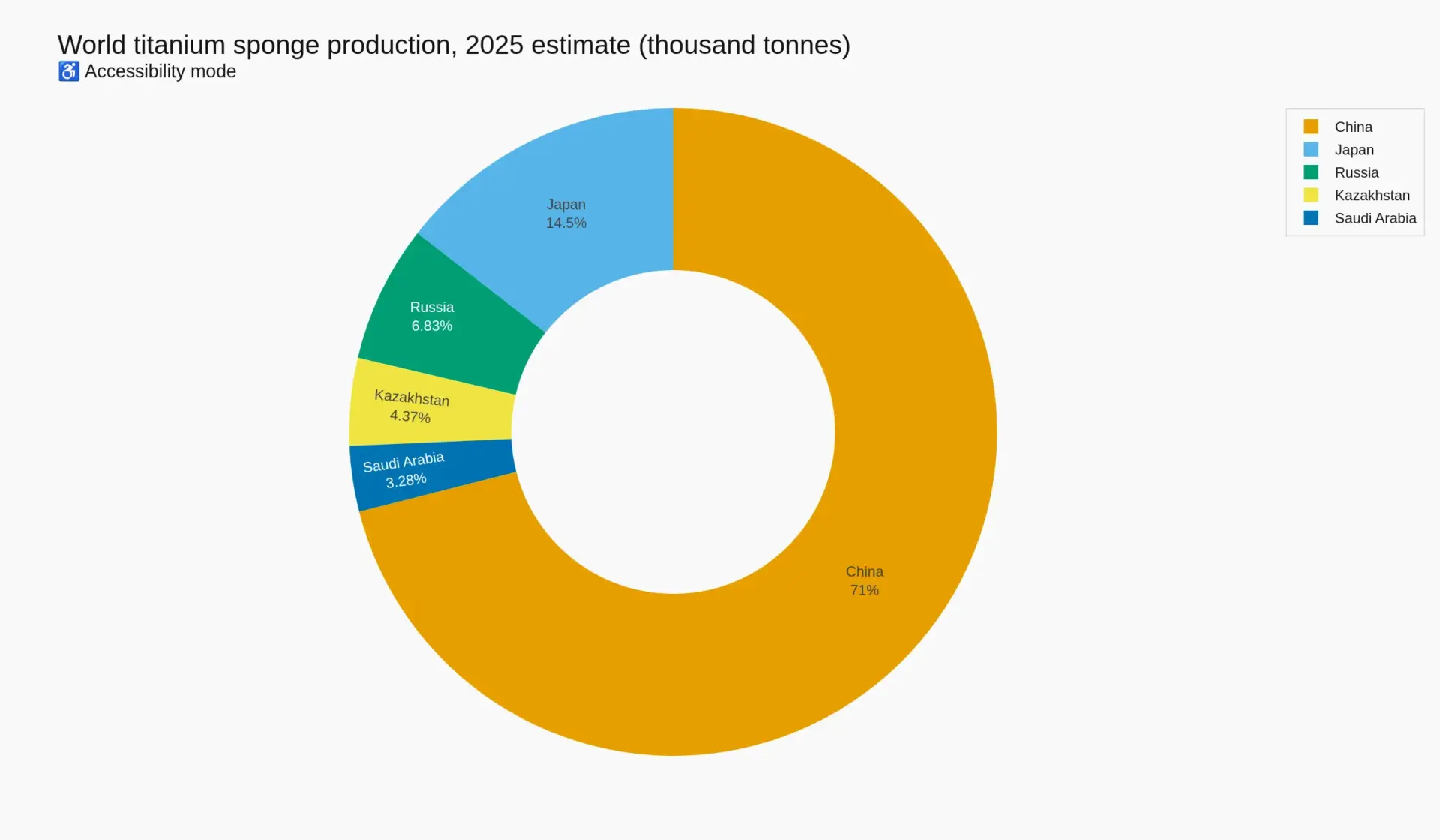
| Titanium sponge, 2025 estimate | Production (kt) | Capacity (kt) | Share of production |
|---|---|---|---|
| China | 260 | 320 | 70% |
| Japan | 53 | 65.2 | 14% |
| Russia | 25 | 46.5 | 7% |
| Kazakhstan | 16 | 26.0 | 4% |
| Saudi Arabia | 12 | 15.6 | 3% |
| India | 0.3 | 0.5 | — |
| United States | 0 | 0 (23.5 idle) | — |
| World | 370 | 470 | 100% |
China holds 70 per cent of production and 68 per cent of capacity. That is real concentration. But the world is running at about 79 per cent utilisation, which means there is roughly 100 thousand tonnes of spare sponge capacity outside the current production figures, in Japan, Russia, Kazakhstan and Saudi Arabia, plus 23.5 thousand idle tonnes in the United States.
A chokepoint is a stage where demand cannot be met from anywhere else at any price within the required time. Sponge is not that. Sponge is a stage where the marginal tonne is available, at a higher price, from three or four alternative countries, and where the fastest response to a shortage is to restart an idled plant.
What controls on the input actually do
The best evidence on this comes from the customs data rather than from commentary. China restricts exports of gallium, germanium, antimony and superhard materials, and its December 2024 announcement went further for the United States specifically: no dual-use exports to US military users or for military end use, and in principle no licences for those four material groups to the United States at all.
Now look at the trade line that carries unwrought gallium, germanium, indium, niobium and vanadium (HS 811292). China’s exports to the world moved from USD 295.9 million on 1,682 tonnes in 2023 to USD 392.7 million on 1,763 tonnes in 2024. Value up 32.7 per cent. Volume up 4.8 per cent. The implied unit value went from USD 175.98 to USD 222.76 per kilogram.
A licensing regime that restricts who may buy raises the price of what still leaves. It does not stop the material leaving, and it does not touch the qualification of a finished part. For the exporter that is a revenue outcome. For the importer it is a cost outcome. Neither is a supply-chain solution, and neither moves the constraint.
Where the leverage actually sits
Titanium sponge becomes ingot through vacuum arc remelting, often double or triple melted; ingot becomes billet and bar; bar becomes a forging; the forging becomes a part that an airworthiness authority and an engine maker have both signed off. The tonnage is decided upstream. The supply of parts is decided at the forge.
That is where the value has settled, and the results show it. ATI’s 2025 external sales were USD 4,587.4 million, split 46 per cent nickel-based and specialty alloys and 22 per cent precision forgings, castings and components — the mix of a company that sells qualified metallurgy rather than metal. Carpenter Technology sold 6 per cent less volume in its fiscal 2025 and earned 8 per cent more excluding surcharge, with aerospace and defence sales up 15 per cent to USD 1,768.6 million, 61 per cent of a USD 2,877.1 million total.
Neither company is a sponge producer of consequence. Both are extremely difficult to replace. If you wanted to hurt the Western aerospace supply chain, you would not start with a sponge plant; you would start with the qualification records.
The uncomfortable conclusion
The United States imports every kilogram of a metal it used to make, from a country holding 70 per cent of world production, while owning plants that could make some of it. That is a genuine dependency, and it is worth reducing. But the money being proposed for it is usually aimed at the wrong stage.
Restarting sponge capacity addresses the cheapest, most substitutable, most cyclical step in the chain. It would shorten a supply interruption in a crisis, which is not nothing. It would not create a single additional qualified forging, and qualified forgings are what a jet engine needs. The lead time on a new melt shop and a part approval is measured in years and the capital is measured in hundreds of millions; the lead time on restarting an idled sponge plant is measured in quarters.
Which means the honest way to state the vulnerability is not “America makes no titanium sponge”. It is: the world has 100 thousand tonnes of spare capacity in the commodity step, and very little in the step that decides whether a fan disk ships. Concentration in the input is visible, measurable and politically convenient. Concentration in the qualified stage is none of those things, which is precisely why it is the one that matters.
Sources: USGS, Mineral Commodity Summaries 2026: Titanium and Titanium Dioxide; UN Comtrade, China exports HS 811292, 2023 and 2024; Ministry of Commerce of China, Announcement No. 46 of 2024; Carpenter Technology, 2025 Annual Report on Form 10-K; ATI, fourth-quarter and fiscal-year 2025 results (3 February 2026), named but not linked because its investor-relations pages refused automated retrieval. Market sizing is set out in the Chemicals and Advanced Materials Market Report 2026–2033.
Frequently Asked Questions
Does the United States produce any titanium sponge?
No. USGS estimates the United States produced no titanium sponge in 2025, with the last domestic plant closing in 2024. It imported an estimated 44,000 tonnes, above the previous record of 40,300 tonnes in 2023, with 73 per cent from Japan, 13 per cent from Kazakhstan and 13 per cent from Saudi Arabia. The country does hold about 23,500 tonnes a year of idle sponge capacity in Nevada and Utah.
Is China's 70 per cent share of titanium sponge a chokepoint?
Not directly. World sponge production is about 370 thousand tonnes against 470 thousand tonnes of capacity, so roughly a fifth of capacity is spare across Japan, Russia, Kazakhstan, Saudi Arabia and idle US plants. A control on the input raises the cost of metal rather than stopping the supply of parts, because the stage that actually gates supply is qualified melt and forging, not sponge.
What does the export-control data show happened?
China's exports on HS 811292, the line carrying unwrought gallium, germanium, indium, niobium and vanadium, went from USD 295.9 million on 1,682 tonnes in 2023 to USD 392.7 million on 1,763 tonnes in 2024. Value rose 32.7 per cent on 4.8 per cent more volume, so the implied unit value rose from USD 175.98 to USD 222.76 per kilogram. Controls raised the price of what still left.
Where is the real bottleneck in the titanium chain?
Qualified melt, forging and part approval. That is where ATI and Carpenter Technology earn their returns: Carpenter sold 6 per cent less volume in fiscal 2025 and earned 8 per cent more excluding surcharge, with aerospace and defence 61 per cent of a USD 2,877.1 million total. Restarting a sponge plant takes quarters; creating a qualified forging supply takes years.