
Editorial Article
Thirteen May 2027: The Date India's Consent Rules Reach the Only Identifier That Matters
For roughly five years, between 2020 and 2025, the global advertising industry conducted a long and expensive argument about a cookie. Publishers, platforms, regulators and trade bodies fought over the third-party cookie — whether it would be deprecated, when, and what would replace it. Entire companies were built on the answer. Venture capital moved on the answer.
India was not in that argument, and it will not be. Not because Indian advertisers were slow, but because the cookie was never the thing that identified an Indian user.
What identifies an Indian user is a mobile advertising identifier, and the rules governing how it may be used arrive not through a browser release note but through statute, on a date that is already fixed: 13 May 2027.
What happened on 13 November 2025
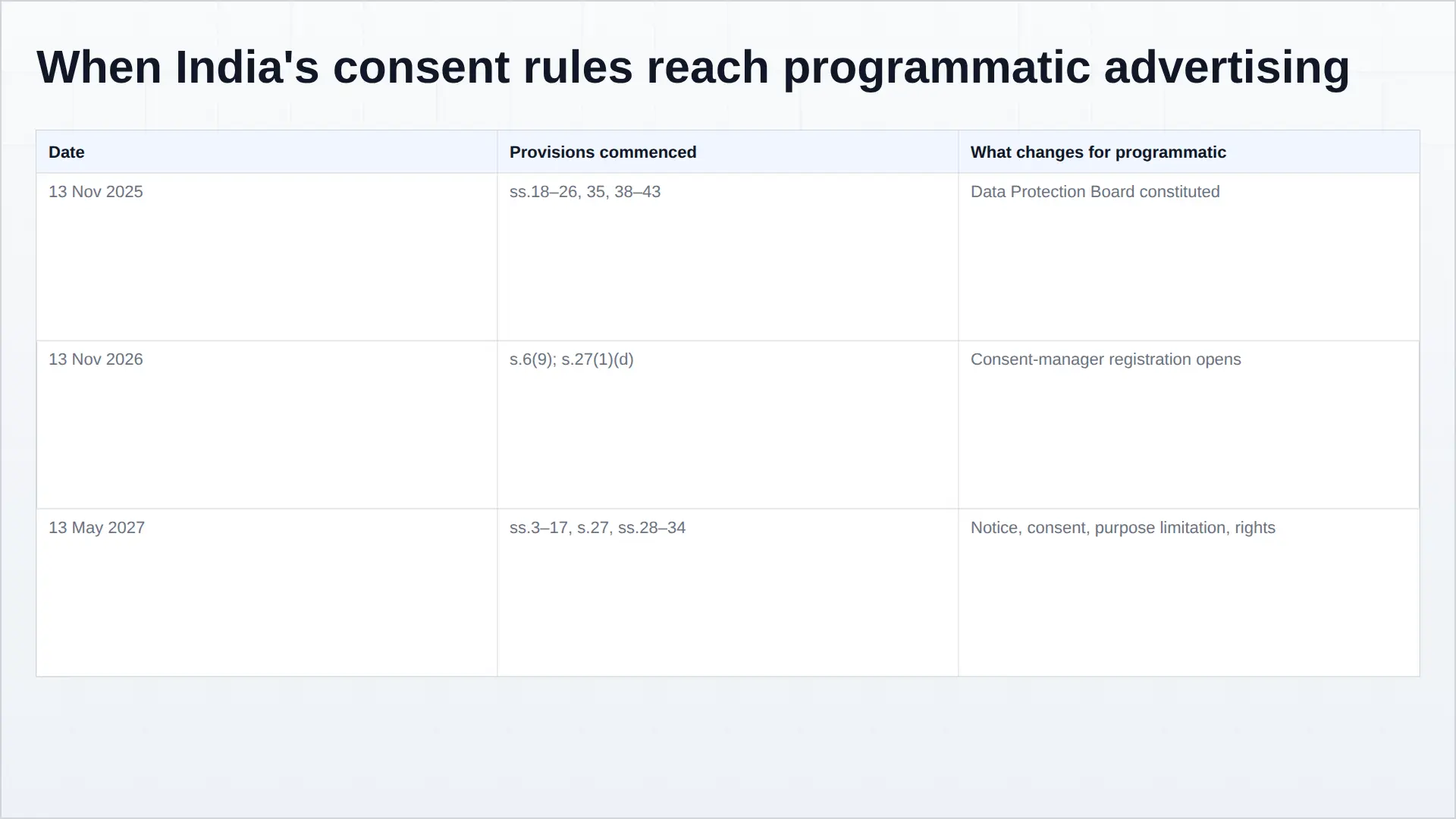
India’s Digital Personal Data Protection Rules were notified in the Gazette of India on 13 November 2025 as G.S.R. 843(E). Rule 1(2) of those Rules commences the parent Act of 2023 in three tranches, and the schedule is the only thing anyone in this market actually needs to diarise.
The first tranche took effect on notification. It covers the definitions and the machinery: sections 18 to 26 and 38 to 43, which constitute and empower the Data Protection Board of India. In plain terms, the regulator already exists. It has existed since November 2025, while the obligations it will eventually enforce do not yet bind anyone.
The second tranche falls at twelve months, on 13 November 2026, and it is precisely two provisions: section 6(9), a single sub-clause of the consent provision, and section 27(1)(d), part of the consent-manager provision. Narrow, technical, and easy to skim past.
The third tranche falls at eighteen months, on 13 May 2027, and it is everything else that matters. Sections 3 to 5 — application, grounds for processing, notice. Section 6(1) to (8) and (10) — consent in full. Sections 7 to 10 — legitimate uses and the data fiduciary’s general obligations. Sections 11 to 17 — the data principal’s rights, and the corresponding duties on the fiduciary. Section 27 in its entirety except sub-clause (1)(d) — consent managers. Sections 28 to 34, 36 and 37 — the Board’s adjudication and appellate machinery.
Read the third tranche as a list of business problems. Notice means you must tell someone what you are doing with their data before you do it, in clear language, in a language they understand. Consent means a free, specific, informed, unconditional and unambiguous affirmative action. Purpose limitation means the consent you have for one thing does not authorise another. Data principal rights mean someone can ask you what you hold, ask you to correct it, and ask you to erase it.
Why the cookie war did not reach India
The answer is a single ratio. At the end of December 2025, TRAI recorded 983.29 million wireless internet subscribers against 45.32 million wired ones. India is, to a first approximation, entirely a mobile-application market.
That means the overwhelming majority of Indian advertising inventory is served inside an application, not on a page. There is no browser to write a cookie to. The identifier is the Google Advertising ID on Android and the Identifier for Advertisers on iOS, and both sit behind a device-level consent surface controlled by the platform that issues them.
Apple’s App Tracking Transparency, which required apps to ask permission before tracking across other companies’ apps and websites, did substantial damage to iOS targeting globally. Its effect on the Indian market as a whole was comparatively limited, because the Indian market as a whole is not an iOS market.
So the privacy shock that reshaped Western adtech has an Indian analogue that is quite different in mechanism. It is not a browser refusing to store an identifier. It is a statute asking whether the purpose for which you hold that identifier was ever validly consented to, and placing the liability for the answer on someone specific.
The question nobody in the chain can answer
Here is the operational problem, and it is considerably harder than any technology decision the shift creates.
An Indian programmatic transaction typically runs through six or seven entities: the advertiser, an agency or trading desk, a demand-side platform, an exchange or supply-side platform, the publisher, and a verification vendor. Personal data touches every one of them. Under the Act, obligations attach to the data fiduciary — the entity that determines the purpose and means of processing.
Ask a straightforward question about a real Indian buy: for the mobile advertising identifier that was bid on, who is the data fiduciary, and on what consented purpose is it being held? In the majority of Indian buys today, no one in the chain is in a position to answer definitively. The advertiser believes the agency holds it. The agency believes the DSP is contractually the processor. The DSP believes it is acting on the advertiser’s instruction. None of that resolves the statutory question, because the statute asks about purpose and control, not about what the contract calls the parties.
The principal model makes this worse rather than better. Where an agency buys inventory and resells it to its client rather than acting as a disclosed agent, the agency is not merely intermediating — it is taking a position in the data flow. That is legal, common, and disclosed in the contracts. It also means that in a material share of Indian programmatic, the entity that determines what happens to the identifier is not the entity that owns the relationship with the person it belongs to.
The consequence that runs against expectation
The instinctive reading is that a consent regime will hurt the big platforms and help the open web, because the platforms are the ones hoarding data. The likely commercial effect in India runs the other way.
Consider two ways of obtaining consent. The first: a person logs into a marketplace to buy a phone, or pays a telecom bill, or opens a social account, and consents in a first-party context where the purpose is obvious and the relationship is direct. That consent is clean, documented, and simple to demonstrate. The second: an identifier is matched across a chain of vendors, each holding a fragment of the purpose, assembled from sources that were never designed to produce a single defensible record. The consent exists in principle and is difficult to evidence in practice.
The first way is how the walled gardens already operate. The second is how the open exchange operates. A regime that raises the cost of third-party data therefore advantages precisely the firms that are already taking the growth in Indian digital advertising — the marketplaces running retail media, the platforms with logged-in users, the telco with the billing relationship.
This is why the consent deadline is not simply a compliance cost to be absorbed. It is a redistribution. And it points to a genuinely uncomfortable possibility for the open programmatic market: that programmatic’s share of Indian digital advertising, currently 42.0% and projected at 43.3% for 2027, could fall after the consent obligations commence rather than rise.
What eighteen months actually requires
Not a consent management platform. That is the easy part and it can be procured in a fortnight.
The hard work is three things, none of which is a technology purchase.
First, a data map that survives contact with reality. Not a data-flow diagram drawn for a compliance deck, but an inventory of every identifier, at every vendor, held on what purpose, under which contract, with what retention. In most Indian advertiser organisations this does not exist, and building it requires cooperation from parties whose commercial interest in revealing their role is limited.
Second, contract architecture through the whole chain. The fiduciary question is answered by contract before it is answered by conduct. Advertiser, agency, DSP, exchange and publisher all need to know, in writing, who determines purpose, who acts on instruction, and who carries the liability when the purpose turns out to have been unclear. Those negotiations are slow, they are between parties of unequal bargaining power, and they cannot be completed by a platform configuration.
Third, notice and consent designed for how Indians actually read. India’s internet population is not English-first at scale, and consent that is not understood is not consent. A notice architecture built for an English-speaking urban minority will not satisfy the clear-and-plain-language requirement for a national audience.
The date is the message
India’s data protection framework is unusual in the clarity of its timetable. It is not a regime that will arrive gradually and be discovered through enforcement. It has a gazette notification, a commencement rule, and three dates, and one of them — 13 May 2027 — is the date on which the obligations begin.
That is eighteen months from notification. The regulator was constituted in November 2025. The consent-manager framework opened in November 2026. The rest is coming, on a schedule that is already public, and the firms that will do well out of it are the ones that spend the eighteen months mapping what they hold rather than the last three months buying software to hold it.
For a market that has spent a decade competing almost entirely on price — a blended ₹55 per thousand impressions against a multiple of that in most developed markets — the basis of competition is about to become something harder to discount: whether you can prove what you are allowed to know.
Frequently Asked Questions
When do India's data protection consent obligations begin?
13 May 2027. Rule 1(2) of the Digital Personal Data Protection Rules, 2025 (G.S.R. 843(E), notified 13 November 2025) commences the operative obligations eighteen months after notification. Those obligations include notice, consent, purpose limitation, the data principal's rights and the data fiduciary's duties. The Data Protection Board was constituted on notification in November 2025, and part of the consent-manager provisions took effect at twelve months, on 13 November 2026.
Why did the third-party cookie debate not affect India?
Largely not. TRAI recorded 983.29 million wireless internet subscribers against 45.32 million wired at December 2025, so most Indian advertising inventory is served inside an application rather than a web page. There is no browser cookie to write. The identifier is the mobile advertising ID — the Google Advertising ID on Android and the Identifier for Advertisers on iOS — which sits behind a device-level consent surface controlled by the platform that issues it.
What makes compliance hard for programmatic buying specifically?
The Act's obligations attach to the data fiduciary — the entity determining the purpose and means of processing. In a typical Indian buy, personal data passes through an advertiser, an agency or trading desk, a demand-side platform, an exchange, a publisher and often a verification vendor. Those contracts frequently do not resolve which entity is the fiduciary for a given identifier, and where buying is done on principal terms the agency is taking a position in the data flow rather than merely intermediating.
Could the consent rules reduce programmatic's share of Indian digital advertising?
It may fall rather than rise. Consent obtained in a first-party context — from a marketplace, a telco, a logged-in platform — is cleaner and easier to evidence than consent assembled across third-party vendors. A regime that raises the cost of third-party data therefore advantages the walled gardens that already hold most of India's digital growth, which is why the consent deadline should be read as a redistribution as well as a compliance cost.