
Editorial Article
India's Adtech Industry Is an Export Business, and the Rupee Arithmetic Explains Why
Here are two numbers that describe the same person.
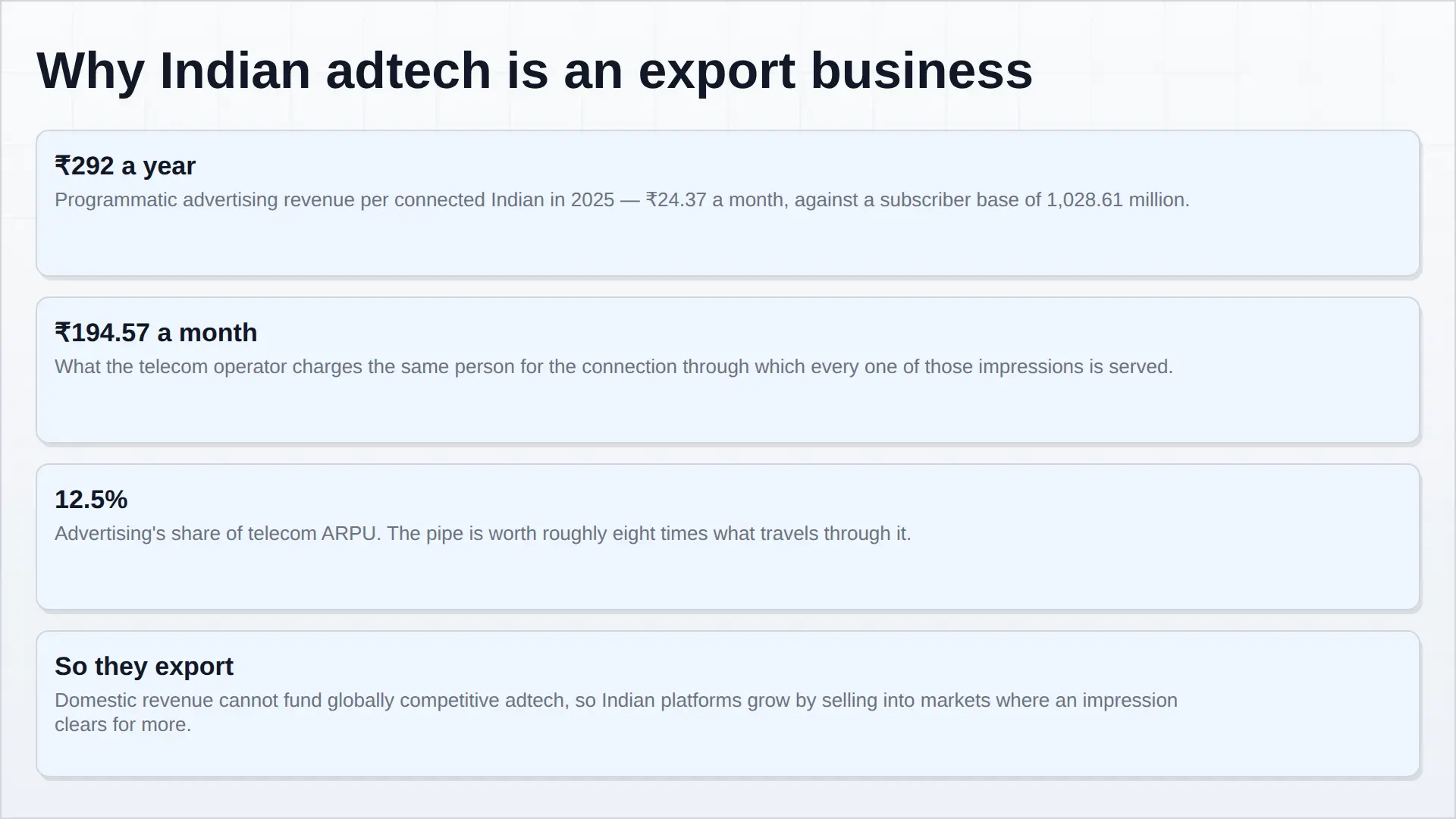
The first is ₹292.44. That is how much programmatic advertising revenue an Indian internet subscriber generated in 2025, over the whole year. It is ₹24.37 a month. It comes from dividing India’s ₹30,081 crore programmatic market by TRAI’s 1,028.61 million internet subscribers at December 2025.
The second is ₹194.57. That is what their telecom operator charged them, per month, for the connection through which every one of those impressions was served. It is TRAI’s wireless ARPU for the quarter ended December 2025, up 7.03% year on year from ₹190.99.
Advertising revenue per connected Indian is 12.5% of what connectivity costs them. The pipe is worth roughly eight times what travels through it.
What that ratio does to an industry
A market of this shape has a specific problem, and it is not demand. It is that the revenue pool is too shallow to fund the technology required to serve it competitively.
Consider what a globally competitive advertising technology platform requires. Identity resolution. Real-time bidding infrastructure at scale. Fraud and invalid traffic detection. Measurement and attribution. Clean-room capability to survive a consent regime. Model training and inference. Engineering talent that is internationally mobile and prices accordingly.
Those costs are largely denominated in the same currency regardless of where you build. A bidder’s engineering is not cheaper in Bengaluru by the factor that Indian impressions are cheaper in Mumbai. The cost base is global; the revenue base is national and thinly priced. At a blended ₹55 per thousand impressions, an Indian adtech business serving only India is trying to fund world-class infrastructure out of revenue that is, per user, about a twelfth of what the telco next door collects for the same customer.
The inference this supports
Here is what follows, and I want to be precise about what is derivation and what is not.
The numbers above are published and the arithmetic on them is simple. The conclusion drawn from them — that Indian adtech companies are structurally export businesses, because the domestic pool cannot fund them — is an inference from that arithmetic, not a measured finding. It is a strong inference, for the reasons set out above, but it is an inference.
The place to test it is in the disclosures. The listed Indian advertising technology companies publish annual reports that describe where their revenue comes from, and a reader who wants the magnitude rather than the direction should read those filings directly rather than take the claim from here. Both of the principal listed Indian platforms make their FY2024-25 annual reports publicly available.
What can be said without overreach is that this is not a story about ambition. A company that earns in dollars and spends in rupees can fund engineering that a purely domestic competitor cannot. Diversifying revenue away from a market where an impression clears at ₹55 is not a retreat from India; it is the condition on which a company can afford to keep serving India at all.
The counter-argument, and why it is weaker than it sounds
The obvious objection is that India’s programmatic market is growing at 19% a year, that digital advertising is going from 59% to 70% of the country’s total ad market, and that a fast-growing market solves this problem on its own.
It does not, for two reasons visible in the same data.
The first is that growth is not lifting the yield. Programmatic was 42.0% of Indian digital media spend in 2025 and is projected at 43.3% in 2027. The market is not taking share within digital; it is riding digital’s growth. And the fastest-growing slice of Indian digital — e-retail advertising, up 55.86% to ₹17,601 crore — is sold inside marketplace auctions that a third-party platform cannot access on equal terms. The growth is real. It is also, in significant part, happening where an independent adtech company is not invited.
The second is the arithmetic of the deadline. Even at the 2033 projected market value, and holding today’s subscriber base constant, programmatic revenue per connected Indian reaches ₹791.76 a year — ₹65.98 a month, or 33.9% of today’s telecom ARPU. Eight years of 13.26% compound growth gets advertising from a twelfth of the connectivity bill to a third of it. That is progress. It is also still less than what the pipe costs.
What would actually change the arithmetic
Three things, and only one of them is about advertising at all.
Opening retail media. If the large marketplaces let third-party demand platforms bid on their inventory rather than keeping the auction closed, the addressable pool for an independent Indian platform expands enormously at a stroke. That is a commercial decision, not a market inevitability, and nothing currently indicates it is imminent.
A connected-TV currency. India’s connected-TV advertising market grew 42% to ₹9,900 crore in 2025 at CPMs of ₹400–800, and it has no accepted third-party measurement standard. Linear television has BARC; connected television has nothing equivalent. Resolve that and the highest-yield inventory in the country becomes scalable, which lifts blended yield across the whole market.
Getting more value out of the same person. The third is the uncomfortable one. The ratio in this article is not primarily an advertising problem. It is a monetisation problem across the whole Indian digital stack — and advertising is the component of it that has been priced most aggressively downward. A market that has competed on being the cheapest place in the world to buy an impression has succeeded at exactly that, and is now discovering what it costs to have won.
What this means if you are valuing one of these businesses
Do not value an Indian adtech company on India’s programmatic TAM. The TAM is real, it is growing, and it is priced at a level that cannot fund the company that serves it.
Value it on where its revenue actually comes from, at what yield, and how much of it is exposed to the same walled-garden substitution that is holding India’s programmatic share at 42%. The domestic market is the proving ground. It is not, on this arithmetic, the business.
Frequently Asked Questions
How much programmatic advertising revenue does an Indian internet user generate?
₹292.44 per year, or ₹24.37 a month. That is India's ₹30,081 crore programmatic advertising market divided by TRAI's 1,028.61 million internet subscribers at December 2025. Against wireless ARPU of ₹194.57 a month, advertising generates 12.5% of what the same subscriber pays for connectivity.
Is the export-business claim measured or inferred?
Not directly. The published figures and the arithmetic on them are documented. The conclusion that Indian adtech companies must earn abroad because the domestic pool cannot fund globally priced engineering is an inference from that arithmetic, not a measured finding — and the place to test its magnitude is the revenue-geography disclosure in the listed Indian platforms' annual reports.
Doesn't India's 19% growth rate solve this?
Partly. Growth raises the total but not the yield: programmatic has held 42.0% of Indian digital media spend and is projected at only 43.3% for 2027, and the fastest-growing inventory — e-retail advertising, up 55.86% to ₹17,601 crore — sits inside closed marketplace auctions. Even at the 2033 forecast and today's subscriber base, revenue per connected Indian reaches ₹791.76 a year, or 33.9% of today's telecom ARPU.
What would change the economics?
Three: opening marketplace retail media inventory to third-party demand platforms; establishing an accepted measurement currency for connected TV, which grew 42% to ₹9,900 crore in 2025 at ₹400–800 CPMs with no BARC equivalent; and raising the overall monetisation of the same connected user. Only the first two are within the advertising industry's own control.