
Editorial Article
The Package Is 1.8 Cents of the Meal — and That Is Why the Whole Substrate Base Can Turn Over
In the United States in 2025, food eaten away from home cost USD 1.41 trillion. That is 56.3 per cent of all food expenditure, according to the USDA Economic Research Service. It buys the food, the labour, the rent, the marketing and the app. The packaging that made all of it portable cost USD 25,428 million.
The package is 1.80 cents of every dollar of the meal.
That ratio is the most useful number in this market, and it is not a curiosity. It explains why an industry that fills every sustainability conference can turn over its entire substrate base inside a decade without a single demand shock — and why the same industry’s capital returns are so sensitive to a line item its customers treat as a rounding error.
What 0.45 per cent buys
Take the substitution the whole market argues about. An expanded polystyrene clamshell weighs 13 grams and realises at 5.81 US cents. The moulded fibre replacement weighs 42 grams and realises at 14.10 cents. That is a 143 per cent increase in the price of the item carried by a 223 per cent increase in the mass that must be bought, shipped and disposed of.
As a fraction of the transaction, it is 0.45 per cent — the arithmetic of a 25 per cent increase applied to a cost line that is itself 1.8 per cent of the price.
This is the hinge the market turns on. Operators do not switch because 0.45 per cent is trivial; they switch because a compliance obligation is binary while a price exposure is fractional. A statute, a chain specification or a municipal contract says the container may not be polystyrene. There is no version of that instruction that lets the operator keep the 13-gram item and put the difference on the menu. Faced with a binary rule and a fractional cost, the rational operator complies and passes 0.45 per cent through.
But the inverse is also true, and it is the more important half. Operators do not switch without a binary rule. A 0.45 per cent saving is not worth a line trial, a barista retrained, a lid that fits differently, or a supply contract renegotiated. The friction is operational and the saving is a rounding error, so absent regulation the incumbent stays. Which is exactly what the data shows: substrate conversion in this market tracks legislative calendars, not relative prices.
The party that captures most per unit makes nothing
Multiply out the whole chain and it stops looking like a packaging market at all. At USD 96,000 million of hub value across 610 billion away-from-home transactions, an operator spends 15.74 US cents on packaging per transaction. Here is where it goes.
| Layer | US cents per transaction | Share of operator spend |
|---|---|---|
| Operator’s packaging spend | 15.74 | 100% |
| Distributor gross margin | 2.90 | 18.4% |
| Converter net revenue | 12.84 | 81.6% |
| — Material | 6.42 | 50% |
| — Energy and labour | 2.57 | 20% |
| — Freight | 0.51 | 4% |
| — SG&A, R&D and waste | 1.16 | 9% |
| — EBITDA | 2.18 | 17% |
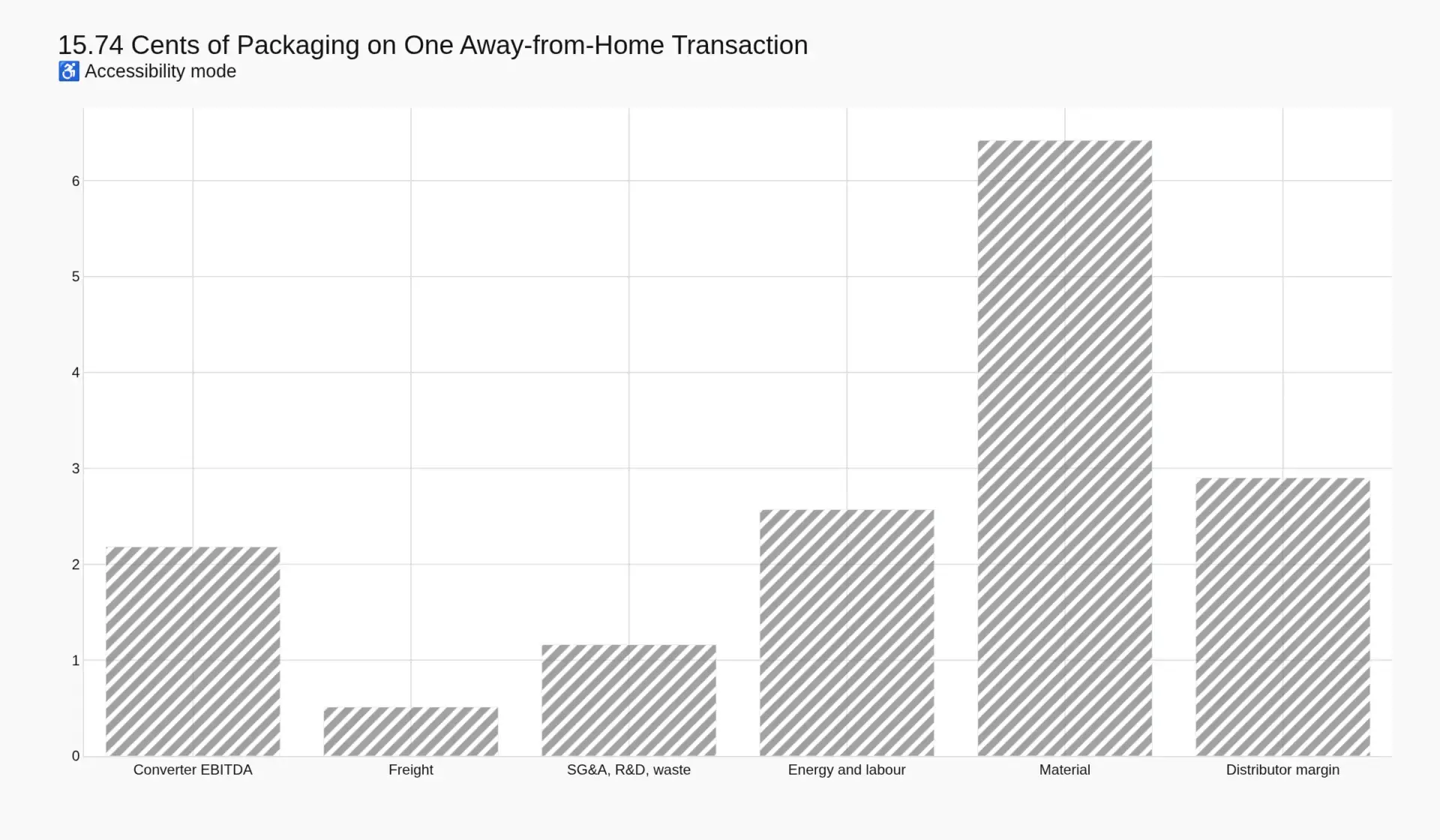
The distributor’s 2.90 cents exceed the converter’s 2.18 cents of EBITDA. That is not a modelling artefact. It is an 18.4 per cent channel margin — Sysco’s fiscal 2025 consolidated gross margin — sitting on top of a 17 per cent manufacturing margin, the Foodservice segment adjusted EBITDA margin Pactiv Evergreen disclosed for 2024.
The converter buys the resin, runs the line, employs the people, carries the qualification risk and earns 2.18 cents. The distributor picks, packs and delivers the case and earns 2.90. On a United States transaction worth roughly twelve dollars, the entire EBITDA of the company that made every package on the tray is under a quarter of one per cent of what the customer paid for lunch.
Which explains a great deal about how this market is organised. There are thousands of converters and three distributors of consequence in North America. A converter with a better cup does not get to call on McDonald’s; it gets to bid a case specification to a distributor who already carries four competing cups. Concentration sits with the customer, not the supplier — Pactiv Evergreen’s 2024 annual report puts its ten largest customers at approximately 44 per cent of net revenues, with a single Foodservice customer at about 10 per cent of consolidated revenue. Lose one account, lose a tenth of the company.
Pricing is pass-through, and the filings say so
The 2024 segment disclosure is unusually clean about the mechanism. Pactiv Evergreen’s Foodservice net revenues were flat at USD 2,572 million. Favourable pricing — largely due to the pass-through of higher material costs — was offset by lower volume and unfavourable mix. Segment adjusted EBITDA fell 8 per cent to USD 426 million on higher manufacturing costs.
Positive price, negative volume, flat revenue, lower profit. That is what a pass-through business looks like in an ordinary year, and it is why realisation per tonne in this market moves from USD 4,253 to USD 4,447 across eight years — 0.56 per cent a year. Compare flexible packaging, where realisation rose 0.83 per cent a year with every one of five substrate lines contributing, because a flexible converter is one step closer to the brand and can hold a spread. In foodservice the converter is one step further from the brand and two from the consumer, and the spread is competed away by the distributor in front and the customer committee behind.
Cheap per meal, existential per line
Now price the transition properly. The entire global pool of EPS foodservice containers is 36.9 billion units a year at 5.81 cents. Convert all of it to moulded fibre at 14.10 cents and the market gains USD 3,059 million of value on unchanged unit volume — 3.19 per cent of the hub.
Three per cent. Every state statute, every conference panel, every qualification programme and every capacity commitment in this transition is competing for three per cent of the market.
For the converter holding an EPS line, it is not three per cent. It is the whole line, and it is a capital decision with a seven-year horizon. A moulded fibre line costs about USD 2.56 million and produces fewer units than a cheaper thermoformer, which puts capital per annual unit at 8.5 to 12.8 cents for fibre against 4.4 to 5.7 cents for thermoforming, and payback at 7.9 years against 4.8. Meanwhile the physical arithmetic is unforgiving: converting the United States EPS pool to fibre removes 480,000 tonnes of plastic and adds 1.07 million tonnes of mass — a 14.3 per cent increase on a market that moves 7.47 million tonnes — while EPR fees are levied per tonne and modulated by recyclability. The compliant substitute attracts a higher fee than the non-compliant incumbent did.
That asymmetry — trivial at market level, existential at asset level — is why the transition proceeds at a pace that looks irrational from outside the industry and entirely rational from inside it.
What would change the story
One number. If packaging were 5 per cent of the meal rather than 1.8, every operator would negotiate it, every specification change would be a procurement event, and the substitution would follow price rather than statute. It is not 5 per cent, and it is not going to be.
The falsifier worth watching is on the other side of the chain: if distributor gross margin on packaging compresses below 15 per cent, the split in the table above is wrong and the converter’s share of the operator’s spend is materially understated. That would not change the size of the market. It would change every strategic conclusion drawn from it — including this one.
Methodology: this article draws on Pheonix Research’s Global Foodservice Packaging report (2025 base year, 2026–2033 forecast), built on a 70 per cent secondary and 30 per cent primary research split. Secondary sources include USDA Economic Research Service Food Expenditure Series, Pactiv Evergreen’s 2024 annual report and segment reporting, Sysco’s fiscal 2025 results and the National Restaurant Association’s 2025 Off-Premises Restaurant Trends report. Primary inputs are converter, distributor and operator interviews, conference proceedings and a structured operator survey. No market-research competitor data is cited.
Frequently Asked Questions
Why do operators adopt more expensive compliant packaging when it is only a rounding error on the meal?
Because the package is only 1.80 per cent of the price of an away-from-home transaction — USD 25,428 million of modelled United States foodservice packaging against USD 1.41 trillion of food-away-from-home spending in 2025. A 25 per cent increase in packaging cost, which is roughly the premium for replacing expanded polystyrene with moulded fibre, therefore adds only 0.45 per cent to the price of the transaction. Compare that with the operational cost of switching: a line trial, retrained staff, a different lid fit and a renegotiated supply contract. The saving is fractional and the friction is real, so absent a binary compliance requirement the incumbent format stays.
How much of the packaging spend on a transaction does the converter actually keep?
At 15.74 cents of packaging spend per away-from-home transaction, the distributor captures 2.90 cents at an 18.4 per cent gross margin — the figure Sysco reported for fiscal 2025 — while the converter retains 12.84 cents. Of that, 6.42 cents is material, 5.40 cents is energy, labour, freight and overhead, and 2.18 cents is EBITDA at the 17 per cent Foodservice segment margin Pactiv Evergreen disclosed for 2024. The distributor's absolute cents per unit are larger than the manufacturer's EBITDA per unit.
How big is the global EPS foodservice container pool, and what is it worth if converted?
Thirty-six billion nine hundred million units a year at 5.81 cents each. Converting all of it to moulded fibre at 14.10 cents is worth USD 3,059 million of additional value on unchanged unit volume, or 3.19 per cent of the USD 96,000 million market. That is the entire prize in value terms — which is small at market level and total for the converter holding an EPS line, and is why the transition pace tracks legislative calendars rather than relative prices.
Is the price of foodservice packaging set by resin and pulp costs or by the converter?
It is pass-through rather than pricing power. Pactiv Evergreen's 2024 Foodservice segment reported flat net revenues of USD 2,572 million, with favourable pricing largely from passing through higher material costs offset by lower volume and unfavourable mix, and adjusted EBITDA down 8 per cent to USD 426 million on higher manufacturing costs. Positive price, negative volume, flat revenue and lower profit is what a pass-through business looks like in an ordinary year, and it is why realisation per tonne moves only from USD 4,253 to USD 4,447 across eight years.