
Editorial Article
Fifty-Five Per Cent of a Flexible Packaging Converter's Revenue Is Film Somebody Else Made
A flexible packaging converter is not, economically, a manufacturer. It is a buyer of film that prints, laminates and slits what it bought, and the arithmetic of that is stark once you lay the price out line by line.
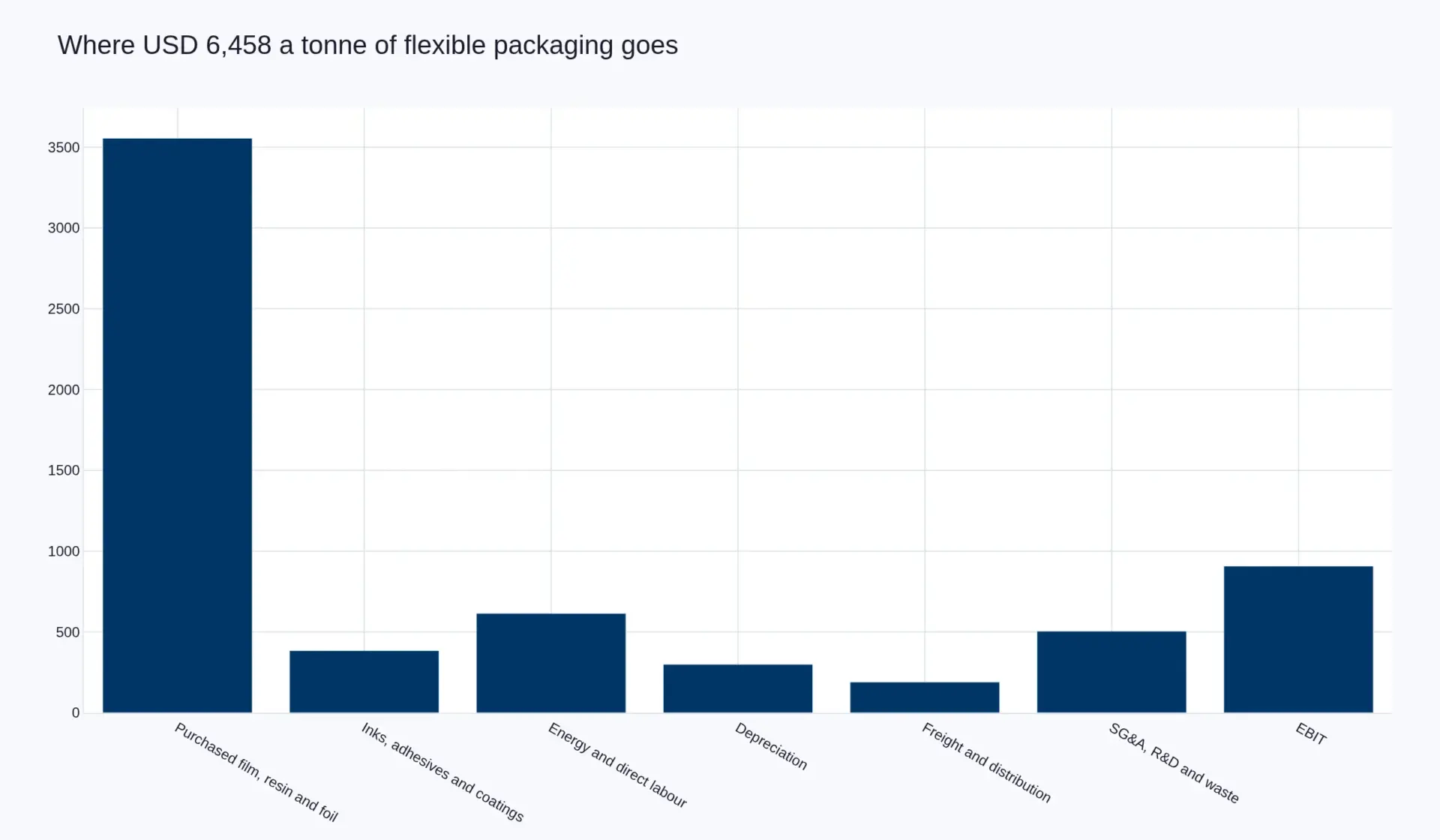
Take the blended realisation of the global market — USD 6,458 a tonne in 2025, from USD 268,000 million of value across 41.50 million tonnes of volume. Rebuild it as a cost stack and reconcile the remainder to a real disclosed margin, and the largest line by a distance is the one the converter does not make.
| Line | USD per tonne | Share of price |
|---|---|---|
| Purchased film, resin and foil | 3,555 | 55.1% |
| Inks, adhesives and barrier coatings | 385 | 6.0% |
| Energy and direct conversion labour | 615 | 9.5% |
| Depreciation on print, lamination and slitting assets | 300 | 4.6% |
| Freight, warehousing and distribution | 190 | 2.9% |
| SG&A, R&D and print waste | 505 | 7.8% |
| EBIT | 908 | 14.1% |
| Realisation | 6,458 | 100% |
The 14.1 per cent is not a modelled assumption. It is Amcor’s Flexibles segment EBIT margin in the quarter to June 2025, the first quarter in which the combined Amcor and Berry business reported. Everything above it is our reconstruction, and the ratio it has to hit is a number a company published.
What the converter actually adds
Add the lines the converter controls — inks and coatings, energy and labour, depreciation, freight, overhead and waste — and it comes to 31 per cent of the price. That is the whole of the value added. The other 55 cents of every revenue dollar buys a substrate from somebody else.
This is the opposite of what happens one format over. In moulded fibre packaging, recovered paper and drying energy are about 12.9 per cent of realisation and the other 87 per cent is the machine, the hall, the people, the tooling and the truck. Fibre converting is a manufacturing business that happens to buy pulp. Flexible converting is a purchasing business that happens to print. The two have completely different returns on capital, completely different consolidation logic, and completely different regulatory exposure — and almost every analyst note treats them as one sector called packaging.
The merger proves the point better than the model does
You do not have to take the stack on trust. Amcor has been unusually explicit about what it thinks the value in combining two flexible packaging businesses is.
The company committed to USD 260 million of synergies in fiscal 2026, rising to USD 650 million by fiscal 2028. On the fourth-quarter call, management described the composition directly: procurement savings make up about 50 per cent of the committed synergies. Not manufacturing footprint, not SG&A, not cross-selling — buying film more cheaply. Two businesses with roughly USD 25 billion of combined sales looked at each other and concluded that the single largest source of value in putting them together was the resin contract.
Berry, notably, buys little PET; the North American beverage business is the big PET buyer, and some of that resin is tolled. That is why the company could say the procurement pool survives a divestment of the beverage business without being eaten. The purchasing logic is portable because it is about polyolefin film and closures, not about one end market.
Why the margins cluster, and why that matters more than the deal
Amcor’s flexibles EBIT margin is 14.1 per cent. Mondi’s Flexible Packaging segment reported revenue of about EUR 3.9 billion with underlying EBITDA of EUR 583 million — a 14.8 per cent margin, though on a pre-depreciation basis, which makes it not directly comparable and is a distinction the sector routinely blurs.
Two of the largest converters in the world, running different asset bases in different geographies, land in the same narrow band. That is not a coincidence and it is not a cycle. It is what a 55-per-cent-purchased-material business looks like: your margin is a spread between what film costs and what a brand will pay for the printed structure, and neither end is yours to set. You cannot integrate backward into resin at this scale — the film producers are larger than you and sell to all your competitors. You cannot integrate forward into the brand.
So you do the only thing available. You get bigger so the spread is struck on better terms, and you re-price annually so the spread is preserved.
The re-pricing is visible in the market data
Look at what happened to realisation per tonne in the same period. Every one of the five substrate lines in the market gains realisation to 2033 — 0.77 per cent a year on polyolefin, 0.97 on polyester, 0.77 on paper, 0.78 on aluminium foil, 1.33 on bio-based. Hold the 2025 mix and grow tonnage to 53.63 million tonnes in 2033 and the market would be worth USD 346,320 million. The model has USD 370,070 million. The USD 23,750 million difference is price.
That is a squeezed conversion layer passing through cost plus a little. It is also, quietly, the thing that makes the paper substitution possible: as the plastic structure gets more expensive, a paper alternative that gives up barrier starts to compete on price in the applications where barrier was never the binding constraint.
What would break this argument
If a converter demonstrated a sustained EBIT margin materially above 20 per cent on a flexible portfolio without a proprietary structure, the 55 per cent purchased-material premise would be wrong — the film would not be a commodity and the converter would be capturing technology rent. Conversely, if Amcor’s flexibles volumes return to growth in fiscal 2026 and 2027 without giving back price, the flat-volume guidance was cyclical destocking rather than a format maturing, and the re-pricing argument loses its urgency.
The first is observable in a segment disclosure. The second is observable within eighteen months.
Sources and method
Amcor plc Form 10-K for the fiscal year ended 30 June 2025 and the fiscal 2025 fourth-quarter results transcript; Mondi Group Flexible Packaging segment result; Sealed Air Corporation fourth-quarter and full-year 2025 results. Blended realisation and the substrate split are from the Pheonix Research report Global Flexible Packaging Market, 2026–2033. The cost stack is a Pheonix reconstruction reconciled to Amcor’s reported flexibles EBIT margin, not a company disclosure, and should be read as judgement rather than evidence.
This article follows the house research basis of 70 per cent secondary and 30 per cent primary sources. No competitor market-research output was used as an input or a citation.
Frequently Asked Questions
What share of a flexible packaging converter's revenue is bought rather than made?
At a blended market realisation of USD 6,458 a tonne, purchased film, resin and foil is 55.1 per cent of revenue. The converter's own contribution — inks and coatings, energy and direct labour, depreciation, freight, overhead and print waste — is 31 per cent, and EBIT is 14.1 per cent. The stack is a Pheonix reconstruction reconciled to the 14.1 per cent flexibles EBIT margin Amcor reported in the quarter to June 2025.
Why is consolidation in flexible packaging a purchasing strategy?
Because the largest single cost line is purchased material, so scale buys a better resin and film contract rather than pricing power. Amcor has committed to USD 260 million of synergies in fiscal 2026 rising to USD 650 million by fiscal 2028, and management has said procurement makes up about 50 per cent of that total. CD&R's USD 10.3 billion take-private of Sealed Air follows the same logic at a 21.2 per cent adjusted EBITDA margin.
Does the converter's margin actually hold if material costs rise?
Because realisation per tonne rises 0.83 per cent a year, from USD 6,458 to USD 6,900, and every one of the five substrate lines contributes — between 0.77 and 1.33 per cent a year. Holding the 2025 mix and growing tonnage to 2033 gives USD 346,320 million against the modelled USD 370,070 million, so the USD 23,750 million difference is price rather than mix. A business with a 55 per cent purchased-material content and a 14 per cent EBIT margin re-prices when it is squeezed.
What would falsify the argument that flexible converting is a spread business?
If any converter demonstrates a sustained EBIT margin materially above 20 per cent on a flexible portfolio without a proprietary structure, the purchased-material premise is wrong and the film is not a commodity. The other falsifier is volume: if Amcor's flexibles volumes return to growth in fiscal 2026 and 2027 without giving back price, the flat guidance was cyclical destocking and the re-pricing argument loses its urgency.