
Global Tele-Rehabilitation Robotics Market Report, Size and Forecast 2026-2033
Global Tele-Rehabilitation Robotics Market Report, Size and Forecast 2026???2033
Market Forecast Snapshot (2025???2033)
| Metric | Value |
|---|---|
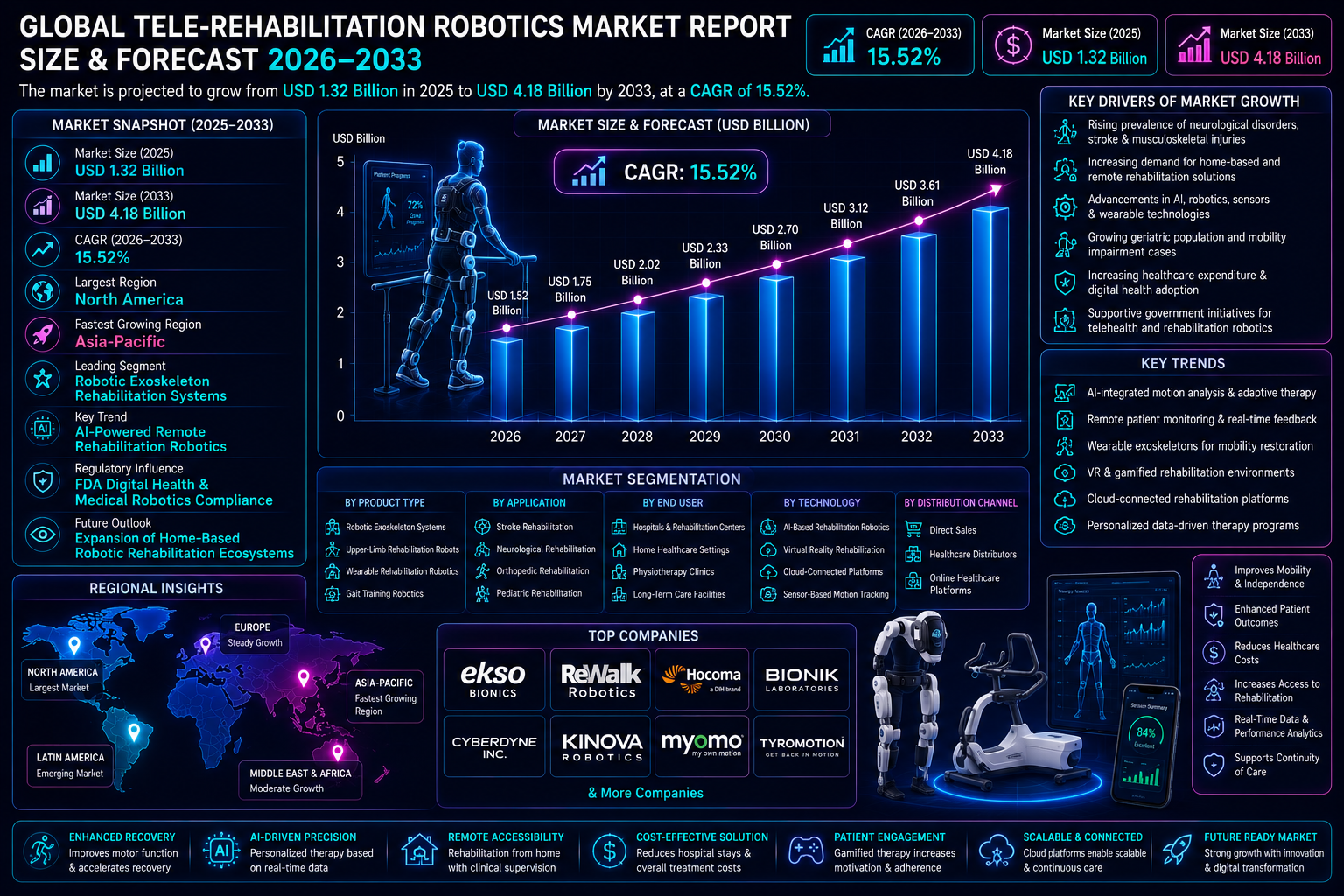
| Market Size (2025) | USD 1.32 Billion |
| Market Size (2033) | USD 4.18 Billion |
| CAGR (2026???2033) | 15.52% |
| Largest Region | North America |
| Fastest Growing Region | Asia-Pacific |
| Leading Segment | Robotic Exoskeleton Rehabilitation Systems |
| Key Trend | AI-Powered Remote Rehabilitation Robotics |
| Regulatory Influence | FDA Digital Health & Medical Robotics Compliance |
| Future Outlook | Expansion of Home-Based Robotic Rehabilitation Ecosystems |
Market Size & Forecast
The Global Tele-Rehabilitation Robotics Market is projected to witness rapid expansion during the forecast period from 2026 to 2033. The market was valued at USD 1.32 billion in 2025 and is anticipated to reach approximately USD 4.18 billion by 2033, growing at a CAGR of 15.52% throughout the forecast period. The strong growth trajectory reflects increasing adoption of remote rehabilitation technologies, advancements in robotic healthcare systems, and rising demand for accessible rehabilitation services globally. The market is being significantly driven by the increasing prevalence of neurological disorders, musculoskeletal injuries, stroke cases, spinal cord injuries, and age-related mobility impairments. Healthcare providers are increasingly adopting robotic rehabilitation systems integrated with telemedicine capabilities to improve patient outcomes while reducing hospitalization burdens and rehabilitation costs. The accelerated adoption of remote healthcare technologies following the COVID-19 pandemic has further strengthened the demand for tele-rehabilitation robotics. Patients increasingly prefer home-based rehabilitation solutions that provide real-time monitoring, personalized therapy, and continuous remote clinical supervision. Technological advancements including AI-driven motion analysis, robotic exoskeletons, wearable rehabilitation systems, haptic feedback technologies, cloud-connected therapy platforms, and virtual reality-based rehabilitation environments are transforming the rehabilitation landscape globally.Global Tele-Rehabilitation Robotics Market Overview
The Tele-Rehabilitation Robotics Market combines robotic rehabilitation technologies with telehealth infrastructure to enable remote physical therapy, neurological rehabilitation, and mobility restoration services. These systems allow clinicians to remotely monitor, assess, and guide patient rehabilitation programs through connected robotic platforms. The market includes robotic exoskeletons, robotic gait training systems, upper-limb rehabilitation robots, wearable assistive robotics, AI-powered rehabilitation platforms, and virtual rehabilitation systems integrated with telemedicine technologies. The market is moderately fragmented with strong participation from rehabilitation robotics manufacturers, healthcare technology companies, and digital health innovators. Companies are increasingly investing in AI-enabled rehabilitation systems capable of adaptive therapy personalization and real-time patient performance analytics. Growing demand for home healthcare, shortage of rehabilitation professionals, increasing elderly populations, and rising healthcare digitalization are contributing significantly to market expansion. Healthcare systems worldwide are increasingly recognizing robotic tele-rehabilitation as a cost-effective solution for long-term rehabilitation management. Furthermore, supportive regulatory initiatives for digital therapeutics, remote patient monitoring, and connected healthcare ecosystems are accelerating commercial adoption of tele-rehabilitation robotic technologies globally.Structural Drivers of Market Growth
1. Innovation and Commercialization Acceleration
Rapid advancements in robotic engineering, AI-driven rehabilitation algorithms, wearable sensors, and cloud-connected therapy systems are accelerating innovation across the tele-rehabilitation robotics market. The integration of virtual reality, machine learning, motion capture technologies, and adaptive robotic assistance is improving rehabilitation accuracy and patient engagement. Smart rehabilitation systems are increasingly capable of delivering highly personalized therapy sessions based on patient performance and recovery progress.Market Implications
Companies focusing on AI-powered rehabilitation robotics, wearable assistive technologies, and digital therapeutic integration are expected to gain substantial competitive advantages. Technological maturity is also enabling broader commercialization of home-based rehabilitation systems.2. Compliance and Risk Repricing
Regulatory agencies are increasing oversight on connected medical robotics, digital therapeutics, cybersecurity standards, and patient data privacy within tele-rehabilitation systems. Compliance requirements surrounding software validation, robotic safety, remote monitoring protocols, and interoperability standards are becoming increasingly stringent. Manufacturers are investing heavily in clinical validation studies, cybersecurity infrastructure, and regulatory approvals to ensure compliance with evolving medical robotics regulations.Market Implications
Companies with strong regulatory capabilities and secure digital healthcare ecosystems will strengthen their long-term market positioning and improve adoption among healthcare providers.3. Competitive and Value-Chain Reconfiguration
The market is experiencing major competitive restructuring driven by convergence between robotics, telemedicine, AI healthcare platforms, and wearable technologies. Traditional rehabilitation equipment manufacturers are increasingly competing with digital health startups and robotic AI companies. Strategic collaborations between hospitals, rehabilitation centers, robotics firms, and telehealth providers are reshaping rehabilitation delivery models and expanding remote therapy accessibility.Market Implications
The integration of robotics with digital healthcare ecosystems will redefine value-chain dynamics and create opportunities for subscription-based rehabilitation services and remote therapy platforms.4. Capital and Capacity Scaling
Increasing healthcare investments in digital rehabilitation infrastructure, robotic manufacturing, and AI healthcare platforms are supporting rapid market scalability. Governments and private healthcare providers are investing in remote rehabilitation capabilities to reduce long-term healthcare costs and improve rehabilitation accessibility. The expansion of cloud infrastructure, wearable healthcare ecosystems, and smart rehabilitation clinics is further supporting deployment scalability globally.Market Implications
Companies investing in scalable robotic manufacturing, AI software platforms, and cloud-connected rehabilitation systems are expected to capture significant long-term growth opportunities.Market Segmentation Analysis
By Product Type
1. Robotic Exoskeleton Systems
Robotic exoskeletons dominate the market due to growing demand for gait rehabilitation, mobility restoration, and neurological recovery support.2. Upper-Limb Rehabilitation Robots
These systems are increasingly utilized for stroke rehabilitation and neuromuscular recovery therapies.3. Wearable Rehabilitation Robotics
Wearable assistive robotic devices are gaining popularity for home-based rehabilitation and remote therapy programs.4. Gait Training Robotics
Robotic gait rehabilitation systems are widely adopted across rehabilitation hospitals and neurological care centers.By Application
1. Stroke Rehabilitation
Stroke rehabilitation remains the leading application segment due to rising global stroke incidence rates.2. Neurological Rehabilitation
Parkinson???s disease, spinal cord injury, and neurodegenerative disorder rehabilitation are major growth areas.3. Orthopedic Rehabilitation
Post-surgical mobility restoration and musculoskeletal rehabilitation continue to drive demand.4. Pediatric Rehabilitation
Robotic rehabilitation technologies are increasingly being adapted for pediatric neurological therapy.By End User
1. Hospitals & Rehabilitation Centers
Large rehabilitation hospitals remain primary adopters of advanced robotic rehabilitation systems.2. Home Healthcare Settings
Home-based rehabilitation represents the fastest-growing segment due to rising telehealth adoption.3. Physiotherapy Clinics
Outpatient rehabilitation facilities increasingly utilize robotic therapy systems to improve therapy efficiency.4. Long-Term Care Facilities
Elderly care centers are adopting robotic rehabilitation technologies for mobility support and chronic rehabilitation management.By Technology
1. AI-Based Rehabilitation Robotics
AI-powered therapy systems enable adaptive rehabilitation and personalized therapy optimization.2. Virtual Reality Rehabilitation Systems
VR-integrated rehabilitation enhances patient engagement and therapy effectiveness.3. Cloud-Connected Tele-Rehabilitation Platforms
Remote monitoring and therapy analytics platforms are becoming increasingly important for decentralized rehabilitation.4. Sensor-Based Motion Tracking Systems
Advanced wearable sensors support real-time biomechanical analysis and rehabilitation progress monitoring.By Distribution Channel
1. Direct Sales
Hospitals and rehabilitation centers primarily procure robotic systems through direct manufacturer sales.2. Healthcare Technology Distributors
Medical technology distributors remain important for regional market expansion.3. Online Healthcare Platforms
Digital healthcare procurement channels are increasingly emerging for wearable rehabilitation systems.Regional Market Dynamics
North America
North America dominates the Global Tele-Rehabilitation Robotics Market due to advanced healthcare infrastructure, strong digital health adoption, high rehabilitation spending, and increasing prevalence of neurological disorders. The United States remains the largest contributor owing to strong investments in AI healthcare and robotic rehabilitation technologies.Europe
Europe is witnessing substantial growth driven by aging populations, increasing demand for neurological rehabilitation, and strong government support for digital healthcare transformation. Germany, France, and the UK remain key regional markets.Asia-Pacific
Asia-Pacific is projected to witness the fastest growth during the forecast period due to expanding healthcare infrastructure, rising elderly populations, increasing stroke prevalence, and strong investments in healthcare robotics across China, Japan, South Korea, and India.Latin America
The Latin American market is gradually expanding due to improving healthcare accessibility and increasing telemedicine adoption.Middle East & Africa
The market in the Middle East & Africa is witnessing moderate growth supported by healthcare modernization initiatives and growing rehabilitation infrastructure investments.Competitive Landscape
The Global Tele-Rehabilitation Robotics Market is highly innovation-driven with companies focusing on AI integration, wearable robotics, cloud-connected rehabilitation platforms, and personalized therapy technologies. Key companies operating in the market include:- Ekso Bionics
- ReWalk Robotics
- Hocoma
- Bionik Laboratories
- Cyberdyne Inc.
- Kinova Robotics
- Myomo
- Tyromotion
Strategic Outlook
The future of the Tele-Rehabilitation Robotics Market will be driven by increasing integration of AI healthcare systems, wearable robotics, cloud-based rehabilitation analytics, and virtual therapy ecosystems. The convergence of robotics, telemedicine, and digital therapeutics will continue reshaping rehabilitation delivery models globally. Healthcare providers are expected to increasingly adopt hybrid rehabilitation models combining in-clinic robotic therapy with remote home-based rehabilitation monitoring. Subscription-based digital rehabilitation platforms and AI-assisted therapy personalization are also expected to emerge as major business models. Furthermore, increasing healthcare workforce shortages and growing rehabilitation demand among aging populations will continue strengthening long-term market opportunities.Final Market Perspective
The Global Tele-Rehabilitation Robotics Market is entering a transformative growth phase driven by rapid healthcare digitalization, increasing rehabilitation demand, and advancements in AI-powered robotics. The shift toward remote healthcare delivery and personalized rehabilitation programs is fundamentally changing the rehabilitation ecosystem globally. As healthcare systems increasingly prioritize accessible, scalable, and data-driven rehabilitation solutions, tele-rehabilitation robotics are expected to become an integral component of future healthcare infrastructure. Companies capable of balancing technological innovation, regulatory compliance, affordability, and clinical effectiveness will be best positioned to capitalize on the market???s long-term growth potential.Table of Contents
Executive Summary
1.1 Market Forecast Snapshot (2026???2033)
1.2 Global Tele-Rehabilitation Robotics Market Size & CAGR Analysis
1.3 Largest & Fastest-Growing Segments
1.4 Region-Level Leadership & Growth Trends
1.5 Key Market Drivers
1.6 Competitive Landscape Overview
1.7 Regulatory Influence & Medical Robotics Compliance Trends
1.8 Strategic Outlook Through 2033
Introduction & Market Overview
2.1 Definition of the Tele-Rehabilitation Robotics Market
2.2 Market Size & Forecast (2026???2033)
2.3 Industry Evolution & Market Development
2.4 Supply Chain & Distribution Infrastructure
2.5 Impact of Remote Healthcare & Home Rehabilitation Trends
2.6 Regulatory & Compliance Landscape for Medical Robotics & Digital Therapeutics
2.7 Technology & Innovation Landscape (AI Robotics, Wearables, VR & Cloud Rehabilitation Platforms)
Research Methodology
3.1 Primary Research
3.2 Secondary Research
3.3 Market Size Estimation Model
3.4 Forecast Assumptions (2026???2033)
3.5 Data Validation & Triangulation
Market Dynamics
4.1 Drivers
4.1.1 Rising Prevalence of Neurological & Musculoskeletal Disorders
4.1.2 Growing Adoption of Remote Rehabilitation Solutions
4.1.3 Expansion of AI-Powered Rehabilitation Technologies
4.1.4 Increasing Demand for Home-Based Healthcare
4.1.5 Advancements in Wearable & Robotic Rehabilitation Systems
4.2 Restraints
4.2.1 High Cost of Rehabilitation Robotics Systems
4.2.2 Limited Accessibility in Low-Income Regions
4.2.3 Complex Regulatory Approval Processes
4.2.4 Lack of Skilled Rehabilitation Robotics Professionals
4.3 Opportunities
4.3.1 Expansion of AI-Based Personalized Rehabilitation
4.3.2 Integration of Virtual Reality & Gamified Therapy
4.3.3 Growth of Cloud-Based Tele-Rehabilitation Platforms
4.3.4 Emerging Market Penetration Across Asia-Pacific & Latin America
4.4 Challenges
4.4.1 Cybersecurity & Patient Data Privacy Risks
4.4.2 Integration Complexity with Existing Healthcare Systems
4.4.3 Reimbursement & Insurance Limitations
4.4.4 Maintaining Long-Term Patient Engagement & Compliance
Tele-Rehabilitation Robotics Market Analysis (USD Billion), 2026???2033
5.1 Market Size Overview
5.2 CAGR Analysis
5.3 Regional Revenue Distribution
5.4 Segment Revenue Analysis
5.5 Distribution Channel Analysis
5.6 Clinical & Healthcare Impact Analysis
Market Segmentation (USD Billion), 2026???2033
6.1 By Product Type
6.1.1 Robotic Exoskeleton Systems
6.1.1.1 Lower-Limb Rehabilitation Exoskeletons
6.1.1.1.1 Mobility Restoration Robotics
6.1.1.1.1.1 AI-Enabled Gait Assistance Systems
6.1.2 Upper-Limb Rehabilitation Robots
6.1.2.1 Arm & Hand Rehabilitation Devices
6.1.2.1.1 Stroke Recovery Robotics
6.1.2.1.1.1 Neuromuscular Therapy Systems
6.1.3 Wearable Rehabilitation Robotics
6.1.3.1 Portable Assistive Rehabilitation Devices
6.1.3.1.1 Smart Sensor-Based Wearables
6.1.3.1.1.1 Home-Based Rehabilitation Support Systems
6.1.4 Gait Training Robotics
6.1.4.1 Robotic Walking Assistance Platforms
6.1.4.1.1 Neurological Mobility Training Systems
6.1.4.1.1.1 Rehabilitation Treadmill Robotics
6.2 By Application
6.2.1 Stroke Rehabilitation
6.2.1.1 Post-Stroke Mobility Recovery
6.2.1.1.1 Neuroplasticity Rehabilitation Programs
6.2.1.1.1.1 AI-Assisted Stroke Therapy Systems
6.2.2 Neurological Rehabilitation
6.2.2.1 Parkinson???s Disease Rehabilitation
6.2.2.1.1 Spinal Cord Injury Rehabilitation
6.2.2.1.1.1 Neurodegenerative Disorder Therapy Systems
6.2.3 Orthopedic Rehabilitation
6.2.3.1 Post-Surgical Mobility Recovery
6.2.3.1.1 Musculoskeletal Therapy Robotics
6.2.3.1.1.1 Joint & Limb Rehabilitation Systems
6.2.4 Pediatric Rehabilitation
6.2.4.1 Pediatric Neurological Therapy
6.2.4.1.1 Pediatric Mobility Support Robotics
6.2.4.1.1.1 Child Rehabilitation Assistive Devices
6.3 By End User
6.3.1 Hospitals & Rehabilitation Centers
6.3.1.1 Advanced Rehabilitation Hospitals
6.3.1.1.1 Neurological Therapy Centers
6.3.1.1.1.1 Robotic Rehabilitation Departments
6.3.2 Home Healthcare Settings
6.3.2.1 Remote Patient Rehabilitation Programs
6.3.2.1.1 Home-Based Robotic Therapy Systems
6.3.2.1.1.1 Connected Rehabilitation Ecosystems
6.3.3 Physiotherapy Clinics
6.3.3.1 Outpatient Rehabilitation Facilities
6.3.3.1.1 Motion Therapy Clinics
6.3.3.1.1.1 Digital Rehabilitation Service Providers
6.3.4 Long-Term Care Facilities
6.3.4.1 Elderly Rehabilitation Centers
6.3.4.1.1 Assisted Mobility Therapy Facilities
6.3.4.1.1.1 Chronic Rehabilitation Support Programs
6.4 By Technology
6.4.1 AI-Based Rehabilitation Robotics
6.4.1.1 Adaptive Therapy Algorithms
6.4.1.1.1 Personalized Rehabilitation Platforms
6.4.1.1.1.1 Predictive Rehabilitation Analytics Systems
6.4.2 Virtual Reality Rehabilitation Systems
6.4.2.1 Immersive Therapy Platforms
6.4.2.1.1 Gamified Rehabilitation Environments
6.4.2.1.1.1 Interactive Motion Therapy Systems
6.4.3 Cloud-Connected Tele-Rehabilitation Platforms
6.4.3.1 Remote Monitoring Infrastructure
6.4.3.1.1 Cloud-Based Rehabilitation Analytics
6.4.3.1.1.1 Telehealth Rehabilitation Ecosystems
6.4.4 Sensor-Based Motion Tracking Systems
6.4.4.1 Wearable Biomechanical Sensors
6.4.4.1.1 Real-Time Movement Analysis Platforms
6.4.4.1.1.1 Smart Rehabilitation Monitoring Devices
6.5 By Distribution Channel
6.5.1 Direct Sales
6.5.1.1 Hospital Procurement Systems
6.5.1.1.1 Rehabilitation Equipment Partnerships
6.5.1.1.1.1 Enterprise Healthcare Robotics Contracts
6.5.2 Healthcare Technology Distributors
6.5.2.1 Regional Medical Technology Suppliers
6.5.2.1.1 Rehabilitation Equipment Distribution Networks
6.5.2.1.1.1 Robotics Channel Partnerships
6.5.3 Online Healthcare Platforms
6.5.3.1 Digital Rehabilitation Device Sales
6.5.3.1.1 Remote Therapy Platform Providers
6.5.3.1.1.1 Subscription-Based Rehabilitation Services
Market Segmentation by Geography
7.1 North America
7.2 Europe
7.3 Asia-Pacific
7.4 Latin America
7.5 Middle East & Africa
Competitive Landscape
8.1 Market Share Analysis
8.2 Product Portfolio Benchmarking
8.3 Product Positioning Mapping
8.4 Strategic Partnerships & Rehabilitation Ecosystems
8.5 Competitive Intensity & Innovation Benchmarking
Company Profiles
9.1 Ekso Bionics
9.2 ReWalk Robotics
9.3 Hocoma
9.4 Bionik Laboratories
9.5 Cyberdyne Inc.
9.6 Kinova Robotics
9.7 Myomo
9.8 Tyromotion
Strategic Intelligence & Pheonix AI Insights
10.1 Pheonix Demand Forecast Engine
10.2 Supply Chain & Infrastructure Analyzer
10.3 Technology & Innovation Tracker
10.4 Product Development Insights
10.5 Automated Porter???s Five Forces Analysis
Future Outlook & Strategic Recommendations
11.1 Expansion of Home-Based Robotic Rehabilitation Ecosystems
11.2 AI-Driven Personalized Therapy & Predictive Analytics
11.3 Growth of Hybrid Rehabilitation Delivery Models
11.4 Wearable Robotics Innovation & Cost Optimization
11.5 Long-Term Market Outlook (2033+)
Appendix
About Pheonix Research
Disclaimer
Competitive Landscape
Global Tele-Rehabilitation Robotics Market Competitive Intensity & Market Structure Overview
The Global Tele-Rehabilitation Robotics Market is characterized by a moderately consolidated structure with high competitive intensity, driven by the convergence of medical robotics, AI-powered healthcare systems, wearable rehabilitation technologies, and telehealth platforms. The market includes specialized rehabilitation robotics companies, healthcare AI firms, and advanced medical device manufacturers competing across neurological rehabilitation, orthopedic recovery, and home-based therapy ecosystems.
Leading companies such as Ekso Bionics, ReWalk Robotics, Hocoma, Bionik Laboratories, and Cyberdyne Inc. are shaping market dynamics through AI-driven rehabilitation robotics, robotic exoskeleton systems, cloud-connected therapy platforms, and wearable assistive technologies.
Competitive intensity is primarily driven by technological innovation, AI integration, robotic therapy personalization, regulatory approvals, clinical effectiveness, and expansion of remote rehabilitation ecosystems. The growing demand for home-based rehabilitation and digital therapeutics is further intensifying competition across global healthcare systems.
Global Tele-Rehabilitation Robotics Market Competitive Intensity & Market Structure Current Scenario
Leading Company Profiles
- Ekso Bionics: Developer of robotic exoskeleton systems for neurological rehabilitation and mobility restoration.
- ReWalk Robotics: Provider of wearable robotic exoskeletons focused on spinal cord injury and mobility rehabilitation.
- Hocoma: Advanced rehabilitation robotics company specializing in gait training and neurological recovery systems.
- Bionik Laboratories: Developer of AI-assisted robotic rehabilitation solutions for stroke and mobility recovery.
- Cyberdyne Inc.: Robotics company focused on wearable assistive rehabilitation systems and AI-integrated healthcare robotics.
- Kinova Robotics: Developer of robotic assistive technologies and rehabilitation support systems.
- Myomo: Provider of wearable robotic orthotics for neuromuscular rehabilitation.
- Tyromotion: Company specializing in robotic therapy platforms and sensor-based rehabilitation systems.
Key Competitive Intensity & Market Structure Signals in Global Tele-Rehabilitation Robotics Market
Several signals define the competitive dynamics of the market:
- The market???s convergence of robotics, AI healthcare platforms, wearable sensors, and telemedicine infrastructure indicates a highly innovation-driven competitive structure.
- Rapid advancements in AI-powered motion analysis, robotic exoskeletons, virtual reality rehabilitation, and cloud-connected therapy systems are accelerating technology-based competition.
- Increasing healthcare demand for home-based rehabilitation and remote therapy monitoring is expanding digital rehabilitation ecosystems globally.
- Regulatory oversight related to medical robotics, cybersecurity, interoperability, and patient data privacy is increasing barriers to entry and strengthening the position of established players.
- Strategic collaborations between hospitals, rehabilitation centers, telehealth providers, and robotics companies are reshaping rehabilitation delivery models.
- Competitive differentiation is increasingly tied to clinical outcomes, adaptive therapy personalization, AI analytics, and wearable device usability.
- Rising investments in digital therapeutics, connected healthcare infrastructure, and rehabilitation automation are accelerating commercialization and market scalability.
Strategic Implications of Competitive Intensity & Market Structure in Global Tele-Rehabilitation Robotics Market
The competitive structure creates several strategic implications:
- Continuous innovation in AI-driven rehabilitation robotics and wearable assistive technologies is essential for maintaining competitive leadership.
- Regulatory compliance, cybersecurity capabilities, and clinical validation are major competitive barriers, favoring technologically mature companies.
- Cloud-connected rehabilitation ecosystems and subscription-based digital therapy platforms are becoming major strategic differentiators.
- Home healthcare integration and telemedicine compatibility are increasingly important for long-term market expansion.
- Strategic partnerships with hospitals, physiotherapy providers, and telehealth ecosystems are critical for strengthening adoption and scalability.
- Personalized rehabilitation analytics and adaptive robotic therapy systems are emerging as premium market differentiators.
- Companies investing in virtual reality rehabilitation, AI motion tracking, and remote patient monitoring technologies are expected to capture significant long-term growth opportunities.
Global Tele-Rehabilitation Robotics Market Competitive Intensity & Market Structure Forward Outlook
Looking ahead, the Global Tele-Rehabilitation Robotics Market is expected to maintain its moderately consolidated structure with sustained high competitive intensity, supported by increasing healthcare digitalization and rising rehabilitation demand globally.
- AI-powered robotic rehabilitation platforms with adaptive therapy personalization will become increasingly mainstream.
- Expansion of wearable rehabilitation robotics and home-based therapy ecosystems will significantly reshape rehabilitation delivery models.
- Integration of virtual reality, cloud analytics, and sensor-based motion tracking will intensify technology competition.
- Healthcare providers are expected to increasingly adopt hybrid rehabilitation models combining in-clinic robotics with remote tele-rehabilitation systems.
- Strategic acquisitions and partnerships between robotics firms, AI healthcare providers, and rehabilitation centers are expected to accelerate.
- Aging populations, rising neurological disorders, and rehabilitation workforce shortages will continue driving long-term market demand.
In conclusion, the Global Tele-Rehabilitation Robotics Market represents a high-growth, technology-intensive, and rapidly evolving competitive landscape, where AI integration, robotic innovation, regulatory capability, and scalable digital rehabilitation ecosystems will determine long-term market leadership.
Value Chain
Global Tele-Rehabilitation Robotics Market Value Chain & Supply Chain Evolution Overview
The Global Tele-Rehabilitation Robotics Market is undergoing rapid transformation driven by increasing adoption of remote healthcare technologies, AI-powered rehabilitation systems, and growing demand for accessible rehabilitation services. The market???s value chain is characterized by a hybrid operational model supported by a hybrid distribution structure integrating direct manufacturer sales, healthcare technology distributors, telehealth ecosystems, and digital rehabilitation platforms. This multi-channel framework is reshaping rehabilitation delivery models, commercialization strategies, and competitive positioning across the healthcare robotics industry.
A defining feature of this value chain is the convergence of robotics, AI healthcare systems, cloud-connected therapy platforms, wearable technologies, and telemedicine infrastructure. Tele-rehabilitation robotics solutions increasingly combine robotic exoskeletons, sensor-based motion tracking, virtual reality rehabilitation, and AI-powered therapy analytics to deliver personalized rehabilitation services remotely. This evolution is accelerating the transition from traditional rehabilitation models toward decentralized and patient-centric rehabilitation ecosystems.
Supply chain complexity remains high due to the integration of robotic hardware manufacturing, wearable sensor technologies, AI software systems, cloud infrastructure, cybersecurity compliance, and stringent medical device regulations. Companies must coordinate across robotic component sourcing, software integration, cloud-based rehabilitation analytics, healthcare interoperability frameworks, and global regulatory compliance requirements while ensuring clinical safety and therapy effectiveness.
Manufacturers are increasingly investing in AI-enabled rehabilitation platforms, scalable robotic manufacturing, wearable assistive devices, and connected healthcare ecosystems to improve rehabilitation accessibility, patient outcomes, and operational efficiency. The value chain is evolving into a highly integrated, digitally connected, and technology-intensive healthcare ecosystem focused on personalized rehabilitation, remote monitoring, and long-term therapy management.
Global Tele-Rehabilitation Robotics Market Value Chain & Supply Chain Evolution Current Scenario
Market-Specific Value Chain
- Raw Material & Component Sourcing: Robotic actuators, wearable sensors, semiconductors, AI processors, cloud infrastructure components, and rehabilitation hardware materials
- Manufacturing & Assembly: Robotic exoskeleton production, wearable rehabilitation device assembly, motion tracking system integration, and product validation
- Technology Integration: AI rehabilitation analytics, virtual reality therapy systems, cloud-connected tele-rehabilitation platforms, and remote monitoring software
- Regulatory & Compliance Management: FDA medical robotics compliance, cybersecurity standards, software validation, interoperability protocols, and patient safety certification
- Distribution: Direct manufacturer sales, healthcare technology distributors, telehealth ecosystems, and online healthcare procurement channels
- End User Utilization: Hospitals, rehabilitation centers, physiotherapy clinics, home healthcare programs, and long-term care facilities
Company-to-Stage Mapping
- Raw Material & Component Sourcing: Robotics component suppliers, semiconductor manufacturers, wearable sensor providers
- Manufacturing & Assembly: Ekso Bionics, ReWalk Robotics, Hocoma
- Technology Integration: Cyberdyne Inc., Kinova Robotics, Tyromotion
- Regulatory & Compliance Management: FDA digital health regulators, medical robotics compliance authorities, healthcare cybersecurity agencies
- Distribution: Medical technology distributors, rehabilitation equipment providers, telehealth networks
- End User Utilization: Rehabilitation hospitals, physiotherapy providers, home healthcare agencies, elderly care facilities
Key Value Chain & Supply Chain Evolution Signals in Global Tele-Rehabilitation Robotics Market
- Expansion of AI-Powered Rehabilitation Robotics
AI-enabled therapy personalization and adaptive robotic assistance are transforming rehabilitation outcomes and patient engagement. - Growth of Home-Based Rehabilitation Ecosystems
Increasing adoption of remote rehabilitation solutions is driving demand for wearable and cloud-connected robotic therapy systems. - Integration of Virtual Reality & Motion Tracking Technologies
VR rehabilitation platforms and real-time biomechanical analytics are enhancing therapy effectiveness and remote monitoring capabilities. - Convergence of Robotics & Telemedicine Platforms
Tele-rehabilitation ecosystems integrating robotics, cloud analytics, and telehealth services are redefining rehabilitation delivery models. - Increasing Medical Robotics Compliance Requirements
Regulatory focus on cybersecurity, interoperability, and patient safety is influencing product development and commercialization strategies. - Scaling of Robotic Manufacturing & Cloud Infrastructure
Investments in automation, AI healthcare platforms, and cloud-connected rehabilitation systems are improving scalability and operational efficiency.
Strategic Implications of Value Chain & Supply Chain Evolution
- Investment in AI & Digital Rehabilitation Ecosystems
Companies integrating robotics with AI-driven healthcare analytics and telemedicine platforms will strengthen competitive positioning. - Expansion of Remote & Subscription-Based Rehabilitation Models
Connected rehabilitation systems are enabling recurring revenue models through remote therapy monitoring and digital healthcare services. - Strengthening Regulatory & Cybersecurity Infrastructure
Compliance with medical robotics regulations and secure patient data management is critical for healthcare provider adoption. - Optimization of Robotic Manufacturing & Cloud Integration
Efficient robotic assembly, software interoperability, and scalable cloud infrastructure are necessary for market expansion. - Localization & Scalability of Rehabilitation Technology Deployment
Regional production capabilities and distributed healthcare ecosystems improve accessibility and supply chain resilience. - Development of Hybrid Rehabilitation Delivery Models
Integration of in-clinic robotic therapy with home-based tele-rehabilitation solutions is becoming a major industry trend.
Global Tele-Rehabilitation Robotics Market Value Chain & Supply Chain Evolution Forward Outlook
Looking ahead, the value chain is expected to evolve into a highly connected, AI-driven, and patient-centric rehabilitation ecosystem.
Key Future Developments Include:
- Expansion of AI-assisted robotic rehabilitation and adaptive therapy systems
- Increased adoption of wearable rehabilitation robotics and exoskeleton technologies
- Growth of cloud-connected tele-rehabilitation and remote patient monitoring platforms
- Integration of virtual reality, digital therapeutics, and predictive rehabilitation analytics
- Expansion of scalable robotic manufacturing and decentralized rehabilitation infrastructure
As the market evolves, competitive advantage will increasingly depend on the ability to combine robotics innovation, digital healthcare integration, regulatory compliance, and scalable rehabilitation ecosystems.
Companies that effectively integrate AI-powered rehabilitation analytics, wearable robotic systems, and connected telehealth platforms will achieve superior patient engagement, operational scalability, and long-term competitive positioning in the Global Tele-Rehabilitation Robotics Market.
Investment Activity
Global Tele-Rehabilitation Robotics Market Investment & Funding Dynamics Overview
The investment and funding landscape within the Global Tele-Rehabilitation Robotics Market is characterized by rapidly rising investment activity and high capital intensity, driven by accelerating healthcare digitalization, increasing rehabilitation demand, and the growing adoption of AI-powered robotic healthcare systems. Structural drivers such as rising prevalence of neurological disorders, increasing aging populations, expansion of telehealth infrastructure, and growing preference for home-based rehabilitation are attracting substantial capital inflows into the market. Investments are primarily focused on robotic exoskeletons, wearable rehabilitation systems, AI-driven therapy platforms, cloud-connected rehabilitation ecosystems, and virtual rehabilitation technologies.
A major factor shaping investment dynamics in this market is the rapid technological advancement of rehabilitation robotics and connected healthcare systems. Modern tele-rehabilitation platforms increasingly integrate AI-based motion analytics, wearable sensors, machine learning algorithms, virtual reality environments, and remote patient monitoring capabilities. These innovations require significant capital allocation toward research and development, robotics engineering, AI software platforms, cybersecurity infrastructure, and cloud-based healthcare ecosystems. As a result, both established medical robotics companies and digital health startups are heavily investing in adaptive rehabilitation technologies and scalable remote therapy systems.
Additionally, increasing demand for decentralized rehabilitation services and long-term healthcare cost optimization is driving investments in home-based robotic rehabilitation ecosystems. Governments, healthcare providers, and institutional investors are increasingly funding tele-rehabilitation infrastructure to improve rehabilitation accessibility and reduce healthcare workforce burdens.
Global Tele-Rehabilitation Robotics Market Investment & Funding Dynamics Current Scenario
In the current scenario, the Global Tele-Rehabilitation Robotics Market is witnessing strong investment momentum supported by rising healthcare automation, increasing digital therapeutics adoption, and expanding investments in AI-driven healthcare technologies. The market???s high capital intensity reflects substantial financial commitments required for robotic hardware development, AI integration, clinical validation, manufacturing scalability, and regulatory compliance.
Investment activity is particularly concentrated in robotic exoskeleton systems, wearable assistive robotics, AI-powered rehabilitation software, cloud-connected therapy platforms, and virtual reality rehabilitation technologies. Companies are allocating significant capital toward advanced rehabilitation analytics, sensor-based motion tracking, remote therapy monitoring systems, and adaptive robotic assistance platforms capable of delivering personalized rehabilitation experiences.
The market is also experiencing active merger and acquisition (M&A) activity as robotics firms, healthcare technology providers, AI companies, and telemedicine platforms seek to strengthen technological capabilities and expand market presence. Strategic collaborations between rehabilitation hospitals, robotics manufacturers, and digital health providers are accelerating commercialization and deployment of integrated rehabilitation ecosystems.
Furthermore, the funding landscape is increasingly supported by venture capital investments, government healthcare modernization programs, and institutional healthcare funding focused on digital rehabilitation infrastructure and connected care delivery models.
Key Investment & Funding Dynamics Signals in Global Tele-Rehabilitation Robotics Market
The investment and funding dynamics in the Global Tele-Rehabilitation Robotics Market are shaped by several key signals reflecting the transformation of rehabilitation healthcare delivery. One of the primary signals is the growing global demand for home-based rehabilitation and remote therapy solutions, which is driving continuous investment in connected robotic rehabilitation systems.
Another major signal is the rapid advancement of AI-powered rehabilitation technologies and wearable robotics. Companies are investing heavily in adaptive therapy algorithms, motion capture systems, AI-driven rehabilitation analytics, and cloud-based therapy management platforms to improve rehabilitation efficiency and patient outcomes.
The increasing integration of telemedicine and digital therapeutics into rehabilitation programs is also significantly influencing investment patterns. Healthcare providers are increasingly adopting hybrid rehabilitation models that combine in-clinic robotic therapy with remote patient monitoring and virtual rehabilitation sessions.
Regulatory developments surrounding digital therapeutics, connected medical devices, cybersecurity, and remote patient monitoring are creating another important investment signal. Companies are investing heavily in regulatory approvals, clinical validation, interoperability standards, and secure healthcare data ecosystems.
Additionally, rising healthcare workforce shortages and growing demand for scalable rehabilitation services are accelerating investments in automation, robotic therapy systems, and AI-assisted rehabilitation platforms.
Strategic Implications of Investment & Funding Dynamics in Global Tele-Rehabilitation Robotics Market
The current investment dynamics have significant strategic implications for companies operating in the Global Tele-Rehabilitation Robotics Market. One of the primary implications is the need for continuous technological innovation and ecosystem integration to remain competitive in a rapidly evolving healthcare robotics environment.
High capital intensity requires companies to strategically allocate resources toward robotics engineering, AI development, cloud infrastructure, regulatory compliance, cybersecurity, and scalable manufacturing systems. Firms capable of combining clinical effectiveness with remote healthcare integration will gain substantial competitive advantages.
The increasing role of M&A activity highlights the importance of technological consolidation and digital healthcare ecosystem expansion. Companies are leveraging acquisitions and strategic partnerships to strengthen AI capabilities, wearable robotics technologies, and telehealth integration.
Furthermore, the shift toward subscription-based rehabilitation services and connected healthcare platforms is reshaping business models across the industry. Investments in digital rehabilitation ecosystems, cloud analytics, and remote therapy management systems are enabling companies to generate recurring revenue streams and improve long-term customer retention.
Global Tele-Rehabilitation Robotics Market Investment & Funding Dynamics Forward Outlook
Looking ahead, the investment and funding dynamics in the Global Tele-Rehabilitation Robotics Market are expected to remain highly positive, driven by increasing adoption of AI healthcare systems, expansion of home-based rehabilitation, and rising demand for scalable remote therapy solutions. The global shift toward decentralized and data-driven healthcare delivery models will continue attracting substantial long-term investments into the market.
Technological innovation will remain a major investment focus, particularly in AI-assisted rehabilitation robotics, wearable exoskeletons, virtual reality therapy systems, cloud-based rehabilitation analytics, and sensor-driven motion tracking technologies. These innovations are expected to significantly improve rehabilitation personalization, therapy accessibility, and patient recovery outcomes.
Future investment trends will also emphasize manufacturing scalability, affordability optimization, and healthcare interoperability to support broader global adoption, particularly in emerging healthcare markets.
Additionally, the convergence of rehabilitation robotics with telemedicine, digital therapeutics, wearable health devices, and remote patient monitoring ecosystems will continue driving investments in integrated healthcare platforms.
In summary, the Global Tele-Rehabilitation Robotics Market is positioned for sustained high-growth investment activity supported by rapid healthcare digitalization, AI integration, and increasing rehabilitation demand worldwide. Companies that strategically invest in robotics innovation, cloud-connected rehabilitation systems, regulatory readiness, and scalable digital healthcare ecosystems will be best positioned to capture long-term market opportunities.
Technology & Innovation
Global Tele-Rehabilitation Robotics Market Technology & Innovation Landscape Overview
The Global Tele-Rehabilitation Robotics Market is undergoing rapid technological evolution driven by advancements in AI-powered robotics, wearable rehabilitation systems, cloud-connected healthcare platforms, and digital therapeutics. The market is characterized by a high innovation intensity level, reflecting accelerated commercialization of intelligent robotic rehabilitation technologies and increasing integration of telehealth ecosystems.
At the center of this transformation are robotic exoskeletons, AI-assisted rehabilitation platforms, wearable assistive robotics, virtual reality (VR)-based therapy systems, haptic feedback technologies, and cloud-connected tele-rehabilitation platforms. These innovations are redefining rehabilitation delivery by enabling personalized, remote, and data-driven therapy solutions.
AI-powered rehabilitation robotics are increasingly capable of adaptive therapy personalization through real-time motion analysis, biomechanical tracking, and machine learning algorithms. These systems continuously monitor patient movement patterns, therapy progress, and rehabilitation outcomes to optimize treatment effectiveness and improve patient engagement.
Another major technological advancement is the growing integration of wearable sensors, cloud analytics, and remote monitoring platforms within rehabilitation ecosystems. These technologies enable clinicians to remotely supervise therapy sessions, track rehabilitation performance, and deliver continuous care outside traditional hospital environments.
Virtual reality and haptic feedback systems are also transforming rehabilitation experiences by creating immersive therapy environments that improve motor learning, neurological recovery, and patient motivation. Combined with robotic gait training systems and upper-limb rehabilitation robots, these technologies are significantly enhancing therapy precision and scalability.
The market is further being shaped by advancements in digital therapeutics, AI-driven motion analytics, sensor-based biomechanics, and cloud-connected rehabilitation infrastructure, supporting the expansion of home-based robotic rehabilitation ecosystems globally.
Global Tele-Rehabilitation Robotics Market Technology & Innovation Landscape Current Scenario
Currently, the Global Tele-Rehabilitation Robotics Market demonstrates high patent activity and rapidly increasing investments in rehabilitation robotics, AI healthcare systems, wearable technologies, and connected rehabilitation ecosystems.
1. AI-Powered Rehabilitation Robotics
AI-driven rehabilitation systems capable of adaptive therapy optimization, movement correction, and personalized rehabilitation planning are becoming central to next-generation therapy platforms.
2. Robotic Exoskeleton Commercialization
Robotic exoskeletons dominate technological innovation due to rising demand for gait rehabilitation, mobility restoration, and neurological recovery support.
3. Cloud-Connected Tele-Rehabilitation Platforms
Cloud-based rehabilitation ecosystems are enabling remote therapy delivery, patient monitoring, and real-time rehabilitation analytics.
4. Wearable Rehabilitation Sensors
Wearable motion sensors and biomechanical tracking systems are improving rehabilitation precision and enabling decentralized therapy management.
5. Virtual Reality & Haptic Rehabilitation
VR-based rehabilitation environments and haptic feedback systems are increasing patient engagement and improving therapy outcomes.
6. AI-Driven Motion Analytics
Advanced machine learning and motion capture technologies are enabling real-time rehabilitation assessment and therapy customization.
Key Technology & Innovation Landscape Signals in Global Tele-Rehabilitation Robotics Market
The market is evolving rapidly through several major innovation signals:
1. Rapid Expansion of Home-Based Rehabilitation
Healthcare systems are increasingly shifting toward decentralized and home-based robotic rehabilitation models.
2. Integration of AI & Personalized Therapy
AI-powered adaptive rehabilitation algorithms are becoming critical differentiators for therapy effectiveness and patient recovery optimization.
3. Growth of Connected Rehabilitation Ecosystems
Cloud-connected rehabilitation platforms integrated with telemedicine and wearable healthcare technologies are reshaping therapy delivery models.
4. Rising Adoption of Robotic Exoskeletons
Exoskeleton technologies are witnessing strong adoption across stroke rehabilitation, spinal cord injury therapy, and mobility restoration programs.
5. Expansion of VR & Immersive Rehabilitation
Virtual reality-based therapy environments are increasingly being integrated into neurological and orthopedic rehabilitation programs.
6. Increasing Digital Therapeutics Integration
The convergence of robotics, AI healthcare, and digital therapeutics is creating fully integrated rehabilitation ecosystems.
Strategic Implications of Technology & Innovation Landscape in Global Tele-Rehabilitation Robotics Market
The evolving technology landscape is significantly transforming competitive dynamics within the market. Companies are increasingly competing on AI capabilities, robotic precision, cloud connectivity, wearable integration, and therapy personalization rather than solely on hardware functionality.
The convergence of telemedicine, rehabilitation robotics, AI healthcare platforms, and wearable assistive technologies is creating opportunities for scalable and subscription-based rehabilitation ecosystems capable of continuous patient monitoring and remote therapy delivery.
Healthcare providers are increasingly adopting hybrid rehabilitation models that combine in-clinic robotic therapy with remote home-based rehabilitation management, improving accessibility while reducing long-term healthcare costs.
Manufacturers are also investing heavily in cybersecurity infrastructure, interoperability standards, clinical validation, and regulatory compliance due to increasing oversight on connected healthcare robotics and digital therapeutics.
Strategic collaborations between robotics firms, rehabilitation centers, hospitals, telehealth providers, and AI healthcare companies are accelerating commercialization and improving global market accessibility.
Global Tele-Rehabilitation Robotics Market Technology & Innovation Landscape Forward Outlook
Looking ahead to 2026???2033, the Global Tele-Rehabilitation Robotics Market is expected to evolve toward highly connected, AI-driven, and fully personalized rehabilitation ecosystems.
Future technological developments are likely to include:
1. AI-Powered Predictive Rehabilitation
Advanced AI systems capable of predicting recovery trajectories, therapy responsiveness, and rehabilitation risks.
2. Fully Autonomous Adaptive Robotics
Development of semi-autonomous and autonomous rehabilitation robots capable of dynamically adjusting therapy protocols in real time.
3. Expanded Home-Based Robotic Rehabilitation
Wider commercialization of affordable wearable rehabilitation robotics for home healthcare environments.
4. Digital Therapeutics & Cloud Healthcare Integration
Increasing interoperability between rehabilitation robotics, digital therapeutics, telemedicine platforms, and cloud healthcare ecosystems.
5. Immersive VR Rehabilitation Platforms
Broader use of immersive virtual rehabilitation environments integrated with robotics and motion tracking systems.
6. Smart Wearable Biomechanics & Motion Sensors
Advanced wearable biomechanics systems capable of continuous rehabilitation analytics and remote clinical supervision.
Overall, companies that successfully combine AI innovation, robotic engineering, wearable healthcare integration, cloud connectivity, affordability, clinical effectiveness, and regulatory compliance will be best positioned to lead the next phase of growth within the Global Tele-Rehabilitation Robotics Market.
Market Risk
Global Tele-Rehabilitation Robotics Market Risk Factors & Disruption Threats Overview
The Global Tele-Rehabilitation Robotics Market is shaped by rapid advancements in AI-powered healthcare robotics, increasing demand for remote rehabilitation services, and the growing adoption of digital healthcare ecosystems. Despite strong growth potential, the market faces multiple operational, regulatory, technological, and economic risks that could influence commercialization timelines and adoption rates.
The overall market risk level is high, primarily due to the market???s dependence on advanced robotics infrastructure, high product costs, regulatory complexity, and evolving reimbursement frameworks. Tele-rehabilitation robotics systems require substantial investment in hardware, AI software, cloud connectivity, cybersecurity, and clinical validation, creating significant entry barriers and operational challenges for market participants.
Geopolitical exposure is moderate, as the industry relies heavily on globally distributed semiconductor supply chains, robotic components, wearable sensors, and cloud infrastructure. Trade restrictions, technology export controls, geopolitical tensions, and disruptions in electronics manufacturing regions could impact production capacity, pricing, and deployment timelines.
Substitution risk is moderate, because traditional physiotherapy, manual rehabilitation programs, non-robotic telehealth platforms, wearable therapy devices, and in-clinic rehabilitation services continue to serve as alternative rehabilitation solutions. In cost-sensitive healthcare systems, providers may prioritize lower-cost rehabilitation methods over advanced robotic systems.
Global Tele-Rehabilitation Robotics Market Risk Factors & Disruption Threats Current Scenario
Currently, the market is experiencing accelerated innovation alongside increasing commercialization and regulatory scrutiny. One of the most significant risks is the high capital intensity associated with robotic rehabilitation systems. Hospitals, rehabilitation centers, and homecare providers often face budget constraints when adopting expensive AI-enabled robotic platforms.
Another major challenge is the complex regulatory environment surrounding connected medical robotics, AI-driven therapy systems, and remote patient monitoring technologies. Regulatory agencies are increasingly emphasizing software validation, cybersecurity compliance, patient safety, and interoperability standards, which may prolong approval timelines and increase compliance costs.
The market also faces operational risks related to cybersecurity and patient data privacy. Cloud-connected rehabilitation systems collect large volumes of sensitive patient data, creating exposure to cyberattacks, system breaches, and compliance violations.
In addition, healthcare workforce training and technology adoption barriers remain critical concerns. Many rehabilitation providers lack the technical expertise required to operate advanced robotic systems efficiently, potentially slowing adoption across smaller healthcare facilities.
Supply chain instability affecting semiconductors, robotic actuators, wearable sensors, and medical-grade electronic components continues to create manufacturing and deployment challenges globally.
Key Risk Factors & Disruption Threats Signals in Global Tele-Rehabilitation Robotics Market
Several market signals illustrate the evolving risk landscape within the industry:
- High Capital & Infrastructure Costs ??? Advanced rehabilitation robotics require significant investment in hardware, AI platforms, and digital healthcare infrastructure.
- Regulatory Complexity ??? Increasing oversight on AI-enabled medical robotics, cybersecurity, and telehealth compliance is raising approval and operational requirements.
- Cybersecurity & Data Privacy Risks ??? Cloud-connected rehabilitation systems face growing vulnerability to cyber threats and patient data breaches.
- Supply Chain Dependency ??? Reliance on semiconductors, sensors, robotics components, and electronics manufacturing creates exposure to global supply disruptions.
- Healthcare Reimbursement Uncertainty ??? Limited reimbursement standardization for robotic tele-rehabilitation services may restrict adoption in some healthcare systems.
- Technology Adoption Barriers ??? Healthcare providers may face operational challenges due to workforce training limitations and integration complexity.
- Competition from Alternative Rehabilitation Methods ??? Conventional physiotherapy, manual rehabilitation, and lower-cost telehealth solutions continue to compete with robotic systems.
- Clinical Validation Requirements ??? Increasing demand for evidence-based rehabilitation outcomes may slow commercialization for emerging robotic technologies.
Strategic Implications of Risk Factors & Disruption Threats
These risks create significant strategic implications for rehabilitation robotics manufacturers, digital health companies, healthcare providers, and investors. Companies must prioritize clinical validation, regulatory compliance, cybersecurity infrastructure, and scalable product design to strengthen long-term market credibility.
Manufacturers are increasingly required to focus on cost optimization and modular robotic systems to improve affordability and accessibility across hospitals, outpatient clinics, and homecare settings.
Strategic partnerships between robotics firms, telehealth providers, rehabilitation centers, insurers, and AI healthcare companies are becoming essential to accelerate ecosystem integration and reimbursement adoption.
Supply chain diversification and localized production strategies are also becoming increasingly important to mitigate exposure to semiconductor shortages and geopolitical disruptions.
Additionally, companies capable of integrating AI-powered analytics, personalized rehabilitation programs, virtual reality environments, and remote monitoring ecosystems will likely achieve stronger competitive positioning.
Global Tele-Rehabilitation Robotics Market Risk Factors & Disruption Threats Forward Outlook
Looking ahead to 2026???2033, the market is expected to remain highly innovation-driven while facing intensifying regulatory, technological, and operational challenges. Demand for decentralized rehabilitation and aging population care will continue supporting long-term market expansion.
Future disruption risks are expected to include:
- Rising cybersecurity and healthcare data protection requirements
- Increasing semiconductor and robotics component supply volatility
- Regulatory tightening for AI-enabled medical devices and digital therapeutics
- Pressure to reduce healthcare costs and improve reimbursement models
- Rapid technology obsolescence due to continuous AI and robotics innovation
- Competition from lower-cost virtual rehabilitation and wearable therapy solutions
- Integration complexity across digital healthcare ecosystems
- Clinical adoption challenges in developing healthcare markets
At the same time, advancements in AI-driven rehabilitation analytics, wearable robotics, cloud-connected therapy platforms, and virtual rehabilitation ecosystems are expected to create substantial growth opportunities.
Overall, the Global Tele-Rehabilitation Robotics Market represents a rapidly evolving and high-growth healthcare technology segment. Companies that successfully balance robotic innovation, affordability, cybersecurity, regulatory compliance, and clinical effectiveness will be best positioned to achieve sustainable long-term growth.
Regulatory Landscape
Global Tele-Rehabilitation Robotics Market Regulatory & Policy Environment Overview
The regulatory and policy environment plays a critical role in shaping the Global Tele-Rehabilitation Robotics Market as robotic rehabilitation systems increasingly integrate AI, telemedicine, cloud-based analytics, and wearable healthcare technologies. Regulatory frameworks govern medical robotics safety, digital therapeutic compliance, cybersecurity standards, interoperability requirements, software validation, patient data privacy, and clinical effectiveness standards.
As tele-rehabilitation robotics evolve into connected healthcare ecosystems, regulatory authorities are strengthening oversight to ensure patient safety, remote therapy reliability, and secure operation of AI-enabled rehabilitation systems. The increasing use of robotic exoskeletons, wearable rehabilitation devices, and cloud-connected therapy platforms has expanded the scope of regulatory supervision beyond traditional medical devices toward broader digital health and software-as-a-medical-device (SaMD) frameworks.
Authorities such as the U.S. Food and Drug Administration, the European Medicines Agency, and regional healthcare regulators across Asia-Pacific are actively updating standards governing medical robotics, AI-driven rehabilitation technologies, and telehealth-enabled therapy systems. Regulatory initiatives supporting digital therapeutics, remote patient monitoring, and connected healthcare infrastructure are accelerating commercialization opportunities while simultaneously increasing compliance requirements.
International standards related to robotic safety, wearable healthcare devices, cloud-connected medical systems, and AI governance are also becoming increasingly important for manufacturers seeking global market expansion.
Global Tele-Rehabilitation Robotics Market Regulatory & Policy Environment Current Scenario
Currently, the Global Tele-Rehabilitation Robotics Market operates within a highly regulated environment characterized by growing scrutiny over medical robotics performance, software reliability, AI decision-making, cybersecurity resilience, and remote patient monitoring compliance.
One of the most important regulatory developments influencing the market is the expansion of digital health and connected medical device frameworks. Regulatory agencies are increasingly classifying AI-driven rehabilitation platforms and robotic therapy systems under advanced medical device categories requiring extensive clinical validation and lifecycle monitoring.
Cybersecurity and patient data protection have also become major regulatory priorities. Tele-rehabilitation systems frequently rely on cloud-connected platforms, wearable sensors, remote clinician interfaces, and AI-powered analytics, requiring strict compliance with healthcare cybersecurity standards and healthcare data privacy regulations.
Another significant trend involves the growing oversight of AI-assisted rehabilitation systems. Regulatory authorities are focusing on transparency of AI algorithms, software validation, adaptive learning systems, and reliability of automated therapy recommendations to ensure patient safety and treatment consistency.
The market is also being influenced by expanding reimbursement and telehealth policy support. Governments and healthcare systems are increasingly recognizing tele-rehabilitation as a cost-effective solution for long-term rehabilitation delivery, particularly in aging populations and underserved regions.
Additionally, interoperability requirements between robotic rehabilitation platforms, telehealth systems, electronic health records, and wearable devices are becoming more important as healthcare ecosystems become increasingly integrated and data-driven.
Key Regulatory & Policy Environment Signals in Global Tele-Rehabilitation Robotics Market
1. Expansion of Digital Health & Medical Robotics Regulations
Regulatory agencies are strengthening oversight of AI-enabled rehabilitation robots, wearable therapy systems, and connected medical robotics to ensure safety, reliability, and clinical effectiveness.
2. Increasing Cybersecurity & Data Privacy Requirements
Cloud-connected rehabilitation platforms and wearable robotic systems are subject to growing healthcare cybersecurity regulations and patient data protection standards.
3. Rising Oversight of AI-Powered Rehabilitation Systems
Authorities are implementing stricter requirements surrounding AI transparency, software validation, adaptive algorithms, and real-time therapy monitoring within robotic rehabilitation systems.
4. Growth of Telehealth & Remote Rehabilitation Policies
Governments are increasingly supporting tele-rehabilitation through reimbursement expansion, remote care initiatives, and healthcare digitalization programs aimed at improving rehabilitation accessibility.
5. Increasing Focus on Clinical Validation & Interoperability
Manufacturers are required to demonstrate clinical effectiveness, software reliability, and interoperability with broader healthcare infrastructure to maintain regulatory approval and healthcare provider adoption.
Strategic Implications of Regulatory & Policy Environment in Global Tele-Rehabilitation Robotics Market
The evolving regulatory environment presents both significant growth opportunities and operational challenges for tele-rehabilitation robotics companies. One of the most important strategic implications is the increasing complexity of compliance requirements associated with AI healthcare systems, connected medical robotics, and cloud-based rehabilitation platforms.
Manufacturers must invest heavily in regulatory approvals, clinical validation studies, cybersecurity infrastructure, software lifecycle management, and interoperability compliance to achieve long-term commercial success. Companies capable of maintaining strong regulatory capabilities are likely to benefit from faster healthcare provider adoption and stronger institutional trust.
The growing convergence between robotics, telemedicine, AI healthcare, and digital therapeutics is also reshaping competitive dynamics within the market. Companies offering fully integrated rehabilitation ecosystems combining robotic hardware, AI analytics, remote monitoring, and cloud-based therapy management are expected to secure stronger long-term competitive positioning.
Additionally, reimbursement policy evolution and government healthcare modernization initiatives are creating favorable conditions for broader adoption of remote rehabilitation technologies. Companies aligning product strategies with telehealth reimbursement frameworks and healthcare accessibility goals will likely gain strategic advantages.
The increasing emphasis on patient safety, remote monitoring reliability, and AI transparency is also encouraging stronger collaboration between robotics manufacturers, rehabilitation hospitals, software developers, and healthcare providers.
Global Tele-Rehabilitation Robotics Market Regulatory & Policy Environment Forward Outlook
Looking ahead to 2026???2033, the regulatory environment for tele-rehabilitation robotics is expected to become increasingly sophisticated, technology-driven, and globally harmonized. Regulatory authorities are likely to introduce more comprehensive frameworks governing AI-enabled rehabilitation systems, autonomous robotic assistance, remote therapy analytics, and connected healthcare ecosystems.
Future regulations are expected to place stronger emphasis on AI accountability, cybersecurity resilience, software lifecycle management, interoperability, and long-term clinical outcome validation. Companies developing adaptive robotic therapy systems may face stricter oversight related to automated decision-making and patient safety protocols.
Healthcare reimbursement frameworks are also expected to expand further in support of remote rehabilitation and digital therapeutics, particularly as healthcare systems seek scalable solutions for aging populations and rehabilitation workforce shortages.
The convergence between robotic rehabilitation, wearable healthcare technologies, virtual reality systems, and telemedicine platforms is likely to encourage greater regulatory harmonization between medical robotics, digital therapeutics, and connected healthcare standards globally.
Additionally, increasing international focus on decentralized healthcare delivery and home-based rehabilitation ecosystems may accelerate government support for tele-rehabilitation infrastructure investments and digital healthcare modernization initiatives.
Overall, the regulatory and policy environment will remain one of the most influential forces shaping innovation, commercialization, and competitive dynamics within the Global Tele-Rehabilitation Robotics Market. Companies that successfully balance technological innovation, cybersecurity compliance, clinical effectiveness, and regulatory adaptability will be best positioned to capitalize on long-term market expansion opportunities.