
Global Casino Market Report, Size, Share and Forecast 2026–2033
Global Casino Market Forecast Snapshot (2026???2033)
| Metric | Value |
|---|---|
| Market Size (2025) | USD 182.65 Billion |
| Market Size (2033) | USD 327.48 Billion |
| CAGR (2026???2033) | 7.58% |
| Largest Segment | Land-Based Casino Gaming |
| Fastest Growing Segment | Online & Mobile Casino Gaming Platforms |
| Leading End-Use Segment | Leisure & Entertainment Consumers |
| Key Trend | Digital Casino Transformation & Immersive Gaming Experiences |
| Regulatory Influence | Gaming Licensing Regulations, Anti-Money Laundering Compliance & Responsible Gambling Policies |
| Future Outlook | Growth Driven by Online Gaming Expansion, Tourism Recovery & Technological Innovation |
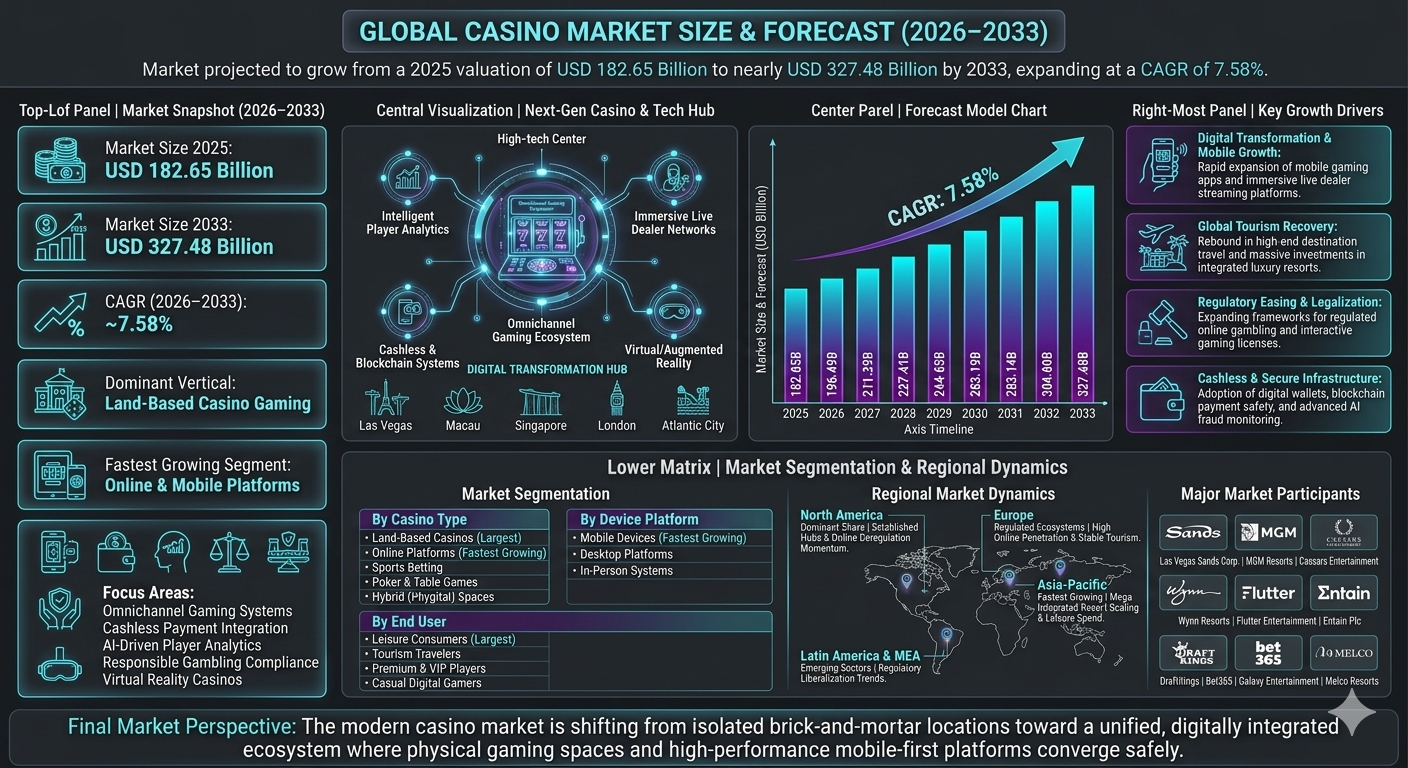
Global Casino Market size and forecast
The Global Casino Market is expected to witness strong growth during the forecast period from 2026 to 2033. The market was valued at USD 182.65 billion in 2025 and is projected to reach approximately USD 327.48 billion by 2033, registering a CAGR of 7.58%. The market growth is primarily driven by rising global tourism, increasing legalization of online gambling, expanding disposable incomes, and growing consumer demand for premium entertainment experiences. Casino services are increasingly critical for tourism-driven entertainment economies, hospitality integration, digital gaming ecosystems, and luxury leisure experiences. Rising adoption of online gaming platforms, AI-powered player analytics, immersive digital experiences, and mobile betting applications is accelerating market growth. In addition, integrated resort development, cashless gaming systems, and virtual reality casino experiences are supporting long-term market expansion.Global Casino Market Overview
The casino market encompasses land-based and online gaming operations that offer wagering-based entertainment experiences across various gaming formats. The market includes slot machines, table games, poker rooms, sports betting, online casino platforms, mobile gaming applications, and integrated resort casinos. Casino services are widely utilized across tourism, hospitality, digital entertainment, and premium leisure sectors. The market is shifting from traditional gaming halls toward digitally integrated casino ecosystems, AI-powered customer engagement systems, cashless gaming technologies, and immersive virtual gaming environments.Structural Drivers of Market Growth
1. Innovation and Commercialization Acceleration
Rapid innovation in mobile casino apps, live dealer platforms, virtual reality gaming, and AI-driven customer analytics is accelerating service expansion. Enhanced personalization and immersive user experiences are significantly improving customer engagement.Market Implications
Companies investing in digital casino platforms, mobile-first technologies, and immersive gaming innovation are expected to strengthen market leadership.2. Compliance and Risk Repricing
Gaming licensing regulations, anti-money laundering compliance, data protection laws, and responsible gambling policies are influencing operational modernization. Governments are increasingly enforcing stricter compliance frameworks for digital gaming platforms.Market Implications
Firms offering compliant, secure, and transparent gaming ecosystems are likely to gain stronger market trust.3. Competitive and Value-Chain Reconfiguration
The market is highly competitive as casino operators, online gaming platforms, resort developers, and technology providers expand offerings. Digital integration and cross-platform entertainment ecosystems are altering value-chain economics.Market Implications
Companies focusing on omnichannel gaming experiences and integrated resort ecosystems may gain stronger margins.4. Capital and Capacity Scaling
Rising investment in integrated casino resorts, online gaming infrastructure, cybersecurity systems, and digital payment platforms is supporting market expansion. Tourism recovery and legalization trends are also increasing demand.Market Implications
Operators scaling digital infrastructure and premium entertainment capabilities are expected to capture future opportunities.Market Segmentation Analysis
By Casino Type
1. Land-Based Casino Gaming
This remains the largest segment due to established resort-based gaming demand and premium entertainment experiences.2. Online Casino Platforms
Fastest-growing due to digital accessibility and mobile gaming adoption.3. Sports Betting
Strong growth driven by legalization and live event integration.4. Poker & Table Gaming
Widely utilized across traditional and online casino formats.5. Hybrid Casino Experiences
Growing demand for integrated physical-digital gaming solutions.By Device Platform
1. Desktop Platforms
Widely used for full-scale online gaming experiences.2. Mobile Devices
Fastest-growing segment due to smartphone penetration and app convenience.3. In-Person Gaming Systems
Strong demand across integrated resort casinos.By End User
1. Leisure & Entertainment Consumers
Largest segment due to recreational gaming participation.2. Tourism Travelers
Strong demand from destination-based casino tourism.3. Premium & VIP Players
High-value segment with luxury gaming experiences.4. Digital Casual Gamers
Growing adoption across mobile platforms.Regional Market Dynamics
North America
North America dominates the global casino market due to established gaming hubs, online legalization momentum, and integrated resort infrastructure.Europe
Europe remains a major market supported by regulated online gaming ecosystems and strong tourism demand.Asia-Pacific
Asia-Pacific is the fastest-growing region due to integrated resort development, rising digital gaming adoption, and tourism expansion.Latin America
Latin America is gradually expanding due to regulatory liberalization and increasing online betting adoption.Middle East & Africa
The region is witnessing selective growth driven by tourism infrastructure development and entertainment sector investments.Competitive Landscape
The Global Casino Market is highly competitive with casino operators, online gaming providers, resort developers, and digital entertainment companies expanding globally.Key Companies Operating in the Market Include:
- Las Vegas Sands Corp.
- MGM Resorts International
- Caesars Entertainment
- Wynn Resorts
- Flutter Entertainment
- Entain Plc
- DraftKings
- Bet365
- Galaxy Entertainment Group
- Melco Resorts & Entertainment
Strategic Outlook
The future of the casino market will be shaped by online gaming innovation, virtual reality casino experiences, blockchain-based payment systems, and AI-powered player engagement. Cashless gaming, responsible gambling analytics, and immersive digital entertainment platforms will significantly improve operational efficiency. The rise of mobile gaming, tourism-driven resort expansion, and hybrid entertainment ecosystems is expected to create strong long-term growth opportunities.Final Market Perspective
The Global Casino Market remains a major segment within entertainment, tourism, and digital gaming ecosystems. Rising online gaming adoption, resort development, and immersive technology integration continue driving long-term market growth. Companies capable of delivering scalable, secure, technology-enabled, and customer-centric gaming ecosystems will be best positioned to capture future opportunities. The convergence of digital gaming, AI personalization, and integrated entertainment experiences is expected to redefine the future of the global casino industry.Table of Contents
Table of Contents
- 1. Executive Summary
- 1.1 Global Casino Market Snapshot (2026???2033)
- 1.2 Market Size & CAGR Analysis
- 1.3 Largest & Fastest-Growing Segments
- 1.4 Key Regional Insights
- 1.5 Major Market Growth Drivers
- 1.6 Competitive Landscape Overview
- 1.7 Strategic Outlook Through 2033
- 2. Introduction & Market Overview
- 2.1 Definition of Casino Market
- 2.2 Scope of the Study
- 2.3 Evolution of Casino Gaming & Entertainment
- 2.4 Gaming & Leisure Ecosystem Analysis
- 2.5 Regulatory & Compliance Framework
- 2.6 Digital Gaming Transformation Trends
- 2.7 Product & Service Innovation Landscape
- 3. Research Methodology
- 3.1 Primary Research
- 3.2 Secondary Research
- 3.3 Market Size Estimation Model
- 3.4 Forecast Assumptions (2026???2033)
- 3.5 Data Validation & Market Triangulation
- 4. Market Dynamics
- 4.1 Drivers
- 4.1.1 Rising Global Tourism & Hospitality Integration
- 4.1.2 Increasing Legalization of Online Gambling
- 4.1.3 Growth in Mobile Gaming Adoption
- 4.1.4 Technological Innovation in Casino Platforms
- 4.1.5 Expansion of Premium Entertainment Experiences
- 4.2 Restraints
- 4.2.1 Stringent Regulatory Compliance Requirements
- 4.2.2 Responsible Gambling Restrictions
- 4.2.3 Cybersecurity & Data Privacy Risks
- 4.2.4 Regional Legal Barriers
- 4.3 Opportunities
- 4.3.1 Virtual Reality Casino Experiences
- 4.3.2 Blockchain-Based Gaming Payments
- 4.3.3 Expansion in Emerging Digital Gaming Markets
- 4.3.4 AI-Powered Player Engagement Systems
- 4.4 Challenges
- 4.4.1 Regulatory Fragmentation Across Regions
- 4.4.2 Responsible Gambling Monitoring
- 4.4.3 Fraud Prevention & AML Compliance
- 4.4.4 Technology Infrastructure Scalability
- 4.1 Drivers
- 5. Global Casino Market Analysis (USD Billion), 2026???2033
- 5.1 Market Size Overview
- 5.2 CAGR Analysis
- 5.3 Regional Revenue Distribution
- 5.4 Digital Gaming Adoption Trends
- 5.5 Consumer Demand Analysis
- 5.6 Future Growth Projections
- 6. Market Segmentation (USD Billion), 2026???2033
- 6.1 By Casino Type
- 6.1.1 Land-Based Casino Gaming
- 6.1.2 Online Casino Platforms
- 6.1.3 Sports Betting
- 6.1.4 Poker & Table Gaming
- 6.1.5 Hybrid Casino Experiences
- 6.2 By Device Platform
- 6.2.1 Desktop Platforms
- 6.2.2 Mobile Devices
- 6.2.3 In-Person Gaming Systems
- 6.3 By End User
- 6.3.1 Leisure & Entertainment Consumers
- 6.3.2 Tourism Travelers
- 6.3.3 Premium & VIP Players
- 6.3.4 Digital Casual Gamers
- 6.1 By Casino Type
- 7. Market Segmentation by Geography
- 7.1 North America
- 7.2 Europe
- 7.3 Asia-Pacific
- 7.4 Latin America
- 7.5 Middle East & Africa
- 8. Competitive Landscape
- 8.1 Market Share Analysis
- 8.2 Product Innovation Benchmarking
- 8.3 Strategic Partnerships & Collaborations
- 8.4 Digital Platform Expansion Analysis
- 8.5 Brand Positioning Strategies
- 9. Company Profiles
- 9.1 Las Vegas Sands Corp.
- 9.2 MGM Resorts International
- 9.3 Caesars Entertainment
- 9.4 Wynn Resorts
- 9.5 Flutter Entertainment
- 9.6 Entain Plc
- 9.7 DraftKings
- 9.8 Bet365
- 9.9 Galaxy Entertainment Group
- 9.10 Melco Resorts & Entertainment
- 10. Strategic Intelligence & Pheonix AI Insights
- 10.1 Gaming Revenue Forecast Engine
- 10.2 Digital Casino Adoption Dashboard
- 10.3 Player Behavior Intelligence Tracker
- 10.4 Market Opportunity Analyzer
- 10.5 Automated Porter???s Five Forces Analysis
- 11. Future Outlook & Strategic Recommendations
- 11.1 Investment in Online Casino Innovation
- 11.2 Expansion of Immersive Gaming Technologies
- 11.3 Strengthening Compliance & Cybersecurity Systems
- 11.4 Development of Hybrid Gaming Ecosystems
- 11.5 Long-Term Market Outlook (2033+)
- 12. Appendix
- 13. About Pheonix Research
- 14. Disclaimer
Competitive Landscape
Global Casino Market Competitive Intensity & Market Structure Overview
The global casino market is highly competitive and moderately consolidated, characterized by intense competition among multinational casino operators, online gaming platforms, sportsbook providers, and integrated resort developers. Competitive intensity is driven by licensing capabilities, digital platform innovation, customer engagement strategies, gaming portfolio diversification, regulatory compliance, and premium entertainment infrastructure.
The market structure includes large integrated resort operators with global casino footprints alongside specialized online gaming companies and emerging digital-first betting platforms. Competition is increasingly shaped by mobile gaming innovation, AI-powered customer analytics, immersive gaming technologies, and seamless omnichannel casino experiences.
Rising online gambling legalization, expanding tourism-driven gaming demand, increasing mobile gaming penetration, and growing consumer preference for immersive entertainment experiences are significantly intensifying competition across the global casino market.
Global Casino Market Competitive Intensity & Market Structure Current Scenario
Leading Global Casino Companies
Las Vegas Sands Corp.: Leading integrated resort operator with strong premium casino infrastructure and global market presence.
MGM Resorts International: Major casino and entertainment company recognized for integrated resort development and digital gaming expansion.
Caesars Entertainment: Prominent casino operator with extensive land-based gaming operations and online sportsbook capabilities.
Wynn Resorts: Premium luxury casino operator focused on high-end gaming experiences and destination entertainment.
Flutter Entertainment: Global leader in online betting and gaming platforms with diversified digital casino offerings.
Entain Plc: Major digital gaming company specializing in sports betting and online casino platforms.
DraftKings: Leading digital gaming operator focused on sports betting and online casino innovation.
Bet365: Established online gaming company with strong mobile casino and global sportsbook operations.
Galaxy Entertainment Group: Major Asia-Pacific casino operator with large-scale integrated resort developments.
Melco Resorts & Entertainment: Leading integrated resort company focused on luxury gaming and entertainment ecosystems.
Key Competitive Intensity & Market Structure Drivers
Growing legalization of online gambling is intensifying competition around digital platform expansion and licensing acquisition.
Rising consumer demand for immersive digital casino experiences is accelerating investment in virtual and live gaming innovation.
Regulatory compliance requirements are strengthening competition around secure payment systems and responsible gambling technologies.
Mobile gaming adoption is increasing competitive pressure for seamless app-based gaming ecosystems.
Integrated resort development and premium tourism experiences are reshaping land-based casino market competitiveness.
Strategic Implications of Competitive Intensity & Market Structure
Casino operators are increasingly investing in AI-powered customer engagement platforms and predictive gaming analytics.
Strategic partnerships with technology providers are becoming essential for digital transformation and platform scalability.
Cashless gaming systems and blockchain-based payment infrastructure are strengthening operational efficiency and customer convenience.
Cross-platform integration between land-based casinos and online gaming platforms is emerging as a major competitive differentiator.
Investment in responsible gambling frameworks and cybersecurity systems is becoming central to long-term market positioning.
Global Casino Market Competitive Intensity & Market Structure Forward Outlook
The global casino market is expected to remain highly competitive as digital gaming expansion and integrated resort development continue accelerating.
Future competition will increasingly focus on virtual reality casino environments, AI-driven player personalization, blockchain-enabled gaming transactions, and immersive omnichannel experiences.
North America and Asia-Pacific will remain dominant competitive regions, while Europe will continue driving regulated online gaming innovation.
Advancements in mobile-first gaming platforms, digital payment ecosystems, and immersive entertainment technologies are expected to significantly reshape market dynamics.
Overall, companies that successfully combine scalable digital infrastructure, regulatory excellence, immersive customer engagement, and premium entertainment ecosystems will remain strongly positioned in the evolving global casino market.
Value Chain
Global Casino Market Value Chain & Supply Chain Evolution Overview
The Global Casino Market value chain is evolving from traditional land-based gaming operations into a highly digitalized, technology-enabled, and omnichannel entertainment ecosystem. This transformation is being driven by increasing legalization of online gaming, rapid mobile platform adoption, rising tourism recovery, and the growing demand for immersive digital entertainment experiences.
The casino value chain is becoming increasingly interconnected through digital gaming infrastructure, advanced analytics systems, cashless payment technologies, customer engagement platforms, and integrated resort development. Operators are prioritizing seamless customer experiences, operational security, regulatory compliance, and personalized gaming environments to strengthen competitive positioning.
The upstream segment begins with gaming software development, gaming hardware manufacturing, payment infrastructure, cybersecurity systems, compliance technology, and resort infrastructure development. This includes slot machine manufacturers, digital platform developers, AI analytics providers, payment processors, and cloud gaming technology vendors.
The operational core consists of gaming platform deployment, customer management systems, betting engines, game content integration, fraud monitoring, responsible gambling controls, and real-time operational analytics. AI-driven personalization, blockchain-enabled transactions, and live-stream gaming technologies are increasingly improving operational efficiency and user engagement.
The downstream distribution network includes land-based casinos, integrated resorts, online casino operators, mobile gaming applications, affiliate marketing channels, digital acquisition platforms, and hospitality service ecosystems.
Overall, the casino value chain is transitioning into a globally connected, digitally responsive, and highly regulated entertainment ecosystem where technology integration, compliance, customer experience, and operational agility define competitive advantage.
Global Casino Market Value Chain & Supply Chain Evolution Current Scenario
The current market structure reflects a hybrid ecosystem combining traditional land-based casino operations with rapidly expanding online and mobile gaming platforms.
Land-based casinos continue to dominate revenue generation through integrated resort experiences, hospitality services, and premium entertainment offerings, while online gaming platforms are growing rapidly due to accessibility and convenience.
Gaming operators are increasingly adopting AI-powered player analytics, loyalty systems, dynamic promotions, and digital payment solutions to improve customer retention and operational efficiency.
Regulatory compliance remains central to operations, with operators required to implement anti-money laundering systems, responsible gambling frameworks, identity verification technologies, and cybersecurity controls.
Cross-platform integration between physical casinos and digital gaming ecosystems is becoming a major focus area for enhancing customer lifetime value.
Key Value Chain & Supply Chain Evolution Signals in Global Casino Market
Online gaming platform acceleration is reshaping casino operations through digital-first service models and mobile accessibility.
Cashless gaming adoption is improving operational efficiency and transaction security across casino environments.
AI-driven player engagement is enabling personalized promotions, predictive retention strategies, and enhanced gaming experiences.
Immersive gaming technologies such as virtual reality and live dealer experiences are redefining digital entertainment standards.
Regulatory technology integration is strengthening compliance monitoring, fraud detection, and responsible gambling management.
Strategic Implications of Value Chain & Supply Chain Evolution in Global Casino Market
The evolving casino value chain presents strong strategic opportunities for casino operators, digital gaming providers, payment technology companies, and resort developers.
Competitive advantage is increasingly determined by digital platform capabilities, customer engagement analytics, regulatory compliance infrastructure, payment security, and omnichannel service integration.
Operators investing in mobile-first platforms, immersive gaming technologies, AI-powered analytics, and integrated resort ecosystems are expected to strengthen market leadership.
Strategic collaborations between casino operators, software developers, fintech providers, and hospitality companies are becoming increasingly critical for long-term growth.
Organizations capable of balancing innovation, regulatory compliance, customer trust, and entertainment differentiation will achieve stronger market positioning.
Global Casino Market Value Chain & Supply Chain Evolution Forward Outlook
Between 2026 and 2033, the casino value chain is expected to evolve into a fully intelligent, omnichannel, and digitally immersive entertainment ecosystem.
AI-powered predictive engagement systems will enhance personalization, fraud detection, responsible gambling analytics, and customer retention strategies.
Virtual reality casinos, metaverse gaming environments, and immersive digital entertainment platforms will significantly expand market experiences.
Blockchain-based payment systems and decentralized identity verification technologies will improve security, transparency, and transaction efficiency.
Integrated resort ecosystems will continue expanding through luxury hospitality, entertainment diversification, and cross-platform customer loyalty systems.
Ultimately, the future casino value chain will be defined by digital innovation, immersive technology, secure financial ecosystems, and highly personalized gaming experiences.
Market-Specific Value Chain
- Technology Infrastructure Development: Gaming software developers, slot machine manufacturers, cloud platform providers, cybersecurity vendors
- Gaming Platform Operations: Online casino operators, sportsbook providers, game engine platforms, betting system integrators
- Compliance & Security Systems: AML monitoring providers, identity verification systems, regulatory reporting platforms
- Payment Processing: Digital wallet providers, cashless payment systems, blockchain transaction platforms
- Customer Engagement & Marketing: Loyalty management systems, affiliate networks, AI-driven customer analytics providers
- Distribution Channels: Land-based casinos, mobile applications, desktop gaming platforms, integrated resort networks
- End-Use Consumer Integration: Leisure players, tourism travelers, premium VIP gaming customers, digital casual gamers
Investment Activity
Global Casino Market Investment & Funding Dynamics Overview
The Global Casino Market is witnessing strong investment momentum driven by the rapid expansion of online gaming platforms, tourism recovery, digital casino transformation, and increasing demand for immersive entertainment experiences. Casino operators, online gaming companies, resort developers, fintech providers, and gaming technology firms are actively investing in digital gaming platforms, AI-powered player engagement systems, cashless gaming infrastructure, cybersecurity solutions, and integrated resort development.
Investment activity is accelerating due to growing demand for mobile gaming accessibility, live dealer platforms, digital payment integration, immersive virtual casino experiences, and cross-platform entertainment ecosystems. The transition toward digitally integrated casino environments is significantly reshaping capital allocation across the market.
Additionally, expanding investments in virtual reality gaming systems, blockchain payment platforms, responsible gambling analytics, online betting infrastructure, and resort modernization projects are strengthening long-term growth opportunities globally.
Global Casino Market Investment & Funding Dynamics Current Scenario
Currently, the global casino market demonstrates increasing investment activity due to rising capital requirements for digital platform development, gaming infrastructure upgrades, compliance systems, and integrated resort expansion. Leading casino operators are heavily investing in AI-driven player analytics, mobile-first gaming platforms, automated payment systems, cybersecurity architecture, and immersive digital entertainment technologies.
The market is attracting strong funding into online casino startups, sportsbook platforms, immersive gaming technology developers, fintech payment solution providers, and gaming cybersecurity companies.
The industry is witnessing active mergers, acquisitions, licensing partnerships, and strategic collaborations as operators and technology firms pursue market expansion, digital transformation, and service diversification.
Key Investment & Funding Dynamics Signals in Global Casino Market
- Rising demand for online and mobile casino gaming is accelerating digital platform investments.
- Expansion of integrated resort developments and premium entertainment destinations is increasing infrastructure-focused capital deployment.
- Growing adoption of cashless gaming systems and digital payment integration is strengthening fintech-driven funding.
- Strategic investments in AI-powered player analytics and immersive gaming technologies are reshaping operational priorities.
- Partnerships between casino operators, technology providers, and payment platform companies are improving ecosystem scalability.
- Increasing regulatory focus on gaming compliance, anti-money laundering controls, and responsible gambling frameworks is supporting investor confidence.
- Rising demand for secure and personalized gaming ecosystems is accelerating R&D spending.
Strategic Implications of Investment & Funding Dynamics in Global Casino Market
- Continuous investment in digital casino innovation and omnichannel gaming platforms is essential for long-term competitiveness.
- Capital allocation toward cybersecurity systems, payment infrastructure, and immersive gaming technologies will strengthen market positioning.
- Companies delivering secure, compliant, and customer-centric gaming experiences are expected to gain stronger market share.
- Strategic acquisitions and platform partnerships will accelerate technology integration and service diversification.
- Investments in virtual reality casinos, blockchain payment ecosystems, and AI-driven engagement systems will remain major priorities.
- Compliance with gaming licensing regulations, AML mandates, and responsible gambling standards will remain critical for sustained growth.
- Organizations scaling digital entertainment ecosystems and integrated resort capabilities are expected to capture substantial future opportunities.
Global Casino Market Investment & Funding Dynamics Forward Outlook
Looking ahead, the Global Casino Market is expected to maintain strong investment growth driven by online gaming expansion, tourism recovery, digital payment innovation, and immersive entertainment development.
Future capital deployment will increasingly focus on virtual reality gaming, AI-based player personalization, blockchain-enabled gaming transactions, smart casino infrastructure, and hybrid physical-digital entertainment ecosystems.
Responsible gaming technologies and immersive digital casino innovation are expected to become major long-term strategic priorities.
In conclusion, the Global Casino Market represents a high-growth entertainment and digital gaming investment landscape where digital transformation, immersive technologies, secure payment ecosystems, and integrated gaming experiences will define future capital strategies.
Technology & Innovation
Global Casino Market Technology & Innovation Landscape Overview
The global casino market is undergoing rapid technological transformation driven by advancements in digital gaming platforms, artificial intelligence, immersive entertainment systems, blockchain-based payment technologies, and next-generation customer engagement solutions. The evolution of casino technologies is increasingly focused on enhancing operational efficiency, improving user personalization, strengthening security frameworks, and delivering seamless omnichannel gaming experiences across land-based and online environments.
Modern casino ecosystems are integrating AI-powered analytics engines, real-time player behavior monitoring systems, biometric authentication, cloud-based gaming architectures, and automated compliance management platforms to improve service delivery and operational performance. These innovations are significantly enhancing customer retention, gaming transparency, and regulatory adherence.
The market is also witnessing widespread adoption of virtual reality casinos, live-stream gaming technologies, smart casino floor automation, mobile-first gaming applications, and blockchain-enabled financial transaction systems that are redefining entertainment experiences globally.
Global Casino Market Technology & Innovation Current Scenario
Currently, innovation in the casino market is centered around digital platform modernization and immersive gaming ecosystem development. Traditional gaming environments are increasingly being enhanced through smart technologies that create highly personalized and interactive experiences.
Online and mobile gaming platforms are expanding rapidly through cloud-based infrastructure that enables seamless access, high-speed gameplay, and real-time interactive engagement.
Artificial intelligence and machine learning systems are emerging as major innovation drivers, enabling predictive player behavior analysis, personalized gaming recommendations, fraud detection, and responsible gambling monitoring.
Cashless gaming technologies are increasingly being adopted to streamline payments, reduce operational friction, and enhance transaction security across physical and digital casino environments.
Virtual and augmented reality technologies are creating immersive digital casino environments that replicate real-world gaming experiences.
Blockchain-powered payment systems and decentralized gaming ledgers are strengthening transaction transparency, auditability, and player trust.
Key Technology & Innovation Trends in Global Casino Market
- AI-Powered Player Analytics: Enabling personalized engagement and behavioral prediction.
- Virtual Reality Casino Platforms: Delivering immersive digital gaming experiences.
- Cashless Gaming Systems: Streamlining secure digital transactions.
- Blockchain Payment Infrastructure: Enhancing transaction transparency and security.
- Biometric Authentication Systems: Strengthening player verification and fraud prevention.
- Live Dealer Streaming Technology: Bridging physical and online gaming experiences.
- Cloud-Based Gaming Platforms: Improving scalability and accessibility.
- Responsible Gambling Monitoring Tools: Supporting compliance and player protection.
- Mobile-First Gaming Applications: Expanding anytime-anywhere casino access.
- Smart Casino Floor Automation: Optimizing operations through connected devices.
Strategic Implications of Technology & Innovation
Technological advancements are significantly reshaping competitive dynamics in the casino market by shifting competition from traditional venue-based gaming toward digitally integrated, data-driven, and immersive entertainment ecosystems.
Companies investing in AI personalization, mobile gaming innovation, and immersive virtual experiences are achieving stronger competitive differentiation through enhanced customer retention and premium user experiences.
The growing integration of predictive analytics is enabling operators to optimize player engagement, improve loyalty program effectiveness, and strengthen operational decision-making.
Advanced automation systems are helping operators reduce manual processes, improve security controls, and streamline compliance management.
However, cybersecurity risks, evolving regulatory requirements, digital fraud concerns, and high infrastructure investment costs remain key challenges for market participants.
Global Casino Market Technology & Innovation Forward Outlook
The future of casino technology is expected to evolve toward fully immersive, AI-orchestrated, and highly secure omnichannel gaming ecosystems capable of delivering personalized entertainment experiences across digital and physical platforms.
Emerging innovations include metaverse-integrated casino environments, autonomous gaming systems, decentralized blockchain gaming platforms, predictive responsible gambling intelligence, and advanced neural-interface entertainment technologies.
Hyper-personalized gaming experiences may increasingly leverage real-time behavioral analytics to dynamically adapt gameplay and promotions.
Connected casino ecosystems supported by IoT and edge computing are expected to enable real-time operational optimization across integrated resorts.
Advanced digital identity verification and smart regulatory monitoring systems may further strengthen compliance and consumer protection.
Overall, the global casino market is evolving toward a highly intelligent ecosystem combining immersive digital experiences, AI-driven personalization, blockchain security, and automated compliance systems to redefine the future of global gaming and entertainment industries.
Market Risk
Global Casino Market Risk & Disruption Analysis
The Global Casino Market operates within a high-risk and rapidly evolving disruption environment shaped by regulatory uncertainty, digital platform competition, cybersecurity threats, changing consumer behavior, responsible gambling scrutiny, and macroeconomic sensitivity. While the market demonstrates strong long-term growth driven by online gaming expansion, tourism recovery, and immersive entertainment innovation, it remains exposed to regulatory intervention, technology disruption, fraud risks, and shifting player engagement models.
A defining structural characteristic of the market is its dependence on consumer discretionary spending, tourism flows, regulatory licensing frameworks, and technology-enabled engagement systems. Profitability is strongly influenced by player retention rates, compliance costs, platform security, operational scale, and entertainment experience differentiation.
Land-based casino gaming remains dominant by revenue contribution, while high-growth value is increasingly shifting toward online casino platforms, mobile gaming applications, sports betting integration, and immersive hybrid gaming ecosystems.
The market is also transitioning from conventional casino operations toward digitally integrated gaming ecosystems, AI-powered customer analytics, cashless gaming systems, blockchain-enabled payments, and virtual entertainment experiences, increasing strategic pressure for continuous innovation.
Global Casino Market Current Risk Environment
The current market environment is characterized by strong growth potential, elevated compliance complexity, and intense platform-driven disruption.
One of the most significant disruption factors involves regulatory uncertainty and licensing volatility. Changes in gambling laws, taxation frameworks, market access restrictions, and responsible gaming regulations can rapidly alter operational economics.
Another major risk area is cybersecurity and fraud exposure. Online gaming platforms face growing risks related to payment fraud, data breaches, identity theft, money laundering attempts, and digital transaction vulnerabilities.
The market also faces substitution pressure from alternative digital entertainment options including esports, streaming platforms, social gaming, and immersive interactive experiences competing for consumer attention.
Additionally, macroeconomic fluctuations and consumer spending sensitivity remain structurally important. Economic slowdowns, inflationary pressures, and travel disruptions can significantly reduce discretionary gaming expenditure.
In parallel, responsible gambling requirements and reputational scrutiny are reshaping customer engagement strategies and operational governance.
Key Market Risk & Disruption Signals in Global Casino Market
- Regulatory & Licensing Volatility: Policy changes can rapidly impact market access and profitability.
- Cybersecurity & Fraud Exposure: Digital gaming systems remain vulnerable to cyberattacks and payment fraud.
- Responsible Gambling Compliance Pressure: Increasing player protection regulations raise operational complexity.
- Consumer Spending Sensitivity: Casino demand is highly linked to discretionary income and economic conditions.
- Competition from Digital Entertainment: Alternative gaming and entertainment platforms create substitution pressure.
- Tourism Dependency Risk: Land-based casino performance is closely tied to travel and hospitality activity.
- Technology Modernization Pressure: Continuous investment is required to maintain digital competitiveness.
- AML & Financial Compliance Risk: Anti-money laundering obligations increase monitoring and governance costs.
Strategic Implications of Market Risk & Disruption
The evolving disruption environment creates both significant growth opportunities and elevated operational complexity.
One of the most important strategic implications is the need for secure, omnichannel gaming ecosystems that integrate physical and digital experiences seamlessly.
Companies increasingly must invest in cybersecurity infrastructure, AI-driven personalization systems, responsible gaming analytics, and mobile-first platform innovation to remain competitive.
Vertical integration across gaming technology, payment systems, compliance management, and customer engagement platforms is becoming increasingly valuable.
The convergence of immersive digital experiences, cashless ecosystems, real-time analytics, and integrated entertainment platforms is reshaping value-chain dynamics.
Operators with stronger regulatory adaptability, technology innovation, and diversified omnichannel offerings are expected to strengthen long-term market leadership.
Global Casino Market Risk & Disruption Forward Outlook
Looking ahead to 2026???2033, the Global Casino Market is expected to become increasingly digital, immersive, and compliance-driven.
- Expansion of Online & Mobile Casino Platforms: Digital channels will capture growing strategic value.
- Greater Adoption of Cashless Gaming Systems: Digital payments will improve convenience and operational transparency.
- Rising AI-Powered Personalization: Advanced analytics will optimize player engagement and retention.
- Higher Regulatory Oversight: Responsible gambling and compliance requirements will intensify globally.
- Growth of Hybrid Gaming Experiences: Integrated physical-digital casino ecosystems will expand.
- Stronger Cybersecurity Investments: Platform security will become a critical competitive differentiator.
- Continued Tourism-Driven Resort Expansion: Destination gaming hubs will remain growth catalysts.
- Greater Industry Consolidation: Strategic partnerships and acquisitions will strengthen market positioning.
In conclusion, the Global Casino Market represents a highly dynamic, regulation-sensitive, and technology-driven entertainment ecosystem where digital innovation, compliance resilience, platform security, and customer experience differentiation will define long-term competitive success.
Regulatory Landscape
Global Casino Market Regulatory & Policy Environment Overview
The regulatory and policy environment governing the global casino market is shaped by gaming licensing regulations, anti-money laundering compliance requirements, responsible gambling policies, digital payment regulations, cybersecurity standards, and consumer protection frameworks. As casino operations increasingly expand across online and land-based platforms, regulatory oversight is becoming more stringent to ensure operational transparency, financial integrity, and responsible gaming practices across international markets.
Casino operators must comply with a broad range of regulations covering licensing approvals, financial transaction monitoring, player identity verification, responsible gambling safeguards, data privacy protections, and platform security compliance standards.
The growing adoption of online gaming platforms, mobile betting applications, and cashless gaming technologies is accelerating policy development around digital compliance frameworks, secure payment ecosystems, and cross-border gaming regulations.
Global Casino Market Regulatory & Policy Environment Current Scenario
The current regulatory framework for the casino market combines gaming authority oversight, anti-money laundering enforcement, responsible gambling mandates, taxation regulations, and digital gaming compliance standards.
In North America and Europe, strict gaming commission regulations govern operator licensing, financial transparency, customer verification procedures, and advertising restrictions. Online gaming operators are increasingly required to implement enhanced identity authentication and transaction monitoring systems.
Responsible gambling regulations addressing player protection, betting limits, self-exclusion programs, and addiction prevention measures are significantly influencing operational platform design and customer engagement practices.
Asia-Pacific markets including Macau, Singapore, Australia, and Japan are strengthening licensing frameworks and regulatory monitoring systems as digital and integrated resort gaming continues to expand.
Land-based casino operators are also subject to hospitality compliance standards, tourism-related regulations, and local operational licensing requirements across key gaming destinations.
Key Regulatory & Policy Environment Signals in Global Casino Market
- Gaming Licensing Regulations: Licensing approvals and operational compliance frameworks are central to market participation.
- Anti-Money Laundering Compliance: Financial monitoring requirements are strengthening transaction transparency and fraud prevention systems.
- Responsible Gambling Policies: Player protection mandates are shaping gaming platform controls and behavioral monitoring systems.
- Digital Payment Regulations: Cashless gaming and online transactions must comply with secure payment processing standards.
- Data Protection Compliance: Cybersecurity and customer data privacy regulations are influencing digital platform modernization.
- Advertising and Consumer Protection Rules: Regulatory restrictions govern promotional practices and gaming transparency standards.
Strategic Implications of Regulatory & Policy Environment
The evolving regulatory landscape is encouraging casino operators to invest heavily in compliance automation systems, secure digital payment infrastructure, advanced identity verification technologies, and responsible gambling analytics platforms.
Anti-money laundering requirements are accelerating adoption of AI-powered fraud detection systems, blockchain-enabled transaction monitoring, and real-time financial compliance reporting.
Responsible gambling regulations are driving deployment of behavioral analytics tools, self-exclusion systems, and predictive player risk assessment technologies.
Digital platform compliance standards are also supporting greater innovation in secure mobile gaming applications, encrypted payment ecosystems, and cybersecurity-enhanced casino infrastructure.
International harmonization of gaming regulations is creating competitive advantages for operators with globally compliant, secure, and transparent gaming ecosystems.
Global Casino Market Regulatory & Policy Environment Forward Outlook
Between 2026 and 2033, the regulatory environment for the global casino market is expected to become increasingly digitally standardized, security-focused, and consumer protection-driven.
Governments are likely to introduce stricter online gaming compliance frameworks, expanded anti-money laundering monitoring requirements, and stronger responsible gambling reporting obligations for casino operators.
Emerging technologies such as blockchain-based payment systems, AI-driven risk management, and digital identity verification may face increasingly specialized regulatory validation requirements.
Cross-border digital gaming compliance frameworks and enhanced global cybersecurity standards are expected to gain broader regulatory relevance as online casino participation accelerates worldwide.
Overall, regulatory and policy developments will remain a critical market influence, with companies investing in compliance innovation, secure digital infrastructure, and responsible gaming technologies expected to maintain long-term competitive advantage.