
Global Anime Market Report, Size & Forecast 2026–2033
Global Anime Market Forecast Snapshot (2026???2033)
| Metric | Value |
|---|---|
| Market Size (2025) | USD 34.85 Billion |
| Market Size (2033) | USD 72.68 Billion |
| CAGR (2026???2033) | 9.62% |
| Largest Segment | Streaming & Television Anime Content |
| Fastest Growing Segment | Anime Gaming, Digital Merchandise & NFT-Based Content |
| Leading End-Use Segment | Entertainment & Digital Media Consumers |
| Key Trend | Global Streaming Expansion & Cross-Media Anime Franchising |
| Regulatory Influence | Copyright Protection Laws, Content Licensing Policies & Digital Distribution Compliance |
| Future Outlook | Growth Driven by Streaming Platforms, International Fanbase Expansion & Immersive Digital Experiences |
Global Anime Market Size & Forecast
The Global Anime Market is expected to witness strong growth during the forecast period from 2026 to 2033. The market was valued at USD 34.85 billion in 2025 and is projected to reach approximately USD 72.68 billion by 2033, registering a CAGR of 9.62%. The market growth is primarily driven by increasing global demand for anime content, expanding streaming platform penetration, rising fandom culture, and growing monetization through merchandising, gaming, and live events. Anime has become increasingly critical within digital entertainment ecosystems, influencing global media consumption, gaming culture, fashion collaborations, and virtual content experiences. Rising adoption of OTT platforms, simulcast distribution, and interactive digital anime experiences is accelerating market growth. In addition, international licensing agreements, social media-driven fandom engagement, and cross-platform franchise expansion are supporting long-term market development.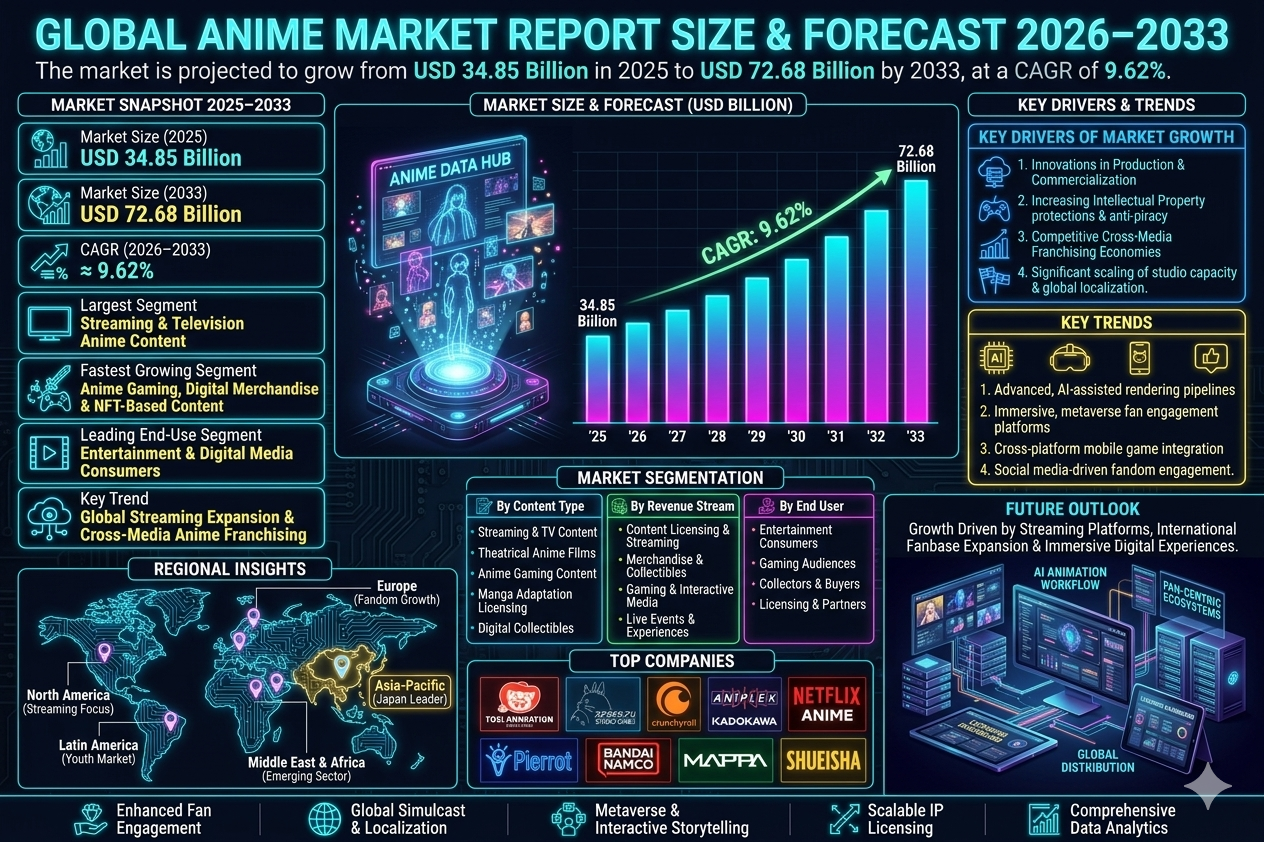
Global Anime Market Overview
The anime market encompasses animated content production, licensing, distribution, merchandising, gaming integrations, and franchise monetization based on Japanese animation and related digital entertainment properties. The market includes television anime, theatrical anime films, streaming content, mobile games, collectibles, merchandise, live events, manga adaptations, and digital collectibles. Anime products and services are widely utilized across entertainment, gaming, publishing, e-commerce, and consumer lifestyle sectors. The market is shifting from traditional broadcast models toward global streaming ecosystems, AI-assisted animation workflows, virtual production pipelines, and immersive fan engagement platforms.Structural Drivers of Market Growth
1. Innovation and Commercialization Acceleration
Rapid innovation in digital animation production, AI-assisted rendering, immersive streaming experiences, and virtual fan interaction platforms is accelerating content commercialization. Advanced production technologies are improving content quality and release efficiency.Market Implications
Studios and distributors investing in advanced animation technology, global simulcast platforms, and franchise ecosystem development are expected to strengthen market leadership.2. Compliance and Risk Repricing
Copyright regulations, international licensing frameworks, anti-piracy enforcement, and digital distribution compliance standards are influencing operational modernization. Governments and content regulators are increasingly enforcing stricter intellectual property protections.Market Implications
Companies offering secure, compliant, and licensed anime distribution ecosystems are likely to gain stronger market trust.3. Competitive and Value-Chain Reconfiguration
The market is highly competitive as animation studios, streaming platforms, gaming companies, publishers, and merchandise brands expand globally. Cross-media franchise ecosystems and digital fan monetization are altering value-chain economics.Market Implications
Companies focusing on integrated content production, merchandise licensing, and direct fan engagement may gain stronger margins.4. Capital and Capacity Scaling
Rising investment in animation studios, digital production infrastructure, streaming platform partnerships, and international localization capabilities is supporting market expansion. Global audience growth and digital monetization are also increasing demand.Market Implications
Operators scaling content production capacity and international distribution infrastructure are expected to capture future opportunities.Market Segmentation Analysis
By Content Type
1. Streaming & Television Anime Content
This remains the largest segment due to widespread digital consumption and subscription platform growth.2. Theatrical Anime Films
Strong demand driven by blockbuster franchise releases.3. Anime Gaming Content
Fastest-growing due to mobile gaming and interactive franchise integration.4. Manga Adaptation Licensing
Growing demand for content development pipelines.5. Digital Collectibles & Virtual Content
Emerging segment driven by immersive fan monetization.By Revenue Stream
1. Content Licensing & Streaming
Largest segment due to recurring digital distribution revenues.2. Merchandise & Collectibles
Strong growth driven by global fandom demand.3. Gaming & Interactive Media
Fast-growing due to mobile and console integrations.4. Live Events & Experiences
Expanding through conventions and immersive experiences.By End User
1. Entertainment & Digital Media Consumers
Largest segment due to mass streaming consumption.2. Gaming Audiences
Strong demand through anime-integrated gaming ecosystems.3. Collectors & Merchandise Buyers
Growing premium fan engagement segment.4. Licensing & Commercial Partners
Used for franchise commercialization and collaboration opportunities.Regional Market Dynamics
Asia-Pacific
Asia-Pacific dominates the global anime market due to Japan???s production leadership, strong regional fandom, and established content ecosystems.North America
North America remains a major market supported by streaming platform penetration and expanding fan communities.Europe
Europe is witnessing strong growth driven by digital distribution and localized anime content demand.Latin America
Latin America is rapidly expanding due to rising mobile streaming adoption and youth-driven fandom culture.Middle East & Africa
The region is witnessing emerging growth driven by digital media accessibility and expanding anime community engagement.Competitive Landscape
The Global Anime Market is highly competitive with animation studios, streaming platforms, gaming companies, and merchandise providers expanding globally.Key Companies Operating in the Market Include:
- Toei Animation
- Studio Ghibli
- Crunchyroll
- Aniplex Inc.
- Kadokawa Corporation
- Netflix Anime
- Pierrot Co., Ltd.
- Bandai Namco Holdings
- MAPPA
- Shueisha Inc.
Strategic Outlook
The future of the anime market will be shaped by AI-assisted production, immersive metaverse experiences, direct-to-consumer digital ecosystems, and global franchise expansion. Virtual fan communities, interactive storytelling, and advanced localization technologies will significantly improve market competitiveness. The rise of global streaming adoption, anime gaming integration, and digital merchandise ecosystems is expected to create strong long-term growth opportunities.Final Market Perspective
The Global Anime Market remains a major segment within entertainment, digital media, and cross-platform franchise ecosystems. Rising global fan engagement, streaming expansion, and digital monetization continue driving long-term market growth. Companies capable of delivering scalable, innovative, globally accessible, and fan-centric anime ecosystems will be best positioned to capture future opportunities. The convergence of streaming, gaming, immersive technology, and franchise licensing is expected to redefine the future of the global anime industry.Table of Contents
Table of Contents
- 1. Executive Summary
- 1.1 Global Anime Market Snapshot (2026???2033)
- 1.2 Market Size & CAGR Analysis
- 1.3 Largest & Fastest-Growing Segments
- 1.4 Key Regional Insights
- 1.5 Major Market Growth Drivers
- 1.6 Competitive Landscape Overview
- 1.7 Strategic Outlook Through 2033
- 2. Introduction & Market Overview
- 2.1 Definition of Anime Market
- 2.2 Scope of the Study
- 2.3 Evolution of Anime Content Production
- 2.4 Digital Entertainment Ecosystem Analysis
- 2.5 Regulatory & Content Licensing Framework
- 2.6 Streaming & Fan Engagement Trends
- 2.7 Franchise Innovation Landscape
- 3. Research Methodology
- 3.1 Primary Research
- 3.2 Secondary Research
- 3.3 Market Size Estimation Model
- 3.4 Forecast Assumptions (2026???2033)
- 3.5 Data Validation & Market Triangulation
- 4. Market Dynamics
- 4.1 Drivers
- 4.1.1 Rising Global Demand for Anime Content
- 4.1.2 Expansion of Streaming Platforms
- 4.1.3 Growth in Cross-Media Franchise Monetization
- 4.1.4 Increasing Anime Gaming Integration
- 4.1.5 Strong Global Fan Community Engagement
- 4.2 Restraints
- 4.2.1 Copyright Infringement & Piracy Risks
- 4.2.2 High Production Costs
- 4.2.3 Talent Shortages in Animation Studios
- 4.2.4 Content Localization Challenges
- 4.3 Opportunities
- 4.3.1 NFT-Based Anime Merchandise
- 4.3.2 Immersive Metaverse Anime Experiences
- 4.3.3 Expansion into Emerging Markets
- 4.3.4 AI-Assisted Animation Production
- 4.4 Challenges
- 4.4.1 Licensing Complexity Across Regions
- 4.4.2 Monetization of Digital Fan Communities
- 4.4.3 Distribution Platform Fragmentation
- 4.4.4 Maintaining Content Quality at Scale
- 4.1 Drivers
- 5. Global Anime Market Analysis (USD Billion), 2026???2033
- 5.1 Market Size Overview
- 5.2 CAGR Analysis
- 5.3 Regional Revenue Distribution
- 5.4 Content Innovation Trends
- 5.5 Consumer Demand Analysis
- 5.6 Future Growth Projections
- 6. Market Segmentation (USD Billion), 2026???2033
- 6.1 By Content Type
- 6.1.1 Streaming & Television Anime Content
- 6.1.2 Theatrical Anime Films
- 6.1.3 Anime Gaming Content
- 6.1.4 Manga Adaptation Licensing
- 6.1.5 Digital Collectibles & Virtual Content
- 6.2 By Revenue Stream
- 6.2.1 Content Licensing & Streaming
- 6.2.2 Merchandise & Collectibles
- 6.2.3 Gaming & Interactive Media
- 6.2.4 Live Events & Experiences
- 6.3 By End User
- 6.3.1 Entertainment & Digital Media Consumers
- 6.3.2 Gaming Audiences
- 6.3.3 Collectors & Merchandise Buyers
- 6.3.4 Licensing & Commercial Partners
- 6.1 By Content Type
- 7. Market Segmentation by Geography
- 7.1 Asia-Pacific
- 7.2 North America
- 7.3 Europe
- 7.4 Latin America
- 7.5 Middle East & Africa
- 8. Competitive Landscape
- 8.1 Market Share Analysis
- 8.2 Franchise Innovation Benchmarking
- 8.3 Strategic Partnerships & Collaborations
- 8.4 Digital Platform Expansion Analysis
- 8.5 Brand Positioning Strategies
- 9. Company Profiles
- 9.1 Toei Animation
- 9.2 Studio Ghibli
- 9.3 Crunchyroll
- 9.4 Aniplex Inc.
- 9.5 Kadokawa Corporation
- 9.6 Netflix Anime
- 9.7 Pierrot Co., Ltd.
- 9.8 Bandai Namco Holdings
- 9.9 MAPPA
- 9.10 Shueisha Inc.
- 10. Strategic Intelligence & Pheonix AI Insights
- 10.1 Anime Content Forecast Engine
- 10.2 Global Streaming Analytics Dashboard
- 10.3 Fan Engagement Intelligence Tracker
- 10.4 Franchise Opportunity Analyzer
- 10.5 Automated Porter???s Five Forces Analysis
- 11. Future Outlook & Strategic Recommendations
- 11.1 Investment in AI-Assisted Production
- 11.2 Expansion of Cross-Media Franchise Ecosystems
- 11.3 Strengthening Global Licensing Strategies
- 11.4 Development of Immersive Digital Fan Platforms
- 11.5 Long-Term Market Outlook (2033+)
- 12. Appendix
- 13. About Pheonix Research
- 14. Disclaimer
Competitive Landscape
Global Anime Market Competitive Intensity & Market Structure Overview
The global anime market is highly competitive and moderately fragmented, characterized by intense competition among animation studios, streaming platforms, gaming publishers, licensing companies, and merchandise ecosystem providers. Competitive intensity is driven by content production capabilities, franchise ownership, international licensing reach, digital distribution scale, fan engagement strategies, and cross-media monetization expertise.
The market structure includes established Japanese animation studios with extensive intellectual property portfolios alongside global streaming platforms, digital-first content distributors, and interactive entertainment companies. Competition is increasingly shaped by global simulcast distribution, AI-assisted animation workflows, immersive fan experiences, and integrated franchise expansion across gaming, merchandise, and digital collectibles.
Rising global streaming consumption, expanding anime fandom communities, increasing cross-platform monetization, and growing demand for immersive digital entertainment experiences are significantly intensifying competition across the global anime market.
Global Anime Market Competitive Intensity & Market Structure Current Scenario
Leading Global Anime Companies
Toei Animation: Leading anime production company with extensive franchise ownership and strong international licensing capabilities.
Studio Ghibli: Globally recognized animation studio known for premium cinematic anime content and iconic intellectual properties.
Crunchyroll: Major anime streaming platform specializing in global simulcast distribution and fan-centric digital ecosystems.
Aniplex Inc.: Prominent entertainment company focused on anime production, licensing, music, and gaming integration.
Kadokawa Corporation: Major media conglomerate with diversified anime publishing, production, and licensing operations.
Netflix Anime: Leading global streaming platform investing heavily in original anime production and international distribution.
Pierrot Co., Ltd.: Established animation studio recognized for long-running high-value anime franchises.
Bandai Namco Holdings: Major entertainment company integrating anime content with gaming and merchandise ecosystems.
MAPPA: Fast-growing animation studio known for premium production quality and high-profile franchise development.
Shueisha Inc.: Key manga and content licensing powerhouse supporting anime adaptation pipelines.
Key Competitive Intensity & Market Structure Drivers
Global streaming platform expansion is intensifying competition around exclusive content licensing and simulcast distribution rights.
Growing demand for anime gaming and digital interactive experiences is accelerating investment in cross-media franchise development.
Copyright enforcement and digital licensing compliance are strengthening competition around secure global distribution ecosystems.
Rising fan demand for collectibles, digital merchandise, and immersive experiences is reshaping monetization competitiveness.
AI-assisted animation production and localization technologies are increasing operational efficiency and release scalability.
Strategic Implications of Competitive Intensity & Market Structure
Anime studios are increasingly investing in advanced digital production systems and AI-assisted animation pipelines.
Strategic partnerships between streaming platforms, gaming companies, and merchandise brands are becoming essential for franchise expansion.
Global localization capabilities and multilingual distribution strategies are strengthening international market penetration.
Direct-to-consumer fan engagement platforms are emerging as major competitive differentiators.
Investment in intellectual property development and cross-platform monetization ecosystems is becoming central to long-term market positioning.
Global Anime Market Competitive Intensity & Market Structure Forward Outlook
The global anime market is expected to remain highly competitive as streaming platform growth and international fandom expansion continue accelerating.
Future competition will increasingly focus on immersive metaverse anime experiences, AI-driven content production, interactive storytelling, and blockchain-enabled digital collectibles.
Asia-Pacific will remain the dominant competitive region, while North America and Europe are expected to witness strong competitive expansion through streaming adoption and fan community growth.
Advancements in virtual production systems, real-time localization technologies, and integrated digital fan ecosystems are expected to significantly reshape market dynamics.
Overall, companies that successfully combine scalable content production, global licensing reach, immersive fan engagement, and cross-media franchise innovation will remain strongly positioned in the evolving global anime market.
Value Chain
Global Anime Market Value Chain & Supply Chain Evolution Overview
The Global Anime Market value chain is evolving from traditional studio-centric production and regional television broadcasting systems into a highly digitalized, globally distributed, and franchise-driven entertainment ecosystem. This transformation is being driven by rising international demand for anime content, rapid streaming platform expansion, growing cross-media monetization opportunities, and increasing fan engagement across digital platforms.
The anime value chain is becoming increasingly interconnected through digital production technologies, global content licensing systems, streaming distribution infrastructure, gaming integrations, merchandise ecosystems, and virtual fan engagement platforms. Companies are focusing on maximizing franchise value through multi-platform content delivery, global localization, and direct-to-consumer monetization strategies.
The upstream segment begins with intellectual property creation, manga publishing, concept development, scriptwriting, animation software development, voice talent sourcing, and digital production infrastructure. This includes manga publishers, creative studios, software providers, production committees, and animation technology developers.
The operational core consists of content development, animation production, post-production, localization, dubbing, subtitling, digital mastering, and content licensing management. AI-assisted animation workflows, cloud-based production systems, and digital rendering technologies are increasingly improving efficiency and production scalability.
The downstream distribution network includes streaming platforms, television broadcasters, theatrical distributors, gaming companies, merchandise licensing partners, digital marketplaces, event organizers, and direct-to-fan content channels.
Overall, the anime value chain is transitioning into a globally integrated, technology-enabled, and fan-driven ecosystem where intellectual property strength, distribution reach, digital monetization, and immersive engagement define competitive advantage.
Global Anime Market Value Chain & Supply Chain Evolution Current Scenario
The current market structure reflects a hybrid ecosystem combining traditional television anime production systems with rapidly expanding digital streaming and cross-media franchise platforms.
Streaming platforms remain the dominant distribution channel for global anime consumption, enabling simultaneous international releases and broader audience accessibility.
Production studios are increasingly adopting AI-assisted workflows, cloud collaboration tools, and advanced rendering technologies to improve output efficiency and address production bottlenecks.
Cross-media monetization through gaming integrations, merchandise licensing, digital collectibles, and live fan events is becoming central to franchise profitability.
Content localization and international licensing remain critical operational priorities, requiring scalable translation, dubbing, and compliance systems across diverse regional markets.
Key Value Chain & Supply Chain Evolution Signals in Global Anime Market
Streaming platform dominance is significantly reshaping content distribution through global simulcast models and subscription-based monetization.
Cross-media franchise expansion is increasing monetization opportunities across gaming, merchandise, live events, and digital collectibles.
AI-assisted animation production is improving workflow efficiency and enabling scalable content output.
Digital fan ecosystem growth is strengthening direct audience engagement through virtual communities, interactive content, and creator-driven platforms.
Global licensing acceleration is expanding anime accessibility across emerging international markets.
Strategic Implications of Value Chain & Supply Chain Evolution in Global Anime Market
The evolving anime value chain presents strong strategic opportunities for production studios, streaming platforms, gaming companies, publishers, and merchandise licensing firms.
Competitive advantage is increasingly determined by intellectual property ownership, production scalability, international licensing capabilities, fan engagement ecosystems, and cross-platform monetization integration.
Companies investing in AI-powered production tools, global localization systems, immersive fan engagement technologies, and franchise diversification strategies are expected to strengthen market leadership.
Strategic collaborations between animation studios, streaming platforms, gaming developers, and consumer merchandise brands are becoming critical for long-term market expansion.
Organizations capable of balancing creative quality, operational scalability, digital accessibility, and global fan engagement will achieve stronger long-term positioning.
Global Anime Market Value Chain & Supply Chain Evolution Forward Outlook
Between 2026 and 2033, the anime value chain is expected to evolve into a fully digital-first, AI-optimized, and immersive franchise ecosystem.
AI-powered animation assistance tools will significantly enhance production speed, rendering efficiency, and creative workflow optimization.
Virtual reality anime experiences, metaverse fan engagement platforms, and interactive storytelling systems will redefine audience interaction.
Blockchain-based licensing and digital ownership systems will improve content rights management and enable secure monetization of digital collectibles.
Advanced localization technologies will accelerate multilingual distribution and improve international audience accessibility.
Ultimately, the future anime value chain will be defined by digital production innovation, immersive fan ecosystems, global franchise scalability, and direct-to-consumer monetization models.
Market-Specific Value Chain
- IP Creation & Content Development: Manga publishers, scriptwriters, concept creators, production committees
- Animation Production: Animation studios, rendering technology providers, voice recording facilities, post-production teams
- Localization & Licensing: Translation providers, dubbing studios, content licensing agencies, compliance management systems
- Distribution Platforms: Streaming services, television broadcasters, theatrical distributors, digital content marketplaces
- Cross-Media Monetization: Gaming developers, merchandise manufacturers, NFT platforms, publishing extensions
- Fan Engagement Channels: Social media communities, virtual event platforms, anime conventions, direct-to-fan commerce systems
- End-Use Consumer Integration: Entertainment viewers, gaming audiences, collectors, global anime fandom communities
Investment Activity
Global Anime Market Investment & Funding Dynamics Overview
The Global Anime Market is witnessing substantial investment momentum driven by expanding global streaming adoption, increasing international fan engagement, cross-media franchise monetization, and rising demand for immersive digital entertainment experiences. Animation studios, streaming platforms, gaming companies, digital merchandise providers, and media technology firms are actively investing in content production infrastructure, AI-assisted animation tools, global localization systems, digital distribution ecosystems, and interactive fan engagement platforms.
Investment activity is accelerating due to growing demand for exclusive anime streaming content, anime gaming integrations, NFT-based digital collectibles, immersive fan experiences, and global licensing expansion. The transition toward digitally integrated anime entertainment ecosystems is significantly reshaping capital allocation across the market.
Additionally, expanding investments in virtual production technologies, AI-based rendering systems, multilingual content localization, metaverse anime experiences, and digital rights management infrastructure are strengthening long-term growth opportunities globally.
Global Anime Market Investment & Funding Dynamics Current Scenario
Currently, the global anime market demonstrates increasing investment activity due to rising capital requirements for content production expansion, international licensing, streaming platform partnerships, and digital fan ecosystem development. Leading market participants are heavily investing in high-quality animation studios, AI-assisted production workflows, cloud-based content distribution systems, and interactive digital monetization platforms.
The market is attracting strong funding into anime streaming startups, digital collectibles platforms, anime gaming developers, virtual fan community ecosystems, and next-generation animation technology innovators.
The industry is witnessing active strategic acquisitions, licensing alliances, co-production partnerships, and global distribution collaborations as content creators and media platforms pursue franchise expansion and market penetration.
Key Investment & Funding Dynamics Signals in Global Anime Market
- Rising demand for global anime streaming content is accelerating digital platform investments.
- Expansion of anime gaming, virtual merchandise, and interactive fan experiences is increasing technology-focused capital deployment.
- Growing adoption of cross-media anime franchise monetization models is strengthening ecosystem funding.
- Strategic investments in AI-powered animation production and localization systems are reshaping operational priorities.
- Partnerships between animation studios, streaming platforms, gaming developers, and merchandise brands are improving ecosystem scalability.
- Increasing regulatory focus on copyright protection, licensing compliance, and digital distribution security is supporting investor confidence.
- Rising demand for immersive digital fan ecosystems and premium anime experiences is accelerating R&D spending.
Strategic Implications of Investment & Funding Dynamics in Global Anime Market
- Continuous investment in digital production infrastructure and global streaming ecosystems is essential for long-term competitiveness.
- Capital allocation toward AI-assisted animation tools and multilingual localization platforms will strengthen market positioning.
- Companies delivering globally accessible, innovative, and fan-centric anime ecosystems are expected to gain stronger market share.
- Strategic acquisitions and co-production partnerships will accelerate franchise diversification and content scalability.
- Investments in anime gaming integrations, NFT ecosystems, and immersive virtual fan platforms will remain major priorities.
- Compliance with copyright regulations, content licensing frameworks, and digital distribution standards will remain critical for sustained growth.
- Organizations scaling global digital anime ecosystems and cross-platform monetization strategies are expected to capture substantial future opportunities.
Global Anime Market Investment & Funding Dynamics Forward Outlook
Looking ahead, the Global Anime Market is expected to maintain strong investment growth driven by streaming platform expansion, international fandom growth, digital collectibles adoption, and immersive media innovation.
Future capital deployment will increasingly focus on AI-powered animation production, metaverse anime ecosystems, virtual fan experiences, blockchain-based content monetization, and integrated cross-media franchise development.
Interactive storytelling and digital fan engagement platforms are expected to become major long-term innovation priorities.
In conclusion, the Global Anime Market represents a high-growth digital entertainment investment landscape where streaming innovation, immersive technology, cross-platform franchise ecosystems, and global fan monetization will define future capital strategies.
Technology & Innovation
Global Anime Market Technology & Innovation Landscape Overview
The global anime market is undergoing rapid technological transformation driven by advancements in AI-assisted animation production, cloud-based content distribution, immersive digital engagement platforms, virtual production pipelines, and next-generation franchise monetization technologies. The evolution of anime technologies is increasingly focused on improving production efficiency, enhancing visual quality, accelerating global content delivery, and expanding interactive fan experiences across digital ecosystems.
Modern anime production systems are integrating AI-powered rendering engines, automated in-between animation systems, cloud collaboration platforms, real-time localization technologies, and advanced digital asset management frameworks to streamline workflows and improve scalability. These innovations are significantly enhancing production speed, reducing operational costs, and enabling simultaneous global releases.
The market is also witnessing widespread adoption of virtual reality anime experiences, NFT-based digital collectibles, interactive storytelling engines, metaverse fan engagement systems, and personalized streaming recommendation algorithms that are redefining anime consumption worldwide.
Global Anime Market Technology & Innovation Current Scenario
Currently, innovation in the anime market is centered around digital production modernization and cross-platform content distribution expansion. Traditional animation workflows are increasingly being enhanced through AI-assisted production systems that improve efficiency and reduce time-intensive manual processes.
Cloud-based animation production platforms are enabling distributed studio collaboration, real-time project management, and faster global production cycles.
AI-powered animation automation is emerging as a major innovation driver, enabling automated frame interpolation, coloring assistance, scene enhancement, and production optimization.
Streaming platform innovation is increasingly enhancing global accessibility through adaptive content delivery, multilingual localization systems, and personalized recommendation engines.
Immersive digital fan experiences including virtual events, interactive live streams, and digital collectible marketplaces are rapidly expanding audience engagement.
Blockchain-enabled digital ownership frameworks are also strengthening monetization opportunities through authenticated virtual merchandise and exclusive fan assets.
Key Technology & Innovation Trends in Global Anime Market
- AI-Assisted Animation Production: Accelerating rendering, interpolation, and workflow automation.
- Cloud-Based Production Collaboration: Enabling global studio coordination and scalability.
- Real-Time Localization Systems: Supporting simultaneous multilingual content releases.
- Immersive Streaming Experiences: Enhancing viewer interactivity and engagement.
- NFT-Based Digital Merchandise: Expanding authenticated fan monetization opportunities.
- Virtual Reality Anime Platforms: Delivering immersive storytelling experiences.
- Personalized Recommendation Algorithms: Improving content discovery and retention.
- Interactive Storytelling Engines: Enabling audience-driven content experiences.
- Metaverse Fan Engagement Ecosystems: Expanding digital community participation.
- Digital Asset Management Automation: Improving content workflow efficiency.
Strategic Implications of Technology & Innovation
Technological advancements are significantly reshaping competitive dynamics in the anime market by shifting competition from traditional studio-based production toward digitally integrated, globally scalable, and highly interactive entertainment ecosystems.
Companies investing in AI-assisted production, immersive fan technologies, and advanced streaming infrastructure are achieving stronger competitive differentiation through faster content delivery and superior user engagement.
The growing integration of intelligent automation is enabling studios to optimize production timelines, reduce operational complexity, and increase content output.
Advanced digital monetization systems are helping content creators unlock new revenue streams through collectibles, virtual experiences, and direct fan engagement models.
However, copyright enforcement challenges, rising platform competition, technology integration costs, and content piracy risks remain key barriers to sustained growth.
Global Anime Market Technology & Innovation Forward Outlook
The future of anime technology is expected to evolve toward fully immersive, AI-orchestrated, and decentralized digital entertainment ecosystems capable of delivering highly personalized and interactive fan experiences.
Emerging innovations include generative AI animation engines, fully interactive anime storytelling systems, holographic fan events, decentralized franchise monetization platforms, and metaverse-native anime universes.
Real-time audience interaction technologies may increasingly allow viewers to influence narrative development and character experiences dynamically.
Connected anime ecosystems supported by AI analytics and blockchain infrastructure are expected to strengthen direct creator-to-fan relationships.
Advanced immersive environments may further expand anime experiences into gaming, virtual social spaces, and cross-media interactive entertainment platforms.
Overall, the global anime market is evolving toward a highly intelligent ecosystem combining AI-driven content creation, immersive fan engagement, decentralized monetization, and global digital accessibility to redefine the future of entertainment and digital storytelling worldwide.
Market Risk
Global Anime Market Risk & Disruption Analysis
The Global Anime Market operates within a high-growth yet disruption-sensitive digital entertainment ecosystem shaped by intellectual property risks, content production bottlenecks, platform competition, piracy exposure, shifting audience preferences, and global licensing complexities.
While the market demonstrates strong long-term expansion driven by streaming adoption, international fandom growth, digital monetization, and cross-media franchise development, it remains exposed to production resource constraints, content saturation, regulatory enforcement challenges, and evolving digital consumption behaviors.
A defining structural characteristic of the market is its dependence on creative talent pipelines, intellectual property monetization, global distribution partnerships, and franchise lifecycle management, where profitability is strongly influenced by content success rates, licensing efficiency, fan engagement retention, and platform visibility.
Streaming and television anime content remains dominant by revenue contribution, while high-value growth is increasingly shifting toward anime gaming integrations, digital collectibles, immersive fan experiences, and NFT-enabled virtual merchandise ecosystems.
The market is also transitioning from traditional broadcast-centric distribution toward digitally integrated, platform-driven, and immersive entertainment ecosystems, increasing strategic pressure for rapid content scalability and innovation.
Global Anime Market Current Risk Environment
The current market environment is characterized by accelerating global demand, rising platform competition, and increasing intellectual property sensitivity.
One of the most significant disruption factors involves content production capacity constraints. High-quality anime production requires specialized creative talent, intensive production schedules, and sophisticated post-production workflows, making studios vulnerable to labor shortages and release delays.
Another major risk area is piracy and unauthorized digital distribution. Illegal streaming platforms and content leaks continue to reduce monetization potential and weaken licensed ecosystem profitability.
The market also faces platform fragmentation and visibility pressure. As streaming services expand anime libraries, content discoverability becomes increasingly competitive, affecting audience retention and franchise monetization.
Additionally, international licensing complexities, regional censorship standards, and localization challenges remain structurally important operational risks.
In parallel, changing consumer preferences, shorter content attention cycles, and rising expectations for interactive entertainment are reshaping monetization strategies.
Key Market Risk & Disruption Signals in Global Anime Market
- Content Production Bottlenecks: Talent shortages and production delays may constrain release schedules.
- Piracy & Illegal Distribution: Unauthorized streaming platforms reduce licensed monetization potential.
- Platform Fragmentation: Increased competition across OTT services impacts visibility and subscriber engagement.
- Licensing Complexity: Cross-border content rights management creates operational challenges.
- Audience Preference Volatility: Rapid shifts in fandom trends can impact franchise longevity.
- Localization & Cultural Adaptation Risk: Global distribution requires region-specific adaptation investments.
- Intellectual Property Protection Pressure: Enforcement challenges may weaken content value capture.
- Digital Monetization Dependency: Heavy reliance on platform ecosystems creates revenue concentration risk.
Strategic Implications of Market Risk & Disruption
The evolving disruption landscape creates both significant global monetization opportunities and operational complexity.
One of the most important strategic implications is the need for vertically integrated franchise ecosystems combining production, distribution, merchandising, gaming, and direct fan engagement.
Companies increasingly must invest in AI-assisted production workflows, anti-piracy enforcement technologies, immersive digital experiences, and multi-platform franchise expansion to remain competitive.
Strategic partnerships across streaming services, gaming publishers, merchandise brands, and virtual content ecosystems are becoming increasingly valuable.
The convergence of anime, gaming, social media communities, virtual experiences, and digital collectibles is reshaping value-chain economics.
Organizations with stronger intellectual property portfolios, global distribution reach, and direct fan monetization capabilities are expected to strengthen long-term market leadership.
Global Anime Market Risk & Disruption Forward Outlook
Looking ahead to 2026???2033, the Global Anime Market is expected to become increasingly digital, immersive, and franchise-centric.
- Expansion of Global Streaming Dominance: OTT platforms will capture growing strategic value.
- Greater Anime Gaming Integration: Interactive franchise ecosystems will accelerate monetization.
- Rising AI-Assisted Production: Automation will improve production efficiency and scalability.
- Higher Anti-Piracy Enforcement: Advanced digital rights protection will become critical.
- Growth of Virtual Fan Experiences: Immersive digital communities will strengthen engagement.
- Stronger Direct-to-Consumer Monetization: Subscription and exclusive fan ecosystems will expand.
- Increased Global Localization Investment: Regional adaptation capabilities will improve market penetration.
- Greater Franchise Consolidation: Strategic acquisitions and studio alliances will strengthen competitive positioning.
In conclusion, the Global Anime Market represents a rapidly evolving, creativity-intensive, and digitally transforming entertainment ecosystem where intellectual property strength, production scalability, platform reach, and immersive fan engagement will define long-term competitive success.
Regulatory Landscape
Global Anime Market Regulatory & Policy Environment Overview
The regulatory and policy environment governing the global anime market is shaped by copyright protection laws, international content licensing regulations, digital distribution compliance standards, intellectual property enforcement frameworks, consumer data privacy mandates, and platform content governance policies. As anime consumption increasingly shifts toward global streaming ecosystems and digital monetization channels, regulatory oversight is becoming more stringent to ensure content protection, fair licensing practices, and secure cross-border distribution.
Anime producers, distributors, and streaming platforms must comply with a broad range of regulations covering copyright ownership protection, licensing agreements, anti-piracy enforcement, digital content classification standards, localization compliance requirements, and platform security protocols.
The growing adoption of global simulcast distribution, AI-assisted content production, digital collectibles, and immersive virtual anime experiences is accelerating policy development around digital rights management, international content monetization, and cross-platform regulatory compliance.
Global Anime Market Regulatory & Policy Environment Current Scenario
The current regulatory framework for the anime market combines intellectual property enforcement, digital platform compliance requirements, content licensing governance, data privacy regulations, and regional content classification standards.
In North America and Europe, strict copyright enforcement laws regulate content distribution rights, licensing agreements, anti-piracy controls, and digital platform content monetization. Streaming providers are increasingly required to implement stronger digital rights management systems and transparent licensing structures.
Content classification regulations governing age restrictions, cultural sensitivity standards, and broadcasting guidelines are significantly influencing international localization and release strategies.
Asia-Pacific markets including Japan, South Korea, China, and Southeast Asia are strengthening copyright protection systems and digital distribution compliance frameworks as anime streaming and digital fan engagement continue to expand.
Digital merchandise, NFT-based anime assets, and interactive fan experiences are also subject to evolving e-commerce regulations, digital transaction compliance requirements, and platform-specific operational policies.
Key Regulatory & Policy Environment Signals in Global Anime Market
- Copyright Protection Laws: Intellectual property rights enforcement is central to protecting original anime content and franchise value.
- Content Licensing Regulations: Cross-border licensing frameworks govern international anime distribution rights and monetization structures.
- Digital Distribution Compliance: Streaming platforms must comply with digital broadcasting standards and regional platform regulations.
- Anti-Piracy Enforcement: Governments and platforms are strengthening measures against unauthorized anime content distribution.
- Content Classification Standards: Regional content rating systems influence localization and audience accessibility.
- Data Privacy and Platform Security Rules: Consumer protection regulations are shaping secure fan engagement and digital transaction systems.
Strategic Implications of Regulatory & Policy Environment
The evolving regulatory landscape is encouraging anime studios, distributors, and streaming platforms to invest heavily in digital rights management systems, secure licensing infrastructure, anti-piracy technologies, and cross-border compliance automation.
Copyright enforcement requirements are accelerating adoption of blockchain-based content authentication, AI-powered piracy detection tools, and automated digital rights monitoring systems.
Content governance regulations are driving enhanced localization oversight, transparent licensing structures, and culturally compliant distribution frameworks.
Digital platform compliance standards are also supporting greater innovation in secure streaming infrastructure, licensed NFT ecosystems, and regulated fan monetization channels.
International harmonization of intellectual property standards is creating competitive advantages for companies operating globally compliant and securely licensed anime distribution ecosystems.
Global Anime Market Regulatory & Policy Environment Forward Outlook
Between 2026 and 2033, the regulatory environment for the global anime market is expected to become increasingly digitally standardized, IP-protection focused, and globally interconnected.
Governments are likely to introduce stricter anti-piracy enforcement mandates, broader cross-border licensing compliance requirements, and stronger consumer data protection obligations for digital anime platforms.
Emerging technologies such as AI-generated animation, metaverse fan experiences, and blockchain-based digital collectibles may face increasingly specialized regulatory validation and content ownership requirements.
Global digital media governance frameworks and advanced platform accountability standards are expected to gain broader regulatory relevance as anime consumption expands worldwide.
Overall, regulatory and policy developments will remain a critical market influence, with companies investing in copyright protection innovation, secure digital infrastructure, and compliant international licensing systems expected to maintain long-term competitive advantage.