
Hydrogen sulfide (Hâ''S) scavengers Market Size and Share Analysis 2026-2033
Market Forecast Snapshot (2026???2033)
| Metric | Value |
|---|---|
| Market Size (2025) | USD 3.2 Billion |
| Market Size (2033) | USD 5.1 Billion |
| CAGR (2026???2033) | 6.0% |
| Largest Segment | Triazine-Based H???S Scavengers |
| Fastest Growing Segment | Eco-Friendly Non-Triazine Scavenger Formulations |
| Leading End-Use Segment | Upstream Oil & Gas Production |
| Key Trend | Shift Toward Sustainable Chemical Formulations and Digital Dosing Optimization |
| Dominant Region | North America |
| Fastest Growing Region | Asia-Pacific |
| Primary Growth Driver | Expansion of Sour Gas Processing and Stringent H???S Safety Compliance Regulations |
Global Hydrogen Sulfide (H???S) Scavengers Market Size & Forecast
The global hydrogen sulfide (H???S) scavengers market is projected to witness steady growth during the forecast period from 2026 to 2033. The market was valued at approximately USD 3.2 billion in 2025 and is expected to reach nearly USD 5.1 billion by 2033, expanding at a CAGR of around 6.0%. Growth is primarily driven by increasing oil & gas production activities, rising sour gas processing requirements, and stringent safety regulations related to toxic gas emissions. Hydrogen sulfide scavengers are essential chemical agents used to remove or neutralize H???S gas during drilling, production, refining, and gas treatment operations. These chemicals play a critical role in ensuring operational safety, protecting infrastructure from corrosion, and meeting environmental compliance standards in upstream and downstream energy operations. The market is further supported by rising global energy demand, expansion of shale gas exploration, and increased deepwater and offshore drilling activities. As sour hydrocarbon reserves become more widely developed, the need for efficient and cost-effective H???S removal solutions continues to increase across the energy value chain. Additionally, technological advancements in triazine-based scavengers, metal-based formulations, and solid scavenging systems are improving efficiency, reducing operational costs, and enhancing environmental performance. The shift toward low-toxicity and eco-friendly scavenger formulations is also shaping product innovation in the industry.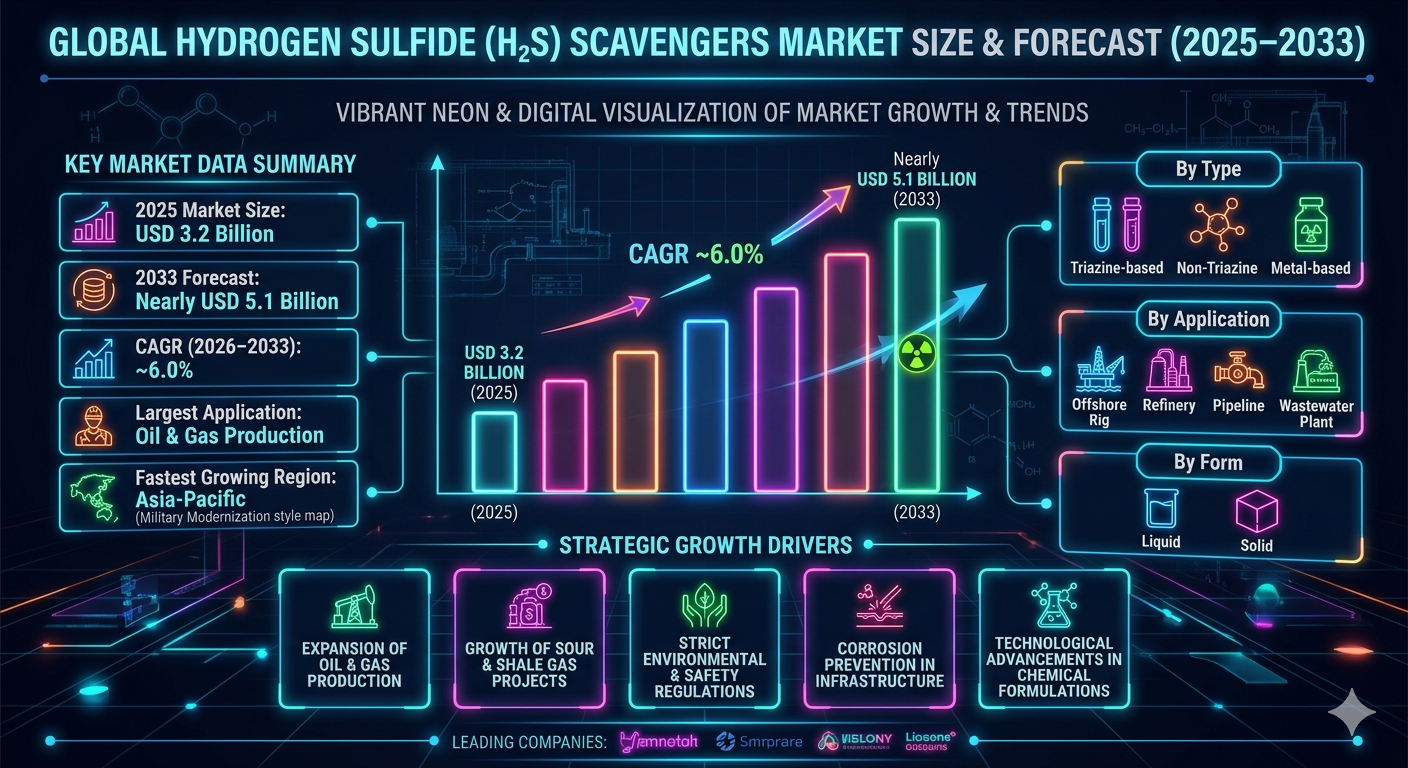
Global Hydrogen Sulfide (H???S) Scavengers Market Overview
The hydrogen sulfide scavengers market operates as a specialized segment within the oilfield chemicals and gas treatment industry. It serves critical applications across upstream exploration, midstream gas processing, and downstream refining operations where H???S removal is necessary to ensure safety and product quality. Key market participants include Baker Hughes, Halliburton, Schlumberger (SLB), BASF SE, Kemira, Ecolab, and specialty oilfield chemical companies. These players compete through advanced chemical formulations, integrated oilfield service offerings, and customized treatment solutions for different reservoir conditions. The market is characterized by strong integration with oil & gas production cycles, making demand highly dependent on drilling activity, crude production levels, and natural gas processing requirements. Sour gas fields, which contain high concentrations of hydrogen sulfide, are a major application area driving consistent demand for scavenging chemicals. Regulatory compliance is a key factor influencing market dynamics. Environmental and occupational safety regulations imposed by agencies such as OSHA, EPA, and regional petroleum authorities require strict control of H???S emissions due to its high toxicity and corrosive nature. This drives continuous adoption of advanced scavenger technologies.Key Drivers of Global Hydrogen Sulfide (H???S) Scavengers Market Growth
Expansion of Oil & Gas Production
Rising global energy demand is driving increased exploration and production of crude oil and natural gas. As more sour reservoirs are developed, the need for H???S removal chemicals is increasing significantly across upstream and midstream operations.Growth of Sour Gas and Shale Gas Projects
The expansion of shale gas production and sour gas fields, particularly in North America, the Middle East, and Asia-Pacific, is a major growth driver. These resources typically contain higher H???S concentrations, requiring continuous chemical treatment.Strict Environmental and Safety Regulations
Regulatory frameworks governing toxic gas emissions and workplace safety are enforcing strict limits on H???S exposure. This is compelling operators to adopt efficient scavenging systems to comply with environmental standards and avoid operational risks.Corrosion Prevention in Infrastructure
Hydrogen sulfide is highly corrosive and can damage pipelines, storage tanks, and processing equipment. Scavenger chemicals help extend asset life, reduce maintenance costs, and improve operational reliability in oilfield infrastructure.Technological Advancements in Chemical Formulations
Innovations in triazine-based, aldehyde-based, and solid scavenger systems are improving reaction efficiency and reducing secondary environmental impacts. Development of low-toxicity and high-performance formulations is expanding application scope.Global Hydrogen Sulfide (H???S) Scavengers Market Segmentation
By Type
The market is segmented into triazine-based scavengers, non-triazine scavengers, iron-based scavengers, and solid scavengers. Triazine-based formulations dominate due to their high efficiency, cost-effectiveness, and wide applicability in upstream operations.By Application
Applications include oil & gas production, refining, natural gas processing, biogas treatment, wastewater treatment, and petrochemical operations. Oil & gas production remains the largest application segment due to extensive sour crude handling.By End User
End users include upstream oil & gas operators, midstream pipeline operators, downstream refineries, industrial gas processors, and environmental service providers. Oilfield operators account for the largest share of demand.By Form
The market is divided into liquid scavengers and solid scavengers. Liquid formulations dominate due to ease of injection and compatibility with existing production systems, while solid scavengers are gaining traction in niche applications.By Geography
The market spans North America, Europe, Asia-Pacific, Latin America, and Middle East & Africa, with demand closely tied to regional oil & gas production activity and regulatory frameworks.Regional Market Dynamics
North America holds a significant share due to large-scale shale gas production in the United States and Canada. High drilling activity and sour gas processing needs continue to drive strong demand for H???S scavengers. Middle East & Africa represents a major market due to abundant sour crude reserves and large-scale oil production in countries such as Saudi Arabia, UAE, and Iraq. Strict safety requirements further support chemical usage. Asia-Pacific is a fast-growing region driven by rising energy consumption, expanding refinery capacity, and increasing exploration activities in countries such as China, India, and Southeast Asia. Europe shows steady demand supported by natural gas processing and refinery operations, along with stringent environmental compliance standards. Latin America is gradually expanding due to offshore oil development projects in Brazil and growing investment in upstream exploration activities.Competitive Landscape
The hydrogen sulfide scavengers market is moderately consolidated with strong presence of global oilfield service companies and specialty chemical manufacturers. Key players include Baker Hughes, Halliburton, SLB (Schlumberger), BASF SE, Kemira, Ecolab, and Dorf Ketal. Baker Hughes and Halliburton lead through integrated oilfield chemical services combined with upstream operational support. BASF focuses on advanced chemical formulations with improved environmental profiles, while Kemira and Ecolab emphasize sustainable water and industrial treatment solutions. Competition is driven by product efficiency, cost optimization, environmental compliance, and customized solutions for specific reservoir conditions. Strategic partnerships with oil & gas operators and regional distributors are critical for market penetration. Barriers to entry remain moderate to high due to technical expertise requirements, regulatory compliance standards, and the need for strong supply chain integration with oilfield operations.Strategic Outlook
The strategic outlook for the hydrogen sulfide scavengers market is shaped by continued growth in sour hydrocarbon production and increasing environmental regulations. Demand is expected to remain stable due to the essential role of H???S removal in ensuring safe and efficient energy operations. Future growth will be driven by development of environmentally friendly scavenger chemistries, improved injection systems, and real-time monitoring technologies for gas treatment efficiency. Companies are increasingly focusing on sustainable formulations to reduce environmental footprint. Integration of digital oilfield technologies with chemical dosing systems is expected to improve efficiency and reduce chemical consumption, creating new value opportunities in the market.Final Market Perspective
The global hydrogen sulfide (H???S) scavengers market is a critical supporting segment of the oil & gas industry, driven by safety, environmental compliance, and operational efficiency requirements. While closely linked to energy production cycles, the market remains resilient due to the persistent need for sour gas treatment. Long-term growth will be supported by expanding energy demand, increasing sour reservoir development, and continuous innovation in chemical formulations. Companies that focus on sustainability, cost efficiency, and integration with digital oilfield systems are expected to maintain a strong competitive advantage in the evolving market landscape.Table of Contents
Table of Contents
- 1. Executive Summary
- 1.1 Market Forecast Snapshot (2026???2033)
- 1.2 Global Hydrogen Sulfide (H???S) Scavengers Market Size & CAGR Analysis
- 1.3 Largest & Fastest-Growing Segments
- 1.4 Region-Level Leadership & Growth Trends
- 1.5 Key Market Drivers
- 1.6 Competitive Landscape Overview
- 1.7 Strategic Outlook Through 2033
- 2. Introduction & Market Overview
- 2.1 Definition of the Hydrogen Sulfide (H???S) Scavengers Market
- 2.2 Scope of the Study
- 2.3 Industry Evolution & Market Development
- 2.4 Supply Chain & Distribution Infrastructure
- 2.5 Impact of Oil & Gas Industry Trends
- 2.6 Environmental & Regulatory Landscape
- 2.7 Technology & Innovation Landscape (Scavenger Chemistries & Digital Oilfield Integration)
- 3. Research Methodology
- 3.1 Primary Research
- 3.2 Secondary Research
- 3.3 Market Size Estimation Model
- 3.4 Forecast Assumptions (2026???2033)
- 3.5 Data Validation & Triangulation
- 4. Market Dynamics
- 4.1 Drivers
- 4.1.1 Expansion of Oil & Gas Production Activities
- 4.1.2 Growth of Sour Gas & Shale Gas Projects
- 4.1.3 Strict Environmental & Safety Regulations
- 4.1.4 Corrosion Prevention in Oilfield Infrastructure
- 4.1.5 Technological Advancements in Chemical Formulations
- 4.2 Restraints
- 4.2.1 Volatility in Oil & Gas Exploration Cycles
- 4.2.2 Environmental Concerns Related to Chemical Usage
- 4.2.3 Regulatory Approval Complexity
- 4.2.4 Price Sensitivity in Mature Oilfields
- 4.3 Opportunities
- 4.3.1 Development of Eco-Friendly Scavenger Chemistries
- 4.3.2 Expansion of Shale Gas & Offshore Projects
- 4.3.3 Integration with Digital Oilfield Systems
- 4.3.4 Growth in Biogas & Industrial Gas Treatment Applications
- 4.4 Challenges
- 4.4.1 Operational Complexity in Harsh Reservoir Conditions
- 4.4.2 Supply Chain Constraints for Specialty Chemicals
- 4.4.3 High Competitive Intensity Among Oilfield Chemical Providers
- 4.4.4 Continuous Need for Product Innovation
- 4.1 Drivers
- 5. Hydrogen Sulfide (H???S) Scavengers Market Analysis (USD Billion), 2026???2033
- 5.1 Market Size Overview
- 5.2 CAGR Analysis
- 5.3 Regional Revenue Distribution
- 5.4 Segment Revenue Analysis
- 5.5 Application-Wise Demand Analysis
- 5.6 End-User Impact Analysis
- 6. Market Segmentation (USD Billion), 2026???2033
- 6.1 By Type
- 6.1.1 Triazine-Based Scavengers
- 6.1.2 Non-Triazine Scavengers
- 6.1.3 Iron-Based Scavengers
- 6.1.4 Solid Scavengers
- 6.2 By Application
- 6.2.1 Oil & Gas Production
- 6.2.2 Refining Operations
- 6.2.3 Natural Gas Processing
- 6.2.4 Biogas Treatment
- 6.2.5 Wastewater Treatment
- 6.2.6 Petrochemical Operations
- 6.3 By End User
- 6.3.1 Upstream Oil & Gas Operators
- 6.3.2 Midstream Pipeline Operators
- 6.3.3 Downstream Refineries
- 6.3.4 Industrial Gas Processors
- 6.3.5 Environmental Service Providers
- 6.4 By Form
- 6.4.1 Liquid Scavengers
- 6.4.2 Solid Scavengers
- 6.5 By Geography
- 6.5.1 North America
- 6.5.2 Europe
- 6.5.3 Asia-Pacific
- 6.5.4 Latin America
- 6.5.5 Middle East & Africa
- 6.1 By Type
- 7. Market Segmentation by Geography
- 7.1 North America
- 7.2 Europe
- 7.3 Asia-Pacific
- 7.4 Latin America
- 7.5 Middle East & Africa
- 8. Competitive Landscape
- 8.1 Market Share Analysis
- 8.2 Product Portfolio Benchmarking
- 8.3 Product Positioning Mapping
- 8.4 Strategic Partnerships & Oilfield Integration
- 8.5 Competitive Intensity & Market Fragmentation
- 9. Company Profiles
- 10. Strategic Intelligence & Pheonix AI Insights
- 10.1 Pheonix Demand Forecast Engine
- 10.2 Supply Chain & Infrastructure Analyzer
- 10.3 Technology & Innovation Tracker
- 10.4 Product Development Insights
- 10.5 Automated Porter???s Five Forces Analysis
- 11. Future Outlook & Strategic Recommendations
- 11.1 Eco-Friendly Scavenger Development
- 11.2 Expansion in Sour Gas & Offshore Projects
- 11.3 Digital Oilfield Integration Opportunities
- 11.4 Sustainability-Driven Chemical Innovation
- 11.5 Long-Term Market Outlook (2033+)
- 12. Appendix
- 13. About Pheonix Research
- 14. Disclaimer
Competitive Landscape
Global Hydrogen Sulfide (H???S) Scavengers Market Competitive Intensity & Market Structure Overview
The Global Hydrogen Sulfide (H???S) Scavengers Market is a highly technical and service-linked chemical segment within the oilfield chemicals industry, characterized by strong integration with upstream, midstream, and downstream oil & gas operations. The market is fundamentally driven by operational safety requirements, sour gas processing needs, and strict environmental compliance standards.
Competitive intensity is moderate to high, primarily due to the presence of large oilfield service companies and specialized chemical manufacturers competing on formulation efficiency, cost performance, corrosion control capability, and field-level customization. Long-term contracts with oil & gas operators and deep integration into production workflows create high switching costs, strengthening incumbent positions.
The market structure is moderately consolidated at the top, with a few global oilfield service giants controlling a significant share, while a secondary layer of specialty chemical providers and regional suppliers compete in niche applications and price-sensitive segments. Demand is closely tied to drilling activity and sour hydrocarbon production cycles, making market dynamics cyclical yet structurally stable.
Global Hydrogen Sulfide (H???S) Scavengers Market Competitive Intensity & Market Structure Current Scenario
Leading Company Profiles
Baker Hughes: Global Oilfield Chemical Leader. Strong integrated portfolio combining H???S scavengers with upstream production optimization services and advanced chemical solutions.
Halliburton: Major Oilfield Services Provider. Offers customized H???S scavenging programs integrated with drilling and production operations across global oilfields.
SLB (Schlumberger): Technology-Driven Energy Services Leader. Focused on digital oilfield integration, advanced chemical treatment systems, and reservoir-specific scavenger solutions.
BASF SE: Global Chemical Manufacturer. Specializes in advanced triazine and non-triazine formulations with emphasis on performance efficiency and environmental compliance.
Kemira: Industrial Chemical Specialist. Strong focus on sustainable water and industrial treatment solutions, including H???S removal applications.
Ecolab: Water & Process Treatment Leader. Provides integrated chemical treatment programs for oil & gas processing and industrial gas purification.
Dorf Ketal: Specialty Oilfield Chemical Company. Focused on customized scavenger solutions and corrosion inhibition technologies for upstream operations.
Clariant Oil Services: Advanced Chemical Solutions Provider. Offers high-performance scavengers tailored for complex reservoir conditions and refinery environments.
ChampionX: Oilfield Chemical & Production Optimization Player. Strong presence in production chemicals including H???S control and corrosion management systems.
Solvay: Specialty Chemicals Company. Engaged in advanced formulation development for industrial gas treatment and environmental compliance solutions.
Key Competitive Intensity & Market Structure Signals in Global Hydrogen Sulfide (H???S) Scavengers Market
A key competitive signal in the market is the increasing shift toward integrated oilfield chemical service models, where H???S scavengers are bundled with corrosion inhibitors, scale inhibitors, and production optimization solutions. This integration strengthens vendor lock-in and increases long-term contract value.
Another major structural trend is the growing demand for high-efficiency and low-toxicity scavenger formulations. Environmental compliance pressures are pushing companies to develop safer chemical systems with reduced secondary emissions and improved biodegradability.
The market is also witnessing increased adoption of digital oilfield technologies, where chemical injection systems are monitored and optimized in real time. This is improving dosage efficiency, reducing chemical waste, and enhancing operational performance across oil & gas facilities.
Regional production dynamics significantly influence competition, with North America driven by shale gas activity, the Middle East dominated by sour crude processing, and Asia-Pacific emerging as a high-growth consumption hub. Companies with strong regional service networks maintain a competitive advantage.
Barriers to entry remain relatively high due to technical formulation expertise, field validation requirements, regulatory compliance, and the necessity of deep integration with oilfield operators and production systems.
Strategic Implications of Competitive Intensity & Market Structure in Global Hydrogen Sulfide (H???S) Scavengers Market
Market leaders are increasingly focusing on performance-based chemical solutions, where scavenger efficiency, corrosion reduction, and cost per barrel treated become key competitive metrics rather than simple product pricing.
Innovation is centered on next-generation triazine alternatives, solid scavenger technologies, and hybrid chemical systems designed to improve reaction efficiency while minimizing environmental impact and operational complexity.
Strategic partnerships with oil & gas operators are becoming essential, as chemical providers increasingly embed themselves within upstream production workflows, offering real-time monitoring, dosing optimization, and technical field support services.
Digital integration is emerging as a key differentiator, with AI-based chemical optimization systems and IoT-enabled dosing units improving accuracy and reducing chemical overuse across production sites.
Sustainability is becoming a critical strategic pillar, with companies investing in low-toxicity formulations and environmentally compliant scavenging systems to align with stricter global environmental regulations.
Global Hydrogen Sulfide (H???S) Scavengers Market Competitive Intensity & Market Structure Forward Outlook
The Global Hydrogen Sulfide (H???S) Scavengers Market is expected to remain structurally stable yet technologically evolving, with continued reliance on oil & gas production ensuring steady baseline demand across all major regions.
Market consolidation is likely to continue, particularly among oilfield service companies expanding their chemical portfolios through acquisitions and integrated service offerings to strengthen upstream dominance.
Growth in sour gas and unconventional resource development will continue to support demand, especially in North America, the Middle East, and emerging Asia-Pacific energy markets.
Future competition will increasingly focus on sustainability, digital chemical management systems, and high-efficiency scavenger technologies capable of reducing total chemical consumption while improving operational safety.
Overall, companies that successfully combine advanced chemical engineering, field integration capabilities, and digital oilfield optimization tools will maintain a strong competitive advantage in the evolving Global Hydrogen Sulfide (H???S) Scavengers Market through 2033.
Value Chain
Global Hydrogen Sulfide (H???S) Scavengers Market Value Chain & Supply Chain Evolution Overview
The Global Hydrogen Sulfide (H???S) Scavengers Market value chain is evolving as a critical enabler within the oilfield chemicals and gas treatment ecosystem, directly supporting safer, cleaner, and more efficient hydrocarbon production. The market is deeply embedded in upstream, midstream, and downstream oil & gas operations, where hydrogen sulfide removal is essential for operational safety, infrastructure protection, and regulatory compliance.
H???S scavengers are specialized chemical formulations designed to neutralize or remove hydrogen sulfide gas during drilling, production, gas processing, and refining activities. These chemicals are widely used to prevent corrosion of pipelines and equipment, reduce toxic emissions, and ensure compliance with stringent environmental and workplace safety standards.
The value chain begins with raw material suppliers providing key chemical feedstocks such as amines, aldehydes, triazines, and iron-based compounds. These inputs are processed by specialty chemical manufacturers and oilfield service companies into customized scavenger formulations tailored for specific reservoir conditions and operational environments.
Major industry participants such as Baker Hughes, Halliburton, Schlumberger (SLB), BASF SE, Kemira, Ecolab, and Dorf Ketal play a central role in integrating chemical innovation with oilfield service delivery. These companies combine chemistry expertise with field engineering capabilities to deliver performance-optimized H???S treatment solutions.
The downstream segment includes oil & gas operators, refinery companies, gas processors, and industrial facilities that deploy scavenger systems through continuous injection, batch treatment, or solid-phase absorption technologies. The integration of chemical dosing systems with digital oilfield platforms is increasingly enhancing operational efficiency and real-time monitoring capabilities.
The supply chain is highly dependent on oil & gas production cycles, drilling activity levels, and regional sour gas development. It is also influenced by regulatory frameworks governing hydrogen sulfide exposure limits, emissions control, and industrial safety compliance across different geographies.
Key challenges in the supply chain include feedstock price volatility, transportation and storage safety requirements, formulation stability under extreme reservoir conditions, and the need for customized chemical solutions across diverse geological environments.
Global Hydrogen Sulfide (H???S) Scavengers Market Value Chain & Supply Chain Evolution Current Scenario
The current market structure is shaped by rising global energy demand, increasing sour gas production, and expansion of shale and offshore drilling activities. These factors are driving consistent demand for high-performance H???S scavenging solutions across upstream and midstream operations.
Oilfield chemical suppliers are increasingly focusing on advanced triazine-based formulations, iron-based systems, and low-toxicity alternatives to improve reaction efficiency and reduce environmental impact. Liquid scavengers remain dominant due to ease of injection and compatibility with existing production infrastructure.
Integration between oilfield service providers and chemical manufacturers is strengthening, with companies offering bundled solutions that combine drilling services, production optimization, and chemical treatment systems.
Digital oilfield technologies are playing a growing role in optimizing chemical usage. Real-time monitoring, automated dosing systems, and predictive analytics are improving scavenger efficiency while reducing operational costs and chemical waste.
At the same time, regulatory pressure from agencies such as OSHA and EPA is driving stricter enforcement of hydrogen sulfide exposure limits, reinforcing the need for reliable and continuous gas treatment solutions across oil & gas facilities.
Key Value Chain & Supply Chain Evolution Signals in Global Hydrogen Sulfide (H???S) Scavengers Market
Several structural trends are reshaping the hydrogen sulfide scavengers ecosystem globally.
First, the expansion of sour gas and shale gas production is increasing demand for continuous and high-efficiency H???S removal systems across upstream operations.
Second, stricter environmental and occupational safety regulations are compelling operators to adopt advanced scavenger formulations with improved toxicity profiles and higher efficiency.
Third, technological innovation in triazine chemistry, solid scavengers, and hybrid chemical systems is enhancing performance while reducing operational costs and environmental risks.
Fourth, digital oilfield integration is enabling real-time monitoring of H???S levels and optimizing chemical injection rates through automated control systems.
Fifth, increasing focus on infrastructure integrity is driving demand for corrosion prevention solutions that extend the lifespan of pipelines, storage facilities, and processing equipment.
Strategic Implications of Value Chain & Supply Chain Evolution in Global Hydrogen Sulfide (H???S) Scavengers Market
Leading companies such as Baker Hughes, Halliburton, SLB (Schlumberger), BASF SE, Kemira, and Ecolab are strengthening their positions through integrated oilfield chemical service models, advanced formulation capabilities, and long-term contracts with upstream operators.
Competitive advantage in this market increasingly depends on chemical efficiency, customization capability, environmental compliance performance, and integration with digital oilfield systems.
Manufacturers that can deliver low-toxicity, high-reactivity scavengers with stable performance under extreme reservoir conditions are expected to capture higher-value contracts from major oil & gas operators.
Strategic partnerships between chemical companies, oilfield service providers, and energy operators are becoming essential for delivering end-to-end H???S management solutions across complex production environments.
Long-term competitiveness will rely on balancing cost efficiency, safety performance, regulatory compliance, and environmental sustainability while adapting to shifting energy production patterns.
Global Hydrogen Sulfide (H???S) Scavengers Market Value Chain & Supply Chain Evolution Forward Outlook
Between 2026 and 2033, the hydrogen sulfide scavengers value chain is expected to become more technology-driven, sustainability-focused, and digitally integrated with oilfield operations.
Future development will emphasize eco-friendly scavenger chemistries, improved solid-phase systems, and hybrid formulations designed to reduce environmental impact while maintaining high removal efficiency.
Digital oilfield integration will continue to expand, with AI-driven chemical dosing systems, predictive corrosion management, and real-time H???S monitoring becoming standard across large-scale production facilities.
Automation in chemical injection and remote monitoring systems will improve operational safety while reducing chemical consumption and overall lifecycle costs.
As sour reservoir development expands globally, demand for advanced scavenger systems will remain structurally strong, particularly in regions such as North America, the Middle East, and Asia-Pacific.
Ultimately, the market will transition from traditional chemical treatment toward intelligent, data-driven gas management ecosystems integrated within broader digital energy infrastructure.
Market-Specific Value Chain
- Raw Material & Chemical Feedstocks: Triazines, amines, aldehydes, iron-based compounds, specialty solvents, corrosion inhibitors, industrial chemical intermediates
- Chemical Formulation & Manufacturing: H???S scavenger synthesis, liquid and solid formulation systems, stability optimization, performance testing, safety compliance validation
- Oilfield Chemical Service Integration: Customized injection programs, reservoir-specific chemical selection, field engineering support, drilling & production integration
- Upstream, Midstream & Downstream Deployment: Wellhead treatment, gas processing facilities, refinery integration, pipeline protection systems, storage safety applications
- Monitoring & Digital Optimization: Real-time H???S monitoring, automated dosing systems, AI-based chemical optimization, predictive corrosion analytics
- Lifecycle & Environmental Management: Waste reduction, chemical recovery optimization, emissions compliance, infrastructure protection, sustainability reporting
Company-to-Stage Mapping
- Raw Material & Chemical Feedstocks: BASF SE, chemical intermediates suppliers, specialty solvent producers
- Chemical Formulation & Manufacturing: BASF SE, Kemira, Ecolab, Dorf Ketal
- Oilfield Chemical Service Integration: Baker Hughes, Halliburton, SLB (Schlumberger)
- Upstream, Midstream & Downstream Deployment: Saudi Aramco service networks, ExxonMobil operations, Chevron, Shell, regional oil & gas operators
- Monitoring & Digital Optimization: Baker Hughes, SLB, Halliburton, industrial IoT and oilfield digital solution providers
- Lifecycle & Environmental Management: Ecolab, BASF SE, integrated oilfield service providers, environmental compliance partners
Investment Activity
Global Hydrogen Sulfide (H???S) Scavengers Market Investment & Funding Dynamics Overview
Investment and funding dynamics in the Global Hydrogen Sulfide (H???S) Scavengers Market are primarily driven by rising oil & gas production activities, increasing development of sour hydrocarbon reserves, and tightening environmental and occupational safety regulations governing toxic gas emissions. Between 2026 and 2033, capital deployment is expected to focus on advanced chemical formulations, upstream oilfield chemical services, and integrated gas treatment solutions across drilling, production, and refining operations.
The market is closely tied to the oilfield chemicals and energy services ecosystem, where major players such as Baker Hughes, Halliburton, Schlumberger (SLB), BASF SE, Kemira, and Ecolab are continuously investing in R&D, customized chemical solutions, and field-based service integration. These companies are strengthening portfolios through high-performance scavenger chemistries designed for sour gas environments and deepwater drilling applications.
A key structural shift influencing investment patterns is the growing focus on environmentally compliant and low-toxicity scavenger formulations. This is pushing capital allocation toward green chemistry innovation, digital chemical dosing systems, and optimized H???S mitigation technologies that reduce operational risks and environmental impact.
Global Hydrogen Sulfide (H???S) Scavengers Market Investment & Funding Dynamics Current Scenario
Currently, investment activity is strongly supported by expanding upstream oil & gas exploration, shale gas development, and increased offshore and deepwater drilling projects. The rising prevalence of sour gas fields is directly increasing demand for efficient H???S removal systems, driving steady chemical consumption across global energy operations.
- North America: Leads investment activity due to high shale gas production in the U.S. and Canada, along with strong adoption of advanced oilfield chemical technologies and service-based delivery models.
- Middle East & Africa: Major investment hub supported by extensive sour crude reserves, large-scale oil production projects, and stringent safety standards in countries such as Saudi Arabia, UAE, and Iraq.
- Asia-Pacific: Fast-growing investment region driven by rising energy demand, refinery expansion, and increasing exploration activities in China, India, and Southeast Asia.
- Europe: Stable investment environment focused on refinery modernization, gas processing efficiency, and strict environmental compliance requirements.
- Latin America: Emerging investment region supported by offshore oil exploration in Brazil and expanding upstream development activities.
Key Investment & Funding Dynamics Signals in Global Hydrogen Sulfide (H???S) Scavengers Market
- Increasing development of sour gas and shale gas fields is driving sustained investment in high-efficiency H???S scavenging chemicals and treatment systems.
- Strong regulatory pressure from environmental and occupational safety agencies is accelerating funding into low-toxicity and compliant scavenger formulations.
- Rising demand for corrosion prevention in pipelines and refinery infrastructure is supporting long-term investments in chemical treatment solutions.
- Technological advancements in triazine-based, iron-based, and solid scavenger systems are attracting R&D funding to improve reaction efficiency and reduce environmental impact.
- Integration of digital oilfield technologies with chemical injection systems is creating new investment opportunities in automated dosing and real-time monitoring solutions.
- Strategic partnerships between oilfield operators and chemical manufacturers are strengthening funding pipelines for customized, field-specific scavenger solutions.
Strategic Implications of Investment & Funding Dynamics in Global Hydrogen Sulfide (H???S) Scavengers Market
- The investment landscape strongly favors established oilfield service companies with integrated chemical, engineering, and operational support capabilities.
- Product innovation focused on low-toxicity, high-efficiency, and environmentally sustainable scavenger chemistries is becoming a key competitive differentiator.
- Customization of chemical solutions based on reservoir type, sour gas concentration, and operational conditions is driving value-added service models.
- Digitalization of chemical injection and monitoring systems is improving operational efficiency, reducing chemical waste, and optimizing cost structures.
- Regulatory compliance and safety-driven investments are becoming mandatory, influencing long-term capital allocation strategies across oilfield operations.
- Long-term contracts with upstream operators and midstream pipeline companies are strengthening revenue stability and encouraging sustained R&D investment.
Global Hydrogen Sulfide (H???S) Scavengers Market Investment & Funding Dynamics Forward Outlook
Looking ahead, the Global Hydrogen Sulfide (H???S) Scavengers Market is expected to maintain steady investment momentum, driven by continued sour gas development, offshore exploration expansion, and stricter global environmental regulations.
Future capital allocation will increasingly focus on advanced green scavenger chemistries, automated chemical dosing systems, and digital oilfield integration solutions that enhance operational efficiency and reduce environmental footprint.
- North America: Will continue leading investments in shale gas production support chemicals and advanced oilfield service integration.
- Middle East & Africa: Will remain a dominant investment hub due to large-scale sour crude production and stringent safety compliance requirements.
- Asia-Pacific: Will experience the fastest growth in chemical demand driven by energy expansion and industrial development.
- Europe: Will focus on sustainable chemical innovation and refinery efficiency optimization solutions.
Digital transformation will increasingly reshape investment strategies, with real-time monitoring systems, AI-driven chemical dosing optimization, and predictive maintenance tools improving efficiency across the oilfield chemicals value chain.
Overall, the market will remain structurally resilient due to its critical role in ensuring safe and compliant hydrocarbon production. Companies that combine chemical innovation, digital integration, and regulatory compliance capabilities will be best positioned to lead the Global Hydrogen Sulfide (H???S) Scavengers Market through 2033.
Technology & Innovation
Global Hydrogen Sulfide (H???S) Scavengers Market Technology & Innovation Landscape Overview
The technology and innovation landscape of the Global Hydrogen Sulfide (H???S) Scavengers Market is evolving as oil & gas operators move toward more efficient, environmentally compliant, and digitally integrated gas treatment systems. Hydrogen sulfide scavengers are no longer limited to basic chemical neutralization; they are increasingly engineered as high-performance, application-specific formulations designed to optimize reaction efficiency, reduce operational costs, and minimize environmental impact.
A key technological shift is the advancement of next-generation chemical formulations, including improved triazine-based systems, low-toxicity aldehyde derivatives, and hybrid metal-based scavengers. These innovations enhance H???S removal efficiency while reducing secondary by-products and corrosion risks across upstream, midstream, and downstream operations.
Another major innovation trend is the development of solid and encapsulated scavenger systems, which provide controlled release mechanisms for enhanced performance in challenging reservoir conditions. These systems are gaining traction in offshore drilling, high-pressure sour gas fields, and remote production sites where liquid chemical handling is limited.
Digital oilfield integration is also reshaping the market, with real-time chemical injection monitoring, automated dosing systems, and IoT-enabled production analytics improving scavenger utilization efficiency. These technologies allow operators to optimize chemical consumption, reduce waste, and maintain consistent H???S control across fluctuating production conditions.
Environmental sustainability is driving significant R&D efforts toward green chemistry-based scavengers. Manufacturers are focusing on biodegradable, low-toxicity formulations that comply with increasingly strict environmental regulations while maintaining high reactivity with hydrogen sulfide gas.
Global Hydrogen Sulfide (H???S) Scavengers Market Technology & Innovation Current Scenario
Currently, the market is dominated by triazine-based liquid scavengers due to their high efficiency, cost-effectiveness, and ease of deployment in existing oilfield infrastructure. However, the industry is gradually transitioning toward more advanced hybrid systems that combine liquid and solid-phase scavenging technologies for improved performance flexibility.
Oilfield chemical providers are increasingly integrating scavenger systems with smart injection technologies that automatically adjust dosage based on real-time H???S concentration levels. This reduces chemical overuse and improves operational safety in high-risk sour gas environments.
Nanotechnology-based scavenger research is emerging as a promising innovation area, focusing on enhancing reaction surface area and improving H???S capture efficiency at lower concentrations. Although still in early stages, these technologies are expected to influence long-term market evolution.
Another key development is the use of predictive analytics in chemical treatment planning. AI-driven models are being deployed to forecast H???S levels in production streams, enabling proactive chemical dosing strategies that improve efficiency and reduce downtime.
Corrosion-resistant additive technologies are also being incorporated into scavenger formulations to protect pipelines, storage systems, and processing equipment, extending asset lifespan and reducing maintenance costs.
Key Technology & Innovation Trends in Global Hydrogen Sulfide (H???S) Scavengers Market
- Advanced Triazine Formulations: High-efficiency scavengers with improved reaction stability and reduced by-product formation.
- Solid & Encapsulated Scavengers: Controlled-release systems for offshore and high-pressure applications.
- Green Chemistry-Based Solutions: Low-toxicity and biodegradable scavenger formulations for environmental compliance.
- Smart Chemical Injection Systems: Automated dosing based on real-time H???S monitoring and production conditions.
- AI & Predictive Analytics Integration: Forecasting H???S levels for optimized chemical usage and operational efficiency.
- Nanotechnology Applications: Enhanced reaction efficiency through high-surface-area scavenging materials.
- Corrosion Inhibition Additives: Dual-function chemicals for H???S removal and infrastructure protection.
- Digital Oilfield Integration: IoT-enabled monitoring systems for continuous performance optimization.
Strategic Implications of Technology & Innovation
Technological advancements are transforming H???S scavengers from conventional consumable chemicals into intelligent, performance-optimized treatment systems integrated with digital oilfield operations. This shift is enabling oil & gas operators to improve safety, reduce environmental impact, and optimize operational efficiency simultaneously.
Chemical manufacturers are increasingly focusing on customized formulations tailored to specific reservoir conditions, gas compositions, and operational environments. This application-specific approach is becoming a key differentiator in a highly competitive market.
Integration of digital monitoring systems with chemical treatment processes is reducing operational uncertainty and enabling predictive maintenance strategies in gas processing facilities. This improves asset reliability and reduces unplanned shutdowns caused by corrosion or H???S-related hazards.
Sustainability regulations are also influencing innovation strategies, with companies investing heavily in eco-friendly scavenger chemistries that align with global decarbonization and environmental compliance goals.
Global Hydrogen Sulfide (H???S) Scavengers Market Technology & Innovation Forward Outlook
The future of the H???S scavengers market will be shaped by intelligent chemical systems, AI-driven optimization, and sustainable formulation technologies. The industry is expected to move toward fully automated chemical management systems integrated with digital oilfield platforms.
Next-generation scavengers will likely combine multiple functionalities, including H???S removal, corrosion inhibition, and flow assurance enhancement within a single formulation, improving operational efficiency and reducing chemical complexity.
As offshore exploration, deepwater drilling, and sour gas development continue to expand, demand for high-performance and adaptive scavenging technologies will increase significantly. Smart dosing systems and real-time monitoring will become standard across major production facilities.
In the long term, the convergence of digital oilfield technologies, advanced chemical engineering, and sustainability-driven innovation will redefine how hydrogen sulfide is managed across the global energy value chain, creating a more efficient, safe, and environmentally responsible operational framework.
Market Risk
Global Hydrogen Sulfide (H???S) Scavengers Market Risk Factors & Disruption Threats Overview
The Global Hydrogen Sulfide (H???S) Scavengers Market is a critical oilfield chemicals segment that directly depends on upstream and midstream oil & gas activity, sour gas processing intensity, and industrial safety compliance requirements. While demand remains structurally stable, the market carries a moderate-to-high operational and demand-linked risk profile due to volatility in energy production cycles, regulatory tightening, raw material dependency, and evolving decarbonization pressures across the oil & gas industry.
One of the primary risk factors is direct dependence on oil & gas drilling and production activity. Any slowdown in upstream investment, crude price downturns, or exploration budget cuts immediately reduces demand for H???S scavenging chemicals across well operations, refining, and gas processing facilities.
Another key disruption factor is increasing environmental regulation targeting chemical toxicity, discharge limits, and operational emissions. Regulatory agencies are progressively tightening restrictions on traditional scavenger chemistries, particularly amine- and triazine-based formulations, forcing reformulation and compliance-driven product redesign.
Additionally, raw material price volatility and petrochemical feedstock dependency create cost instability for manufacturers. Fluctuations in amine derivatives, formaldehyde-based inputs, and specialty chemical intermediates directly impact production economics and pricing competitiveness.
Technological substitution risks are also emerging as alternative gas sweetening technologies, including membrane separation systems, advanced amine treatment units, and digital gas monitoring systems, gradually reduce reliance on chemical scavengers in certain applications.
Global Hydrogen Sulfide (H???S) Scavengers Market Risk Factors & Disruption Threats Current Scenario
The current market scenario reflects steady demand supported by active shale gas production, offshore drilling projects, and sour crude processing operations in key oil-producing regions. However, demand remains cyclical and closely aligned with global energy price fluctuations and capital expenditure trends in the oil & gas sector.
Operators are increasingly prioritizing cost optimization, leading to greater scrutiny of chemical consumption efficiency and performance benchmarking of H???S scavenging solutions. This is putting pressure on chemical suppliers to deliver higher efficiency at lower dosage rates.
Environmental compliance enforcement is intensifying across North America, Europe, and parts of the Middle East, requiring stricter handling, storage, and disposal protocols for chemical scavengers, thereby increasing operational complexity and compliance costs.
At the same time, integration of digital oilfield technologies is transforming chemical injection systems through real-time monitoring and automated dosing, reducing overuse but also limiting overall chemical volume demand in mature fields.
Supply chain disruptions in specialty chemical manufacturing, logistics constraints, and geopolitical tensions are further adding uncertainty to global distribution networks for oilfield chemicals.
Key Risk Factors & Disruption Threats Signals in Global Hydrogen Sulfide (H???S) Scavengers Market
A major disruption signal is the gradual shift toward alternative gas sweetening and desulfurization technologies, including membrane separation, advanced amine systems, and hybrid chemical-mechanical treatment processes that reduce reliance on traditional scavengers.
Increasing regulatory pressure on toxic chemical formulations is driving a transition toward low-toxicity, biodegradable, and environmentally safer scavenger chemistries, forcing manufacturers to invest heavily in R&D and product reformulation.
Volatility in global crude oil prices continues to act as a key demand signal, with lower price environments leading to reduced drilling activity and consequently lower consumption of H???S scavengers across upstream operations.
Digitalization of oilfield operations, including AI-driven predictive maintenance and smart chemical dosing systems, is reducing chemical wastage and optimizing usage, thereby moderating long-term volume growth potential.
Additionally, increasing adoption of sour gas processing optimization technologies at the production stage is gradually reducing downstream dependency on chemical scavenging in certain high-efficiency fields.
Strategic Implications of Risk Factors & Disruption Threats in Global Hydrogen Sulfide (H???S) Scavengers Market
Market participants must prioritize innovation in low-toxicity, high-efficiency scavenger formulations to align with tightening environmental regulations and maintain competitiveness in regulated markets.
Investment in digital chemical injection systems and real-time monitoring technologies will become essential to improve product efficiency, reduce consumption rates, and support integration with modern oilfield automation platforms.
Companies should diversify product portfolios toward hybrid gas treatment solutions that combine chemical, mechanical, and digital approaches to maintain relevance amid emerging substitution technologies.
Strengthening supply chain resilience and raw material sourcing strategies will be critical to mitigate cost volatility and ensure stable production amid fluctuating petrochemical feedstock markets.
Strategic partnerships with oil & gas operators, EPC companies, and oilfield service providers will play a key role in securing long-term contracts and maintaining market stability in a cyclical demand environment.
Global Hydrogen Sulfide (H???S) Scavengers Market Risk Factors & Disruption Threats Forward Outlook
Looking ahead to 2026???2033, the Hydrogen Sulfide (H???S) Scavengers Market is expected to maintain stable but cyclical growth, closely tied to global energy production trends and sour gas development activities. However, the market structure will increasingly shift toward environmentally compliant and digitally optimized chemical solutions.
Demand for traditional scavengers will remain strong in upstream and offshore operations, but efficiency improvements and alternative gas treatment technologies may limit long-term volume expansion in mature oilfields.
The next phase of market evolution will be defined by green chemistry innovation, real-time dosing automation, and integration with smart oilfield ecosystems that optimize chemical usage and reduce environmental impact.
At the same time, regulatory tightening and decarbonization policies will continue to reshape product development strategies, pushing manufacturers toward safer, low-emission, and biodegradable formulations.
Overall, while the market remains fundamentally essential for oil & gas safety and infrastructure protection, long-term growth will depend on balancing operational efficiency, environmental compliance, and technological adaptation in an increasingly digital and regulated energy landscape.
Regulatory Landscape
Global Hydrogen Sulfide (H???S) Scavengers Market Regulatory & Policy Environment Overview
The regulatory and policy environment for the Global Hydrogen Sulfide (H???S) Scavengers Market is strongly influenced by industrial safety laws, environmental protection standards, and oil & gas operational compliance frameworks. Because hydrogen sulfide is a highly toxic and corrosive gas, its handling, emission, and neutralization are strictly governed by occupational safety and environmental agencies across major producing regions.
Regulatory authorities such as the U.S. Environmental Protection Agency (EPA), Occupational Safety and Health Administration (OSHA), European Chemicals Agency (ECHA), and national petroleum regulators enforce strict exposure limits for H???S in workplace environments. These regulations mandate continuous monitoring, gas treatment systems, and the use of approved scavenger chemicals in drilling, production, and gas processing operations.
Environmental compliance frameworks are also becoming increasingly stringent, focusing on reducing toxic emissions, preventing gas leaks, and minimizing the environmental impact of oilfield chemical usage. Regulations such as REACH in Europe and hazardous air pollutant (HAP) standards in North America are directly shaping chemical formulation requirements for H???S scavengers.
In addition, the oil & gas industry is subject to strict operational safety standards governing sour gas handling, pipeline integrity, and refinery emissions control. These frameworks ensure that hydrogen sulfide is effectively neutralized during extraction, transportation, and refining processes to prevent equipment corrosion, operational hazards, and environmental contamination.
Global Hydrogen Sulfide (H???S) Scavengers Market Regulatory & Policy Environment Current Scenario
The current regulatory landscape is defined by increasing enforcement of industrial safety standards, stricter environmental compliance requirements, and growing emphasis on sustainable chemical usage in oilfield operations. North America maintains some of the most rigorous H???S exposure limits, with OSHA enforcing strict permissible exposure limits (PEL) and mandatory safety protocols for oilfield workers.
In Europe, REACH regulations and environmental directives require detailed chemical registration, toxicity assessments, and controlled usage of scavenger formulations. This has encouraged manufacturers to develop low-toxicity, environmentally compliant triazine and non-triazine-based solutions.
The Middle East & Africa region, being a major sour crude production hub, maintains strong operational safety standards through national oil companies and petroleum regulators. Countries such as Saudi Arabia, UAE, and Qatar enforce strict H???S management protocols in upstream and downstream operations to ensure worker safety and infrastructure protection.
Asia-Pacific is witnessing evolving regulatory frameworks driven by rising oil & gas consumption and expanding refining capacity. Countries such as China and India are strengthening environmental laws, industrial emission controls, and workplace safety standards related to toxic gas management in energy operations.
Latin America is gradually tightening environmental compliance requirements, particularly in offshore drilling regions such as Brazil, where regulatory focus is increasing on gas emissions control and chemical usage safety in oilfield operations.
Across all regions, regulatory pressure is pushing operators to adopt more efficient, low-toxicity, and environmentally responsible H???S scavenger formulations while ensuring compliance with occupational safety and environmental protection standards.
Key Regulatory & Policy Environment Signals in Global Hydrogen Sulfide (H???S) Scavengers Market
- Occupational Exposure & Workplace Safety Regulations: Strict H???S exposure limits enforced by OSHA and global safety agencies mandate continuous monitoring and chemical treatment systems.
- Environmental Emission Control Standards: Regulations targeting toxic gas emissions are driving adoption of efficient and low-residue scavenger formulations.
- Chemical Registration & Toxicity Compliance (REACH/EPA): Scavenger chemicals must meet stringent safety, toxicity, and environmental impact assessments before commercialization.
- Sour Gas Handling & Pipeline Safety Rules: Oilfield safety frameworks require effective neutralization of H???S to prevent corrosion and operational hazards.
- Industrial Waste & Effluent Management Policies: Regulations governing wastewater and refinery emissions are influencing chemical usage and disposal practices.
- Sustainable Oilfield Chemical Initiatives: Growing regulatory push for green chemistry is encouraging development of eco-friendly scavenger formulations.
Strategic Implications of Regulatory & Policy Environment in Global Hydrogen Sulfide (H???S) Scavengers Market
Regulatory requirements are driving continuous innovation in scavenger chemistry, with manufacturers focusing on low-toxicity, high-efficiency formulations that comply with environmental and occupational safety standards. This is accelerating the shift from traditional high-reactivity chemicals toward more sustainable and controlled-release scavenging systems.
Strict workplace safety regulations are increasing demand for real-time monitoring and integrated chemical injection systems in oilfield operations. This is encouraging adoption of automated dosing technologies and digital oilfield integration to ensure precise H???S control and regulatory compliance.
Environmental compliance costs are influencing procurement strategies across oil & gas operators, leading to increased demand for cost-efficient scavenger solutions that balance performance with regulatory adherence. Companies are increasingly focusing on lifecycle optimization and reduced chemical consumption.
Regional regulatory fragmentation is also shaping market strategies, requiring global chemical manufacturers to customize formulations and compliance documentation based on jurisdiction-specific environmental and safety standards.
Additionally, sustainability-driven regulations are encouraging partnerships between oilfield operators and chemical manufacturers to develop greener alternatives and reduce the environmental footprint of sour gas treatment operations.
Global Hydrogen Sulfide (H???S) Scavengers Market Regulatory & Policy Environment Forward Outlook
Between 2026 and 2033, the regulatory environment for the Global Hydrogen Sulfide (H???S) Scavengers Market is expected to become increasingly stringent, with stronger emphasis on environmental sustainability, chemical safety, and emissions reduction in oil & gas operations.
North America is expected to further tighten occupational exposure limits and expand environmental compliance requirements, driving greater adoption of advanced monitoring systems and low-toxicity scavenger technologies.
Europe will continue leading in chemical safety regulation through REACH enhancements and stricter environmental directives, pushing manufacturers toward green chemistry and sustainable oilfield chemical solutions.
The Middle East & Africa region is expected to maintain strong demand for H???S scavengers due to extensive sour gas production, while gradually adopting more advanced safety and environmental standards aligned with global best practices.
Asia-Pacific will witness increasing regulatory maturity, with stronger enforcement of industrial safety standards and environmental protection laws supporting the adoption of modern scavenging technologies in expanding oil & gas infrastructure.
Overall, the regulatory landscape will continue to drive innovation toward safer, cleaner, and more efficient hydrogen sulfide management solutions. Companies that align with evolving environmental regulations, invest in sustainable chemical development, and integrate digital monitoring systems will be best positioned to succeed in the global market.