
Editorial Article
Europe Needs 2.5 Million Tonnes of Flexible Recyclate in 2030, Has About 1.5, and the Plants Take Four Years
Europe’s flexible packaging industry has a recycling target it cannot meet with the assets it has, and the shortfall is not measured in ambition. It is measured in tonnes, in plants and in years.
Start with the requirement. By 2030, polyolefin-based flexible packaging placed on the European market must contain 35 per cent post-consumer recyclate where it is not contact-sensitive and 10 per cent where it is. Apply those two rates to a consumer flexible market of about 8.4 million tonnes a year and the requirement is around 2.5 million tonnes of recyclate. Current supply is conservatively estimated at about 1.5 million tonnes.
That gap — a million tonnes — is the whole of the European flexible packaging problem in one line. And because 2.5 divided by 8.4 is 29.76 per cent, the implied average recycled content of the entire pool is close to 30 per cent. Any converter planning for the letter of a 35/10 rule rather than its aggregate effect is planning for the wrong number.
The capacity does not exist either
Recyclate is an output. Behind it sits input capacity, and the modelling from CEFLEX puts that at 2.4 million tonnes in 2024, 7.4 million tonnes in 2030 and 10 million tonnes in 2035.
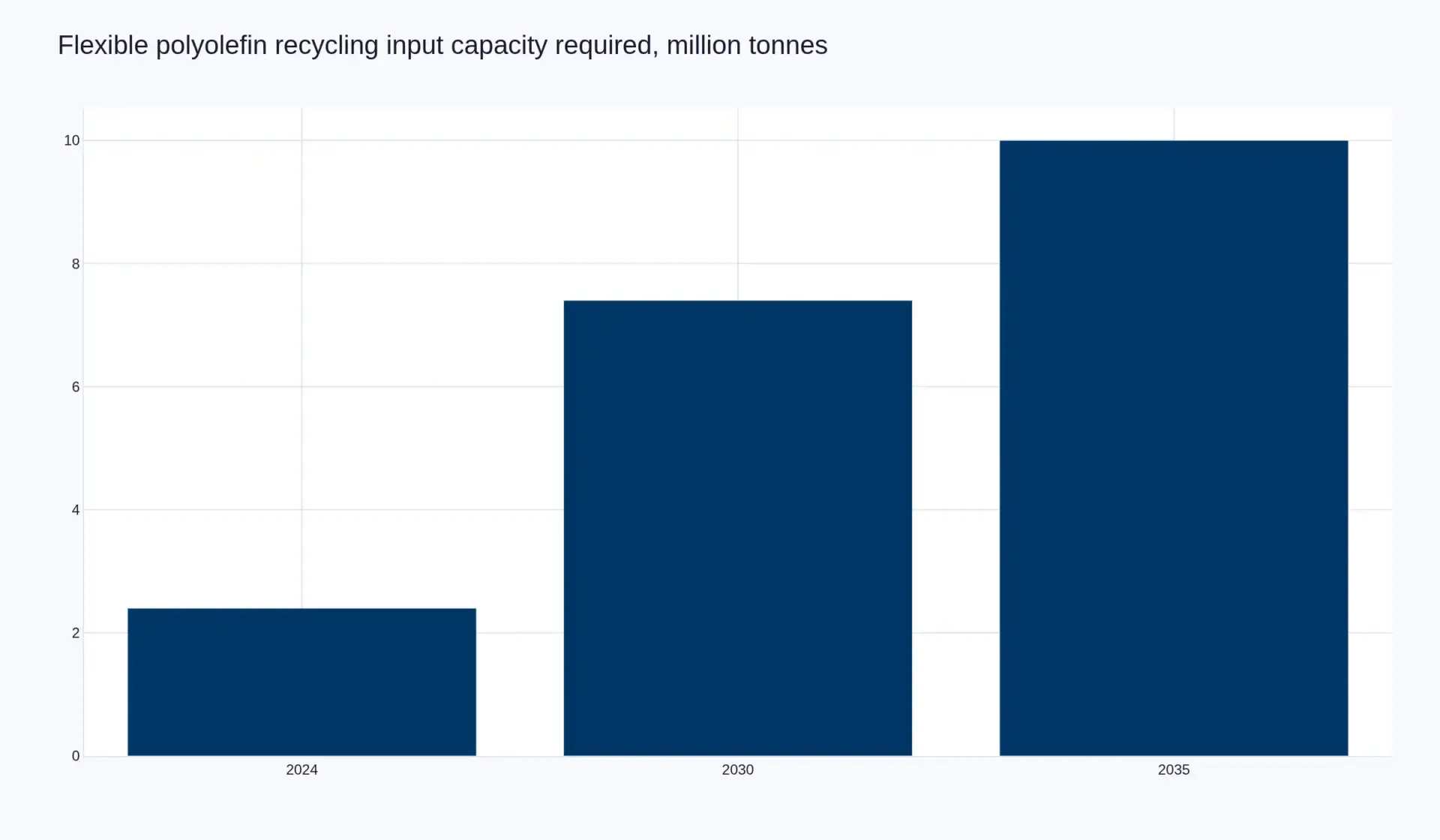
Five million tonnes of new input capacity in six years is roughly 830,000 tonnes a year, every year, for six years. At a representative 40,000-tonne line that is twenty new lines a year, across the whole of Europe, each one financed against a specification that is still being finalised in a CEN committee. Nothing about that is impossible. It is simply not what is happening.
And the clock is worse than the tonnage. CEFLEX puts a recycling plant at one to two years for permitting, a further one to two years for construction and about six months to become operational. Decision to output is two and a half to four and a half years. A plant that has not been committed by 2027 cannot contribute to a 2030 compliance year. The decision window is not the decade; it is the next eighteen months.
The destination problem is worse than the shortfall
Here is the finding that should worry the industry more than the million-tonne gap. Around 80 per cent of mechanical recyclate demand in 2030 is concentrated in a small number of high-volume applications: stretch film, shrink film, refuse sacks and heavy-duty bags.
Those are the lowest-specification film applications in the market. The waste being generated, meanwhile, is concentrated in the highest-specification one. A Fraunhofer IVV study of European polyethylene-containing waste streams found that while polyolefin sorting fractions are 85 to 90 per cent PE — the sort works — within food packaging specifically 63 to 84 per cent of structures are multi-layer and 50 to 70 per cent are multi-material. You cannot sort a structure that was never separable, and you cannot mechanically recycle a barrier that was engineered to resist chemical attack.
The result is a system that collects the hard material and sells the recyclate into the easy applications. Even on favourable assumptions, recycling flexible packaging back into flexible packaging reaches about 25 per cent in 2030; including open-loop rigid and non-packaging uses it reaches around 42 per cent. The 2035 recycled-at-scale test is a 55 per cent rate. The arithmetic is not close.
The design rule that constrains everything
The constraint has a number. CEFLEX’s Designing for a Circular Economy guidelines permit adhesives and coatings up to 5 per cent by weight of a polyolefin structure, and polyamide up to 35 per cent in a PE structure and only with specific tie layers. Everything else — inks, metallisation, EVOH, PVDC, fillers — has a material-specific compatibility threshold tested through more than 600 samples across 55 materials.
Now put that next to the function. A food laminate earns its price from barrier delivered by three to twelve microns of EVOH, metallised PET, foil or PVDC inside 40 to 120 microns of total film. Barrier is measured in cubic centimetres per square metre per day. Recyclability is measured in percentage of mass. They are not the same axis, and no amount of testing makes them the same axis.
The industry’s answer is to give up the multi-layer structure. Machine-direction oriented polyethylene lets an all-PE laminate replace the oriented polyester print web — Walki and Dow demonstrated exactly that for frozen food pouches in June 2026, down to solving the matte finish that brand owners would not trade away. It is a real advance. It is also a 40 to 50 per cent of the market that is not mono-polyolefin today and has no route to mechanical recyclability without changing what it is made of.
What to watch, and what would prove this wrong
The single observable that matters is committed, permitted, funded capacity. If European flexible recycling input capacity passes 4.5 million tonnes by the end of 2027, the 2030 shortfall becomes a price problem rather than a capacity problem, the recyclate premium compresses, and the paper substitution loses its cost rationale. That is a test the sector’s own announcements can be measured against — provided the announcements are of permitted lines rather than memoranda of understanding, a distinction the industry has not been careful about.
The second observable is technical. If a mono-PE structure delivers an oxygen transmission rate within 1.5 times that of a metallised PET laminate at commercial line speed and commercial price, the multi-layer share was a design choice rather than a physical constraint, and the redesign opportunity is the whole market rather than the 20 to 40 per cent of SKUs that early adopters have already identified.
Sources and method
CEFLEX Modelling the future of flexible packaging; CEFLEX analysis on unlocking recycled content at scale; CEFLEX position on whether recycling regulation is driving real change; CEFLEX multi-country compositional study of European packaging waste streams; CEFLEX Designing for a Circular Economy Guidelines, September 2025; Freitag et al., Fraunhofer IVV with SUEZ, Materials 2024, 17(13), 3202, Waste Study on Flexible Food and Non-Food Packaging; Walki and Dow mono-material MDO-PE case study, June 2026; European Commission PPWR explanatory material.
This article follows the house research basis of 70 per cent secondary and 30 per cent primary sources, with the primary component drawn from Pheonix’s own practitioner interviews and structured comparison of converter disclosures. No competitor market-research output was used as an input or a citation.
Frequently Asked Questions
How much flexible packaging recyclate does Europe need by 2030?
About 2.5 million tonnes of post-consumer recyclate, against current supply conservatively estimated at around 1.5 million tonnes. The requirement comes from the PPWR thresholds of 35 per cent recycled content for non-contact-sensitive polyolefin flexibles and 10 per cent for contact-sensitive ones, applied to a European consumer flexible market of roughly 8.4 million tonnes a year. That implies an average recycled content across the pool of 29.76 per cent.
How much recycling capacity has to be built, and how quickly?
From 2.4 million tonnes in 2024 to 7.4 million tonnes in 2030, and 10 million tonnes by 2035 — about 830,000 tonnes a year of new input capacity. Because a recycling plant takes one to two years to permit, one to two years to build and about six months to commission, a facility not committed by 2027 cannot contribute to 2030 compliance. The decision window, not the target date, is the constraint.
Where does all the recyclate actually go?
Around 80 per cent of mechanical recyclate demand in 2030 is concentrated in stretch film, shrink film, refuse sacks and heavy-duty bags — the lowest-specification film applications. The waste is generated by the highest-specification ones: 63 to 84 per cent of food packaging structures are multi-layer and 50 to 70 per cent multi-material. Even on favourable assumptions, closed-loop recycling of flexibles back into flexibles reaches about 25 per cent in 2030, or 42 per cent including open-loop applications.
What are the design limits on a recyclable flexible structure?
Adhesives and coatings may be no more than 5 per cent by weight of a polyolefin structure, and polyamide no more than 35 per cent in a PE structure and only with specific tie layers. Everything else — inks, metallisation, EVOH, PVDC, fillers — has a tested compatibility threshold. The problem is that barrier performance is measured in cubic centimetres per square metre per day and recyclability in percentage of mass, so the two rules do not describe the same property.