
Semiconductors & Electronics / Market Segment
Test, Measurement & Inspection
Test, Measurement & Inspection: the segment that decides whether a part ships
Every manufactured part carries a question that no production record answers on its own: is this one good? Test, Measurement & Inspection is the segment that answers it — the instruments, detectors, sources, sensors, software and services that establish whether a weld is sound, a casting is dense, a machined surface is where the drawing says it is, and a joint will hold at pressure.
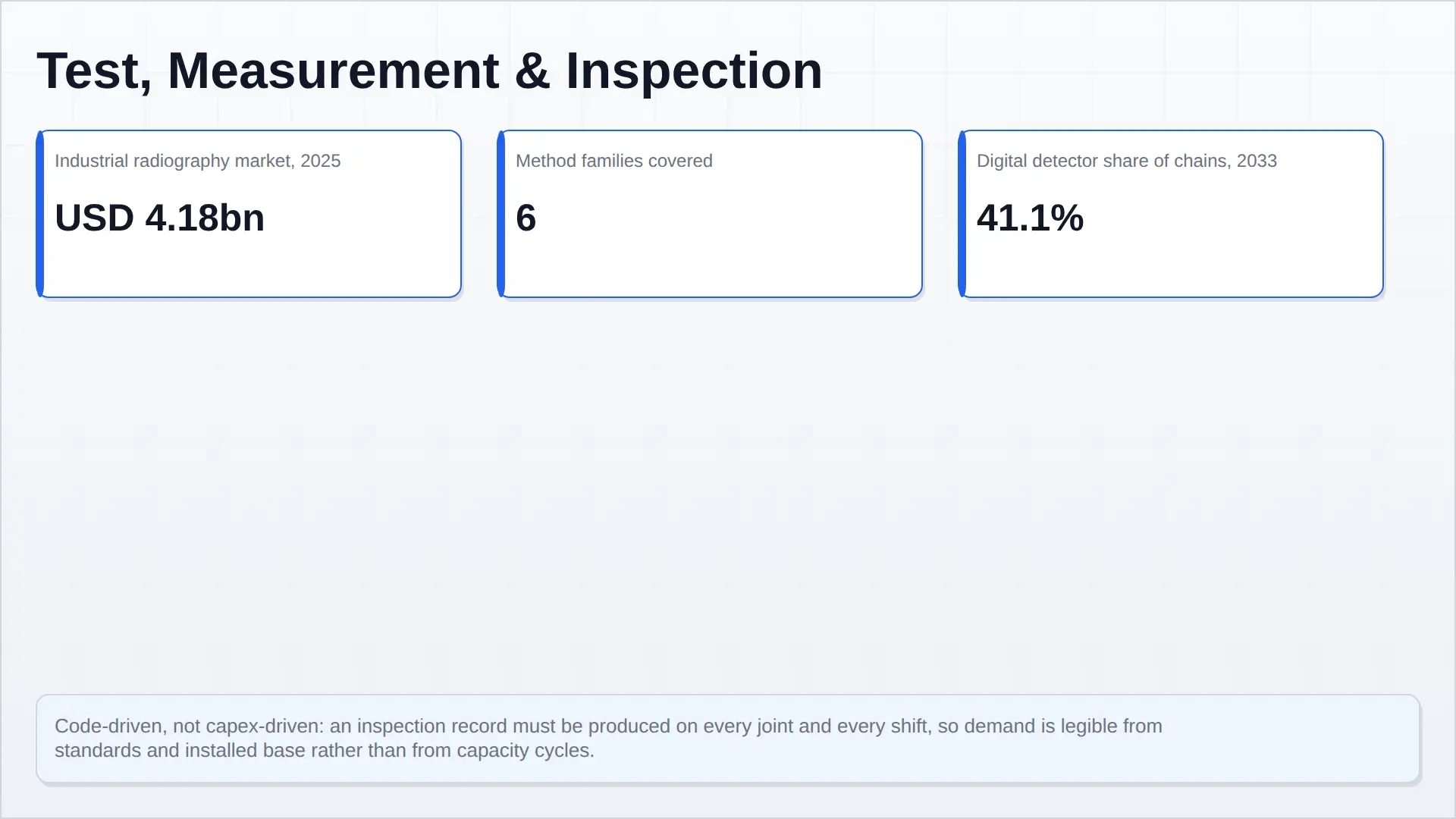
We treat this as a separate segment from semiconductor capital equipment and from general industrial automation for one reason: it is a recurring, code-driven purchase, not a capacity purchase. A fabricator does not buy radiography because demand rose; it buys it because a construction code, a customer specification or an insurer requires an inspection record, and it keeps buying because the record must be produced on every joint, every casting and every shift. That makes the segment’s demand legible from standards and installed base rather than from capex cycles, and it makes the technique mix inside the segment — not its topline — the thing worth forecasting.
What sits inside the segment
- Radiographic testing — industrial X-ray and gamma sources, film, computed radiography (phosphor imaging plates and readers), digital detector arrays, computed tomography, and the handling and software around them.
- Ultrasonic and acoustic methods — conventional and phased-array UT, time-of-flight diffraction, guided-wave and acoustic emission.
- Surface and volumetric methods outside radiation — eddy current, magnetic particle, liquid penetrant, leak testing and visual/remote inspection.
- Dimensional metrology — coordinate measuring machines, laser trackers, optical scanners, form and surface instruments, and in-line gauging.
- Machine vision and automated optical inspection — industrial cameras, lighting, and the inference software that now decides pass/fail in line.
- Materials and physical test — hardness, tensile, fatigue, and the reference standards and calibration chains that keep every other instrument honest.
- Inspection services — third-party NDT contractors and their labour, which is the largest cost line inside most inspection budgets and the reason automation economics matter so much in this segment.
Excluded deliberately: medical and security imaging, which share detector physics but not buyers, codes or procurement; and semiconductor wafer inspection, which is a capital-equipment cycle that belongs with the fab, not with the inspector.
Why the technique mix is the number that matters
The buyers in this segment are converting between techniques, not adding capacity. Film gives way to computed radiography, which gives way to digital detector arrays; manual UT gives way to phased array and to automated immersion; contact metrology gives way to optical and in-line. Each conversion changes who supplies the consumable, who owns the software, and where the margin sits — and a topline growth rate hides all of it. A market growing at six per cent can contain a technique declining at seven and another compounding at thirteen, and the three parts have entirely different buyers, price behaviour and competitive structures.
So we build every report in this segment as a decomposition: installed units or inspection events × technique take-rate × realised price and service content, split by end-market and region, with the standards that gate each conversion read directly rather than summarised second-hand. Where a code change or a supply constraint is the actual driver — a film producer repricing, an acceptance standard admitting a digital technique, a certified-inspector shortage — it enters the model as an explicit input, not as narrative risk.
Where the evidence comes from
Roughly seventy per cent of the input is secondary and fully attributed in the sentence: standards bodies and code text (ISO, ASME, ASTM, API, AWS), regulator and agency publications, supplier filings and product documentation, trade-association workforce and economic-impact studies, and national statistics. The remaining thirty per cent is our own construction — installed-base builds, price and specification reading across supplier documentation, and bottom-up arithmetic that produces a number we can defend line by line. Where our primary layer is analytical rather than fielded — no commissioned interviews or surveys for a given edition — the methodology note on each report says so plainly.