
Global Vegetable Seeds Market Report, Size, Share and Forecast 2026–2033
Market Snapshot
| Indicator | 2026–2033 Position |
|---|---|
| Market size, 2025 | USD 8.60 billion |
| Forecast size, 2033 | USD 13.10 billion |
| CAGR, 2026–2033 | 5.40% |
| Largest crop group | Solanaceous — tomato, pepper, eggplant (30.0% of value) |
| Largest seed type | Hybrid (71.5% of value) |
| Largest region | Asia-Pacific (33.0% of value) |
| Fastest-growing cultivation system | Protected cultivation, including hydroponic and semi-closed greenhouses |
| Market structure | Moderately consolidated — the top eight breeders hold roughly 62% of value |
| Tier-1 participants | Bayer (Seminis, De Ruiter), Syngenta, Limagrain, Rijk Zwaan, Sakata, Bejo, Enza Zaden, Takii |
Market Size and Forecast
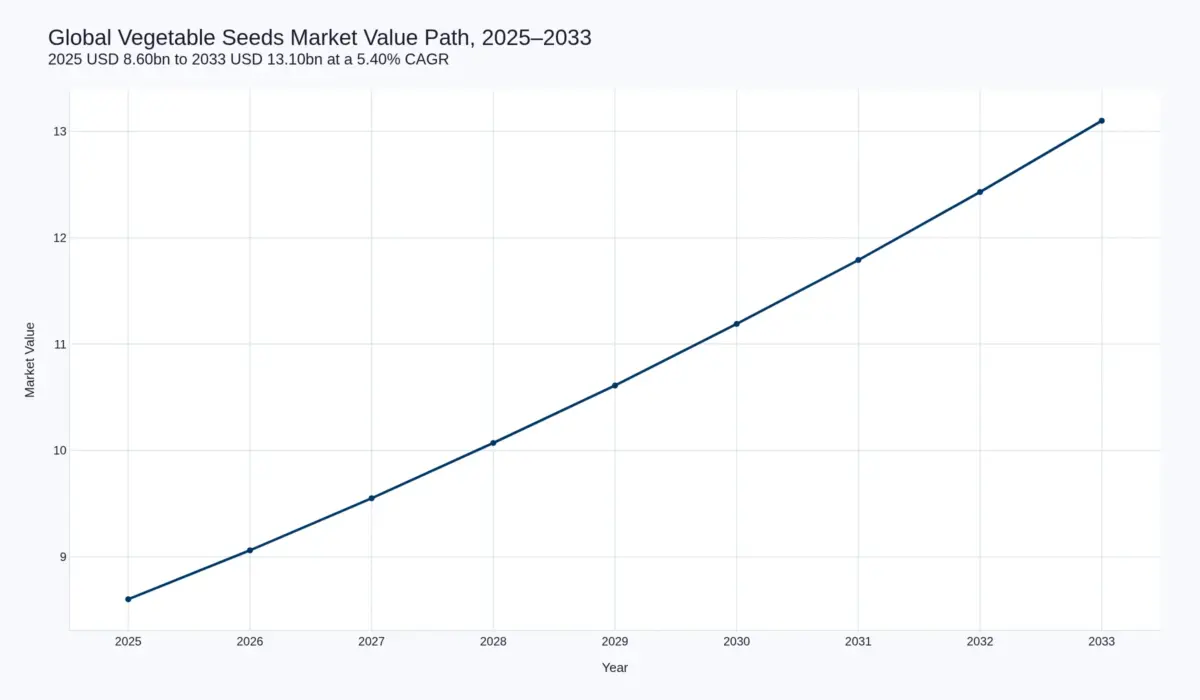
The global vegetable seed market is valued at USD 8.60 billion in 2025 and is forecast to reach USD 13.10 billion by 2033, a compound annual growth rate of 5.40% over 2026–2033. That is USD 4.50 billion of absolute value added in eight years — more than the entire market was worth as recently as the early 2010s.
The figure is triangulated from three directions rather than taken from a single study. The first is top-down: this report's parent dataset places the total global seed market at USD 78.40 billion in 2025, and vegetable seed represents 11.0% of it, consistent with the share implied by the vegetable segment of every tier-1 breeder's disclosed seed revenue. The second is bottom-up from company disclosure — Syngenta Seeds reported USD 4.8 billion of total seed sales in 2025 with vegetable seed growing 5%, Rijk Zwaan reported EUR 684 million for FY2024/25 and Enza Zaden EUR 511.6 million for calendar 2025, and adding Bayer's vegetable seed franchise, Limagrain, Sakata, Bejo and Takii brings the top eight to roughly USD 5.4 billion, implying a total market near USD 8.7 billion at a 62% concentration ratio. The third is national value data: seed replacement rates and certified vegetable seed consumption in China, India, the United States, Japan and the Mediterranean protected-horticulture belt. The three methods converge within a USD 8.2–9.1 billion band for 2025; the midpoint is taken.
Forecast growth is set at 5.40%. That sits deliberately below the upper end of published expectations, which in this market have run as high as 6.8%, because the volume arithmetic does not support it. Global vegetable harvested area is expanding at roughly 1% a year, and seed rate per hectare is falling as precision sowing, primed seed and transplant propagation replace broadcast and direct drilling. Almost none of the forecast increment comes from planting more seed. It comes from paying more per unit of seed — and that is a far more durable source of growth than area, because it is attached to germplasm value rather than land.
Why This Is Not a Volume Story
Vegetable seed is the highest-value-per-kilogram product in agriculture. A tomato hybrid at retail seed price can transact at several thousand US dollars per kilogram; the equivalent weight of commodity wheat seed trades at a few dollars. The consequence is that vegetable seed economics are set almost entirely by genetics, not by tonnage, and the market's growth rate therefore tracks the rate at which breeders succeed in putting more commercial value into each seed lot.
That dynamic is visible in the cost line of a protected-cultivation grower. Seed is a small single-digit percentage of total cost in open-field vegetables but rises sharply as a share of variable cost in high-wire greenhouse tomato, pepper and cucumber production, where a single season's seed investment sits against a crop worth several hundred thousand dollars per hectare. In that setting growers do not shop on seed price. They shop on the probability that the variety will deliver marketable yield under the disease pressure, light levels and retail specification actually present on their farm — which is why resistance traits command a premium and why a variety that fails in one season is rarely forgiven.
Three Structural Shifts Defining 2026–2033
1. Disease resistance has replaced yield as the purchase criterion
Tomato brown rugose fruit virus is the clearest case in modern vegetable breeding. ToBRFV emerged around 2014, broke the six-decade durability of the Tm-2² tobamovirus resistance gene, and within a decade had reshaped the entire tomato seed market. The industry response has been fast by breeding standards: Enza Zaden identified a novel high-resistance locus and used genomics-assisted introgression to launch 18 commercial tomato varieties within seven years of first identifying the pathogen. Independent field trials now show that combining a Tm-1-based resistant scion with a resistant rootstock cuts early infection rates from above 92% in susceptible controls to 16.43%. Resistance is no longer a feature listed on a spec sheet; in tomato, pepper and cucumber it is the precondition for a variety being listed at all.
2. The buyer is now a retail specification, not only a farmer
Supermarket and food-service buyers increasingly dictate fruit size, colour, shelf life, brix, uniformity and year-round availability, and those requirements translate one-for-one into breeding briefs. Rijk Zwaan's French business describes the shift plainly: households are smaller and cooking time is shorter, so the portfolio has moved toward 1.5-kilogram watermelons where the category once ran to 12 kilograms, and toward elongated, low-seed, high-sugar peppers. The breeder that reaches the retail specification first captures the variety royalty for the life of the specification. This is why the top breeders spend between a fifth and a quarter of revenue on research and development — Rijk Zwaan invested EUR 204 million in FY2024/25 and Enza Zaden put 27% of revenue into breeding, technology and digitalisation in 2025.
3. Breeding capacity is being rebuilt around data and gene editing
The EU's new genomic techniques regulation, adopted by Parliament on 17 June 2026, splits edited plants into NGT-1 (treated as conventional once verified) and NGT-2 (retained under GMO rules), and opens a legal pathway for edited vegetable varieties in a market that had been effectively closed to them. Simultaneously the large breeders are buying predictive capability: Syngenta's 2025 partnerships with BetterSeeds, Tropic Biosciences and Heritable Agriculture target next-generation breeding technology and AI-driven prediction of variety performance by region. The competitive moat is migrating from germplasm collections alone to germplasm plus the phenotyping and modelling capacity that turns a collection into a pipeline.
Market Drivers
- Vegetable consumption growth in Asia and Africa. Per-capita vegetable demand rises with urbanisation and income, and it rises fastest in the regions where seed replacement rates are still well below Western levels — the single largest source of incremental certified seed demand.
- Protected cultivation expansion. Greenhouse, plastic-tunnel and hydroponic area grows faster than open-field area and uses several times more seed value per hectare, because protected systems sow at higher density with primed, high-germination seed and re-crop within the season.
- Resistance trait premiums. Varieties carrying high resistance to ToBRFV, TYLCV, Fusarium and downy mildew are priced at a premium and are displacing susceptible material faster than the underlying area grows.
- Retail and food-service specification. Contracted supply programmes require documented variety, uniformity and continuity, which forces commercial seed purchase and locks out farm-saved material.
- Seed technology attach. Priming, pelleting, film coating and treatment raise the value of each seed lot and are increasingly bundled into the variety price rather than sold separately.
- Climate-driven portfolio refresh. Heat tolerance, fruit-set stability under high night temperatures and abiotic stress tolerance have moved from niche to core breeding objectives, shortening replacement cycles.
Market Segmentation
By seed type
| Segment | Share of 2025 value | 2025 value (USD bn) | Growth |
|---|---|---|---|
| Hybrid | 71.5% | 6.15 | 5.9% — fastest |
| Open-pollinated and hybrid derivatives | 28.5% | 2.45 | 4.2% |
Hybrid penetration is the structural engine of this market and it is uneven. In Asia-Pacific hybrids already hold roughly three-quarters of value; in South Asia and much of Sub-Saharan Africa open-pollinated varieties still dominate volume, and every percentage point of conversion is worth far more in value than it is in tonnage. Rootstock seed — the grafted-tomato, pepper and melon segment — is small in value but growing fastest of all, because it is the practical answer to soil-borne disease where genetic resistance in the scion is insufficient.
By crop group
| Crop group | Share of 2025 value | 2025 value (USD bn) |
|---|---|---|
| Solanaceous — tomato, pepper, eggplant | 30.0% | 2.58 |
| Cucurbits — melon, watermelon, cucumber, squash | 18.5% | 1.59 |
| Root and bulb — onion, carrot, radish | 17.0% | 1.46 |
| Brassicas — cabbage, cauliflower, broccoli | 13.5% | 1.16 |
| Leafy and salad | 11.0% | 0.95 |
| Legumes and other vegetables | 10.0% | 0.86 |
Tomato alone is the largest single species by value and the most contested commercially. Onion is the quiet volume market — a crop with low seed cost per hectare but enormous planted area and rapidly professionalising seed supply in India, Brazil, the Netherlands and Japan.
By cultivation system
| System | Share of 2025 value | 2025 value (USD bn) | Growth |
|---|---|---|---|
| Open field | 69.0% | 5.93 | 4.6% |
| Protected cultivation (greenhouse, tunnel) | 26.5% | 2.28 | 7.3% |
| Hydroponic, vertical and semi-closed | 4.5% | 0.39 | 9.1% — fastest |
Regional Analysis
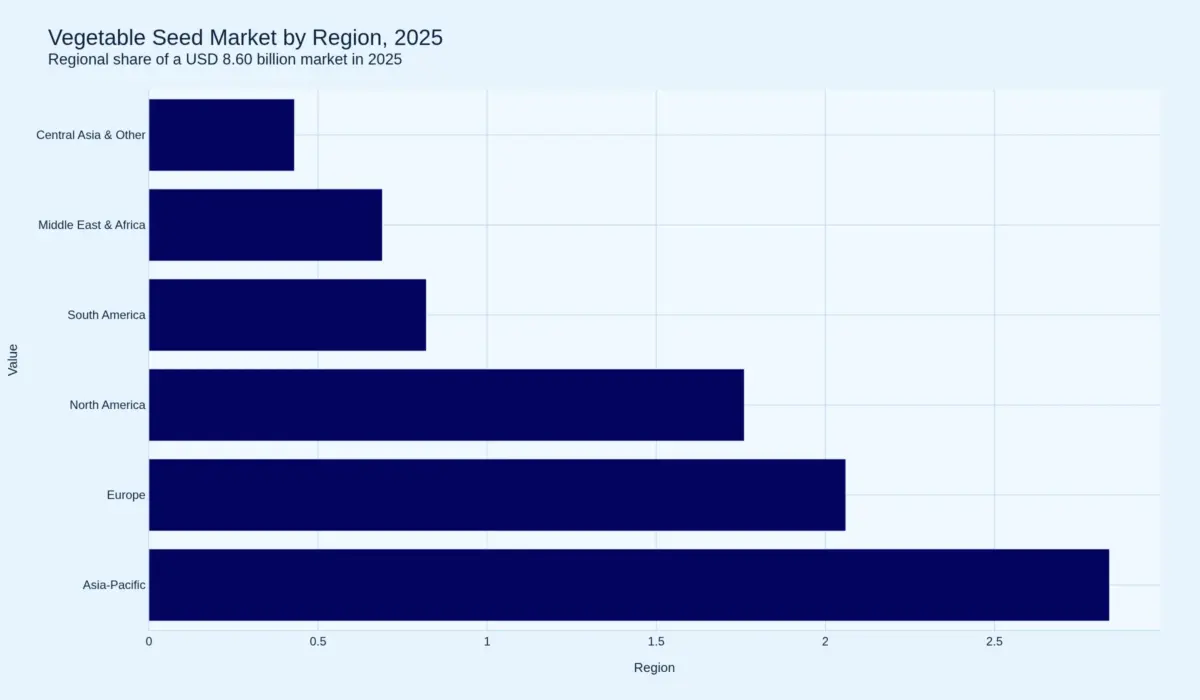
| Region | Share of 2025 value | 2025 value (USD bn) | Growth 2026–2033 | Character |
|---|---|---|---|---|
| Asia-Pacific | 33.0% | 2.84 | 6.1% | China and India together dominate; highest volume, fastest hybrid conversion |
| Europe | 24.0% | 2.06 | 4.1% | Highest value per hectare; Dutch and Mediterranean breeding and propagation cluster |
| North America | 20.5% | 1.76 | 4.5% | Consolidated retail; strong processing and protected-cultivation demand |
| South America | 9.5% | 0.82 | 6.4% | Brazil-led; expanding protected tomato and pepper |
| Middle East and Africa | 8.0% | 0.69 | 6.8% | Open-pollinated base, transitioning; strong donor and development funding |
| Central Asia and others | 5.0% | 0.43 | 4.0% | Turkey, Uzbekistan, Caucasus; seed import dependent |
The Netherlands is small as a consumption market and disproportionate as a production one: it hosts the breeding, seed multiplication and seed-health infrastructure for a large share of European and global vegetable seed supply, and the Dutch breeding cluster — Bayer, Rijk Zwaan and Sakata all operate major sites in the same southern region — functions as the sector's technical centre of gravity.
Competitive Landscape
The market is moderately consolidated: eight breeders hold roughly 62% of global value, but concentration is materially lower than in corn, soybean or canola seed, because regional and domestic breeders retain genuine strength in crops and geographies where a global portfolio does not travel well. Japan's Takii and Sakata, Korea's Nongwoobio, India's domestic hybrid houses and China's provincial breeders all defend real share on locally adapted material.
| Company | Anchor brands | FY2025 disclosure | Position |
|---|---|---|---|
| Bayer | Seminis, De Ruiter | Group sales EUR 45.6 billion; vegetable seed a named Crop Science product line | Largest single vegetable seed franchise; unified Seminis and De Ruiter branding; multi-gene ToBRFV tomato launches |
| Syngenta | Syngenta Vegetable Seeds | Seeds USD 4.8 billion, up 2%; vegetable seeds up 5% | Broadest global footprint; new Seed Health Lab in the Netherlands; AI and gene-editing partnerships |
| Limagrain | Vilmorin & Cie, Hazera | Cooperative group; vegetable seed the largest single division | Strong in carrot, melon, tomato and brassicas; cooperative ownership supports long breeding horizons |
| Rijk Zwaan | Rijk Zwaan | Sales EUR 684 million, up 9%; R&D EUR 204 million; net profit EUR 68 million | Family-owned; 200+ new varieties in FY2024/25; premium position in tomato, cucumber and lettuce |
| Sakata | Sakata Seed Corporation | Acquired Agritu Sementes (Brazil) July 2025 | Onion, brassica and cucurbit leadership; ~900 varieties across 28 species in Europe alone |
| Enza Zaden | Enza Zaden | Revenue EUR 511.6 million, up 6.8%; 27% of revenue into breeding and digitalisation | Tomato, pepper, lettuce and cucumber; first to commercialise high-resistance ToBRFV varieties at scale |
| Bejo | Bejo Zaden | Private; Dutch cooperative-rooted | Carrot, onion and leafy leadership; organic and untreated seed capability |
| Takii | Takii & Co. | Private, Japan-listed history | Asian vegetable and flower seed; strong Japanese and Southeast Asian position |
Strategic Outlook
Three conclusions follow from the dataset. First, growth will be concentrated where germplasm value can be priced — protected tomato, pepper, cucumber and leafy salads — and will continue to lag in crops where farm-saved seed and low-cost open-pollinated material set the reference price. Second, the resistance race is not a one-off event but a permanent operating condition: every major disease breakthrough resets the market and rewards the breeder that reaches it first, which structurally favours the eight firms with the largest phenotyping and marker capacity. Third, the EU's NGT framework removes the single largest regulatory asymmetry between European and American vegetable breeding, and the first edited vegetable varieties reaching European commercial release will create a new premium tier.
The strategic risk is not demand. It is seed multiplication. Vegetable seed is produced on contract in a small number of climatically suitable regions, and a poor flowering season, a phytosanitary interception or a transport disruption in any one of them can leave a high-value variety short for an entire selling season. The breeders that win through 2033 will be those that treat seed production and seed health as core competitive assets rather than as a cost line — which is exactly the logic behind Syngenta's new Dutch seed health laboratory and the multi-year investment programmes at Rijk Zwaan and Enza Zaden.
Watch List
- First commercial NGT-1 vegetable variety registrations in the EU, and whether member-state opt-outs fragment the addressable market.
- Whether ToBRFV resistance-breaking isolates emerge in commercial greenhouse production, forcing a second resistance generation.
- Hybrid conversion rate in India, Bangladesh and Nigeria — the largest single lever on global value growth.
- Seed multiplication capacity and contract prices in Chile, Peru, Tanzania, Thailand and the Netherlands.
- Consolidation among mid-tier European and Asian breeders, where the acquirable pipeline sits.
- Retail specification concentration and its effect on variety life cycles.
This report sits inside a connected corpus on the global seed value chain. The global seed market establishes the total category within which vegetable seed is the highest-value segment, and the global seed treatment market covers the technology layer applied to the seed before sale. Because vegetable seed value is realised only when the crop reaches harvest, the demand side is examined in the crop protection and biostimulant work, while the technology pull is covered in remote sensing for agriculture, artificial intelligence in agriculture and urban farming.
Table of Contents
Table of Contents
- Executive Summary
- 1.1 Snapshot
- 1.2 Key Findings
- 1.3 Segments Covered
- 1.4 Methodology and Data Sources
- Market Overview
- 2.1 Definition and Scope
- 2.2 The Vegetable Seed Value Chain
- 2.3 Commercial Seed versus Farm-Saved Seed
- Market Size and Forecast (USD Billion), 2026–2033
- 3.1 Historical Market Size, 2021–2025
- 3.2 Base-Year Market Size, 2025
- 3.3 Forecast Market Size, 2026–2033
- 3.4 Forecasting Assumptions
- Market Drivers
- 4.1.1 Rising Vegetable Consumption and Dietary Shift
- 4.1.2 Expansion of Protected Cultivation
- 4.1.3 Disease Resistance Pressure — ToBRFV and Beyond
- 4.1.4 Yield and Uniformity Economics
- 4.1.5 Retail Variety Specification and Year-Round Supply
- Market Restraints and Challenges (USD Billion), 2026–2033
- 5.1 Counterfeit and Illegal Seed Trade
- 5.2 Seed Health and Phytosanitary Regimes
- 5.3 Breeding Cost and Germplasm Concentration
- 5.4 Farm-Saved Seed and Royalty Collection
- Market Segmentation (USD Billion), 2026–2033
- 6.1 By Seed Type
- 6.1.1 Hybrid
- 6.1.2 Open-Pollinated and Hybrid Derivatives
- 6.1.3 Rootstock
- 6.2 By Crop Group
- 6.2.1 Solanaceous — Tomato, Pepper, Eggplant
- 6.2.2 Cucurbits — Melon, Watermelon, Cucumber, Squash
- 6.2.3 Root and Bulb — Onion, Carrot, Radish
- 6.2.4 Brassicas — Cabbage, Cauliflower, Broccoli
- 6.2.5 Leafy and Salad
- 6.2.6 Legumes and Other Vegetables
- 6.3 By Cultivation System
- 6.3.1 Open Field
- 6.3.2 Protected Cultivation
- 6.3.3 Hydroponic, Vertical and Semi-Closed
- 6.1 By Seed Type
- Regional Analysis
- 7.1 Asia-Pacific
- 7.2 Europe
- 7.3 North America
- 7.4 South America
- 7.5 Middle East and Africa
- 7.6 Central Asia and Other Regions
- Value Chain Analysis
- 8.1 Germplasm and Pre-Breeding
- 8.2 Breeding, Trials and Selection
- 8.3 Seed Production and Multiplication
- 8.4 Conditioning, Priming, Pelleting and Treatment
- 8.5 Distribution and Channel Economics
- Competitive Landscape
- 9.1 Bayer (Seminis, De Ruiter)
- 9.2 Syngenta Vegetable Seeds
- 9.3 Limagrain (Vilmorin & Cie, Hazera)
- 9.4 Rijk Zwaan
- 9.5 Sakata Seed Corporation
- 9.6 Bejo Zaden
- 9.7 Enza Zaden
- 9.8 Takii & Co.
- 9.9 East-West Seed and the Tropical Segment
- 9.10 Regional and Domestic Breeders
- Strategic Intelligence
- 10.1 Competitive Positioning Matrix
- 10.2 Pricing and Royalty Benchmarks
- 10.3 Breeding Pipeline Assessment
- 10.4 M&A and Partnership Screen
- 10.5 Automated Porter’s Five Forces Analysis
- Regulatory Landscape
- 11.1 Variety Registration and Seed Marketing
- 11.2 Phytosanitary and Seed Health Rules
- 11.3 New Genomic Techniques — the EU NGT Regulation
- 11.4 Intellectual Property and Plant Variety Rights
- 11.5 Organic and Non-GMO Standards
- Technology and Innovation
- 12.1 Molecular Markers and Genomic Selection
- 12.2 Doubled Haploid and Speed Breeding
- 12.3 Gene Editing in Vegetable Crops
- 12.4 Phenotyping and AI-Assisted Selection
- 12.5 Seed Technology — Priming, Pelleting and Coating
- Investment Activity
- 13.1 M&A and Consolidation
- 13.2 Growth Capital and Private Investment
- 13.3 R&D Spending Benchmarks
- 13.4 Capacity and Infrastructure Investment
- Market Risks and Outlook
- 14.1 Demand-Side Risks
- 14.2 Seed Production and Supply Risks
- 14.3 Regulatory and Trade Risks
- 14.4 Competitive and Intellectual Property Risks
- 14.5 Forward Outlook and Watch List
Competitive Landscape
Overview
The global vegetable seed industry is moderately consolidated. Eight breeders account for roughly 62% of value, and the top four for a little under half. That is a materially lower concentration ratio than in corn, soybean or canola seed, where four firms hold the overwhelming majority of the commercial market, and the difference is structural rather than temporary. Vegetable species diversity is far greater, local adaptation matters more, and a breeding programme aimed at Japanese cucumber or Indian okra does not confer advantage in Dutch tomato. Consolidation has therefore proceeded along crop and region lines rather than as a single global roll-up.
Current Scenario
Bayer operates the largest single vegetable seed franchise, trading under Seminis and De Ruiter, which the company has been unifying into a single commercial identity. Group sales were EUR 45.6 billion in 2025, and vegetable seed is a named Crop Science product line rather than a peripheral activity. Bayer’s competitive position rests on scale in tomato, pepper, melon and cucumber, a deep cucurbit portfolio, and the ability to push multi-gene ToBRFV resistance into new tomato launches — a strategy aimed squarely at the durability problem that single-gene resistance has already failed once.
Syngenta reported Seeds sales of USD 4.8 billion in 2025, up 2%, with vegetable seeds up 5% in an environment the company described as stable with solid growth. Its vegetable business has the broadest geographic footprint of any competitor and is investing conspicuously in capability rather than capacity: a new seed health laboratory in the Netherlands, a centralised continuous nursery facility in Guatemala, and 2025 partnerships with BetterSeeds, Tropic Biosciences and Heritable Agriculture covering next-generation breeding technology and AI-driven prediction of variety performance by region.
Limagrain operates through Vilmorin & Cie and Hazera, with vegetable seed its largest single division. Cooperative ownership gives it a longer investment horizon than a listed peer and a structural tolerance for breeding programmes that pay back over a decade. It is strongest in carrot, melon, tomato and brassicas.
Rijk Zwaan is family-owned and reported sales of EUR 684 million in FY2024/25, up 9%, with research and development expenditure of EUR 204 million, net profit of EUR 68 million and more than 200 new varieties introduced in the year. Its position is premium and concentrated in tomato, cucumber, lettuce and specialty crops, with a deliberate strategy of building varieties around retail and consumer specifications — smaller watermelons, elongated low-seed sweet peppers, convenience-oriented salad types — rather than around agronomic yield alone.
Sakata Seed Corporation holds onion, brassica and cucurbit leadership and expanded in July 2025 by acquiring Brazil’s Agritu Sementes to deepen onion breeding, production and local route-to-market. Its European business illustrates the operating scale of a serious breeder: a 23-hectare site in southern France running 28 species across roughly 900 commercial varieties for professional growers, with only 1 to 2% of created varieties reaching market.
Enza Zaden reported revenue of EUR 511.6 million in 2025, up 6.8%, operational result of EUR 67.4 million and net profit of EUR 57 million, with 27% of revenue committed to breeding, technology and digitalisation. It is the clearest example of a mid-large independent competing on the strength of a single trait platform: its ToBRFV programme produced 18 high-resistance commercial tomato varieties within seven years, and its portfolio strength in tomato, pepper, lettuce and cucumber is built directly on that position.
Bejo Zaden is privately held and Dutch, with leadership in carrot, onion and leafy crops and a differentiated capability in organic and untreated seed — a position that becomes more valuable as European organic area and retailer residue standards tighten. Takii & Co. holds a strong Japanese and Southeast Asian position across vegetables and flowers and remains a genuine counterweight to the European and American firms in Asian crop portfolios.
Beyond the tier-1 group, the landscape is populated by substantial regional breeders: Korea’s Nongwoobio, India’s domestic hybrid houses, China’s provincial and national breeders, and the Mediterranean seed companies that dominate specific crops in specific markets. East-West Seed occupies a distinct position as the tropical smallholder specialist, and its model — vegetable seed sold to growers whose alternative is farm-saved material — addresses the largest untapped volume pool in the market.
Signals
Consolidation activity is real but narrow. The tier-1 firms are not acquiring each other; they are buying capability and regional access at the mid-tier. Sakata’s Brazilian acquisition is the template: a crop-specific, geography-specific purchase that strengthens leadership in one species in one market. Expect more of the same in onion, brassica, leafy and tropical vegetables.
Partnership structures are replacing acquisition where the asset is intellectual. Syngenta’s arrangements with gene-editing and AI specialists are collaborations rather than purchases, which lets a large breeder access frontier capability without absorbing the risk of a platform that may not mature.
Pricing behaviour reveals the competitive hierarchy. In a market where hybrid penetration is already above 70%, share is gained by taking a specification first, not by undercutting. In our channel work across European and Latin American protected-cultivation clusters, the observable pattern is that growers will pay a substantial premium for a variety with documented high resistance to the pathogens actually present on their farm, and will revert to a cheaper alternative only when the resistant variety fails to deliver on fruit quality — which is precisely the trade-off the current generation of ToBRFV programmes is being judged on.
Strategic Implications
The competitive map through 2033 will be decided by two capabilities. The first is resistance durability. Single-gene resistance has already been broken once in tomato, and the firms deploying multi-gene constructs and combining resistant scions with resistant rootstocks are building a defensible position that a single-locus competitor cannot match. Field evidence is unambiguous about the mechanism: combining Tm-1-based resistant scions with resistant rootstocks has been shown to bring early infection rates down from above 92% in susceptible controls to 16.43%, and neither component alone delivers that outcome.
The second is breeding-cycle speed. When the difference between first and third to market is measured in seasons, phenotyping throughput and genomic selection capacity become the binding competitive variables. This is where the smaller independents face genuine strategic risk: they can compete on a single crop in a single region indefinitely, but they cannot sustain a multi-crop programme against firms spending a fifth to nearly a third of revenue on research.
For the Indian, Chinese, Korean and Japanese domestic breeders the logic is different. Their advantage is adaptation and channel proximity, and it is durable in crops where the global portfolio does not transfer. The risk to them is not the tier-1 breeder entering; it is the tier-1 breeder licensing a locally adapted line into their market through a partner.
Forward Outlook
The most likely shape of the market by 2033 is not a tighter oligopoly but a two-tier structure: eight global firms controlling the majority of value in the internationally traded, high-specification crops, and a long tail of regional champions holding defensible positions in locally adapted material. Concentration will rise modestly, driven by mid-tier acquisition and by the rising fixed cost of phenotyping, but it will not approach row-crop levels.
The variable that could change the picture is gene editing. If the EU’s new genomic techniques framework results in a workable NGT-1 registration pathway, the breeders with existing edited pipelines will gain a multi-year advantage in the world’s highest-value-per-hectare market. That advantage will be temporary in technology terms but commercially durable, because the first approved varieties in a new regulatory class tend to hold shelf space and grower confidence well beyond their genetic lead.
Value Chain
Overview
The vegetable seed value chain differs from every other input chain in agriculture in one respect: the value of the product is almost entirely determined before the seed is ever grown. Germplasm selection, breeding and trait introgression decide what a seed is worth. Everything downstream — multiplication, conditioning, treatment, distribution — protects and delivers that value rather than creating it. Analysing the chain therefore means locating where breeding risk concentrates, who absorbs it, and how much of the final price each stage can claim.
The consequence is a chain with unusually high fixed cost at the front, unusually high working capital in the middle, and unusually high margin concentration at the back. It also explains why the sector is structured as it is: eight vertically integrated breeders control roughly 62% of global value because only an integrated structure can carry a breeding programme for a decade and then monetise it through a controlled seed-production network.
Current Scenario
Germplasm and pre-breeding. Every commercial variety begins in a working collection. The tier-1 breeders hold tens of thousands of accessions across tomato, pepper, cucurbit, brassica, allium and leafy species, and the strategic value of a collection lies less in what it contains than in what has been characterised within it. The ToBRFV episode demonstrated this precisely: the resistance sources that mattered were wild Solanum accessions and a small number of cultivated lines carrying Tm-1, and the breeders that already held characterised material moved first. Enza Zaden converted a newly identified high-resistance locus into 18 commercial tomato varieties within seven years of the pathogen first being described — a pace that is only possible when pre-breeding material already exists.
Breeding, trials and selection. This is the cost centre. Rijk Zwaan reported research and development expenditure of EUR 204 million in FY2024/25 against sales of EUR 684 million, and Enza Zaden committed 27% of its EUR 511.6 million 2025 revenue to breeding, technology and digitalisation. The output funnel is brutally narrow: Sakata’s European business reports that only 1 to 2% of the varieties it creates ultimately reach the market. A breeder therefore carries the full cost of the 98 to 99% that are discarded, and the price of a commercial variety has to recover a decade of failed lines.
The trial layer is where breeding meets geography. A tomato line must be tested across protected and open-field systems, under different light regimes, in different soil and water chemistries, and against locally prevalent pathogen races. This is why no global portfolio travels without local adaptation, and why regional breeders retain real share in Japan, Korea, India and China despite spending a fraction of what the tier-1 firms spend.
Seed production and multiplication. Commercial hybrid seed is produced almost entirely under contract, in a small number of climatically suitable regions: Chile and Peru for counter-season production, Tanzania and Kenya for tropical species, Thailand, India and China for Asian crops, and the Netherlands, France and Italy for European material. Growers are contracted at a fixed price per kilogram against strict isolation, roguing and purity standards, and the breeder retains ownership of the parental lines throughout. This stage carries the chain’s most under-appreciated risk. A poor flowering window, a heat event at anthesis or a phytosanitary interception in one production region can leave a high-value variety short for an entire selling season, and there is no substitute supply available on the timescale that matters.
Conditioning, priming, pelleting and treatment. Harvested seed is dried, cleaned, graded and tested for germination and health, then increasingly upgraded. Priming advances the seed’s physiological state so that emergence is faster and more uniform — worth a great deal in a transplanted crop where a two-day advantage in the nursery translates into an earlier first harvest. Pelleting and encrusting make very small seed such as lettuce and onion sowable at precision singulation. Film coating and treatment carry fungicide, insecticide or biological active ingredients, and this is the junction at which the vegetable seed chain meets the seed-applied technology layer covered in this report’s companion analysis. In our channel work across the Dutch, Spanish and Mexican production clusters, treated and primed product commands a clear premium and is now default rather than optional in protected tomato, pepper and cucumber.
Distribution and channel economics. Vegetable seed reaches growers through a layered channel: breeder to regional distributor to dealer or crop advisor to grower, with a direct arm for the largest protected-cultivation operations. Distributors carry the credit risk, the local agronomy and the variety demonstration plots; in return they take a margin that in several markets is larger than the breeder’s own net margin on the same seed. This is the least consolidated stage of the chain and the one most exposed to consolidation pressure, because breeders increasingly regard the dealer relationship as the point at which variety loyalty is won or lost.
Signals
Three signals are visible in the current structure. First, capital is moving upstream: the largest breeders are investing in seed health infrastructure and controlled-environment nursery capacity rather than in distribution, which suggests they regard production reliability and phenotyping throughput as the binding constraint. Syngenta’s new seed health laboratory in the Netherlands and its investment in a centralised continuous nursery facility in Guatemala both point the same way.
Second, the breeding cycle is shortening. Genomic selection, marker-assisted backcrossing and doubled haploid production have compressed the interval between trait identification and commercial release, and the ToBRFV response demonstrated that a seven-year cycle from pathogen identification to 18 commercial varieties is now achievable. Shortening cycles raise the value of the pipeline and raise the cost of being late.
Third, seed production is being treated as strategic. Contract multiplication prices have risen in the principal production regions, and breeders are increasingly securing multi-year capacity rather than buying season by season. That behaviour is consistent with a market in which demand for a given variety is more certain than the supply of its seed.
Strategic Implications
For a breeder, the implication is that competitive advantage has migrated from the collection to the pipeline — from owning germplasm to being able to characterise, select and multiply it quickly and reliably. A large collection without phenotyping capacity is a cost; a modest collection with fast cycling and clean seed production is an asset.
For an input supplier adjacent to seed — treatment, biologicals, coating technology, nursery services — the lesson is that the seed is the delivery vehicle and the breeder is the gatekeeper. Access to the seed lot is worth more than any individual product claim, which is why seed-applied technology economics follow seed share so closely.
For a grower, the chain’s structure explains the price. The seed is expensive not because seed is scarce but because the variety was selected from a hundred candidates, produced under contract in a climatically fragile region, tested for health, primed, pelleted and then delivered with an agronomic support layer attached. Judged against the value of the crop it produces, it remains one of the cheapest inputs on the farm.
Forward Outlook
Through 2033 the chain will consolidate at two points. Upstream, breeding and pre-breeding will concentrate further as the cost of phenotyping and data infrastructure rises beyond what mid-tier breeders can sustain alone; expect licensing, joint development and selective acquisition of specialist genetics. Downstream, the distributor layer will be squeezed as breeders build direct digital channels to large growers and as retail specification shortens variety life cycles.
The stage least likely to change is seed production, and that is the stage that deserves the most attention. Vegetable seed multiplication depends on a handful of regions with the right combination of isolation distance, labour skill, climate reliability and phytosanitary standing. There is no technology that substitutes for a good flowering season, and no amount of breeding capacity compensates for a variety that cannot be multiplied at commercial scale. The chain’s most valuable and least visible asset remains the contract grower network.
Investment Activity
Overview
Investment in vegetable seed flows through four channels: internally funded breeding programmes, acquisition of mid-tier breeders and crop-specific assets, physical infrastructure for seed production and seed health, and partnership capital directed at technology platforms the incumbents cannot build fast enough themselves. The pattern across all four is the same — capital is being committed to capability rather than to capacity, because capacity is not the constraint in a market where volume is flat and value comes from genetics.
The sector’s investment profile is also structurally unusual. Three of the eight leading breeders are family-owned or cooperative — Rijk Zwaan, Limagrain and Bejo — and a fourth, Sakata, has a long history of patient institutional ownership. That ownership mix supports multi-decade breeding horizons and makes the sector notably less quarterly-earnings-driven than row-crop seed. It also means that when acquisition opportunities arise, the buyers are as likely to be strategic and unhurried as they are to be financially engineered.
Current Scenario
Research and development spending. The disclosed benchmarks are high and rising. Rijk Zwaan reported research and development expenditure of EUR 204 million in FY2024/25 against sales of EUR 684 million — close to 30% of revenue — with net profit of EUR 68 million, down from EUR 80 million the prior year, as R&D expenditure grew from EUR 191 million. Enza Zaden committed 27% of its EUR 511.6 million 2025 revenue to breeding, technology and digitalisation, and reported operational result up 5.8% to EUR 67.4 million with net profit of EUR 57 million, the decline attributable to adverse currency effects rather than to operating performance. Those two data points define the competitive benchmark: a serious vegetable seed breeder now spends between a quarter and a third of revenue on the technology pipeline, and accepts margin compression to do so.
Bayer, as a division of a EUR 45.6 billion group, does not disclose vegetable seed R&D separately, but the direction of travel is visible in its product strategy — unified Seminis and De Ruiter branding and multi-gene ToBRFV resistance pushed into new tomato launches in North America in 2025. Syngenta Seeds reported USD 4.8 billion of 2025 sales with vegetable seeds growing 5%, and its investment activity is concentrated in capability infrastructure and external partnership rather than in acquired volume.
Mergers and acquisitions. Consolidation is active but targeted. The clearest 2025 example is Sakata’s July 2025 acquisition of Brazil’s Agritu Sementes, made specifically to deepen onion seed research, production and local route-to-market in South America. That is the template the sector is following: crop-specific, geography-specific purchases that convert a regional strength into leadership in one species in one market, rather than transformative mergers.
The absence of large-scale consolidation is itself informative. The tier-1 firms are not buying each other, and regulatory scrutiny of agricultural input concentration has hardened considerably since the mid-2010s wave. With the largest players already holding the portfolios they need, the acquirable assets are mid-tier European and Asian breeders with strong crop franchises and succession issues — a pipeline that will be worked through slowly, one asset at a time.
Infrastructure investment. This is where the largest single commitments are being made, and they are aimed at reliability rather than at output. Syngenta opened a new seed health laboratory in the Netherlands in 2025 and invested in Guatemala to develop a centralised continuous nursery facility designed to accelerate innovation in fruity crops. Bayer describes its seed breeding, propagation, production and processing as taking place close to customers, either at its own facilities or under contract, which reflects the underlying economics: vegetable seed production cannot be centralised because the multiplication environment determines whether the seed can be produced at all.
Sakata’s European business illustrates the scale at the site level — a 23-hectare facility in southern France handling 28 species across roughly 900 commercial varieties for professional growers, with a EUR 8 million expansion programme under way. Investments of that kind are not discretionary. A breeder that cannot multiply, condition and ship clean seed cannot monetise a breeding pipeline regardless of how good the genetics are.
Partnership and platform investment. The most strategically interesting capital is flowing into collaborations. Syngenta’s 2025 partnerships with BetterSeeds and Tropic Biosciences cover next-generation breeding technology, and its arrangement with Heritable Agriculture applies artificial intelligence to predict top-performing vegetable varieties by region. These are structured as partnerships rather than acquisitions, which allows a large breeder to access frontier capability without absorbing the risk of a platform that may not mature — and it signals that the incumbents believe the technology frontier is currently moving faster than internal R&D cycles can absorb.
Signals
The investment trend direction is unambiguously rising, and three signals support that view. First, R&D intensity has crossed a threshold: when two of the leading independents are spending 27% and close to 30% of revenue respectively, the sector has effectively re-based its cost structure around technology rather than around production.
Second, the composition of spending has shifted toward data and physical infrastructure. Sequencing and genotyping costs have fallen far enough that they are no longer the constraint; phenotyping capacity, controlled-environment facilities and seed health capability are. Those are capital-intensive assets with long payback periods, which structurally favours the firms with patient ownership.
Third, in our channel work across European and Latin American production clusters, the observable behaviour of mid-tier breeders is defensive consolidation of scope — narrowing to fewer crops, investing in the one or two traits that matter in their home market, and where possible licensing enabling technology rather than building it. That is the behavioural signature of rising fixed costs in a market that cannot be won on scale alone.
Strategic Implications
For the tier-1 breeders, the investment logic is straightforward: sustain R&D intensity above 20% of revenue, keep the breeding cycle shortening, and defend the resulting position through resistance durability and seed production reliability. The risk is not under-investment but misallocation — spending on breadth in crops where a regional specialist will always be better adapted.
For the mid-tier, the implication is that the model of a broad multi-crop programme on a sub-scale budget no longer works. The viable positions are depth in a crop and geography, licensing rather than building technology, and where capital allows, acquiring a complementary regional franchise to reach the scale at which fixed R&D costs amortise.
For investors, vegetable seed remains an attractive structural growth asset precisely because it is not volume-dependent. Its revenue grows with germplasm value, which is a function of breeding capability rather than of commodity prices or planted area — a materially lower-beta profile than most agricultural inputs. The corresponding risk is that the value is intangible and walks out of the door with the breeders, which is why the sector’s acquisitions are almost always structured around retaining people as much as assets.
Forward Outlook
Through 2033 expect three patterns. First, continued mid-tier acquisition at a steady but unspectacular rate, concentrated in onion, brassica, leafy and tropical vegetables where regional champions hold defensible franchises. Second, a rising share of capital expenditure going into phenotyping, controlled-environment and seed health infrastructure, at the expense of conventional production capacity. Third, more partnership structures at the technology frontier, particularly in gene editing and predictive modelling, as breeders seek access without ownership risk.
The wildcard is the EU’s new genomic techniques framework. If NGT-1 registration proves workable, expect a visible step-up in European breeding investment from 2027 onward as firms position edited pipelines for the first commercial releases. If implementation stalls, that investment will flow instead to jurisdictions where the pathway is already open — and Europe’s position as the sector’s technical centre of gravity will erode by exactly as much as the delay lasts.
Technology & Innovation
Overview
Vegetable breeding has changed more in the last fifteen years than in the preceding fifty, and the change is not primarily about any single technique. It is about throughput. The classical breeding cycle for a vegetable crop ran eight to twelve years from cross to commercial variety, dominated by the number of seasons required to grow, select and evaluate each generation. Molecular markers, doubled haploid production, genomic selection and controlled-environment speed breeding have compressed that cycle, and the compression compounds: a programme running a three-year cycle rather than a six-year cycle makes twice as many selection decisions in the same period and accumulates genetic gain at twice the rate.
That is the mechanism behind the market’s value growth. Vegetable seed volume is flat; the price per seed is rising because breeders can now deliver traits — principally disease resistance — that were previously unavailable at any price. Innovation is therefore not an adjacent theme in this market. It is the growth driver itself.
Current Scenario
Molecular markers and genomic selection. Marker-assisted selection is now standard practice across the tier-1 breeders and increasingly across the mid-tier. The technique allows a breeder to identify a plant carrying a desired allele from a leaf sample at the seedling stage, rather than waiting a full season to observe the phenotype, and it is what made the rapid ToBRFV response possible: the resistance locus could be tracked through backcross generations without waiting for the plants to be challenged with the virus. Genomic selection goes further, using genome-wide marker data to predict the performance of candidates that have never been phenotyped, which raises the number of lines a programme can evaluate per season by orders of magnitude.
Doubled haploid and speed breeding. Doubled haploid production converts a heterozygous line into a fully homozygous one in a single generation, eliminating the multiple selfing generations that classical programmes required to fix a trait. In species where the technique is routine — brassicas, cucurbits, some solanaceous crops — it can remove two to three years from the cycle on its own. Speed breeding, using extended photoperiod and controlled environment, adds further generations per calendar year. The combination is why the industry can now speak credibly of a seven-year interval between identifying a novel pathogen and holding eighteen commercial resistant varieties.
Gene editing. CRISPR-based editing is where the technology frontier currently sits. In vegetable crops the commercially meaningful targets are disease resistance, abiotic stress tolerance, fruit quality and plant architecture — the traits that carry retail and grower value. Editing offers a decisive advantage over transgenic approaches in that a targeted knock-out of a susceptibility gene leaves no foreign DNA, which places the resulting plant in the same category as a conventionally bred variant under the EU’s new NGT-1 classification, provided it meets the criteria. That regulatory shift is what makes editing commercially relevant in Europe for the first time. The constraint is not the editing itself; it is knowing which genes to edit, which requires exactly the functional genomics and pre-breeding capacity discussed above.
Phenotyping and AI-assisted selection. The binding constraint across the industry has shifted from genotyping to phenotyping. Sequencing is now cheap; measuring what a plant actually does across environments is not. This has driven investment in automated imaging platforms, controlled-environment phenotyping and, more recently, predictive modelling. Syngenta’s 2025 partnership with Heritable Agriculture is explicitly aimed at using artificial intelligence to predict top-performing vegetable varieties by region — an attempt to substitute computation for a portion of the multi-environment trial grid. If that works, it reduces the number of locations and seasons required to make a confident commercial decision, which is the single largest remaining cost in the breeding cycle.
Seed technology. Downstream of genetics, the seed itself is engineered. Priming advances the seed’s physiological state to deliver faster, more uniform emergence — worth a measurable amount in transplanted crops where nursery timing sets the harvest window. Pelleting and encrusting make very small seed sowable at precision singulation, which is what allows lettuce and onion to be drilled mechanically rather than handled. Film coating carries active ingredients and improves flow. In protected tomato, pepper and cucumber production in Europe and North America, primed and treated seed is now the default specification rather than an upgrade, and the technology layer is priced into the seed rather than sold separately.
Integrated resistance management. The most important innovation in this market may be agronomic rather than genetic. ToBRFV broke a resistance gene that had held for six decades, and the industry’s conclusion has been that single-locus resistance is a temporary asset. The practical response is stacking: multi-gene constructs in the variety, combined with grafting onto resistant rootstocks where the pathogen is soil-borne. Independent field trials have demonstrated the scale of the effect — resistant scions grafted onto resistant rootstocks recorded a 16.43% early infection rate against more than 92% in susceptible controls, with neither component alone achieving the result.
Signals
Research intensity is rising and is being disclosed. Rijk Zwaan’s FY2024/25 results show EUR 204 million of research and development expenditure against EUR 684 million of sales; Enza Zaden committed 27% of 2025 revenue to breeding, technology and digitalisation. Those are not incremental increases in a mature cost base — they are the profile of an industry that believes the returns to R&D are still rising.
The nature of the investment is also shifting. Capital is moving from laboratory capacity toward data infrastructure, phenotyping and controlled-environment facilities. Syngenta’s centralised continuous nursery facility in Guatemala and its Dutch seed health laboratory are both examples of investment in the physical and data infrastructure that converts germplasm into a faster pipeline.
A third signal is the direction of collaboration. The large breeders are partnering with specialist technology firms rather than building everything internally — BetterSeeds and Tropic Biosciences for next-generation breeding technology, Heritable Agriculture for AI-driven prediction. That pattern implies the frontier is moving faster than internal R&D cycles can absorb, and that access to external capability is being treated as a strategic asset.
Strategic Implications
For the tier-1 breeders, the strategic logic is to shorten the cycle and widen the funnel simultaneously, and to defend the resulting position with resistance durability rather than a single trait. The firms that win will be those whose pipeline generates more candidates per season and whose seed production and health systems can deliver them reliably.
For mid-tier and regional breeders, the viable strategy is depth over breadth: own a crop and a geography completely, invest in the one or two traits that matter locally, and where possible license the enabling technology rather than build it. The firms that attempt a broad multi-crop programme on a sub-scale R&D budget will lose ground steadily rather than abruptly.
For input suppliers around the seed, the implication is that the seed is the delivery channel and the breeder is the gatekeeper. Seed-applied technology growth is therefore tied to seed share, and access to the leading vegetable seed lots is a more valuable commercial asset than any individual product claim.
Forward Outlook
By 2033 the breeding cycle for major vegetable species is likely to be half what it was in 2020, with genomic selection and predictive phenotyping removing a substantial part of the multi-environment trial burden. Gene editing will be commercially routine in at least one major jurisdiction and probably two, and the first generation of edited vegetable varieties will have established whether the technology delivers the resistance durability that conventional introgression has struggled to sustain.
The constraint that will not yield is the biology of the plant. Resistance genes get broken, pathogens evolve, and every genetic solution has a half-life. The industry’s own response — stacked resistance, integrated rootstock and scion strategies, and continuous pipeline refresh — is an admission that the durable commercial position is not a trait but a capability. The breeders investing 25 to 30% of revenue in research are not buying a variety. They are buying the ability to replace one.
Market Risk
Overview
The risks that matter in this market are not demand risks in the conventional sense. Vegetable consumption is among the most predictable demand curves in agriculture: it rises with population, urbanisation and income, and it does not fall sharply in recessions because vegetables are a staple rather than a discretionary purchase. The genuine risks sit on the supply and regulatory side, and they share a common characteristic — they are concentrated in a small number of points in the value chain where a single failure propagates across an entire season.
The overall risk profile is best characterised as moderate, with geopolitical exposure moderate and substitution risk moderate. Regulatory complexity is high, and supply chain complexity is high. Those two high ratings are the honest summary of where the fragility lies.
Current Scenario
Seed production concentration. This is the most under-priced risk in the market. Commercial vegetable seed is multiplied under contract in a small number of climatically suitable regions — Chile, Peru, Tanzania, Kenya, Thailand, India, China, the Netherlands, France and Italy among them — and each crop has an even narrower set of viable production areas. A heat event during flowering, an unusual rainfall pattern at harvest, a labour shortage or a phytosanitary interception in any one of these regions can leave a high-value variety short for an entire selling season. There is no substitute supply available on that timescale, because the multiplication cycle cannot be compressed once the season has passed.
The economics of this risk are asymmetric. A shortfall in a low-value open-pollinated line is an inconvenience; a shortfall in a protected-cultivation tomato hybrid with a resistance package that took seven years to develop is a commercial loss measured in millions of dollars and in grower confidence that does not fully return.
Resistance breakdown. ToBRFV broke Tm-2², a gene that had protected tomato production for six decades. That precedent establishes the central technical risk in this market: every resistance trait has a finite life, and the more widely a single resistance gene is deployed, the faster the pathogen population selects against it. Industry trials already show resistance-breaking isolates emerging against novel traits, and the current strategy of stacking multiple genes and combining resistant scions with resistant rootstocks is a mitigation, not a solution. A pathogen that defeats a multi-gene construct would reset the tomato seed market for a second time in fifteen years.
Counterfeit and illegal seed. Vegetable seed is high-value, low-weight and easy to relabel, which makes it an attractive target for counterfeiters. Illegally multiplied or mislabelled seed undermines breeder revenue, and more seriously it puts unverified genetics — and unverified seed health status — into growers’ fields. In markets with weak enforcement, the problem is material rather than marginal, and it interacts directly with the phytosanitary risk: a counterfeit lot carries no traceability, so a pathogen detection cannot be traced to source.
Regulatory and trade risk. Emergency phytosanitary measures can close a trade route with little notice and shift the burden of proof onto the exporter. On the genomic techniques side, the divergence between the EU’s three-category framework, the American product-based approach and the varied Asian positions means a single edited variety may require three different regulatory strategies, with different timelines and different evidence packages. The EU framework itself remains subject to implementation risk: the verification mechanism for NGT-1 status, the public database and the sustainability monitoring obligations all have to be built, and a slow verification process would render the reform largely theoretical.
Demand-side risk. This is real but second-order. Retail specification concentration means variety life cycles shorten and a variety that loses a specification can be displaced quickly. Protected-cultivation oversupply in any given region — southern Spain, Mexico, parts of China — can compress grower margins sharply in a single season and defer replanting and variety renewal. And a broader consumer shift toward cost-driven purchasing in a high-food-inflation environment can slow the premiumisation of retail specifications that underpins part of the value growth.
Intellectual property and competitive risk. Plant variety rights are a weaker instrument than patents, and the essentially derived variety concept — while useful — is contested in practice and expensive to enforce. Breeders face a persistent leakage of germplasm through the breeder’s exemption, through illegal multiplication and, in some jurisdictions, through weak enforcement of protection altogether. Utility patents on edited traits, if they become routine in vegetables, would strengthen protection but would also invite the antitrust scrutiny that has followed trait concentration in row crops.
Signals
Three signals warrant attention. First, the largest breeders are investing in seed health and seed production infrastructure rather than in further breeding capacity — a clear statement that they regard the production side as the binding constraint on growth. Syngenta’s Dutch seed health laboratory and Guatemalan nursery facility are the visible expression of that judgement.
Second, contract multiplication terms are tightening. Breeders are securing multi-year capacity rather than buying season by season, which is rational behaviour in a market where demand for a specific variety is more certain than the supply of its seed, but it also raises the fixed cost base and increases exposure if a variety is withdrawn.
Third, in our primary channel work across European and Latin American production clusters, grower willingness to switch varieties on price alone is low where a resistance package is at stake and higher where it is not. That asymmetry means that resistance traits are the most defensible part of the portfolio and the most exposed if they fail — the two properties are the same property.
Strategic Implications
For breeders, the risk agenda is dominated by diversification of seed production geography and by resistance durability. A single-region multiplication strategy is an unhedged bet, and a single-gene resistance strategy is a dated one. The firms that manage this well will treat seed production as a strategic asset with the same seriousness they apply to breeding.
For growers, the practical exposure is variety availability and seed price. Concentration in breeding means fewer independent sources for any given specification, and a shortfall in a key variety cannot be covered from an alternative supplier because the alternative supplier does not hold the genetics.
For the input and technology layer adjacent to seed, the exposure is dependence on a small number of breeder relationships. Seed-applied technology revenue follows seed share, so a shift in variety leadership transfers the adjacent revenue with it.
Forward Outlook
The most probable path through 2033 is continued moderate, value-led growth with episodic supply shocks. Seed production will remain concentrated because the agronomic requirements for clean multiplication are not easily replicated, and the frequency of weather-driven disruption is more likely to rise than fall. Resistance traits will continue to command premiums, and the industry will continue to cycle through generations of resistance as pathogens adapt.
The two developments that could change the risk profile materially are both regulatory. A workable NGT-1 pathway would give breeders a faster route to new resistance traits and shorten the interval between a pathogen emerging and a commercial response — reducing exactly the risk that currently dominates the sector. Conversely, a fragmented or delayed implementation would preserve the current situation, in which the industry’s response time to a new pathogen is measured in years and the cost of being late is borne by growers.
The risk most likely to be underestimated is the ordinary one: a poor multiplication season in a key region coinciding with strong demand for a new variety. It is unglamorous, it does not appear in any forecast model, and it is the mechanism by which this market most often fails to deliver.
Regulatory Landscape
Overview
Vegetable seed is regulated at three separate layers, and the three are not administered by the same authorities or reviewed on the same cycle. Variety registration and seed marketing rules govern whether a variety may be sold at all. Phytosanitary and seed health rules govern whether a specific lot may cross a border. Intellectual property rules govern who may multiply and sell the genetics. A breeder can hold an excellent variety and still lose a market to any one of these layers, and it is routine for a globally successful variety to be commercial in one jurisdiction and unregistrable in another for a decade.
The regulatory burden in this sector is therefore best understood as a tax on breadth. The cost of registering a variety is broadly fixed, so a firm with a large portfolio and a small-market presence carries a proportionately heavier load than a specialist defending one crop in one country. This is one of the less discussed reasons why regional breeders survive: their registration footprint matches their commercial footprint.
Current Scenario
Variety registration and seed marketing. Most jurisdictions require a candidate variety to pass distinctness, uniformity and stability testing before it can be listed and marketed, and many add a value-for-cultivation or agronomic-performance hurdle. DUS testing is a formal, slow and relatively expensive process, and it sits chronologically in front of every commercial launch. The European system, the North American system and the Japanese system each have different documentary requirements and different acceptance of foreign test reports, which is why the same variety commonly launches under different names in different markets and why the tier-1 firms maintain permanent regulatory affairs teams rather than treating registration as an administrative afterthought.
Phytosanitary and seed health. Seed is a recognised pathway for the movement of regulated pathogens, and vegetable seed is subject to specific testing regimes for bacterial, viral and fungal contaminants. ToBRFV has been the dominant example since 2019: national plant protection organisations in the EU, the UK, the US, Mexico, Turkey and across Asia introduced testing and certification requirements for tomato and pepper seed, and several markets introduced emergency measures restricting the movement of fruit and planting material from affected areas. The practical effect is that seed health testing has moved from a quality assurance function to a market access function. It is also the direct commercial rationale for the investments the largest breeders have made in dedicated seed health laboratory capacity.
New genomic techniques. The most significant regulatory change in this market for a generation is the EU framework adopted by the European Parliament on 17 June 2026, following a December 2025 provisional agreement with the Council. The regulation shifts the basis of oversight from how a plant was made to what it finally looks like genetically, and splits edited plants into two categories. NGT-1 covers plants with a limited number and type of changes that could have occurred through conventional breeding; once verified as meeting that criterion they are treated like conventional plants. NGT-2 covers more extensive or complex modifications, remains subject to the existing GMO rules, and requires risk assessment and authorisation before commercialisation.
Several features of the framework matter commercially. Parliament secured an exclusion so that plants engineered for herbicide tolerance or to produce insecticidal substances cannot be classified as NGT-1 — a carve-out that removes the two most contentious trait categories from the light-touch route. Traceability and labelling obligations remain for NGT-2, and member states may restrict or prohibit cultivation of an authorised NGT-2 plant. Plant varieties containing or derived from an NGT-1 plant must be listed in a public EU database and all seed bags and reproductive material labelled NGT-1, so that farmers can make an informed choice. Sustainability impacts of NGT plants must be monitored. No NGTs are permitted in organic production, although the technically unavoidable presence of NGT-1 material will not constitute non-compliance. Patenting of NGTs is permitted except for traits or sequences occurring in nature or produced by essentially biological processes, and MEPs inserted safeguards intended to prevent market concentration and to preserve farmers’ rights to save and replant seed.
Intellectual property. Vegetable varieties are protected principally through plant variety rights under the UPOV system, most commonly the 1991 Act, which grants a breeder’s exemption for use in further breeding but also establishes the essentially derived variety concept — a variety that is predominantly derived from a protected variety cannot be commercialised without the original breeder’s authorisation. Plant variety rights are the workhorse of this industry; utility patents on vegetable traits are far less common than in corn and soybean, which is why the patent activity level in this market is best characterised as moderate rather than high. India operates a distinct model under its Protection of Plant Varieties and Farmers’ Rights framework, which formally recognises farmers’ rights alongside breeders’ rights and constrains the scope of protection more tightly than UPOV 1991.
Signals
Two signals stand out. First, regulatory convergence is not happening; divergence is. The EU is deliberately creating a third category between conventional and GMO, the United States continues to regulate edited plants according to the characteristics of the final product with a lighter evidentiary burden, and Asian jurisdictions are moving at different speeds. A breeder launching an edited vegetable variety globally will therefore run three separate regulatory strategies for one product.
Second, seed health enforcement has become unpredictable. Emergency measures introduced in response to a pathogen detection can close a trade route with little notice, and the burden of proof falls on the exporter. In our channel work, the observable response from growers and distributors is defensiveness: buyers increasingly demand lot-level testing documentation before accepting delivery, and the transaction cost of that documentation falls hardest on smaller breeders and on seed produced in regions with weaker official certification infrastructure.
Strategic Implications
The NGT framework changes the competitive calculus in Europe materially. For the first time since the 2001 GMO Directive, there is a plausible route to commercial release for edited vegetable varieties in the highest-value-per-hectare market in the world. The firms with existing edited pipelines and the regulatory capacity to file will gain a lead measured in seasons, and the first NGT-1 vegetable varieties registered will carry a scarcity premium irrespective of their genetic merit.
The framework’s safeguards cut the other way for concentration. Labelling requirements for NGT-1 seed bags, a public variety database, monitoring obligations and the explicit political intent to prevent market concentration all raise the visibility of who is selling what. For the tier-1 breeders this is manageable; for anyone hoping to build share quietly through a lightly documented pipeline, it is not.
For growers and distributors, the practical implication is that variety choice increasingly carries a compliance dimension. An organic operation cannot use NGT material at all. An exporter supplying a market with strict seed health requirements must source from a production region with certified testing. Those constraints reduce the effective choice set and reinforce the position of breeders able to supply compliant material across multiple jurisdictions.
Forward Outlook
The next several years will be dominated by implementation rather than legislation. The EU must stand up the verification mechanism for NGT-1 status, the public database and the monitoring framework, and the practical workability of the regime will be decided in that detail — a verification process that takes years would render the reform largely theoretical, while a fast one would trigger a wave of registrations.
On seed health, expect the direction of travel to be toward harmonised testing protocols and digital phytosanitary certification, driven by the cost of repeated emergency measures. That trend favours the largest breeders, who can amortise certification infrastructure across the widest portfolio, and it favours production regions with strong official systems — which is a quiet structural advantage for the Dutch and European multiplication cluster.
The unresolved question is intellectual property scope for edited traits. If patents on edited vegetable traits become routine, the economics of the industry shift toward row-crop-style trait licensing and the plant variety right becomes a secondary instrument. If the political safeguards hold and edited traits remain largely accessible through plant variety rights, the current structure survives intact. That is the single most consequential open question in the market’s regulatory outlook to 2033.