
Editorial Article
Chile Made the Anti-Theft Device Free. Seventy-Six Per Cent of the Insured Parc Still Isn't Connected.
Chile did something almost no country has done: it wrote the anti-theft device into the insurance contract. Since 2019, Ley 21.170 has obliged every insurer writing motor cover to hand the policyholder a GPS unit. No purchase, no negotiation, no optional extra. And yet, six years later, Pheonix estimates that 24.0 per cent of the 2,211,320 insured vehicles in Chile carry an active recovery subscription — which means roughly three in four of the vehicles the state decided should be traceable are not traceable at all.
The gap is not a technology failure, a crime failure, or even an enforcement failure in the ordinary sense. It is a price-placement failure: the statute put the obligation on the handover and left the two steps that make a device work — installation and activation — with the owner.
What the free device actually costs
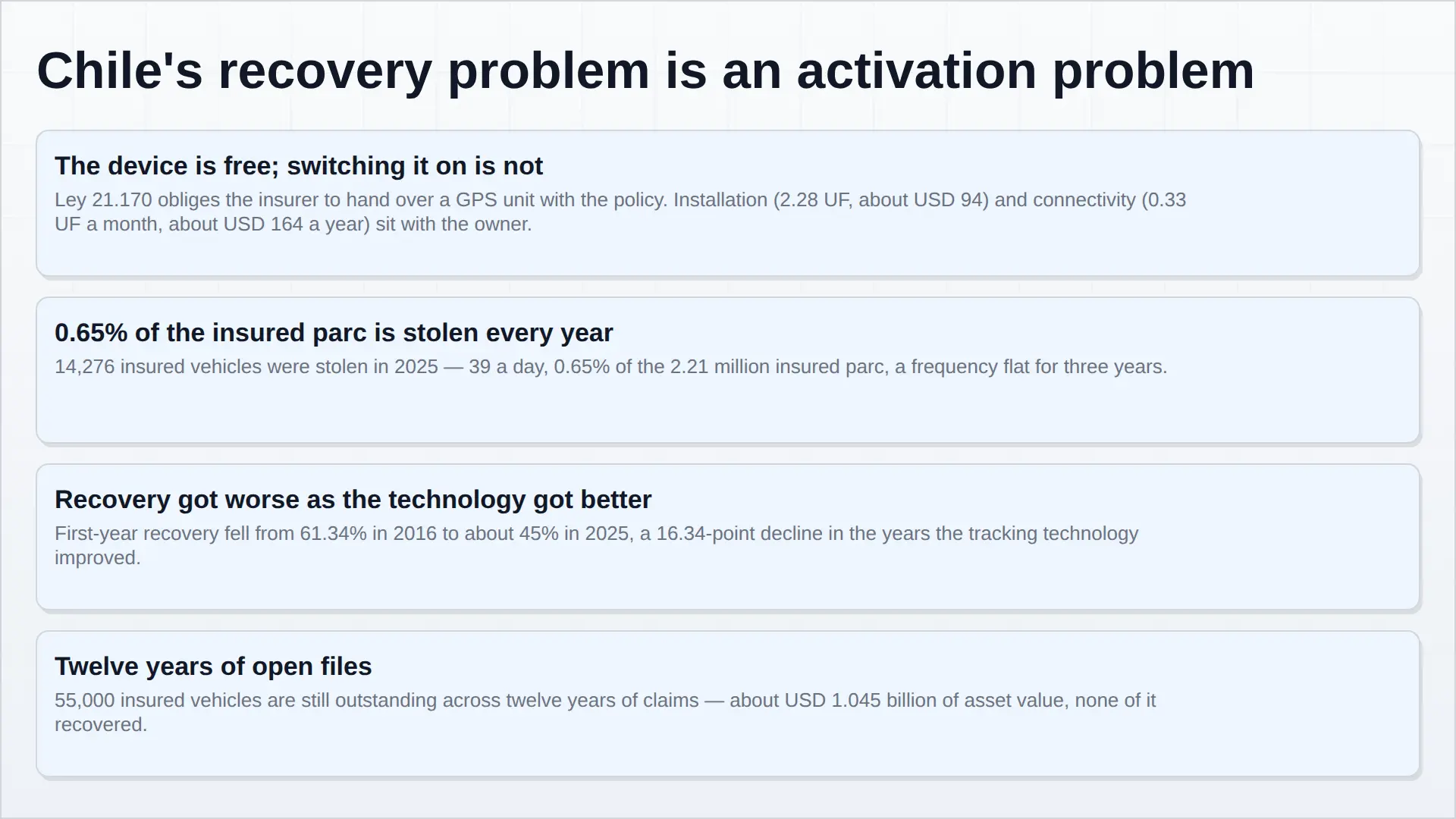
Chilean tracking is priced in Unidades de Fomento, so the contract the consumer is offered is written in an inflation-indexed unit and paid in pesos. At the 2025 averages — a UF worth about CLP 39,300 and a dollar at CLP 951.25 — the standard consumer plan is 0.33 UF a month, or USD 163.59 a year, with installation at 2.28 UF, or USD 94.19. A fleet plan runs 0.28 UF a month (USD 138.80) with a 1.66 UF installation (USD 68.58). A corporate plan runs 0.57 UF a month (USD 282.47) with a 1.00 UF installation (USD 41.31).
So the free device costs its owner USD 257.78 in the first year to do anything at all. Set that against the thing it is insuring. Chile’s insured theft frequency is 0.65 per cent — three consecutive years at the same rate — and the average insured vehicle is worth about USD 19,007. Multiply the two and the entire expected annual theft loss on an average insured car is USD 123.55.
That is the number that decides this market. The total expected loss is smaller than the subscription. A rational owner who reads the arithmetic is not being reckless by leaving the unit in the glovebox; they are being correct. And no sales argument survives it, because even a device that guaranteed recovery — a 100 per cent uplift, which no product delivers — would only be worth USD 123.55 a year to the person paying USD 163.59.
The cost is in the wrong place, so the value is too
The reason the arithmetic looks absurd is that the device is not protecting the owner’s asset. It is protecting the insurer’s balance sheet. When a car is stolen and not recovered, the owner loses a deductible and the use of the vehicle for a few weeks; the insurer loses the car. The recovery rate is a claims variable, not a consumer convenience.
Which means the party with the strongest economic interest in the device working is the party that does not pay to switch it on. Chile’s insurers carry an expected theft loss of roughly USD 273 million a year across the insured parc — 0.65 per cent of 2.21 million vehicles at USD 19,007 each — against which a device that raised the recovery rate by even a few points is worth many multiples of its cost. The owner faces USD 18.53 of expected annual benefit for a 15-point uplift in recovery probability. Those two numbers are the same technology seen from opposite ends of the contract.
| Measure | Value |
|---|---|
| Insured vehicles, 2025 | 2,211,320 |
| Share of vehicle parc insured | 31.81% of 6,951,716 |
| Insured vehicles stolen, 2025 | 14,276 (39 a day) |
| Annual theft frequency | 0.65% |
| Average insured vehicle value (Pheonix estimate) | USD 19,007 |
| Expected annual theft loss per insured vehicle | USD 123.55 |
| Installation cost to owner | USD 94.19 (2.28 UF) |
| Connectivity cost to owner | USD 163.59 a year (0.33 UF a month) |
| Year-one cost of the “free” device | USD 257.78 |
| Estimated active recovery subscriptions | 531,000 units — 24.0% of insured vehicles |
What the recovery rate did while all this was being installed
Chile recovered about 45 per cent of the insured vehicles stolen in 2025 within the first year of the claim. That is an improvement — the second consecutive annual rise — and it is still 16.34 percentage points below the 61.34 per cent of 2016, and 9.75 points below the 54.75 per cent of 2017. About 6,424 vehicles came back. About 7,852 did not, worth roughly USD 149.2 million, or 10.95 per cent of the entire USD 1.363 billion Chilean vehicle-insurance premium.
Across twelve years of claims, roughly 55,000 insured vehicles remain outstanding — about USD 1.045 billion of asset value that nobody in the chain is paid to find. Not the installer, not the platform, not the insurer, not the state. A market that pays on subscription rather than on outcome has no incentive to search for a vehicle that has been gone for a year.
What a rational version of this policy would look like
Three changes, in ascending order of difficulty, and none of them requires new technology.
1. Move the installation and the first year of connectivity to the party that owns the loss. A bill before Congress would do exactly this — amending Ley 21.170 to facilitate installation of GPS and anti-theft immobilisers rather than merely mandating the handover. At 2025 tariffs, each 100,000 additional activations is worth USD 16.4 million of annual subscription revenue and USD 9.4 million of installation revenue. A shift that activated 300,000 vehicles would add about USD 49.1 million of recurring revenue and USD 28.3 million of installation to a market that is USD 131.1 million today. That is not a forecast; it is the size of the prize sitting in a clause.
2. Verify installation at the point of claim. Nothing in the claims process tests whether the unit the insurer was obliged to provide was ever fitted. Until something does, a compliant insurer and an unconnected vehicle remain entirely compatible states of affairs, and the 76 per cent stays in the drawer.
3. Buy recoveries, not subscriptions, where the economics favour it. Chile already owns the cheapest recovery instrument in the country. The insurer-funded licence-plate recognition network returned 1,858 vehicles across more than 260 communes in 2025 for roughly USD 2,476 of programme spend per recovery. The full recovery stack spends USD 20,408 per vehicle returned through all channels. The camera is 8.24 times cheaper per recovery, because a pole reading every plate in a commune is shared infrastructure and a subscription covers one car.
None of this makes the device redundant. A plate read tells you a vehicle passed a point; a telematics unit tells you where it is now. The point is that Chile has been buying the expensive half of the system and giving away the cheap half, and then measuring the result as though it were a technology problem.
The numbers the market actually transacts in
Pheonix sizes Chile’s vehicle theft recovery market — what insurers, fleet operators and owners pay to locate, immobilise and recover stolen vehicles and put them back on the road — at USD 131.1 million in 2025, reaching USD 261.4 million by 2033 at 9.01 per cent. Recurring subscriptions are 81.9 per cent of that; installation is 7.5 per cent; the plate network 3.5 per cent; re-securing and custody 3.0 per cent; investigation and salvage 4.1 per cent.
The growth is not a pricing story. Connected recovery-capable units go from 627,000 to 1,108,000 (7.38 per cent) while spend per connected unit goes from USD 209.09 to USD 235.92 (1.52 per cent) — 77.2 per cent of the USD 130.3 million added is more vehicles, 22.8 per cent is more per vehicle. Every vendor in this market who plans to grow through tariff increases is planning against 1.52 points of indexation, which is another way of saying they are planning to lose.
The concentration of the demand side makes that harder still. BCI Seguros writes 29.3 per cent of vehicle policies and HDI 27.5 per cent — 56.8 per cent between them — with Sura at 8.5 per cent, Zurich 8.0 per cent, Consorcio 5.3 per cent and Reale 5.0 per cent. Two procurement functions set the device specification and the recovery service level for more than half the market, in a segment where 4,182,519 policies were issued in 2025, up 10.79 per cent, at an average premium 21.43 per cent lower than a year earlier. A recovery line is the easiest thing in the world to trim when an actuary is defending a loss ratio.
The vehicles that get taken
The recovery market is shaped as much by what is stolen as by how much is insured. The ten most-stolen insured models in Chile account for roughly a third of insured thefts, and the list is dominated by pickups and compact SUVs with strong resale and a deep parts market: the Toyota Hilux, RAV4 and Land Cruiser, the Mitsubishi L200, the General Motors Chevrolet Groove, the Ford Territory, the Suzuki Baleno, the Kia Soluto and Rio, and the Nissan Frontier. Hyundai, through Hyundai Motor Company, is the other high-volume brand in the insured mix.
That composition matters to the economics. A pickup is worth more as parts than as a vehicle, which is why the recoverable window is short and why the recovery rate is not a function of how many trackers are sold. It also explains the fleet overlap: the same Hilux and L200 that dominate the theft list dominate commercial fleets, which is where the telematics platforms — Geotab and Samsara among them — sell recovery as a feature inside a routing and compliance contract rather than as a stand-alone subscription. Fleet recovery revenue per unit is lower than consumer, and churn is far lower, because nobody changes a telematics platform to save USD 25 a year. For the adjacent fleet markets, see Pheonix’s coverage of global fleet management, fuel cards and fleet payment, fleet depots and overnight yard charging and road safety and enforcement systems, which is where the camera half of this market is analysed.
What to watch
The signal that this market is being restructured is not the theft count. It is the share of insured recoveries produced by the plate network: 1,858 of 6,424 in 2025, or 28.9 per cent. If that share rises while total recoveries stay flat, the buyer has found the cheaper instrument, and the subscription layer’s growth stops being a function of demand and starts being a function of regulation.
The second signal is the installation bill. If it passes in a form that moves cost to insurers, the drawer opens, and the device layer gets the largest revenue event available to it this decade. If it stalls, the base case holds: five points of attach in eight years, a market that grows because Chile insures more vehicles, and a recovery rate stuck somewhere near 45 per cent while the technology that is supposed to fix it sits unplugged.
Both outcomes are knowable, and neither depends on the crime rate. That is the unusual thing about this market: it is not really a security story at all. It is a story about who pays USD 94 to fit a device into a car worth USD 19,007.
Sources: Ley 21.170 and the bill before Congress amending it; Asociación de Aseguradores de Chile vehicle-insurance statistics for 2025; Carabineros de Chile, Glosa N°15; Comisión para el Mercado Financiero; Instituto Nacional de Estadísticas; Servicio de Impuestos Internos UF and dollar series; published Chilean tracking tariffs. Read the full Chile Vehicle Theft Recovery market report for the seven-layer reconstruction, the tariff economics and the eleven-risk register.
Frequently Asked Questions
Why would a Chilean driver not activate a free anti-theft device?
Because the device is not the cost. At 2025 tariffs, installation is 2.28 UF (about USD 94.19) and connectivity 0.33 UF a month (about USD 163.59 a year), so the free unit costs USD 257.78 in year one. Against a 0.65 per cent theft frequency and an average insured vehicle value of about USD 19,007, the entire expected annual theft loss on that vehicle is USD 123.55 — less than a single year of the subscription. The device protects the insurer's balance sheet, not the owner's.
Does a GPS tracker actually improve the chance of getting a stolen car back in Chile?
It improves it for a vehicle that is still being driven and has not been contained, and it does very little once the car is in a container, a basement or a yard with the antenna cut. That is consistent with the data: Chile recovered about 45 per cent of insured stolen vehicles in the first year of the claim in 2025, up on the prior year but 16.34 points below the 61.34 per cent of 2016, in the same years that tracking technology improved. Pheonix treats the link between containment and the falling recovery rate as an inference, not a measured finding.
What is the pending bill on GPS installation in Chile?
A bill before Congress would amend Ley 21.170 to facilitate the installation of GPS devices and anti-theft immobilisers in motor vehicles, in practice shifting installation and activation from the vehicle owner to the insurer. On 2025 tariffs and Pheonix's attach model, each 100,000 additional activations is worth about USD 16.4 million of annual subscription revenue and USD 9.4 million of installation revenue.
Why is the licence-plate network cheaper than a tracked vehicle?
Because it is shared infrastructure. The insurer-funded network returned 1,858 vehicles across more than 260 municipalities in 2025 for roughly USD 2,476 of programme spend per recovery, while the full recovery stack spends about USD 20,408 per vehicle returned through all channels. A camera reads every plate that passes it; a subscription covers one vehicle and is paid whether or not that vehicle is ever stolen.