
Editorial Article
Europe's Most Ambitious Sustainable Funds Have Shed Client Money for Eight Straight Quarters
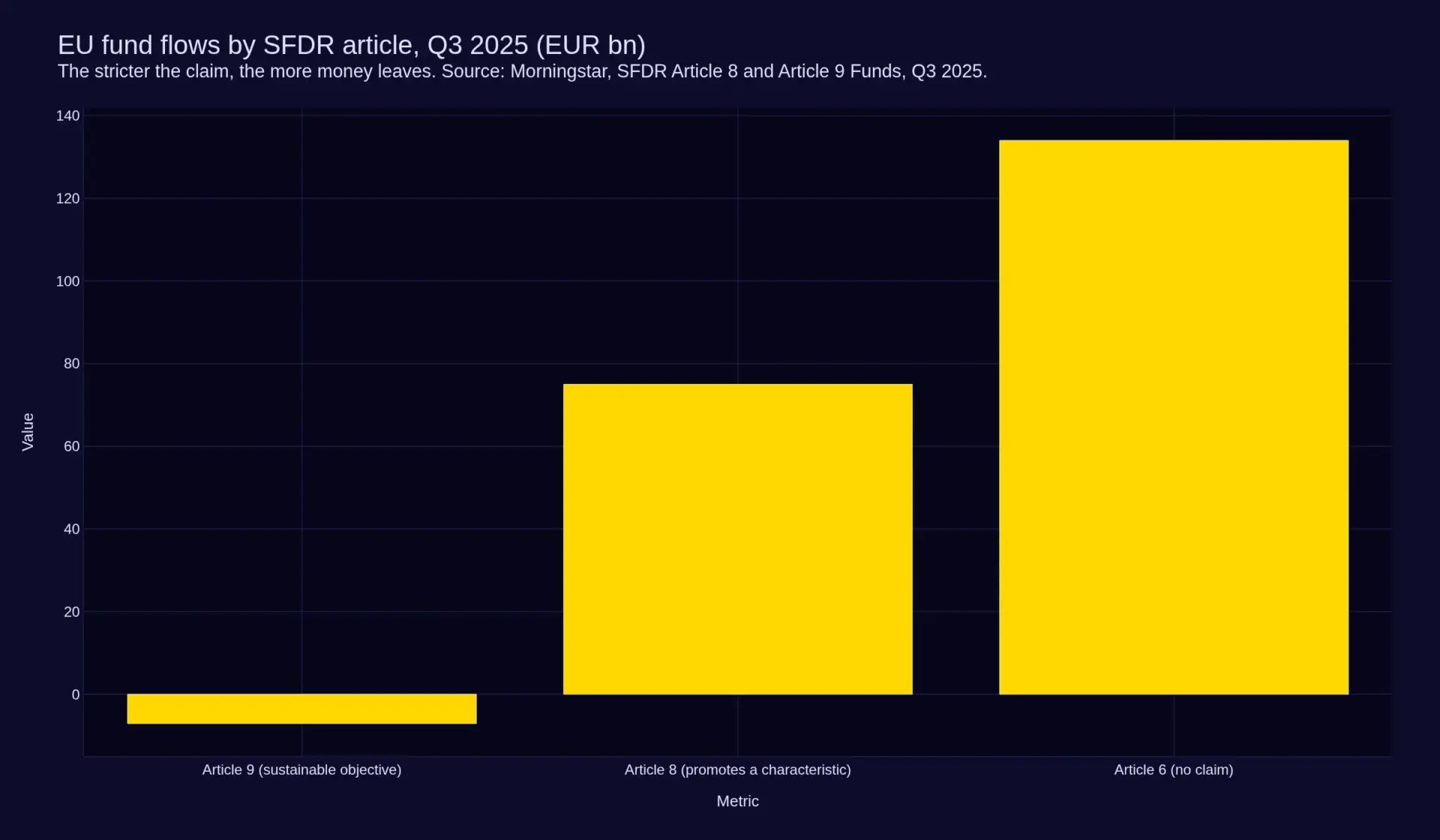
In the third quarter of 2025, the only European fund category that legally promises a sustainable objective lost EUR 7.1 billion of client money. It was the eighth consecutive quarter of redemptions. In the same three months, the category that promises no sustainability objective at all took in EUR 134 billion — eighteen times more than the category that promotes a characteristic, and more than the entire sustainable fund universe manages in a quarter.
Article 9 funds are the strictest thing European regulation allows a fund manager to sell. They must hold a minimum proportion of sustainable investments, they must show that no holding significantly harms an environmental or social objective, they must report on adverse impacts, and their classification is reviewed. Article 6 funds make none of these claims and are subject to none of these obligations. Between them, the market has now voted for two years running, and the vote has been consistent: the more a fund promises, the less money it holds.
This is not a story about investor indifference
The easy reading of those numbers is that European investors have lost interest in sustainability. The data does not support it. Article 8 funds, which promote an environmental or social characteristic without committing to a sustainable objective, took in EUR 75 billion in the same quarter — up from EUR 47 billion in the second quarter. Combined, Article 8 and 9 funds held EUR 6.8 trillion and accounted for roughly 59 per cent of all EU fund assets. The capital did not leave sustainable investing. It moved one step down the ambition ladder, to the rung where the promise is softer and the legal exposure is smaller.
The ambition tax
There is a structural reason why the strictest category struggles, and it has nothing to do with performance or conviction. A sustainable objective shrinks the investable universe. A smaller universe produces more tracking error against a conventional benchmark, which is precisely what a consultant’s monitoring report highlights in the years when the effect goes the wrong way. It raises the cost of holding each position, because every candidate has to be assessed against the do-no-significant-harm test and the adverse-impact indicators. And it converts a marketing claim into a legal one: an Article 9 fund that fails its own stated objective is not merely disappointing, it is contestable.
Add the fee comparison and the trap closes. A manager running an Article 9 equity strategy carries a higher cost base and a narrower opportunity set than a manager running an otherwise identical unlabelled strategy, and both are competing for the same allocation from the same platform. The unlabelled fund can undercut on price, hold whatever it likes, and describe itself afterwards. In a market where the average sustainable fund holds USD 552 million and fees are compressing, that is not a fair fight.
The renaming wave is the same decision, made differently
Between January 2024 and September 2025, at least 1,450 European funds were renamed — roughly 31 per cent of those in scope of the naming guidelines — including 121 in the third quarter of 2025 alone, 64 of which dropped ESG language from their names. Each of those renamings is a manager reaching the same conclusion as the investor: that the word costs more than it earns.
What makes this more than a marketing cycle is that a rename is often the alternative to a closure. Managers facing a naming review have three options — restructure the portfolio to justify the name, rename the fund, or merge or close it. The evidence says they are choosing the middle option at scale, which means the assets survive and the label does not. For the industry’s public statistics, that is indistinguishable from a redemption. For the client, nothing happened at all.
What the Article 6 buyer is actually getting
The uncomfortable possibility is that the Article 6 inflows are not a retreat from sustainability so much as a rejection of packaging. An unlabelled European equity fund run by a manager with a house-wide exclusion policy and an engagement programme may be more sustainable in practice than a labelled fund that satisfies the disclosure requirements and does little else. The regulation does not measure that. It measures the claim.
This is the gap the market has found and is now exploiting. Investors who want the practice without the promise can buy an unlabelled fund at a lower fee and take the sustainability as an unstated by-product. Investors who want the promise have to accept the concentration, the cost and the tracking error. Presented that way, the eight quarters of Article 9 outflows look less like a verdict on sustainable investing and more like a rational response to a badly designed price.
What would reverse it
Two things could. The first is a genuine transition category with its own framework — a classification for funds that hold high-emitting assets with credible, dated decarbonisation plans, rather than funds that hold only the already-clean. That category does not currently exist in European regulation, and its absence pushes transition capital into either unlabelled funds or segregated mandates. The second is the continued migration to mandates, where an asset owner writes its own objective and does not need a fund’s name to carry the claim. That is already happening, and it is why European sustainable fund assets reached a record USD 3.3 trillion in 2025 in the same year the flows turned negative.
The paradox resolves if you stop treating Article 9 as the market and start treating it as the market’s most expensive product. Eight quarters of redemptions from a category that promises the most is not evidence that investors stopped caring. It is evidence that they have started pricing the promise, and did not like the price.
Frequently Asked Questions
What is an Article 9 fund under SFDR?
An Article 9 fund is a European fund whose stated objective is sustainable investment. It must hold a minimum proportion of sustainable investments, demonstrate that holdings do no significant harm to environmental or social objectives, report on adverse sustainability impacts, and be able to substantiate the objective. It is the strictest of the three SFDR classifications, above Article 8 (which promotes a characteristic) and Article 6 (which makes no sustainability claim).
Why have Article 9 funds lost money for eight consecutive quarters?
Because the strictest claim carries the highest cost and the narrowest investable universe, while competing for the same client allocation as unlabelled funds that carry neither. A sustainable objective produces concentration, more tracking error against conventional benchmarks, higher per-position diligence costs and genuine legal exposure if the objective is missed. Investors moved one step down the ladder to Article 8 funds, which took in EUR 75 billion in the third quarter of 2025, and to Article 6 funds, which took in EUR 134 billion.
Does this mean investors have lost interest in sustainable investing?
No. Article 8 and Article 9 funds together held EUR 6.8 trillion, about 59 per cent of all EU fund assets, in the third quarter of 2025, and European sustainable fund assets reached a record USD 3.3 trillion in 2025. What has changed is packaging preference: capital is moving from products that make a legal promise to products that do not, and into segregated mandates that are invisible in fund-flow statistics.
How many European funds were renamed and what was the effect?
At least 1,450 European funds were renamed between January 2024 and September 2025, roughly 31 per cent of those in scope of the naming guidelines, including 121 in the third quarter of 2025 alone of which 64 dropped ESG language. A rename does not redeem a single unit, but it removes the fund from the measured sustainable universe, so the effect on published market statistics is the same as an outflow.