
Editorial Article
Forty New Funds a Quarter: Sustainable Investing Has Stopped Launching Products
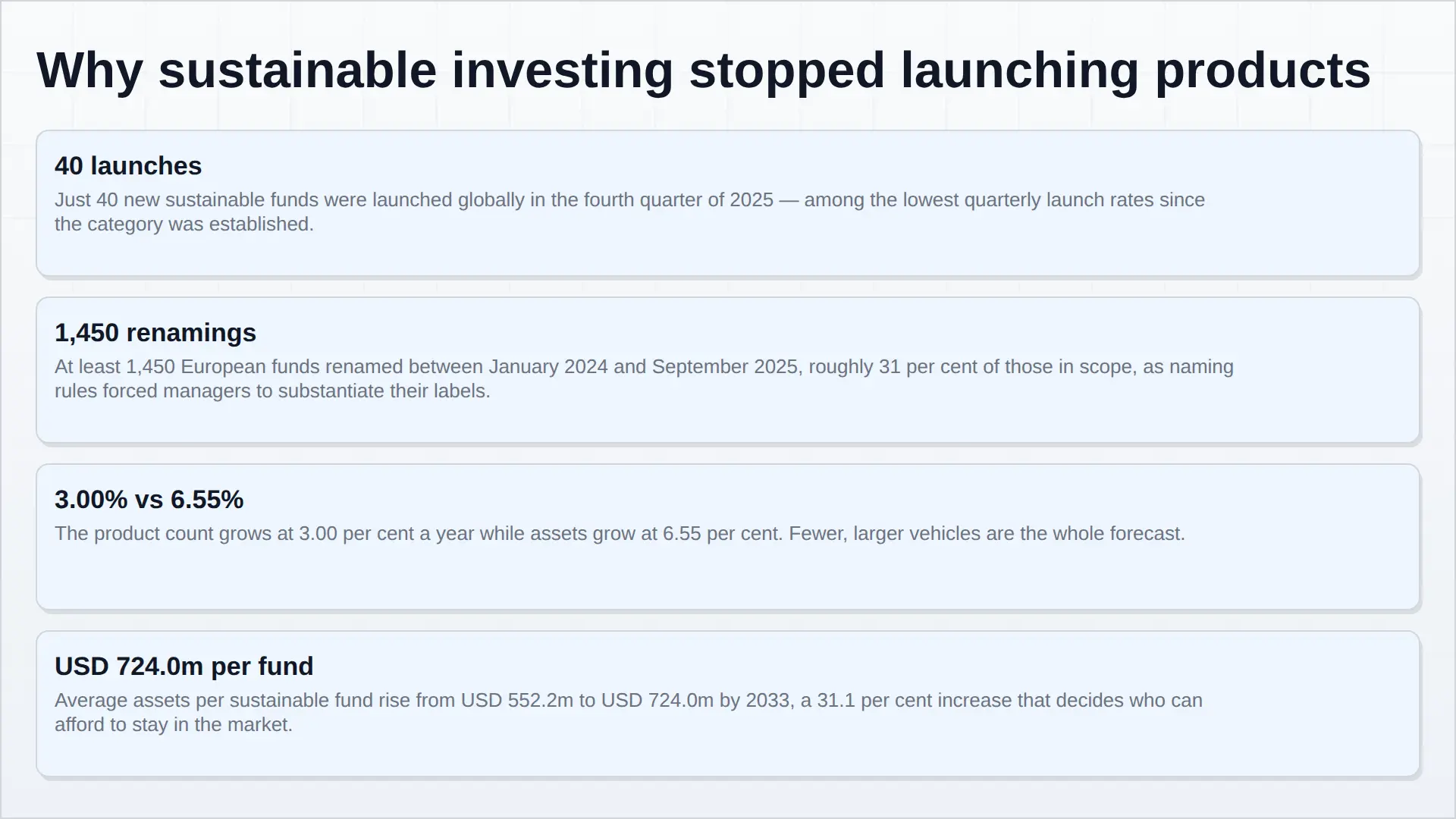
Forty. That is how many new sustainable funds were launched across the entire world in the fourth quarter of 2025. Forty products, in a market holding USD 3,901 billion across 7,064 funds, at a time when the sector’s own surveys report that 88 per cent of individual investors are interested in sustainable investing and 86 per cent of asset owners expect to increase allocations. The launch rate is the single most honest indicator this industry produces, because a launch is the one decision a manager makes with its own money before a client has committed anything.
A launch is a business case, and the business case broke
Launching a European sustainable fund now requires clearing four gates that did not exist in 2020. The name has to survive a naming review that requires evidence the portfolio actually delivers what the name implies. The disclosure pack has to satisfy a classification regime that distinguishes between promoting a characteristic and committing to an objective. The distribution platform has to find shelf space against incumbent products with a ten-year track record. And the fee has to be competitive with an index fund that can underdeliver on the name without anyone asking.
Run the arithmetic and it stops being a close call. On a Pheonix estimate of 38 basis points of average fee, a fund that gathers USD 100 million generates USD 380,000 a year of revenue. That is the number that has to cover portfolio management, compliance, the naming and disclosure work, distribution and a share of the platform’s own margin. A new sustainable fund does not need to be bad to fail at that size; it needs to be average. The rational response for a manager in 2025 was not to launch, and 40 launches in a quarter is what rationality looks like.
When you cannot launch, you rename
The same cost structure explains the other number. Rather than build new products, managers rebuilt old ones: at least 1,450 European funds were renamed between January 2024 and September 2025, roughly 31 per cent of those in scope, with 121 renamings in the third quarter of 2025 alone. Renaming is cheap relative to launching and it preserves the assets. It also shrinks the measured sustainable universe, which is why the industry’s headline product count is growing far more slowly than its assets.
That is the whole forecast in one line. Pheonix models the sustainable fund universe growing from 7,064 products to 8,950 by 2033 — 3.00 per cent a year — while assets grow from USD 3,901.0 billion to USD 6,480.0 billion at 6.55 per cent. The gap between those two rates is not a rounding difference; it is a change in the industry’s growth model, from building products to filling them.
What USD 724 million per fund means
Average assets per sustainable fund rise from USD 552.2 million to USD 724.0 million over the forecast period, a 31.1 per cent increase. That single figure decides the competitive landscape more than any sustainability thesis. A manager with sixty sub-scale products cannot spread the fixed cost of naming, disclosure and compliance across enough assets to make them viable, and cannot easily close them without writing off the distribution relationships attached to them. A manager with fifteen large products can.
This is why the concentration already visible in the league table will deepen. The ten largest sustainable fund franchises held USD 1,585.0 billion, 40.6 per cent of the universe, at the end of 2025, with BlackRock alone at USD 452.6 billion or 11.6 per cent. The top ten did not get there by launching more products than everyone else. They got there by being the incumbent on the platforms where European distribution actually happens.
The launches that still make sense
The 40 products that did launch in the fourth quarter of 2025 are worth more analytical attention than the thousands that already exist, because they reveal what still clears the bar. Three categories recur.
Fixed income, first. Sustainable bond funds took in USD 12.1 billion in the fourth quarter while sustainable equity funds lost USD 26.1 billion, and a bond mandate carries a lower fee but a far larger addressable balance — a single institutional allocation can be USD 500 million. Second, transition and climate-transition strategies aimed at high-emitting assets with credible plans, because that is where the unlabelled competition is weakest and the client’s own disclosure obligations are hardest to meet without help. Third, private and real-asset vehicles, where fees are higher, the label is negotiated rather than filed, and the flow statistics do not reach.
What no longer clears the bar is another generalist sustainable equity fund with a screening overlay and a name. That product’s economics were viable when the label carried a distribution advantage. It does not carry one any more.
The strategic conclusion
An industry that launches forty products a quarter and renames a thousand a year is not in decline; it is in the middle of changing what it sells. The assets under management are growing at more than twice the rate of the product count, and the fee pool is growing more slowly than either. That combination — assets up, products flat, revenue lagging — describes a market consolidating around scale, in which the winners are the platforms that already have the shelf and the losers are the boutiques that built a business on being early.
The number to watch next is not the flow figure. It is the launch count. When it turns, and it will turn only after the fee arithmetic works again, the industry will have finished repricing the label. Until then, forty is the number that tells the truth.
Frequently Asked Questions
How many new sustainable funds were launched in 2025?
Forty new sustainable funds were launched globally in the fourth quarter of 2025, one of the lowest quarterly launch rates since the category was established. That compares with at least 1,450 European fund renamings between January 2024 and September 2025, and with a global universe that already holds 7,064 products and USD 3,901.0 billion of assets.
Why has sustainable fund product development slowed so sharply?
Because the unit economics stopped working. On a Pheonix estimate of 38 basis points of average fee, a new fund needs well over USD 100 million of assets to cover portfolio management, compliance, the naming and disclosure work and distribution. A product must also clear a naming review, a disclosure classification and a platform's shelf decision before it earns anything. Renaming an existing fund is far cheaper than launching a new one.
What does the rising average fund size mean for competition?
Average assets per sustainable fund rise from USD 552.2 million in 2025 to a forecast USD 724.0 million in 2033, a 31.1 per cent increase. Because the compliance cost per product is largely fixed, scale advantages compound: managers with a small number of large products can absorb the cost, while managers with many sub-scale products cannot. The ten largest franchises already hold 40.6 per cent of the universe.
Which sustainable products still attract launches?
Three categories clear the bar: sustainable fixed income, where institutional allocations are large despite lower fees and where bond funds took in USD 12.1 billion in the fourth quarter of 2025; transition strategies aimed at high-emitting assets with credible decarbonisation plans; and private and real-asset vehicles where fees are higher and the label is negotiated rather than filed. Another generalist sustainable equity fund no longer clears it.