
Company Profile
Hengan International
Hengan International Group Company Limited (HKEX: 1044) is a Jinjiang, Fujian consumer hygiene group that sells tissue paper, sanitary napkins and baby diapers into the world’s most contested consumer market. It is the largest Chinese-owned participant in the feminine hygiene category Pheonix Research models in its Global Feminine Hygiene Products Market report — a US$39,800m market in 2025 growing 3.80% a year to US$53,650m by 2033 — and it is also the clearest evidence that in China the constraint on that growth is price, not demand.
Identifiers
| Legal name | Hengan International Group Company Limited |
|---|---|
| Listing | The Stock Exchange of Hong Kong, ticker 1044 |
| Headquarters | Jinjiang, Fujian Province, China |
| Founded | 1985 |
| Fiscal year | 1 January to 31 December |
| Wikidata ID | Q5714244 — label “Hengan International”, described as a Chinese company |
| Pheonix entity ID | MIEN-node_11b6c9d7 |
| Official website | hengan.com |
| Investor relations | HKEXnews, stock code 1044 |
| Regulatory filings | Annual results announcement for the year ended 31 December 2025 |
| Pheonix coverage | The China position in the Global Feminine Hygiene Products Market report, and a named brand owner in The pad got shorter because nobody measures the absorbent core |
Executive Summary
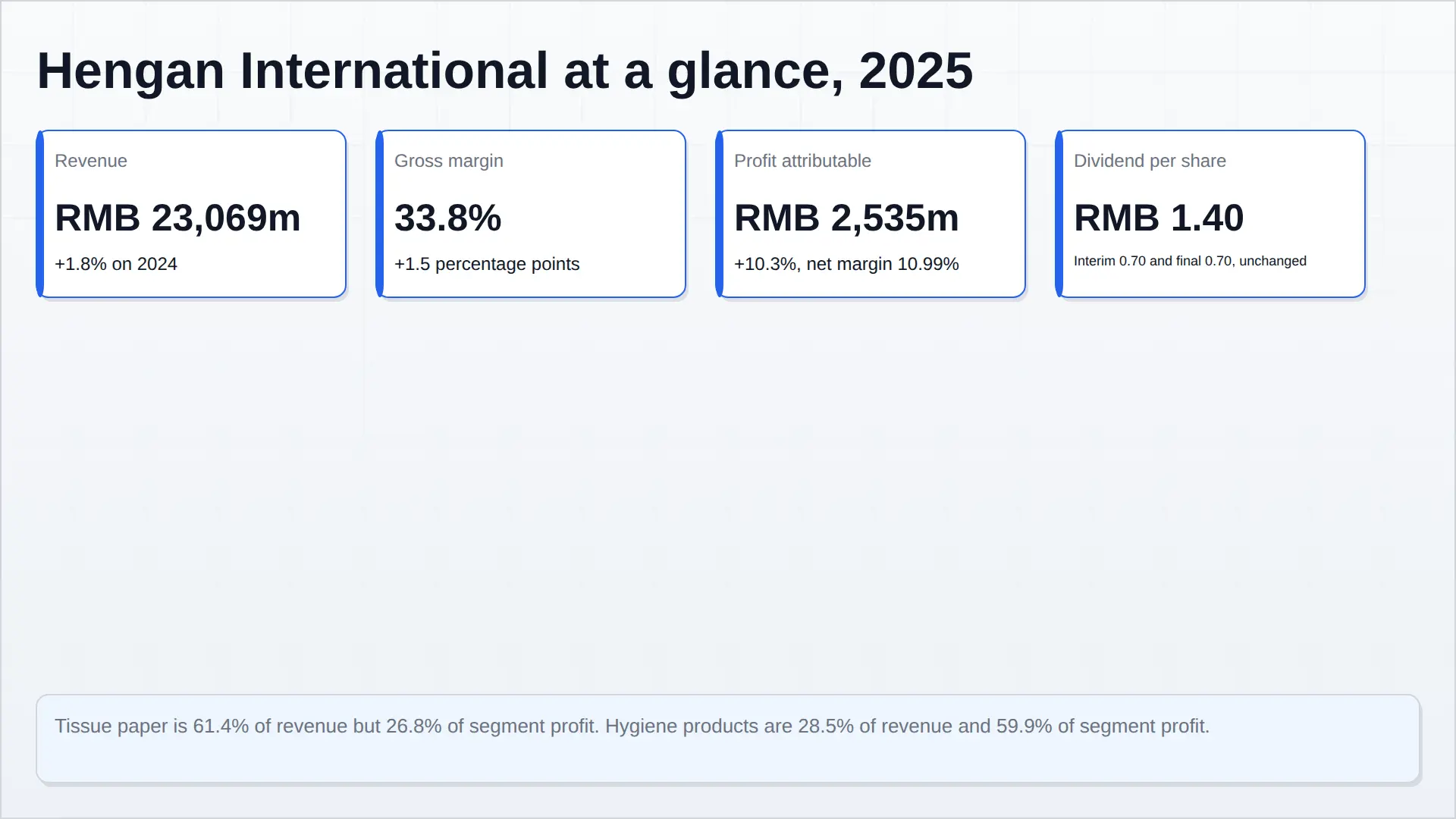
Hengan reported revenue of RMB 23,068.9m for 2025, up 1.8%, gross margin of 33.8% against 32.3%, and profit attributable to shareholders of RMB 2,535.0m, up 10.3%. On flat-to-modest revenue growth the company delivered a tenth more profit, which is the signature of a business buying margin through input cost and mix rather than selling more units. Basic earnings per share rose 10.5% to RMB 2.227 and the dividend was held at RMB 1.40 for the year, split evenly between an interim and a final of RMB 0.70 each.
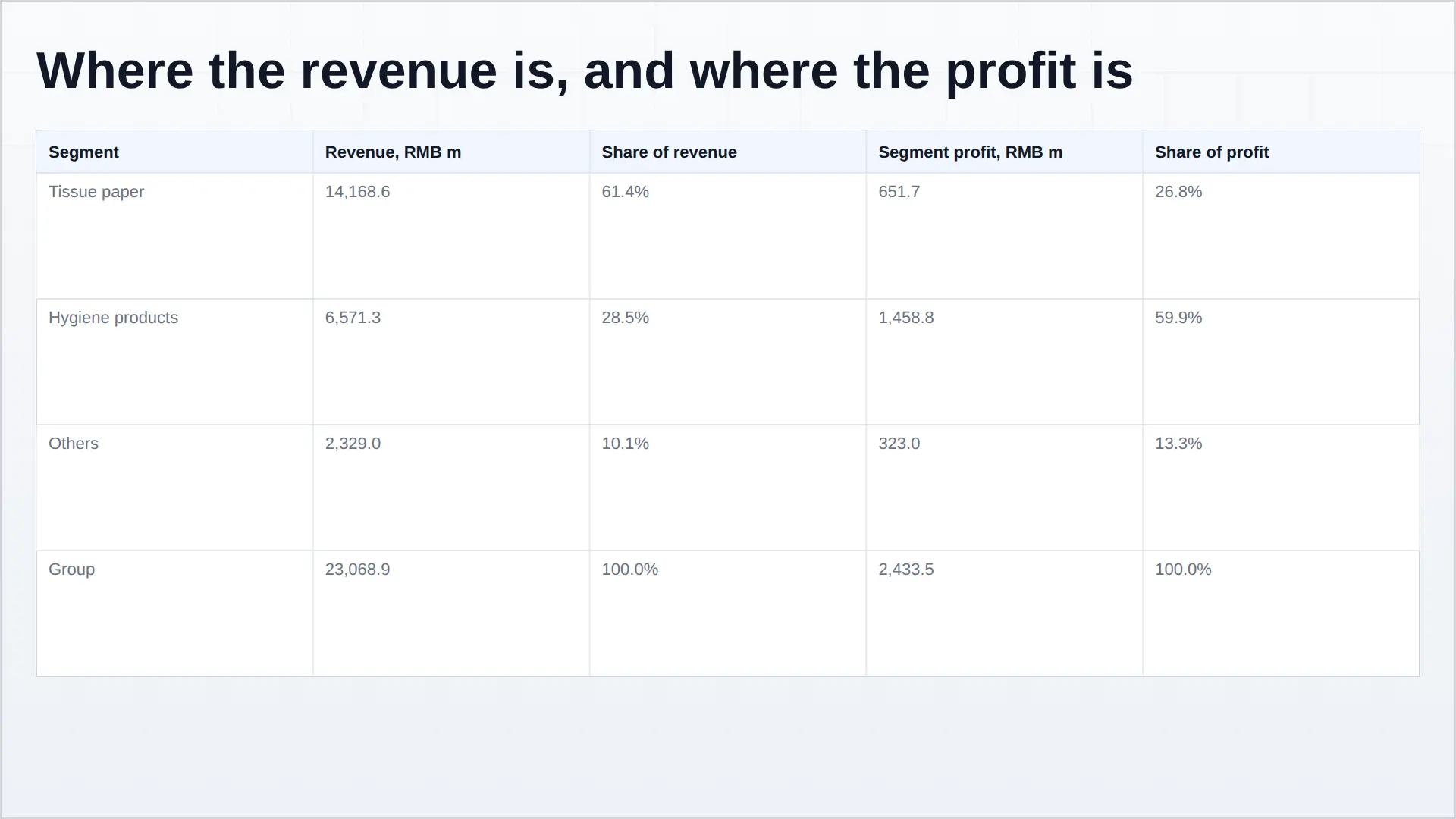
The shape of the business matters more than the totals. Tissue paper produced RMB 14,168.6m of revenue, 61.4% of the group, and RMB 651.7m of segment profit, 26.8% of the total. Hygiene products — sanitary napkins and baby diapers — produced RMB 6,571.3m of revenue, 28.5%, and RMB 1,458.8m of segment profit, 59.9%. The smaller business earns more than twice the profit of the larger one. That inversion is the whole investment case, and it is also the reason the company’s exposure to pulp prices cuts both ways: cheap pulp flatters the tissue margin, and it is the tissue business that has the thinner margin to protect.
|
RMB 23,069m 2025 revenue, up 1.8% on 2024 |
33.8% Gross margin, up 1.5 percentage points |
RMB 2,535m Profit attributable to shareholders, up 10.3% |
59.9% Share of segment profit from hygiene, on 28.5% of revenue |
Key Highlights
| Period | Highlight |
|---|---|
| 2025 revenue | RMB 23,068.9m (+1.8%), with the core tissue and hygiene segments at RMB 20,739.9m (+1.9%). Cost of goods sold fell to RMB 15,263.0m from RMB 15,344.3m on lower input costs. |
| 2025 profitability | Gross margin 33.8% from 32.3%; operating profit RMB 3,484.1m (+3.9%); net finance costs fell to RMB 279.2m from RMB 383.2m; profit attributable RMB 2,535.0m (+10.3%). |
| 2025 returns | Basic earnings per share RMB 2.227 (+10.5%); rate of return 11.6% against 11.0%; dividend held at RMB 1.40 per share, interim 0.70 and final 0.70. |
| 2025 working capital | Accounts receivable turnover improved to 36 days from 39, and finished goods turnover to 42 days from 46. The current ratio fell to 1.2 from 1.4. |
| First half 2026 | Reported sales fell 6%: tissue paper −5.9%, baby diapers −8.8%, sanitary napkins −1.2%. Gross margin still improved to 35.3% on lower pulp prices and better mix, while the operating expense ratio rose two percentage points on brand investment. |
| Strategy and channel | New retail and e-commerce are approximately 40% of total sales. Management has said it will not sacrifice pricing to gain share, and will rely on product upgrading and channel migration instead. |
Company Overview
Business Description
Hengan reports three segments. Tissue paper is the largest by revenue and the smallest by margin: RMB 14,168.6m of revenue against RMB 651.7m of segment profit, sold under brands including Xinxiangyin into a market where household penetration is high and price competition is severe. Hygiene products is the profit engine: RMB 6,571.3m of revenue for RMB 1,458.8m of segment profit, split between sanitary napkins, where the group sells under Space 7 and other brands, and baby diapers, where Anerle is the principal brand. Others contributed RMB 2,329.0m of revenue and RMB 323.0m of segment profit.
The economics of the two main segments are broadly opposite. Tissue paper is a commodity-adjacent business with high volume, thin margins and a direct dependence on pulp cost. Hygiene is a branded business with lower volume, higher margin and a dependence on consumer preference and channel access. That is why a 1.5 percentage point improvement in group gross margin in 2025, driven by lower input costs, does not equally benefit both halves — and why the sanitary napkin line, which fell only 1.2% in the first half of 2026 while tissue fell 5.9% and diapers 8.8%, is the part of the franchise holding up best.
Organisational Structure and Footprint
Manufacturing and sales are concentrated in mainland China, with tissue paper mills located close to pulp supply and hygiene production sited near consumer demand. The segment structure separates the two businesses because they are managed with different priorities: tissue for scale and cost, hygiene for brand and margin. Corporate items sit outside segment profit, which is why the segment total of RMB 2,433.5m does not equal the reported operating profit of RMB 3,484.1m — the difference being other income and other gains of RMB 1,093.7m, net of unallocated costs of RMB 43.1m.
| Segment | Revenue | Share of revenue | Segment profit | Share of profit |
|---|---|---|---|---|
| Tissue paper | 14,168.6 | 61.4% | 651.7 | 26.8% |
| Hygiene products | 6,571.3 | 28.5% | 1,458.8 | 59.9% |
| Others | 2,329.0 | 10.1% | 323.0 | 13.3% |
| Group | 23,068.9 | 100.0% | 2,433.5 | 100.0% |
Financial Performance
Key Financial Highlights
The 2025 income statement is the story of a modest top line and an improving middle. Revenue rose 1.8% while cost of goods sold fell slightly, from RMB 15,344.3m to RMB 15,263.0m, which lifted gross profit from RMB 7,324.9m to RMB 7,805.9m and the margin from 32.3% to 33.8%. Selling and distribution costs rose to RMB 3,892.4m from RMB 3,687.7m and administrative expenses to RMB 1,469.8m from RMB 1,422.5m, absorbing part of that gain. Operating profit still rose 3.9% to RMB 3,484.1m.
Below the operating line, two movements did the rest of the work. Net finance costs fell from RMB 383.2m to RMB 279.2m as finance costs dropped from RMB 563.6m to RMB 350.7m, and the tax charge was essentially flat at RMB 671.8m. That combination — gross margin up, finance costs down, tax flat — is what turned a 3.9% increase in operating profit into a 10.3% increase in profit attributable to shareholders.
| Line | 2024 | 2025 |
|---|---|---|
| Revenue | 22,669.2 | 23,068.9 |
| Cost of goods sold | (15,344.3) | (15,263.0) |
| Gross profit | 7,324.9 | 7,805.9 |
| Selling and distribution costs | (3,687.7) | (3,892.4) |
| Administrative expenses | (1,422.5) | (1,469.8) |
| Other income and other gains, net | 1,207.9 | 1,093.7 |
| Operating profit | 3,354.6 | 3,484.1 |
| Net finance costs | (383.2) | (279.2) |
| Income tax expense | (675.2) | (671.8) |
| Profit attributable to shareholders | 2,298.5 | 2,535.0 |
| Basic earnings per share, RMB | 2.015 | 2.227 |
| Gross margin | 32.3% | 33.8% |
Revenue Breakdown
By segment the group is 61.4% tissue paper, 28.5% hygiene products and 10.1% other. By profit it is 26.8% tissue paper, 59.9% hygiene and 13.3% other. Read as a portfolio, Hengan is a tissue company that survives on a hygiene business: two thirds of the capital and manufacturing base is committed to the lower-margin category, and the profit that funds the dividend comes from the smaller one.
The demand picture in 2026 has been weaker than 2025 in every line. In the first half of 2026 reported sales fell 6%, with tissue paper down 5.9%, diapers down 8.8% and sanitary napkins down 1.2%; volumes fell 4.0%, 7.8% and 2.6% respectively, while average selling prices moved −2.1%, −1.0% and +1.4%. Tissue and diapers therefore lost both volume and price, and sanitary napkins held price while ceding volume — the only line where the company’s pricing discipline showed up in the numbers.
Profitability Analysis
Margin, not revenue, is where Hengan’s story has been. Group gross margin rose to 33.8% in 2025 and improved further to 35.3% in the first half of 2026, a three percentage point gain the company attributes to lower pulp prices and an improved product mix. That is a reminder of how directly a tissue-heavy manufacturer is levered to its principal raw material — the same fluff and market pulp that Pheonix Research identifies as roughly 10 points of a 100-point shelf-price index in absorbent hygiene.
The offsetting pressure is operating expense. In the first half of 2026 the operating expense ratio rose two percentage points on increased brand investment and new-channel development, so gross margin gains were partly consumed before they reached operating profit, and the revenue decline itself produced deleverage. The company expects the expense ratio to improve in the second half. Working capital in 2025 moved the right way: receivables fell to 36 days from 39 and finished goods to 42 days from 46, although the current ratio slipped to 1.2 from 1.4. Return on equity rose to 11.6% from 11.0%.
SWOT Analysis
|
Strengths
|
Weaknesses
|
|
Opportunities
|
Threats
|
Recent Developments
| Date | Event |
|---|---|
| 19 August 2026 | Reported first-half 2026 results with sales down 6% and profit lower, and set out a priority of brand building and product upgrading over market share. Management flagged retailer private label and e-commerce competition as the main risks for the second half. |
| 17 March 2026 | Published the 2025 annual results: revenue RMB 23,068.9m (+1.8%), gross margin 33.8%, profit attributable RMB 2,535.0m (+10.3%) and a final dividend of RMB 0.70, taking the year to RMB 1.40. |
| 2025 | Cut net finance costs by RMB 104.0m to RMB 279.2m, and improved receivables and finished goods turnover by three and four days respectively. |
Business Strategy
Global Strategy
Hengan’s strategy is stated in defensive terms, which is appropriate for the position it occupies. The company has said it will prioritise sustaining its scale at home and stepping up brand building against intense competition rather than aggressively chasing market share, and that it will not sacrifice pricing to buy volume. The growth it does pursue comes from two places: upgrading established product lines, approached in a measured way as new launches gain traction, and moving volume into modern channels, where new retail and e-commerce already account for approximately 40% of sales.
| Pillar | What it means |
|---|---|
| Price before share | Sanitary napkin average selling prices rose 1.4% in the first half of 2026 while tissue and diaper prices fell, which is the strategy visible in the numbers. |
| Channel migration | New retail and e-commerce at approximately 40% of total sales, with continued investment flagged as a cause of the higher operating expense ratio. |
| Product upgrading | A measured upgrade path for established lines as new launches grow, rather than a wholesale relaunch of the portfolio. |
| Margin through input cost and mix | Gross margin from 33.8% in 2025 to 35.3% in the first half of 2026 on lower pulp prices and better mix, with the dividend held at RMB 1.40 per share. |
Focus-Market Strategy
China is the focus market and, at present, the difficult one. Hengan’s sanitary napkin business held price and lost 2.6% of volume in the first half of 2026; its tissue business lost both volume and price; its diaper business lost 7.8% of volume and 1.0% of price. The competitive pressure is coming from two directions at once — e-commerce brands competing on price and novelty, and supermarkets launching their own private-label ranges — and management has responded by defending brand and product rather than matching the price.
Against the market that Pheonix Research models, Hengan’s position reads as a value-versus-volume problem with a clear arithmetic. The global category is growing 3.80% in value on 0.80% volume growth, with 78.4% of the value growth coming from price and mix. A participant that holds price and cedes volume should therefore still participate in value growth — but only if the mix it sells improves. That is exactly why the sanitary napkin line, where average selling price rose, is the franchise to watch, and why diapers, where both fell, are the one to worry about.
Sources
- Hengan International Group Company Limited, “Annual Results Announcement for the Year Ended 31 December 2025”, 17 March 2026 — HKEXnews (PDF)
- Hengan International, 2026 interim results and management commentary, 19 August 2026, as reported by The Standard, 19 August 2026
- Pheonix Research, Global Feminine Hygiene Products Market — value and volume growth, and the price-and-mix decomposition
- Pheonix Research, The pad got shorter because nobody measures the absorbent core — on the absorbent core and its material costs
- Wikidata, Q5714244
Provenance: this page is bound to Wikidata Q5714244 and to the Pheonix entity MIEN-node_11b6c9d7. Financial figures are taken from Hengan’s 2025 annual results announcement, in renminbi as reported, and first-half 2026 figures from the company’s interim results. Segment shares are calculated from reported segment revenue and segment profit. Interim figures are unaudited. Last verified 18 November 2026.