
Editorial Article
The Substituting Material Reprices Slower Than the Material It Replaces
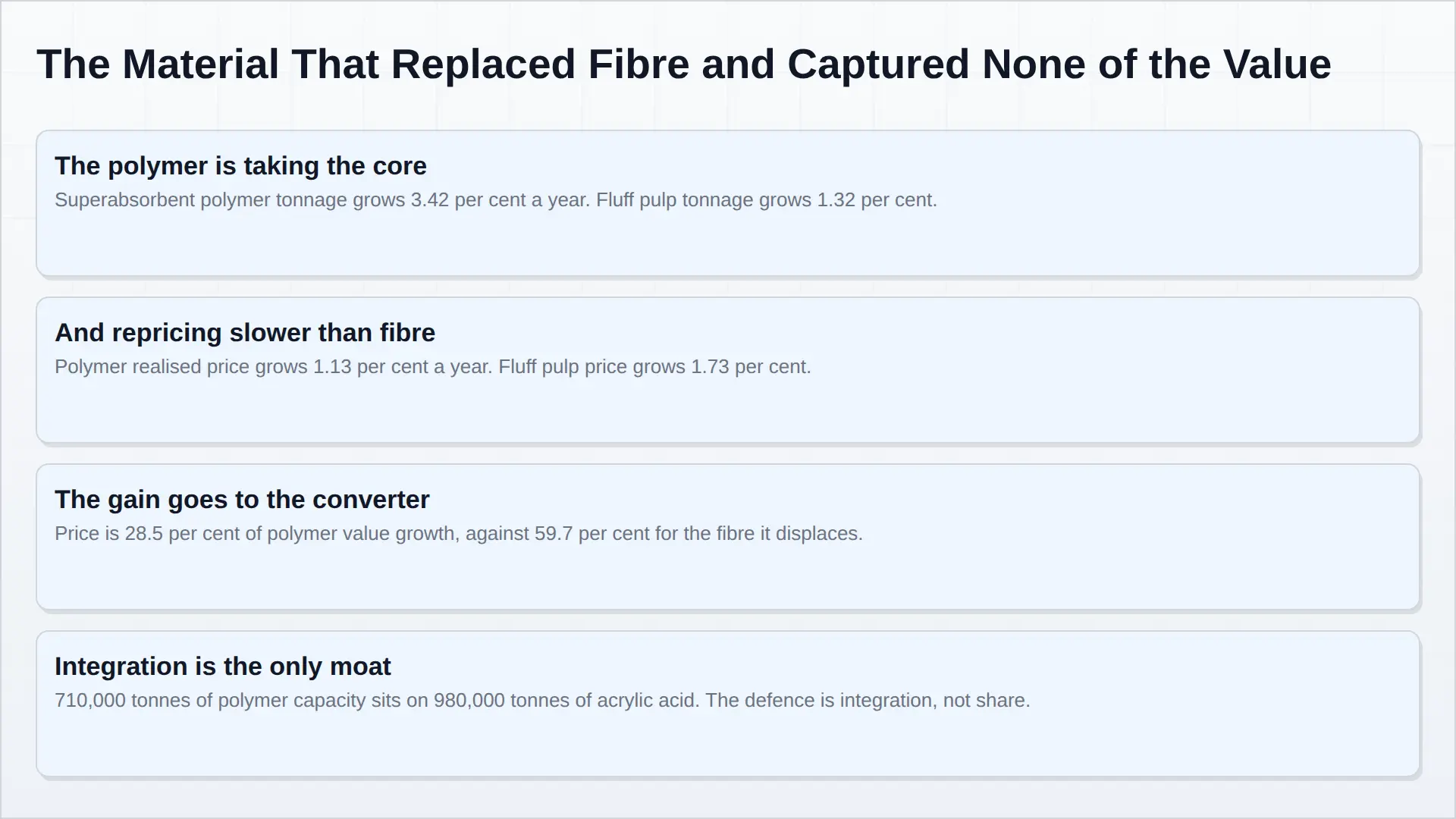
Two materials go into the same absorbent core, and they have behaved in opposite ways for a decade. Superabsorbent polymer volume grows 3.42 per cent a year; fluff pulp volume grows 1.32 per cent. The polymer is winning the core — 2.59 times the tonnage growth of the fibre it displaces.
And then the prices. Polymer price grows 1.13 per cent a year; fluff pulp price grows 1.73 per cent. The substituting material reprices at 65.3 per cent of the rate of the material it is replacing. Price accounts for 28.5 per cent of the polymer market’s value growth, against 59.7 per cent for fibre. This is the strangest result in the whole absorbent chain: the material taking share is the one that cannot charge for it.
The relative price is the entire incentive
Nobody redesigns a core for elegance. A converter takes fibre out and puts polymer in because the resulting unit performs at least as well on the metrics that matter — absorbency under load, rewet, pad integrity — and because the arithmetic of the swap keeps improving.
Look at the direction of both lines. The material being removed is repricing up at 1.73 per cent a year. The material being added is repricing at 1.13 per cent. Every year, the substitution case gets marginally better without anyone having to invent anything. That is why the programme continues through cycles in which the finished product’s price is barely moving — the adult incontinence realisation line is 1.64 per cent a year, and the polymer line sits comfortably below it.
Why fibre can price and polymer cannot
The answer is not demand. Both materials face growing demand from the same end uses. The answer is what each asset can do when its market turns.
A fluff mill is usually a swing asset. The same fibre line can run paper-grade softwood kraft, so the mill holds an option: it can leave the fluff grade when packaging or board earns more per tonne, without closing anything. That option is the reason fluff supply tightens in a way that supports price, and it is why the fluff report prices the grade against northern bleached softwood kraft rather than against hygiene demand.
A superabsorbent plant has no such option. It is a single-purpose capital asset with a long life and low variable cost once built. It cannot make anything else. When the market is in surplus the rational move for every owner is to run and take share, because the alternative is to write the asset off — and that is precisely the behaviour that holds utilisation at 72.7 per cent and price growth at 1.13 per cent.
A share of 17.2 per cent — Nippon Shokubai’s position on surveyed global capacity — should confer pricing power. It does not, because price is set by the ability not to supply, and no owner of a single-purpose plant in a surplus has that ability.
Integration is the only defence that works
Nippon Shokubai holds 710,000 tonnes a year of polymer capacity on 980,000 tonnes of acrylic acid. That is more monomer than its own polymer requires, which makes it a net seller of feedstock rather than a buyer of it. A monomer rise is a transfer inside its own books instead of a margin loss.
The stand-alone producer has the opposite position. It buys acrylic acid at a propylene-linked price and sells polymer into a market where the marginal tonne is exported from China at up to 70 per cent of a plant’s output. Every point the monomer moves against it comes straight off its margin. That, not scale, is what separates the survivors in this industry.
What the converter sees
From the other side of the transaction, the polymer is a small line that can be absorbed. About 16 grammes at USD 1,700 a tonne is 2.72 US cents inside an adult incontinence unit realising 37.06 cents. If the polymer rises five per cent, the converter has a conversation at the next contract and price recovery is possible, because the material is a small share of a product with real pricing latitude.
The materials together are 18.9 per cent of that unit. The converter’s margin does not live or die on the polymer line; the stand-alone polymer producer’s entire business does.
Where the advantage ends
The substitution has a ceiling, and it is a specification ceiling rather than a price one. Polymer intensity in the core has been rising for thirty years because absorbency under load is the performance characteristic that matters, but each increment of polymer substitutes for a declining quantity of fibre — the first gramme of polymer replaces more fibre than the fifteenth. The report’s demand line of 3.42 per cent is consistent with that approach to a limit rather than with an open-ended trend.
There is also a floor under the fibre. Even a fluff-less core needs structure, and the mills that supply it have shown they can hold a price against a customer designing them out. A supplier whose volume falls 1.32 per cent while its price rises 1.73 per cent is not losing the argument; it is monetising a smaller position better.
What would break this
Closures. If Chinese polymer capacity rationalises, the volume-to-price gap closes quickly, because it is a surplus phenomenon rather than a structural one. That is the single largest swing factor in the forecast and the report says so.
A bio-based premium. If regulation creates a genuinely differentiated polymer grade, that grade prices like a specialty and the aggregate price line changes shape. Whether the premium is durable is an open question.
A fibre squeeze. If packaging demand pulls enough swing capacity away from fluff that the fibre price accelerates, the substitution case strengthens further and the polymer volume line rises — but the polymer still cannot capture the value, because its constraint is capacity and not cost. That asymmetry is the one thing in this analysis most likely to persist regardless of which way the cycle turns.
How this was researched
Seventy per cent secondary, thirty per cent primary. Capacity, integration and utilisation data come from producer disclosure and trade-press survey coverage of eleven producers at 4,126,000 tonnes a year; fibre capacity and grade range come from mill disclosure corroborated against the Nordic Swan and EU Ecolabel registers; per-unit material intensities and realisations are taken from the companion reports in this cluster. The primary programme comprises structured interviews with absorbent-material suppliers and converter procurement teams, open-ended interviews with core-design engineers, trade-show technical and commercial conversations, and a converter survey on specification authority and substitution decisions. No market-research competitor data is used or cited.
Read next
- One point two six million tonnes and a price that cannot move — the capacity story behind the polymer price line.
- The only material whose customer is paying to use less of it — the fibre side of the same swap.
- Global Superabsorbent Polymer Market — the full report.
Frequently Asked Questions
How fast is the polymer-for-fibre substitution?
Polymer tonnage grows 3.42 per cent a year against fluff pulp's 1.32 per cent, and polymer price grows 1.13 per cent against the fibre's 1.73 per cent — 65.3 per cent of the fibre's rate.
Why can fibre hold price when polymer cannot?
A fluff mill is usually a swing asset that can run paper-grade softwood kraft, so it holds the option of leaving the fluff grade and that option supports price. A superabsorbent plant is single-purpose — it cannot make anything else — so in a surplus every owner runs and takes share rather than writing the asset off.
What does integration change?
Nippon Shokubai holds 710,000 tonnes a year of polymer capacity on 980,000 tonnes of acrylic acid, making it a net seller of feedstock. A rise in monomer is then a transfer inside its own books rather than a margin loss. A stand-alone producer buying acrylic acid at a propylene-linked price does not have that protection.
What would break this pattern?
Closures in Chinese capacity would close the volume-to-price gap quickly, since the gap is a surplus phenomenon. A durable bio-based premium, or a fibre squeeze that accelerates substitution, would each change one side of the equation — but the polymer's constraint is capacity, not cost.