
Press Release
Sustainable Funds Lost USD 84 Billion in 2025 and Ended the Year With More Assets Than They Started
Sustainable funds worldwide recorded their first annual net redemption since 2018 in 2025, losing USD 84 billion — and ended the year with more assets than they started it. The global universe of sustainably-labelled funds and exchange-traded products closed 2025 at USD 3,901.0 billion across 7,064 products, with Europe at a record USD 3,342.6 billion after a 23 per cent annual gain, according to a Pheonix Research report published today.
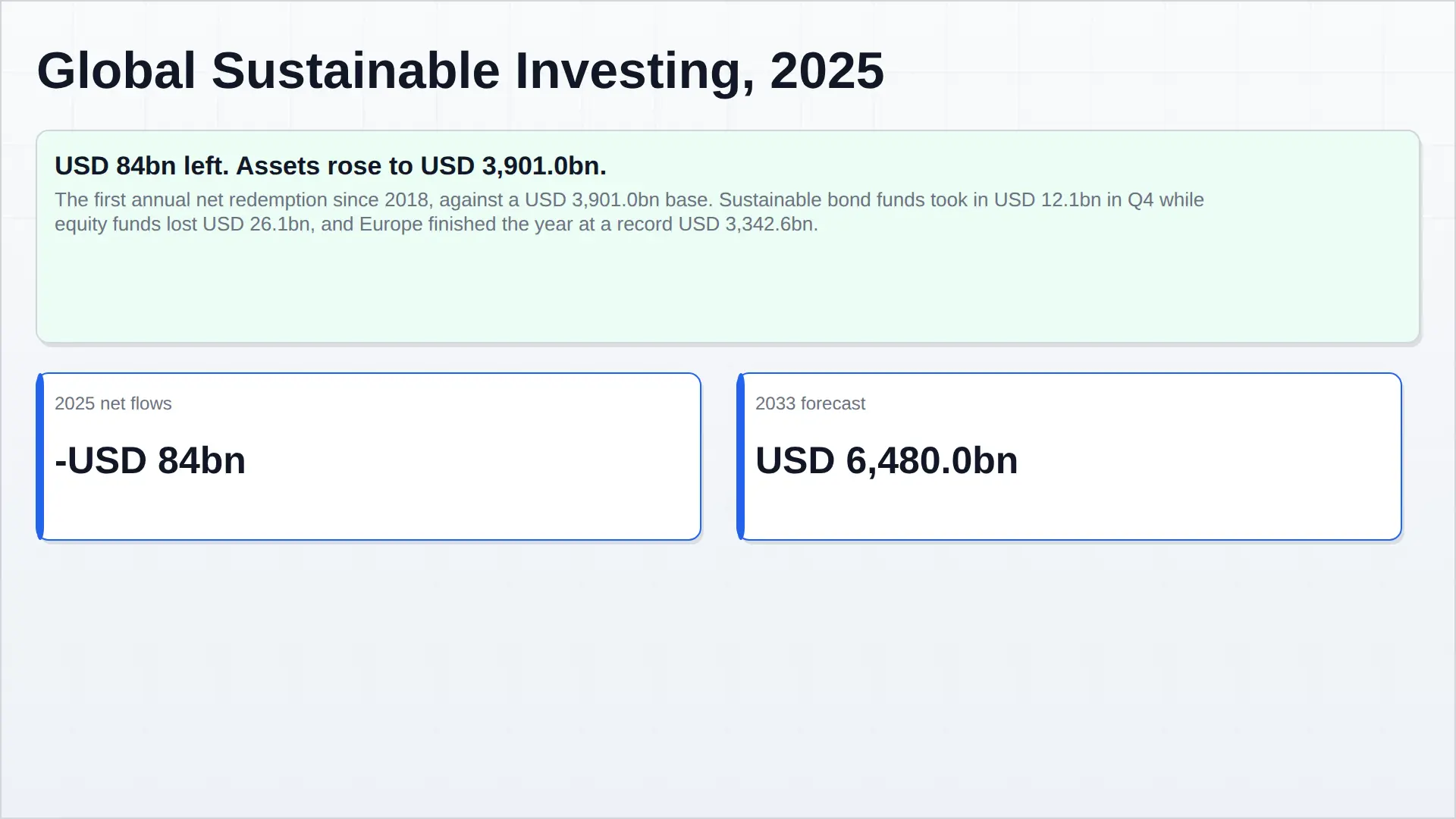
The USD 84 billion of redemptions is 2.15 per cent of the opening asset base, a reversal from USD 38 billion of inflows in 2024. In the same twelve months, market movement did more than ten times as much work on the asset total as flows did. The two numbers are not in conflict; they are no longer the same order of magnitude.
Where the money went instead
The outflow was concentrated and the rotation inside it was decisive. Sustainable equity funds lost USD 26.1 billion in the fourth quarter of 2025 while sustainable bond funds took in USD 12.1 billion. Sustainable passive funds recorded their first full year of net redemptions at USD 35.1 billion, against USD 48.9 billion from active vehicles. Outside the funds market, aligned green bond issuance reached USD 653.5 billion in 2025 — the second-highest annual volume on record — and total aligned green, social, sustainability and sustainability-linked issuance passed USD 1 trillion for the third consecutive year, taking the cumulative stock to USD 6.8 trillion.
| Metric | 2025 | 2033 (Pheonix forecast) | CAGR |
|---|---|---|---|
| Sustainable fund assets (USD bn) | 3,901.0 | 6,480.0 | 6.55% |
| Number of funds | 7,064 | 8,950 | 3.00% |
| Assets per fund (USD m) | 552.2 | 724.0 | 3.45% |
| Net flows (USD bn) | −84.0 | +77.8 | — |
The label cost more than it earned
The second mechanism behind the 2025 numbers is administrative. European fund naming rules required managers to substantiate sustainability language in product names, and at least 1,450 European funds renamed between January 2024 and September 2025 — roughly 31 per cent of those in scope — including 121 renamings in the third quarter of 2025 alone, of which 64 dropped ESG language. A rename does not redeem a single unit, but it removes assets from the measured sustainable universe, and at 31 per cent of the in-scope population the effect is now large enough to move the market statistic on its own.
Concentration is the structural consequence. The ten largest sustainable fund franchises hold USD 1,585.0 billion, 40.6 per cent of the universe, led by BlackRock at USD 452.6 billion, or 11.6 per cent. Europe holds 85.7 per cent of global sustainable fund assets and 74.1 per cent of the products, and sustainable funds represent roughly 20 per cent of the European fund universe against about 1 per cent of the United States one, where funds recorded a thirteenth consecutive quarter of outflows in the fourth quarter of 2025.
Forecast
Pheonix models the universe reaching USD 6,480.0 billion by 2033 at a 6.55 per cent compound annual growth rate, with the product count growing at only 3.00 per cent. The forecast combines a 5.25 per cent market-return assumption, a net-flow path that recovers to a 1.2 per cent inflow by 2030, and roughly 240 net new funds a year once renamings stop reducing the universe. On a Pheonix estimate of 38 basis points of average fee compressing to 34 basis points, the sustainable fund fee pool grows from USD 14.82 billion to USD 22.03 billion — a 5.08 per cent CAGR, materially below asset growth.
The full report, Global Sustainable Investing Market Report, Size, Share and Forecast 2026–2033, is published at pheonixresearch.com.