
Editorial Article
Victrex Sold 12 Per Cent More PEEK and Earned 1 Per Cent More. That Gap Is the Market.
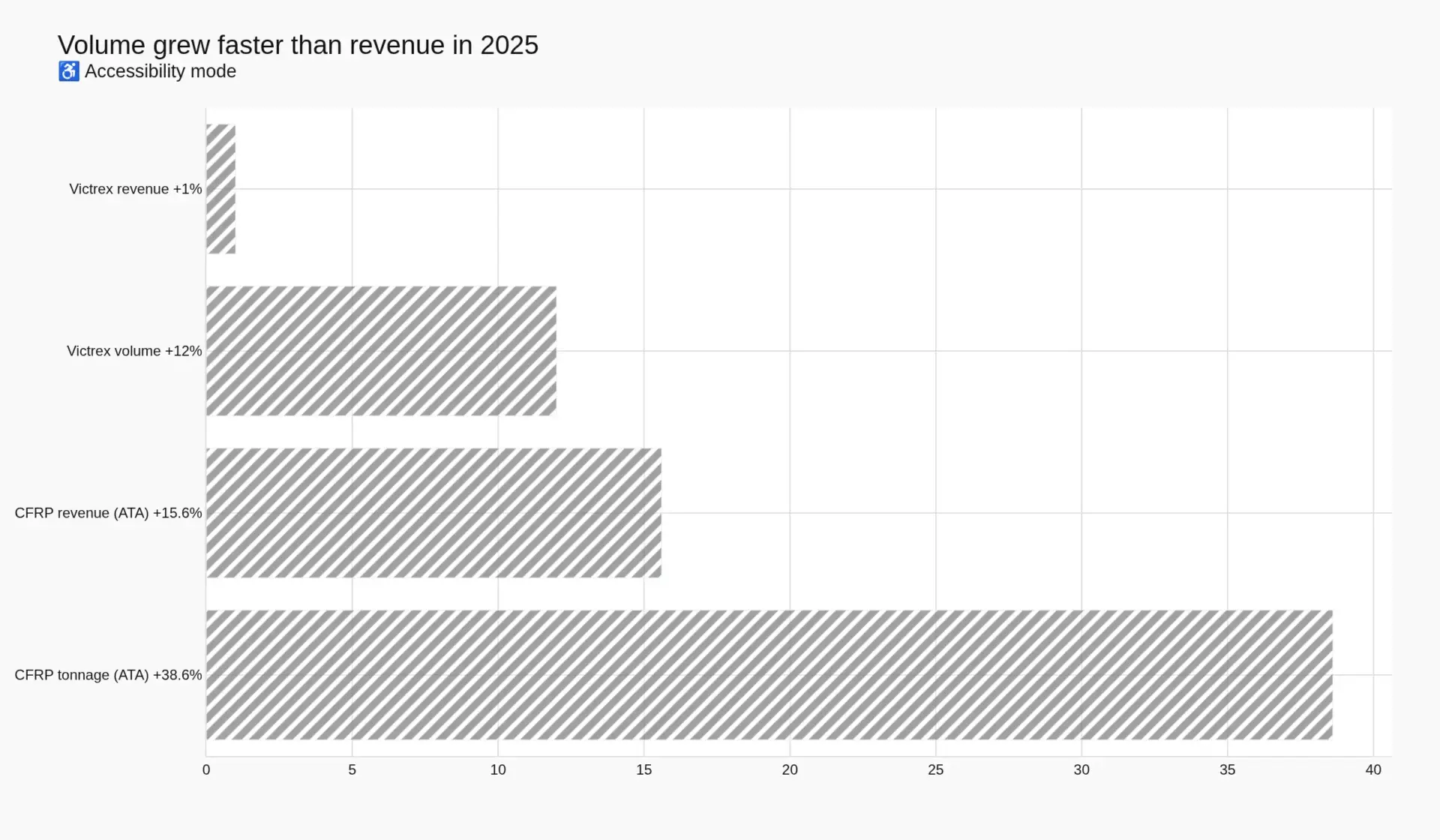
Two lines in Victrex’s 2025 annual report, a few paragraphs apart, explain more about how advanced materials are priced than any forecast: group sales volume of 4,164 tonnes, up 12 per cent on the prior year; group revenue of £292.7 million, up 1 per cent.
Victrex makes PEEK, a polymer whose combination of temperature resistance, chemical resistance and mechanical strength is genuinely hard to replicate. It has spent decades building specification positions in aerospace, medical and energy applications where a substitute requires requalification. And in a year when it sold 12 per cent more of the stuff, it earned one per cent more money for it. Average selling price fell 10 per cent to £70.3 per kilogram.
The interesting question is not why the price fell. It is why it fell without anyone deciding to cut it.
What the company actually said
Victrex is unusually explicit. Roughly 80 per cent of the year-on-year movement in average selling price was due to sales mix and currency, not to price. Like-for-like pricing was robust across key end markets outside of resellers and energy and industrial. Where price did come down, the company says it was either to regain business — energy and industrial is the example it gives — or in response to competitive activity, “including from less established Asian manufacturers”.
So the average moved because the barrels moved. Look at where the volume came from:
| As disclosed by Victrex | FY2025 volume (t) | FY2024 (t) | Volume change | Revenue |
|---|---|---|---|---|
| Value added resellers (channel view) | 1,797 | 1,488 | +21% | — |
| Energy & Industrial | 705 | 604 | +17% | — |
| Transport (Aero & Auto) | 1,012 | 1,022 | −1% | — |
| Electronics | 464 | 454 | +2% | — |
| Medical | 186 | 163 | +14% | £58.8m (−5%) |
| Group | 4,164 | 3,731 | +12% | £292.7m (+1%) |
Victrex discloses volume both by channel (value added resellers) and by end market, and the two views overlap; the figures above are as the company reports them, not a sum.
The medical paradox is the whole story
Medical is the most heavily qualified end market Victrex serves. A PEEK implant grade is specified into a device, approved by a regulator and locked into a manufacturing process that is expensive to change. If qualification conferred pricing power in the way people assume, medical should be the segment where price is most stable and revenue tracks volume.
Medical volume rose 14 per cent. Medical revenue fell 5 per cent, to £58.8 million from £61.9 million. The company attributes the revenue weakness to a softer Medical Spine business — the mix within medical moved toward lower-value applications.
So the specification did its job at the level of the individual device: the material in an approved spinal implant was never going to be swapped out on price. It did nothing at the level of the portfolio, because the growth came from a different device than the one the franchise was built on. Qualification protected the revenue that was already inside it. It did not protect the average.
Qualification is a stock, not a flow
That distinction is the most useful idea in this market, and it generalises well beyond polymers.
Qualification behaves like a stock of protected revenue: it is built over years, it defends the installed base, and it depreciates only if a customer chooses to requalify. What it is not is a flow. It does not attach to the next tonne, which usually goes into an application where the customer has more options, the specification is newer, and the qualification is shorter. A company can hold every specification it had five years ago and still watch its average price fall, because the incremental volume is arriving somewhere else.
This is visible at market level too. In 2025 the global carbon fibre composite industry shipped 38.6 per cent more material than the year before and booked 15.6 per cent more revenue — a 16.6 per cent fall in revenue per tonne — with the growth concentrated in wind, industrial and other applications whose qualification cycles are measured in months, while aerospace, the most heavily qualified demand, was still working through destocking.
The same year, the opposite result
Carpenter Technology sells superalloys and titanium into aerospace and defence, the most gated end of the materials chain. In its fiscal 2025, sales excluding surcharge rose 8 per cent on 6 per cent lower volume. Aerospace and defence sales rose 15 per cent to USD 1,768.6 million, about 61 per cent of a USD 2,877.1 million total.
One company sold more and earned proportionally less. The other sold less and earned more. Both are well-run. The difference is what the incremental demand was made of, and how many qualified alternatives stood behind it.
What to watch, if you price or buy this stuff
Three signals will tell you which way a supplier’s pricing power is moving, and none of them is the price list.
Where the volume is coming from. If growth is concentrated in resellers, distributors and short-cycle industrial applications, the average price will fall even with no discounting. Victrex’s own channel disclosure is the tell: resellers up 21 per cent, transport flat to down.
Whether revenue tracks volume. Over two or three years, the ratio of revenue growth to volume growth is a cleaner measure of franchise strength than any margin, because it cannot be flattered by cost cuts or one-off pricing.
Whether the growth application is inside or outside the existing specification. Growth inside the qualified base is durable and priced. Growth outside it is real volume and thin margin, and it dilutes the average as it arrives.
Victrex is not in trouble: it shipped 12 per cent more material, held its position in the hardest-to-qualify applications, and told its shareholders precisely why the arithmetic moved against it. But the lesson of its year is that a specification is a licence to keep a customer, not a licence to charge more. The price of the next tonne is set by the application it goes into, and that is decided long before the sales conversation.
Source: Victrex plc, Annual Report 2025; Carpenter Technology, 2025 Annual Report on Form 10-K; ATA / CompositesWorld global carbon fibre composites market report 2025. Market sizing and the five-family forecast are set out in the Chemicals and Advanced Materials Market Report 2026–2033.
Frequently Asked Questions
What did Victrex's 2025 results actually show?
Volume rose 12 per cent to 4,164 tonnes and group revenue rose 1 per cent to GBP 292.7 million, while average selling price fell 10 per cent to GBP 70.3 per kilogram. The company attributes roughly 80 per cent of the price movement to sales mix and currency rather than to price cuts.
Did Victrex cut its prices?
Not according to the company. It says like-for-like pricing was robust in key end markets outside of value added resellers and energy and industrial, and that where price did fall it was to regain business or in response to competitive activity, including from less established Asian manufacturers. The average price fell because the volume mix moved toward lower-priced applications.
Why did medical revenue fall while medical volume rose?
Medical volume rose 14 per cent to 186 tonnes but medical revenue fell 5 per cent to GBP 58.8 million from GBP 61.9 million, which the company attributes to a softer Medical Spine business. Growth came from lower-value applications inside the same end market, so volume and revenue moved in opposite directions despite the segment being the most heavily qualified part of the portfolio.
What does this mean for pricing in advanced materials generally?
Because qualification protects the revenue already inside it, not the next tonne. A specification is durable for the installed base but does not attach to incremental demand, which usually arrives in applications with shorter qualification cycles and more qualified alternatives. That is why a company can hold every specification it had five years ago and still see its average selling price fall.