
Editorial Article
Ofcom Refused to Write the Number. That Refusal Is the Age-Assurance Market.
In July 2025, every service in the United Kingdom that allows pornography had to have what Ofcom calls highly effective age assurance in place. Ofcom published a non-exhaustive list of methods capable of meeting that standard — facial age estimation, photo ID matching, open banking, mobile network operator checks, credit card checks, digital identity services, email-based age estimation — and said plainly that self-declaration of age and payment methods which do not require a person to be 18 are not sufficient. It also required that the content itself must not be visible before, or during, the process of completing a check.
Then it did the more consequential thing. It declined to set a numerical threshold. Its published position acknowledges that numerical thresholds — its own parenthetical example is 99 per cent accuracy — may complement its four criteria in future, pending further developments in testing methodologies, industry standards and independent research. The four criteria are technical accuracy, robustness, reliability and fairness. Four adjectives, no number.
That refusal is the market. A regulator who writes “99 per cent” turns age assurance into a benchmark that a vendor either passes or fails, and the buyer’s decision collapses into price. A regulator who writes four adjectives and no figure hands the decision to the buyer, the auditor and the claimant’s lawyer — and thereby makes evidence, certification and a demonstrable process into the product. It is also the cleanest illustration of the argument running through the Pheonix biometric technologies forecast: the sensor deflates and the decision inflates.
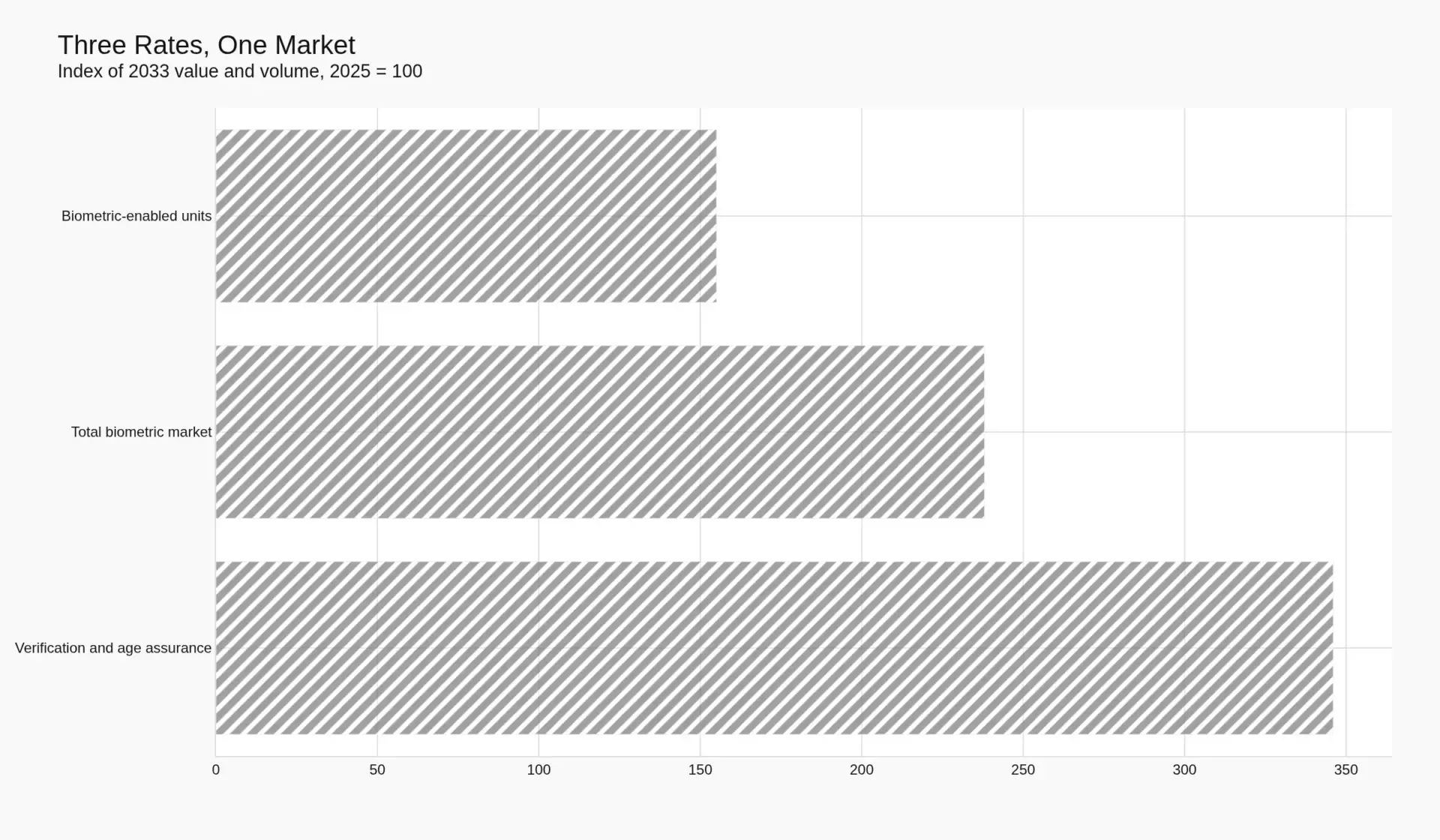
The arithmetic of that argument is in three rates. The market is USD 44.80 billion in 2025 and USD 106.65 billion in 2033, 11.45 per cent a year. Biometric-enabled unit shipments run from 1,880 million to 2,910 million over the same window, 5.61 per cent. Digital identity verification and age assurance — the layer that answers whether this is a live human, the right human, an entitled human, and whether you can prove it afterwards — goes from USD 8.90 billion to USD 30.80 billion at 16.79 per cent, from 19.9 per cent of market value to 28.9 per cent, and takes USD 21.90 billion of the USD 61.85 billion of value the market adds by 2033. That is 35.4 per cent of all incremental value.
A duty that attaches to services, not to travellers
Border programmes are the visible part of this market, and they are bounded by travellers. The EU Entry/Exit System registered more than 45 million border crossings before it became fully operational on 10 April 2026; the United States runs biometric facial comparison at 238 airports under a final rule that took effect on 26 December 2025. Those are large, one-off build-outs with a permanent operating obligation attached.
An age-assurance duty is a different shape of demand. It attaches to every service a child can reach, it applies to every session rather than every journey, and it has no completion date: the obligation recurs for as long as the service exists. It also lands on a buyer who is not a government — a social platform, a retailer, a gambling operator, a dating app — and who has no in-house identity engineering. A recurring per-attempt obligation, landing on a buyer with no capability, is what a per-check software market is made of.
What a threshold-free standard does to a tender document
Across our interviews with systems integrators, identity-verification vendors, access-control OEMs and channel distributors through 2025 and 2026, the change in the specification document is consistent. Five years ago a requirement set named a false-accept rate and a false-reject rate. Today it names a liveness certification level, a documented attack-detection test regime, a template-protection method, a data-retention period and an audit-log format. Price is compared at the level of cost per successful verification, not cost per device.
That is a different market with different winners, and it explains a commercial fact that looks odd from the outside: buyers in this layer routinely pay for a certificate they could not themselves reproduce. ISO/IEC 30107-3 defines how presentation-attack detection is tested, and independent laboratories accredit vendors at successive levels. Yoti states that its liveness model is the only one to have passed iBeta Level 3 evaluation under that standard. We do not present that as an independent finding — it is a vendor’s claim about its own product — but it is the right shape of claim for this market in a way that a marketing accuracy figure is not, because a third party can audit it against a published method.
The attack arrived in the month the duty did
Yoti reports detecting 3.2 million injection attacks across its verification and age-assurance services in 2025, with a single-month peak of 527,013 in August 2025 — the month after the UK duty took effect — while running more than eight million checks a week.
Injection is the detail that matters, and it is routinely misdescribed. It is not a mask held up to a camera. It is synthetic pixels pushed directly into the software pipeline by a tool that never went near a sensor, which is why a system that only compares images does not see an attack at all.
That distinction separates the two halves of the technology conversation. The National Institute of Standards and Technology’s Face Recognition Technology Evaluation measures the comparison of images supplied to it, and it remains the most useful table in the industry: its 1:N identification track stayed open through 2025 and 2026, the underlying report reached a forty-seventh draft update in February 2026, and each revision added developers. Frontier matching accuracy is published every few weeks at no cost to any buyer, which is why it cannot be a moat. But an evaluation of image comparison does not tell you whether the image was a face. For that you need a test against ISO/IEC 30107-3, and a certificate.
Fusion is now the default, and the orchestrator is the line item
Every modality has a failure population. Fingerprints fail on worn or wet skin and on a meaningful share of manual workers. Face fails on identical twins, on occlusion, and on templates enrolled years earlier. Iris needs cooperation and near-infrared illumination. Voice is the easiest to replay.
The engineering answer is fusion, and our fieldwork suggests it has moved from premium feature to default in exactly two places. Border and immigration systems pair face with fingerprint, because the two fail on different populations. Age assurance pairs facial age estimation with a document, a payment instrument or a network-operator check, because no single method is accurate at the boundary ages — 13, 16, 18 — where the law actually bites.
The commercial consequence is not that fusion raises the price of a sensor. It is that fusion requires something to decide which signals to request, in what order, and what to do when one fails. That orchestrator is software, it is priced per check, and it is the layer this argument rests on.
The unit economics of a check
A sensor is bought once per device. A liveness check is bought once per attempt, and the number of attempts is set by the regulator rather than by the buyer’s capital budget. That asymmetry, not any consumer enthusiasm for biometrics, is why a market growing at 11.45 per cent contains a layer growing at 16.79 per cent.
It is also why the compliance cost lands where it does. Under the EU AI Act, the prohibited practices took effect on 2 February 2025 — real-time remote biometric identification in publicly accessible spaces for law enforcement, biometric categorisation inferring sensitive attributes, and emotion recognition in the workplace and in education. Remote biometric identification outside those prohibitions, together with systems used in migration, asylum and border control, sits in the high-risk class under Annex III. Following the simplification package known as the AI Omnibus — proposed on 19 November 2025, politically agreed on 7 May 2026 and in force from 27 July 2026 — obligations for that class now apply from 2 December 2027, with high-risk AI embedded in products already covered by Annex I legislation following on 2 August 2028. The Commission’s own regulatory framework page carries the current position.
High-risk status brings risk management, data governance and dataset-quality obligations, activity logging, technical documentation, human oversight and demonstrated robustness. For a national programme, that documentation is a qualification to bid. For a small algorithm vendor, it is a fixed cost that arrives before any revenue does — and fixed costs arriving before revenue consolidate a layer.
Three things that would falsify this
First, a number. If Ofcom or the European Commission writes a numerical accuracy threshold, the differentiator becomes a pass mark, and a pass mark is a commodity. Second, export of the certification habit: whether liveness certification becomes a tender prerequisite outside the UK and the EU, in US state procurement, in India, in the Gulf. That is what would turn 16.79 per cent from a forecast into a floor. Third, the relative cost of attack and defence. If generating a convincing synthetic identity keeps getting cheaper faster than detecting one, the check gets more expensive to run — and since the check is the market, the revenue line rises while the fraud loss rises with it.
Our risk chapter runs one version of that test. Halve the verification layer’s growth to 8.4 per cent and 2033 comes in at USD 92.82 billion and 9.53 per cent: two percentage points of growth and roughly USD 14 billion gone. That is the line to watch, and it is the reason this piece separates the layer from the market rather than reporting a single number.
What sits underneath, and what it costs
Two adjacent reports bound this argument. The credential reader market shows the same shape in physical access: hardware value per reader falling while credential platform value per reader rises, because the unit of sale moves from the door to the person. The sensors market supplies the other half — the capture layer, where improvement is incremental because the physics is. Neither adjacent market explains this one, but the three share a single mechanism: value migrates from the component to the decision as the component becomes ordinary.
Method
This article rests on the 70 per cent secondary, 30 per cent primary basis of the underlying report: open-ended interviews with systems integrators, border and immigration technology leads, commercial identity-verification vendors, access-control OEMs and channel distributors through 2025 and 2026; a specification and procurement survey covering modality choice, false-accept tolerances, liveness certification requirements and migration timing; distributor and channel interviews on sensor and reader price bands; and conference-floor discussion with sensor suppliers, algorithm vendors, platform engineers and standards participants. Secondary material is statutory and regulatory text, official announcements, standards and independent evaluation material, exchange filings and official statistics. Vendor statements about their own products are attributed, not adopted. No third-party market-research citation appears anywhere in it.
None of that changes what the regulator did. It is possible to read Ofcom’s decision as restraint, and there is a fair case for it: a number set too early freezes a method that later evidence would improve. But a threshold-free standard does not leave the question open. It moves the question into a room where a buyer, an auditor and a lawyer decide it case by case, one deployment at a time, with a certificate in the file. That is a slower, more expensive and more durable kind of demand than a benchmark — and it is the kind this layer gets to charge for.
Sources
Ofcom, Age checks to protect children online (methods list, the four criteria, and the decision not to introduce numerical thresholds). European Commission, regulatory framework for AI. European Commission, Entry/Exit System fully operational 10 April 2026. US Customs and Border Protection, final rule on biometric entry and exit. NIST Face Recognition Technology Evaluation. Yoti, injection-attack and liveness disclosure, 2025. Pheonix Research, Global Biometric Technologies Market Report 2026–2033 (model, tables and sensitivity).