
Editorial Article
The Barrier Chose the Plate, Not the Wallet: Airport Parking's Ticketless Year
Between January and November 2026, airport parking in the United States, Estonia, Hawai’i and Australia made the same decision, mostly without announcing it as one. The paper ticket went. What replaced it was a camera reading a number plate and a payment made on a phone. Almost nowhere did the thing the access-control industry spent a decade building — a credential, issued to a person, signed, scoped, revocable, resident in a wallet — appear at the barrier at all.
Boise Airport turned its system on in the week of 19 October 2026. Tickets now carry a QR code; a driver scans it to see duration and rate, pays, receives a receipt, and drives to the exit, where licence plate recognition confirms payment and lifts the gate. No app download, no registration, and the traditional payment options remain. Tallinn Airport followed on 3 November, announcing that from 9 November the A2 outdoor car park and then the multi-storey would go ticketless: cameras read plates on entry and exit, payment by QR code, card kiosk or the Pargi.ee app, with the system supplied and installed by Hansab Eesti and built on its Entringo platform.
Hawai’i’s Department of Transportation got there in January, at Kona and Hilo, with Metropolis: register a phone number, plate and payment method once, then drive in and drive out, with the state noting the deployment sat among nine airports nationwide. By July, Fresno Yosemite — the largest California airport on the platform — had gone the same way, and its announcement noted that SP+, a Metropolis company, had operated parking at the airport for decades. Brisbane Airport’s guidance to pre-booked customers is the same shape in a different country: the gate opens on the plate, and a QR code is kept on hand in case it does not.
Two identifiers at a barrier, and one of them is free
A barrier has to answer one question: is this vehicle entitled to be here, and has it paid. There are two ways to answer it. Bind the entitlement to the vehicle, which means a plate. Or bind it to a person, which means a credential. The second is what the access-control industry sells, and what Aliro 1.0 standardised across Apple, Google and Samsung wallets when the Connectivity Standards Alliance published it on 26 February 2026.
Airports chose the first, and the reason is enrolment cost. A plate already exists, is already displayed, and requires nothing of the customer at the point of entry. A credential requires issuance, a wallet, a reader capable of the right transport, and a lifecycle to revoke what has been issued. At a barrier processing a few thousand anonymous transactions a day, needing no attribution beyond “paid”, the camera is not merely cheaper. It is sufficient.
The economics reward the cheapest identity that closes the transaction
Pheonix sizes airport parking at USD 21.52 billion in 2025, the base year, reaching USD 38.49 billion in 2033 at 7.54 per cent, against volume growth of 2.98 per cent — 1,020 million parking stays rising to 1,290 million. Parking is not a side line: ACI World’s 2026 Airport Economics Report puts car parking at 24.1 per cent of global non-aeronautical income and 43.2 per cent in North America, or USD 1.82 per passenger and 8.84 per cent of everything an airport earns.
Within that, the layer that decides identity is splitting in two. Plate recognition grows at 12.25 per cent a year to 2033 and bay-level detection at 7.67 per cent, taking recognition’s share of the USD 2.87 billion 2025 sensing market from 32.4 to 38.0 per cent. Bay-level detection — a puck in the ground or a camera over each bay — is bought only where inventory certainty is contractual: reserved bays, permit holders, EV-bay blocking, accessible bays and pre-book. Everything else is served by a camera at the barrier that costs nothing per bay, because there is nothing in the bay.
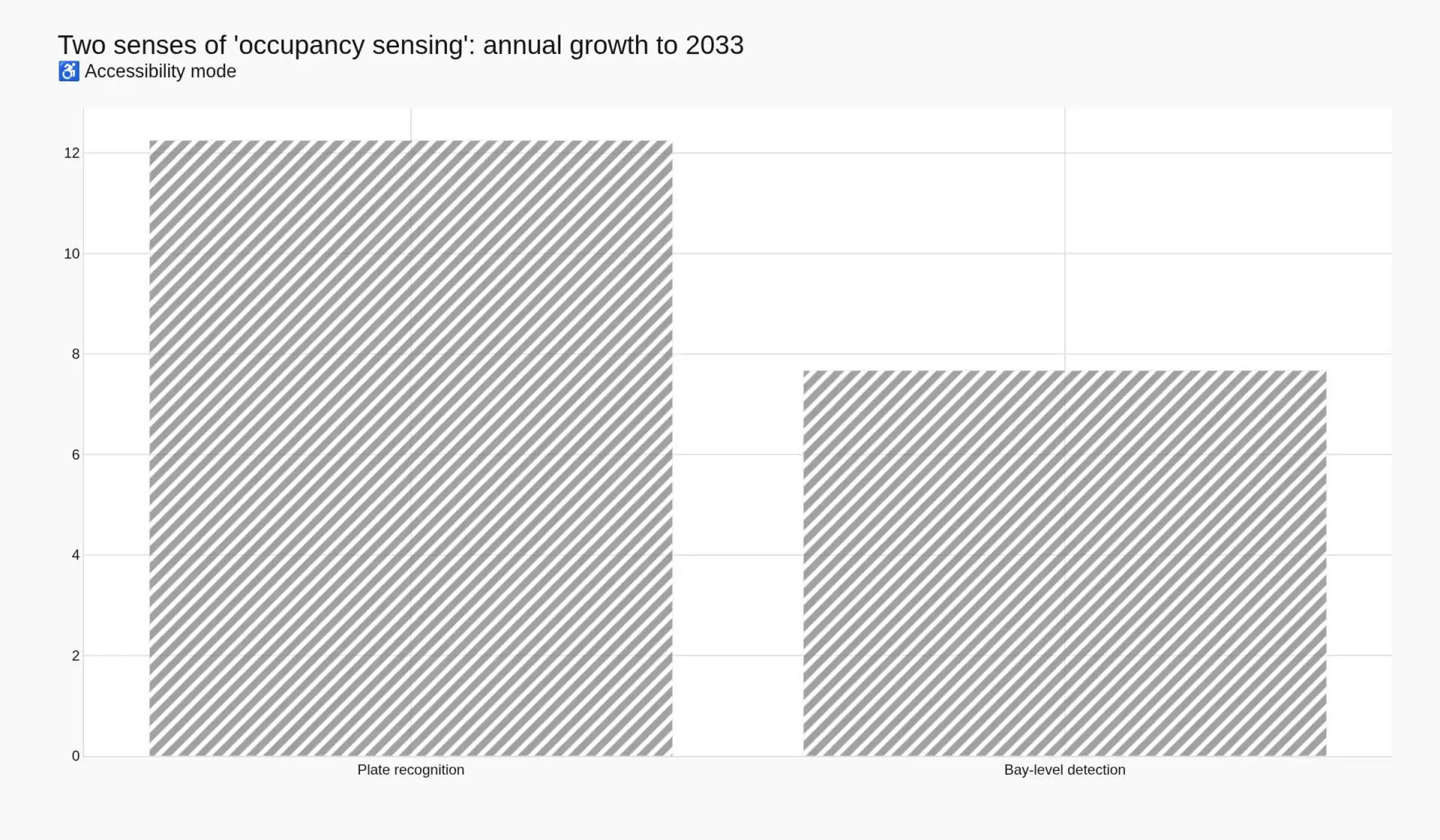
The access and revenue control layer shows the same logic from the other side. Pheonix sizes PARCS at USD 3.10 billion in 2025 rising to USD 6.19 billion in 2033 at 9.03 per cent, with revenue per controlled space rising 71.8 per cent — growth that comes from selling the same bay as a service rather than from adding spaces. The gate is not where the margin is. The transaction is.
Where the plate breaks, and the credential earns its price
Tallinn’s own customer guidance contains the tell. Asked what happens if plate recognition fails, the airport explains that a step-by-step prompt appears to start a session by automated phone call — and the parking payment is then linked to the phone number rather than the registration number. The moment vehicle identity is unavailable, the system reconciles to the person. The plate is the fast path. It is not the truth.
Four situations put weight on that truth.
A shared vehicle. One plate, two drivers, different entitlements. A plate can be sold a permit; it cannot be revoked for one of the two people who use it. Tenancy, contracting staff and second drivers all break in the same place.
Contractual rather than transactional access. Reserved bays, permit holders, EV-bay blocking, accessible bays and pre-booked inventory are sold as guarantees, and a guarantee has to be enforced against an entitlement rather than a fee. That is precisely the half of the sensing market that still requires hardware in the bay — the half growing at 7.67 per cent while recognition runs at 12.25.
Attribution. A business expense claim, a refund dispute, an insurer asking who was driving. A plate identifies a vehicle. Only a credential identifies a person, and only a credential produces an audit trail that survives the transaction it was created for.
Privacy and revocation. A plate is a public identifier that anyone standing in the car park can read and photograph. A credential is bound to a device, can be scoped to a time window, and can be withdrawn without touching a windscreen. Where an operator has to show that it protects the identity of the people it admits, the credential is the only identifier that can be defended.
The reservation is the wedge
The most interesting line in Tallinn’s announcement is not about the camera. It is the reservation, promised for early 2027: a passenger books and pays from home, the reservation guarantees a space in the terminal car park or the outdoor one, and on arrival and departure the system recognises the plate and opens the barrier. The airport says plainly that there will be nothing further to do on site.
That is a dated, priced, contracted asset — the Pheonix argument that a bay is perishable inventory while a booking is an asset, which is why the reservation layer grows at 15.88 per cent against the market’s 7.54. In 2026, 32 per cent of gross airport parking value moves through a pre-booking, USD 7.41 billion; by 2033 it is 45 per cent and USD 17.32 billion, on a platform take rate widening from 5 to 6 per cent.
And once a booking exists, the identity question changes. It is no longer “has this vehicle paid” but “does this vehicle belong to this booking, for this period, on these terms”. A plate answers that on the day. It does not answer it when the customer arrives in a rental car, changes a plate, lends the car, or needs the booking transferred — and it says nothing at all about who is entitled to the record afterwards. Sydney Airport’s terms already price reservation against drive-up explicitly; Brisbane already runs plates with a QR fallback. The commercial machinery to price a person rather than a vehicle is being assembled in public.
The technical objection to credentials in car parks has also gone. Aliro 1.0 was written for places without network coverage, naming underground parking garages, and an offline lock can verify a signed access document presented from a wallet. The remaining question is not whether a credential can open a barrier three levels down. It is whether an operator has any reason to want one there.
What to watch
Three signals over the next two years. Whether any airport prices a person-level product — a reserved bay bundled with an entitlement that can be revoked, transferred and audited. Whether plate-to-person binding arrives as a wallet feature, which would collapse the distinction from the other direction. And whether recognition’s share of the sensing market keeps climbing past 38 per cent, which would confirm that the barrier was never the place the credential was going to win.
The plate won the barrier because it was free. The credential will win the relationship because it is revocable. Those are two different contests, and only one of them is where the money ends up.
Sources and further reading
City of Boise, Modernized Parking Technology Arrives at Boise Airport, 19 October 2026. Tallinn Airport, licence plate recognition as paper parking tickets are phased out, 3 November 2026. Hawai’i Department of Transportation, new streamlined parking system at Kona and Hilo airports, 21 January 2026. Fresno Yosemite International Airport, contactless drive-in, drive-out parking, 8 July 2026. Brisbane Airport, online booking entry instructions. Sydney Airport, parking terms and conditions, effective 14 January 2026. Market figures from Pheonix Research reports, base year 2025.
Related research
Global Airport Parking & Pre-Booked Reservation Platforms Market Report 2026–2033 — the full report behind the reservation economics, the ACI World revenue shares and the platform take-rate analysis used here.
Parking Occupancy Sensing & Space-Guidance — why plate recognition grows at 12.25 per cent and bay-level detection at 7.67, and which procurement conditions still force hardware into the bay.
Parking Access & Revenue Control Systems (PARCS) — the same transaction logic priced from four real council and airport awards, one bay at a time.
Global Smartphone Credential Reader Market Report 2026–2033 — the credential layer this article argues has not yet reached the barrier: USD 3.63 billion in 2025, USD 11.77 billion in 2033.
Companies and systems referred to in this article
Metropolis Technologies — the plate-recognition platform operating parking at Kona, Hilo and Fresno Yosemite, and the acquirer of SP+. Hansab Eesti — the Estonian supplier behind Tallinn Airport’s Entringo system, which combines plate recognition, ticketless parking and cashless payment in one service. Pargi.ee and SP+ — the consumer app and the operating company through which both side of the transaction reach the barrier.