
Editorial Article
The Reader Stopped Being the Product: Aliro 1.0 and the Repricing of a Door
Every access-control reader sold this decade carried a protocol that no other vendor’s reader spoke, and that incompatibility was the product. The electronics have never been the expensive part. The expense was the door: re-badging an estate, re-testing a controlled opening, re-tendering a maintenance contract, and retraining the people who issue and revoke credentials. On 26 February 2026 the Connectivity Standards Alliance published Aliro 1.0 — a standard credential and communication protocol built with Apple, Google and Samsung — and formally ended that particular form of pricing power.
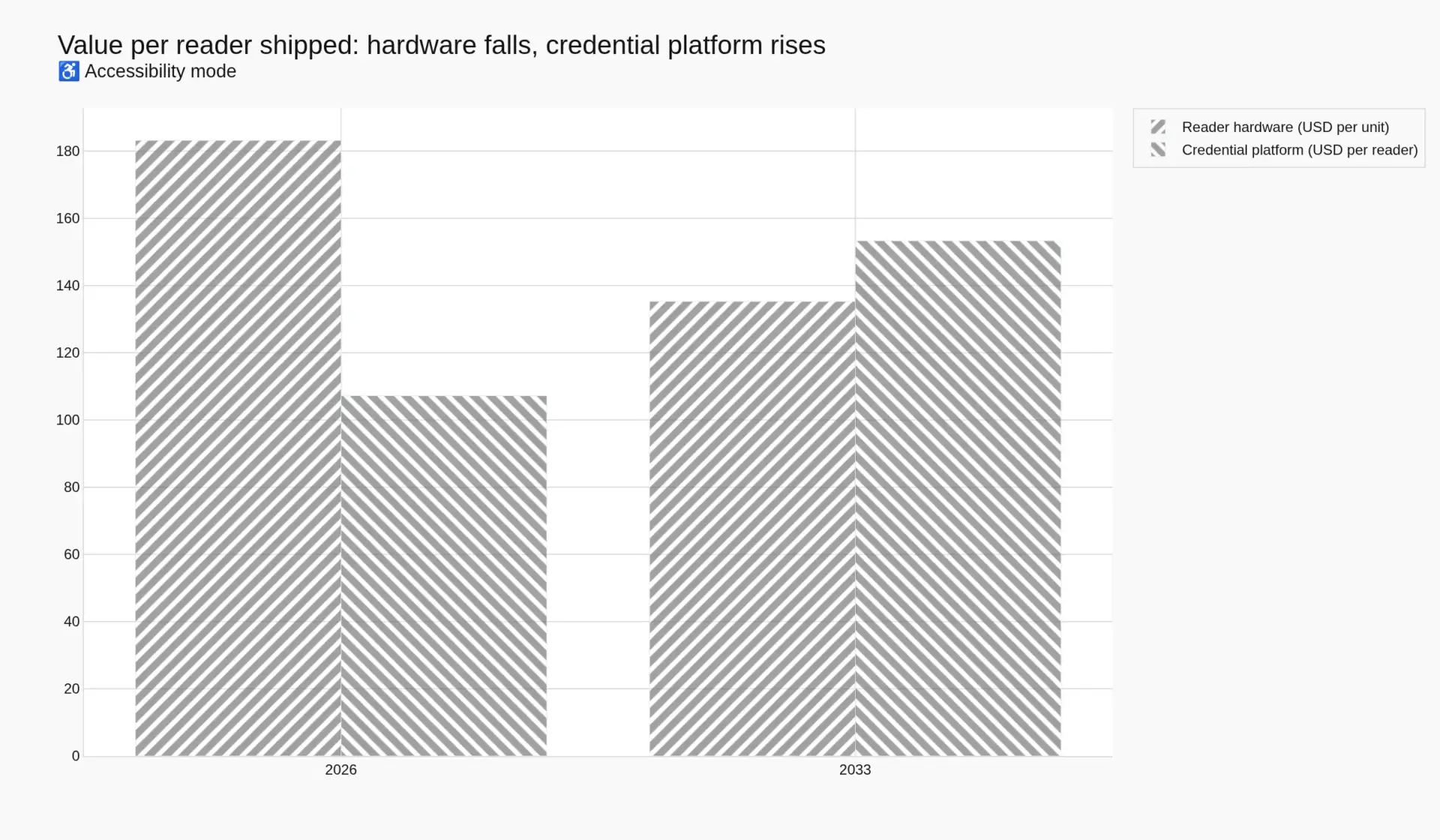
The market it lands in is USD 3.63 billion in 2025, the base year, reaching USD 11.77 billion in 2033 at 15.86 per cent compound annual growth. The totals are not the point. Inside them, reader hardware value per unit shipped falls 26.1 per cent, from USD 183.19 in 2026 to USD 135.29 in 2033, while credential platform value per reader rises 43.0 per cent, from USD 107.23 to USD 153.33. Hardware’s share of spend falls from 41 to 30 per cent; platform and provisioning rises from 24 to 34 per cent and takes 39.6 per cent of all value added across the window.
That combination — a growing market in which the physical product gets steadily cheaper — is what a standardisation event looks like from the inside. It is not a technology story. It is a story about where a door stops being worth money.
What the specification actually settled
Aliro 1.0 defines a credential and a communication protocol between a user device and a reader, using asymmetric cryptography so that the reader verifies a signature rather than a shared secret. It supports three transports: near-field communication for a deliberate tap, Bluetooth Low Energy for user-initiated longer-range access, and Bluetooth LE paired with ultra-wideband for hands-free authentication. It ships with a certification programme and test suites run through authorised laboratories, which is the part that matters commercially — an interoperable standard without a certification regime is an aspiration, not a procurement criterion.
The Alliance lists more than 220 member companies, and names Apple, Allegion, Aqara, Google, HID, Kastle, Kwikset, Last Lock, Nordic Semiconductor, Nuki, NXP, Qorvo, Samsung and STMicroelectronics as the first expected to certify. Two details in the release are worth more than the rest of it combined. The first is that the specification is designed to hold up even in “areas without network coverage, such as underground parking garages and elevators”. The second is the two-phase access handshake: an expedited phase for a device the reader already knows, and a step-up phase in which the wallet presents a signed access document from a trusted authority, so an offline lock can grant entry on proof rather than on a database lookup. Access schedules and restrictions travel inside the credential, which means time-bounded and partially-privileged access can be issued without anyone provisioning the reader.
Aliro is a separate project from Matter, and a lock need not be a Matter device to carry an Aliro credential. That separation matters: the standard does not arrive with a smart-home product cycle attached, and it can be adopted on commercial hardware that has no consumer use case at all.
Why a standard deflates the box and inflates the contract
Read the Alliance’s own account of who benefits and how. Manufacturers get a universal arbiter for interoperability certification, which reduces research and development cost and simplifies integration with new partners. Integrators get easier setup and faster troubleshooting across hardware from multiple vendors. System owners get the ability to mix and match vendor-independent hardware and software. Each of those three sentences is a price argument in the buyer’s favour, and none of them is about a better reader.
What remains defensible is smaller and harder: the certification, the radio, and the credential lifecycle. A reader that must satisfy a laboratory test suite and a published protocol competes on price and reliability, because the thing that used to differentiate it — a proprietary credential format embedded in an installed base — is now a standard that any certified competitor can speak. What does not commoditise is the operation behind it: who issues a credential, how fast it can be revoked at two in the morning, and who can prove in March which person entered which door in January.
That is why the money moves the way it does in the model. The box is priced per door. The credential is priced per person. A building with forty controlled doors and a thousand badge holders has twenty-five times the billing base for the same physical installation, and standardisation is what makes the per-person business addressable by someone other than the lock manufacturer.
The trading evidence is already volume-led
You do not have to wait for the forecast to see this. The two largest access-solution groups publish enough to show what the top of the hardware stack looks like under deflation.
ASSA ABLOY reported 2025 sales of SEK 152,409 million with organic growth of 3 per cent, acquired growth of 5 per cent and a currency drag of 7 per cent, and operating income of SEK 24,664 million at a 16.2 per cent margin. It completed 23 acquisitions in the year. dormakaba’s Access Solutions segment reported CHF 2,440.7 million of sales with 4.4 per cent organic growth, split into price of +1.5 per cent and volume of +2.9 per cent, and adjusted EBITDA of CHF 382.6 million at 15.7 per cent, up 50 basis points.
Read the two together and the pattern is clear. Organic growth is mid single digit at both, margin is held, and at dormakaba the organic gain is more than half volume. Price contributes 1.5 points. A business whose growth is volume-led at 1.5 points of price is absorbing deflation and replacing it with units and with acquired channel — ASSA ABLOY’s five points of acquired growth is the purchase of distribution, not a pricing achievement. That is the shape of a market where the unit gets cheaper and the relationship gets more valuable.
What a reader still does that a wallet cannot
Three things, and all three are worth money.
The first is physics. Ultra-wideband ranging establishes distance, which is what makes hands-free access safe rather than merely convenient: a credential that opens a door from thirty metres away is a liability, and one that opens it from a metre and a half is a product. The same ranging that makes that work also says whether a person is standing in front of the device — which is why a credential reader with UWB is, without anyone designing it as such, a presence sensor. That is the same physics under the bay-level half of the parking sensing market, where plate recognition grows 12.25 per cent a year against 7.67 per cent for detection in the bay. A reader that ranges is a sensor with a business model attached.
The second is authority when the network is gone. A signed access document that an offline lock can verify is the difference between a credential that works in a basement car park and one that works in a lobby with good Wi-Fi. Any deployment that matters — transport, utilities, healthcare, industrial — has doors where the network is the least reliable thing in the building.
The third is regulatory. The Radio Equipment Directive’s cybersecurity requirements, set out in delegated regulation 2022/30 and supported by the EN 18031 series, have applied since 1 August 2025; the Cyber Resilience Act’s vulnerability handling and reporting duties follow from 11 December 2027. A reader is now a device with a software lifecycle and a duty of care. That does not restore margin, because every certified competitor carries the same duty. It does mean the reader cannot be bought as a commodity component and forgotten.
If you are buying readers this year
The procurement question has changed shape. You are no longer buying a supplier’s readers; you are buying a credential supply chain and an operating contract, and the readers are the part of it that sits on the wall.
Four things worth putting in the document. Who holds the root of trust, and whether it can move without re-badging the estate. What revocation latency is, measured rather than promised — the interval between a decision to remove access and the last door that still opens for that credential. What firmware support commitment outlives the warranty, given that the Cyber Resilience Act makes the answer a legal exposure rather than an inconvenience. And who audits: the ability to reconstruct, months later, exactly who was authorised and who entered.
Interoperability cuts both ways here. It makes exit cheaper, which is good for the buyer and dangerous for the incumbent — and it means the incumbent’s case has to be made on the operating contract rather than on the installed base. Buyers who do not ask about revocation latency and firmware commitment will find that the cheapest compliant reader is exactly as cheap as it looks.
The box is priced per door, the credential per person
Aliro 1.0 did not create this market. It told the market the truth about itself. A protocol that anyone certified can speak cannot be the product; a credential that has to be issued, revoked, audited and proved cannot stop being one. The hardware line falls 26.1 per cent per reader across the forecast window and the credential line rises 43.0 per cent, and neither number is an accident of the model — they are the same event measured at both ends of the transaction.
The reader is not going away. It is becoming the cheapest, most certified, most physically capable sensor in the building, while the part that used to make money moves to whoever holds the person.
Sources and further reading
Connectivity Standards Alliance, Introducing Aliro 1.0: A Unified Standard to Transform the Access Control Ecosystem, 26 February 2026. The Alliance’s Aliro specification page. Description of the two-phase access protocol and the signed access document at Matter Alpha, 26 February 2026. Allegion’s Aliro 1.0 announcement and Samsung Research’s technical note. Company figures as disclosed in ASSA ABLOY’s 2025 annual report and dormakaba’s Access Solutions reporting. Pheonix Research, Global Smartphone Credential Reader Market Report, Size, Share and Forecast 2026–2033, base year 2025.
Related research
Global Smartphone Credential Reader Market Report 2026–2033 — the full twelve sections and six analytical chapters behind every figure here, including the layer split, the vertical split and the credential lifecycle economics.
Parking Occupancy Sensing & Space-Guidance — where the same recognition-versus-instrumentation contest decides which sensor gets bought at all.
Parking Access & Revenue Control Systems (PARCS) — the layer where a gate stops being hardware and becomes a transaction fee, priced from four real procurement records.
Airport Parking & Pre-Booked Reservation Platforms — the vertical where a credential has to be a guarantee rather than a fee.
Companies referred to in this article
ASSA ABLOY — 2025 sales of SEK 152,409 million, 16.2 per cent operating margin, 23 acquisitions. dormakaba — Access Solutions organic growth of 4.4 per cent split into 1.5 points of price and 2.9 points of volume. Allegion — among the first expected to certify under Aliro 1.0. HID Global — reader and credential supplier, also in the first certification cohort. NXP Semiconductors and Infineon Technologies — the silicon and cryptography layer beneath both.