
Editorial Article
The State Set the Price of a Fingerprint at Zero. India's Biometric Market Moved Above It.
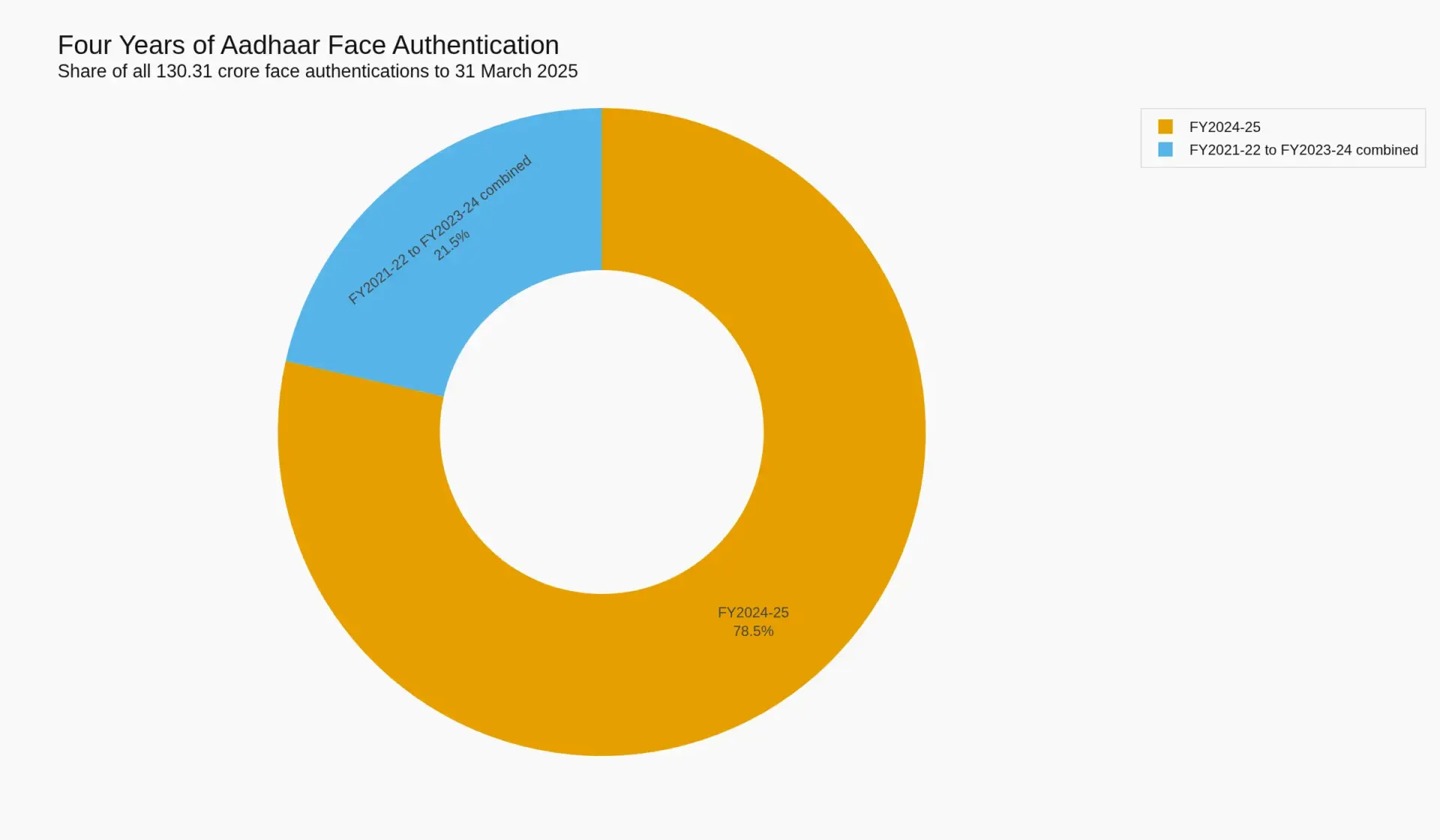
India ran 102.31 crore Aadhaar face authentications in the financial year ended 31 March 2025. That single year accounts for 78.5 per cent of every face authentication the system had performed since UIDAI launched the modality on 15 October 2021, and it took the cumulative total to 130.31 crore. In a world that ships 1,880 million biometric-enabled devices and terminals in a year, a public authority ran rather more than a billion face checks in twelve months — out of a solutions catalogue it built itself, and at a marginal cost no vendor in the market can approach.
The annual series is not a line. It is a step. Face authentications ran 0.017 crore in FY2021-22, 4.47 crore in FY2022-23, 23.50 crore in FY2023-24 and 102.31 crore in FY2024-25 — growth of 335.4 per cent in the last of those years alone, according to UIDAI’s Annual Report 2024-25.
Look at what sits underneath it. Average daily authentications across all Aadhaar modalities rose from 8 crore to 9.6 crore, with a peak day of 13.2 crore. Face authentication alone recorded 15.25 crore transactions in March 2025, 21.6 per cent above February, and close to 39.5 crore across the January–March quarter; the single-day peak reached 1.1 crore during the year and 1.5 crore by September 2025. UIDAI’s face solution, built in-house on its own AI and machine learning, is now used by 105 entities — state government departments, central ministries, telecom operators, banks and non-banking finance companies.
Those volumes are produced by a public authority, on public infrastructure, for a stated public purpose. Which is why the Indian commercial question is not who sells the reader. It is what remains to be sold once the state has set the unit price of an authentication at effectively nothing.
The global arithmetic, and where India sits on it
The market our biometric technologies forecast describes is USD 44.80 billion in 2025 rising to USD 106.65 billion in 2033 at 11.45 per cent, on unit shipments of 1,880 million rising to 2,910 million at 5.61 per cent. Value per biometric-enabled unit goes from USD 23.83 to USD 36.65, up 53.8 per cent, while the sensor itself gets cheaper every year of the window. The gap between the two rates is the whole argument: the money is not in more sensors, it is in what happens after a sensor reads something.
The component layer has already disclosed that deflation in its own numbers. Goodix shipped 1.25 billion units in 2024, up 5.5 per cent, and its revenue fell 0.8 per cent to RMB 4,375 million on average selling price pressure. Fingerprint Cards completed the wind-down of its mobile and PC product groups in 2025 to protect its viability, cutting operating loss from SEK −421.1 million to SEK −59.2 million on a materially smaller business. A box that reads a finger is a commodity with a decent margin on a shrinking price.
In India that pressure is further along than anywhere else, because a public utility has already demonstrated the floor.
What a public authentication utility does to the private market
It commoditises capture and matching, and it pushes value into four places: the edge device that has to produce an image good enough for a system whose error characteristics are publicly known; the orchestration above it, which decides which check to run and in what order; the assurance beneath it, which is the evidence that the check worked; and the integration around it, which is the unglamorous business of making a state platform usable inside a bank, a telco or a hospital.
There is a second, subtler effect. A public utility also sets the specification. Once a national system runs at nine and a half crore authentications a day, a private deployment in the same country is measured against that system’s behaviour — its latency, its tolerances, its audit trail — rather than against a competitor’s price list. That is a hard bar to clear with an off-the-shelf product, and it is where the vendor with a certified liveness product and a documented test regime starts ahead.
The DPDP Rules create a licensed intermediary class
India notified the Digital Personal Data Protection Rules on 14 November 2025, operationalising the 2023 Act and introducing an eighteen-month phased compliance period. Provisions on the Data Protection Board took effect on publication; obligations relating to consent managers begin twelve months later; and the operational requirements — consent notices, security safeguards, breach reporting, retention, children’s data, significant data fiduciary duties and international transfers — apply from 13 May 2027. Consent managers must be companies based in India. The Government of India release sets out the framework.
That is not a compliance footnote; it is an entry requirement. A consent manager is a registered intermediary whose product is the record of consent, held for a population measured in hundreds of millions, in a jurisdiction that insists the holder be an Indian company. And consent is the one part of a biometric deployment that cannot be reconstructed after the fact: a biometric is not a password, it cannot be reissued, so the lawful basis has to be evidenced at enrolment and carried forward for as long as the template exists. Somebody has to hold that record. Registration requirements are where margins live, because they cap the number of sellers.
The one thing that cannot be reissued
Template protection is where the liability sits if a template is breached. ISO/IEC 24745 governs it; cancelable biometrics and secure enclaves reduce the damage rather than eliminate it. Under the DPDP Rules, breach reporting and retention limits turn that technical question into a compliance obligation with a date attached, and a date attached to a cost is a purchase order.
The harder item is children’s data, where the framework requires verifiable parental consent. Age assurance is the most difficult problem in the whole stack at the boundary ages, and it is the fastest-growing layer in the global market — verification and age assurance runs at 16.79 per cent a year against 11.45 per cent for the market as a whole. India has now put a statutory requirement on the same capability that the United Kingdom’s Online Safety Act turned into a commercial market in July 2025. Vendors who have already been through Ofcom’s regime arrive holding a certified liveness product and an audit trail. Vendors who have not will be buying one, and the buying will happen before 13 May 2027.
What Indian tenders now ask for
Our primary work through 2025 and 2026 — open-ended interviews with systems integrators, border and immigration technology leads, verification vendors, access-control OEMs and channel distributors; a specification and procurement survey covering modality choice, false-accept tolerances, liveness certification requirements and migration timing; distributor interviews on sensor and reader price bands; and conference-floor discussion with sensor suppliers, algorithm vendors and standards participants — shows the same shift visible in the UK. Five years ago a requirement set named a false-accept rate and a false-reject rate. Today it names a liveness certification level under ISO/IEC 30107-3, a documented attack-detection test regime, a template-protection method to ISO/IEC 24745, a retention period and an audit-log format. Price is compared per successful verification, not per device.
That shift favours whoever already holds the certificates, which is a consolidation argument rather than a growth argument — and it explains why the layer above the utility is where the incremental value concentrates. Of the USD 61.85 billion the global market adds between 2025 and 2033, USD 21.90 billion — 35.4 per cent — lands in verification and age assurance rather than in hardware.
Where the money is, in order of how defensible it is
Assurance and certification. A certificate is bought before a deployment and cannot be self-issued. It is the closest thing this market has to a recurring toll.
Consent and audit infrastructure. The DPDP Rules make it a registered function with an Indian-company requirement, which limits supply by statute.
Verification orchestration for private relying parties. The bank, the telco and the platform need to decide which check to run, in what order, and what to do when one fails, and they pay per check rather than per device.
Access control and physical identity at the edge. Real hardware revenue, genuinely large, and closest to the deflation that Goodix and Fingerprint Cards are already living through.
What would break this
Three things, and none of them is a technology risk. If DPDP enforcement slips materially past May 2027, the consent-manager class arrives without demand pull and consolidates before it has customers. If UIDAI extends its own stack upward into private verification, it absorbs the layer instead of enabling it — a live question for any state platform, and a sharper one here because the in-house face solution already serves 105 entities. And the honest one: nobody has solved template irreversibility. The largest single risk in the market is also the least tractable technically, which is why the assurance layer earns a price rather than a fee.
What 78.5 per cent in one year actually means
A single financial year carrying four-fifths of all activity in a system’s history is not a curiosity. It is the adoption curve of a public utility reaching its users, and it tells a commercial reader something specific: the volume is settled, so the argument above it is about price. The state has demonstrated that biometric authentication can be delivered at national scale and near-zero marginal cost. Everything a private vendor sells in India from here is either an input to that utility, evidence about it, or a lawful basis for using it — and those three are the layers this piece puts at the top, not the reader at the bottom.
Method
Seventy per cent secondary, 30 per cent primary, matching the underlying report. The base year is 2025, the window 2026–2033, and the 2025 base is built bottom-up from biometric-enabled device and terminal shipments by end-market multiplied by realised price bands, plus credential and transaction populations multiplied by annual licence and per-check values. The end-market split, value-chain split, modality split and regional split are Pheonix model build-ups rather than disclosed series, and every derived figure reconciles to the USD 44.80 billion base. Company figures are quoted in reporting currency as disclosed. UIDAI volumes are taken from the Annual Report 2024-25, Table 9, and from UIDAI’s own statements on daily averages and peaks. No competitor or third-party market-research citation appears anywhere in this article.
Sources
UIDAI Annual Report 2024-25 (Table 9, year-wise and cumulative face authentication transactions; average daily authentications; entity count). UIDAI annual reports index. Government of India, Digital Personal Data Protection Rules notification. Pheonix Research, Global Biometric Technologies Market Report 2026–2033 (model, value-chain layer split and sensitivity). Pheonix Research, India Video Surveillance Market Report 2025–2033 for the adjacent Indian capture and deployment base.