
Global Pet Companion Robots Market Report, Size, Share and Forecast 2026–2033
Global Pet Companion Robots Market Forecast Snapshot (2026???2033)
| Metric | Value |
|---|---|
| Market Size (2025) | USD 1.84 Billion |
| Market Size (2033) | USD 6.42 Billion |
| CAGR (2026???2033) | 16.89% |
| Largest Segment | Interactive Robotic Dogs |
| Fastest Growing Segment | AI-Powered Emotional Companion Robots |
| Leading End-Use Segment | Residential Consumers |
| Key Trend | AI-Driven Emotional Interaction & Smart Home Integration |
| Regulatory Influence | Consumer Electronics Safety Standards, AI Ethics Guidelines & Data Privacy Regulations |
| Future Outlook | Growth Driven by Social Robotics, Aging Population Support & Intelligent Companion Technologies |
Global Pet Companion Robots Market
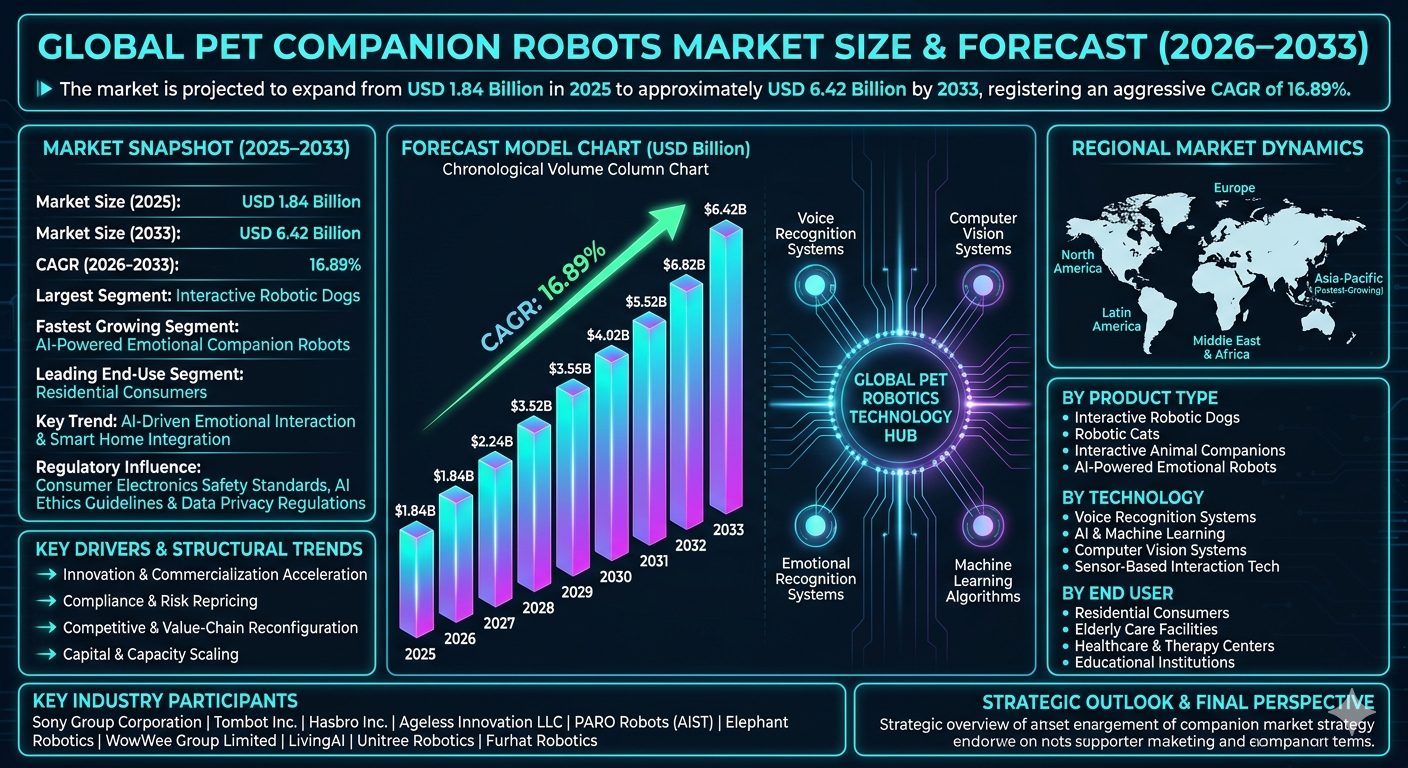
The Global Pet Companion Robots Market is expected to witness strong growth during the forecast period from 2026 to 2033. The market was valued at USD 1.84 billion in 2025 and is projected to reach approximately USD 6.42 billion by 2033, registering a CAGR of 16.89%. The market growth is primarily driven by increasing demand for interactive companion technologies, rising adoption of AI-powered consumer robots, growing elderly care requirements, and expanding smart home ecosystems. Pet companion robots are becoming increasingly popular as alternatives or complements to traditional pets, offering emotional engagement, entertainment, companionship, and cognitive interaction without the responsibilities associated with live animals. In addition, advancements in artificial intelligence, machine learning, natural language processing, and robotic mobility are supporting long-term market expansion.Global Pet Companion Robots Market Overview
Pet companion robots are intelligent robotic devices designed to simulate the behavior, interaction, and companionship of pets through sensors, AI algorithms, voice recognition, and emotional response systems. The market includes robotic dogs, robotic cats, interactive animal companions, AI-powered emotional support robots, and smart robotic pets integrated with connected home technologies. These robots are widely utilized for companionship, elderly assistance, child engagement, therapy support, and entertainment applications. The market is evolving from simple programmable robotic toys toward emotionally responsive, learning-enabled, and highly interactive robotic companions.Structural Drivers of Market Growth
1. Innovation and Commercialization Acceleration
Rapid innovation in AI, computer vision, emotional recognition systems, voice interaction technologies, and autonomous robotic movement is significantly enhancing user experiences. Advanced robotics platforms are enabling more realistic behavior, personalized interactions, and adaptive learning capabilities.Market Implications
Companies investing in emotional AI, advanced sensors, and personalized robotic interaction systems are expected to strengthen market leadership.2. Compliance and Risk Repricing
Consumer electronics regulations, AI governance frameworks, cybersecurity requirements, and data privacy standards are influencing product development. Manufacturers are increasingly focusing on responsible AI deployment and secure user data management.Market Implications
Firms offering compliant, secure, and ethically designed robotic companion solutions are likely to gain stronger consumer trust.3. Competitive and Value-Chain Reconfiguration
The market is highly competitive as robotics companies, consumer electronics manufacturers, AI developers, and smart home technology providers expand their offerings. Integration of software services, subscription-based AI updates, and connected ecosystems is reshaping value-chain economics.Market Implications
Companies focusing on AI-driven personalization and ecosystem integration may gain stronger recurring revenue opportunities.4. Capital and Capacity Scaling
Rising investments in social robotics, AI research, semiconductor technologies, and smart consumer electronics manufacturing are supporting market expansion. Growing demand from households, healthcare facilities, and senior care providers is accelerating commercialization efforts.Market Implications
Manufacturers scaling AI capabilities and robotic production infrastructure are expected to capture future opportunities.Market Segmentation Analysis
By Product Type
1. Interactive Robotic Dogs
This remains the largest segment due to strong consumer familiarity and widespread adoption.2. Robotic Cats
Growing demand driven by companionship and therapeutic applications.3. Interactive Animal Companion Robots
Used for entertainment and emotional engagement.4. AI-Powered Emotional Companion Robots
Fastest-growing segment due to advanced emotional interaction capabilities.5. Therapeutic Robotic Pets
Increasingly utilized in healthcare and senior care environments.By Technology
1. Voice Recognition & Response Systems
Largest segment due to natural user interaction requirements.2. Artificial Intelligence & Machine Learning
Fast-growing segment enabling adaptive and personalized experiences.3. Computer Vision Systems
Used for object recognition and environmental awareness.4. Sensor-Based Interaction Technologies
Essential for responsive behavioral simulation.By End User
1. Residential Consumers
Largest segment due to growing household adoption of companion robots.2. Elderly Care Facilities
Strong demand for emotional support and engagement solutions.3. Healthcare & Therapy Centers
Used for therapeutic and cognitive stimulation purposes.4. Educational Institutions
Growing adoption for interactive learning applications.Regional Market Dynamics
North America
North America dominates the global pet companion robots market due to strong consumer technology adoption, advanced AI innovation, and growing smart home penetration.Asia-Pacific
Asia-Pacific is the fastest-growing region due to leadership in robotics manufacturing, aging population trends, and increasing acceptance of social robots.Europe
Europe remains a major market supported by healthcare robotics adoption and technological innovation.Latin America
Latin America is gradually expanding due to increasing consumer awareness and smart device adoption.Middle East & Africa
The region is witnessing emerging growth driven by digital transformation and premium consumer electronics demand.Competitive Landscape
The Global Pet Companion Robots Market is highly competitive with robotics innovators, AI technology providers, and consumer electronics companies expanding globally.Key Companies Operating in the Market Include:
- Sony Group Corporation
- Tombot Inc.
- Hasbro Inc.
- Ageless Innovation LLC
- PARO Robots (AIST)
- Elephant Robotics
- WowWee Group Limited
- LivingAI
- Unitree Robotics
- Furhat Robotics
Strategic Outlook
The future of the pet companion robots market will be shaped by emotional AI, advanced natural language processing, autonomous mobility, and smart home connectivity. Integration of generative AI, personalized learning systems, and cloud-connected robotic ecosystems will significantly enhance user engagement. The rise of social robotics, digital companionship solutions, and healthcare-focused robotic assistants is expected to create strong long-term growth opportunities.Final Market Perspective
The Global Pet Companion Robots Market remains an emerging and rapidly evolving segment within consumer robotics, artificial intelligence, and smart living ecosystems. Rising demand for companionship technologies, emotional engagement solutions, and intelligent robotics continues driving long-term market growth. Companies capable of delivering safe, intelligent, emotionally responsive, and technologically advanced robotic companions will be best positioned to capture future opportunities. The convergence of AI, robotics, smart home technologies, and human-machine interaction is expected to redefine the future of the global pet companion robots industry.Table of Contents
Table of Contents
- 1. Executive Summary
- 1.1 Global Pet Companion Robots Market Snapshot (2026???2033)
- 1.2 Market Size & Growth Overview
- 1.3 Key Market Highlights
- 1.4 Largest & Fastest-Growing Segments
- 1.5 Regional Performance Summary
- 1.6 Competitive Landscape Overview
- 1.7 Strategic Outlook Through 2033
- 2. Market Introduction & Overview
- 2.1 Definition of Pet Companion Robots
- 2.2 Scope of the Global Pet Companion Robots Market
- 2.3 Evolution of Social & Companion Robotics
- 2.4 Pet Companion Robots Value Chain Analysis
- 2.5 Regulatory & AI Governance Framework
- 2.6 Emerging Trends in Emotional AI & Social Robotics
- 2.7 Smart Home Integration & Human-Robot Interaction
- 3. Research Methodology
- 3.1 Primary Research Approach
- 3.2 Secondary Research Sources
- 3.3 Market Size Estimation Methodology
- 3.4 Forecasting Assumptions (2026???2033)
- 3.5 Data Validation & Triangulation
- 4. Market Dynamics
- 4.1 Market Drivers
- 4.1.1 Rising Demand for AI-Powered Companionship Solutions
- 4.1.2 Growing Elderly Care & Emotional Support Requirements
- 4.1.3 Expansion of Smart Home Ecosystems
- 4.1.4 Advancements in Robotics & Human-Machine Interaction
- 4.1.5 Increasing Consumer Adoption of Intelligent Robots
- 4.2 Market Restraints
- 4.2.1 High Cost of Advanced Robotic Companion Systems
- 4.2.2 Data Privacy & Cybersecurity Concerns
- 4.2.3 Limited Emotional Authenticity Compared to Live Pets
- 4.3 Market Opportunities
- 4.3.1 Expansion of Healthcare & Therapeutic Robotics Applications
- 4.3.2 Integration of Generative AI & Personalized Learning
- 4.3.3 Growing Demand in Aging Population Support Programs
- 4.3.4 Development of Subscription-Based AI Service Models
- 4.4 Market Challenges
- 4.4.1 Ethical Concerns Around Human-Robot Relationships
- 4.4.2 Rapid Technology Obsolescence
- 4.4.3 Balancing AI Sophistication with Consumer Affordability
- 4.1 Market Drivers
- 5. Global Pet Companion Robots Market Size & Forecast (USD Billion), 2026???2033
- 5.1 Market Revenue Analysis
- 5.2 CAGR Analysis
- 5.3 Demand-Supply Trends
- 5.4 Pricing Analysis
- 5.5 Investment Trends
- 5.6 Future Market Outlook
- 6. Market Segmentation Analysis (USD Billion), 2026???2033
- 6.1 By Product Type
- 6.1.1 Interactive Robotic Dogs (Largest Segment)
- 6.1.2 Robotic Cats
- 6.1.3 Interactive Animal Companion Robots
- 6.1.4 AI-Powered Emotional Companion Robots (Fastest-Growing Segment)
- 6.1.5 Therapeutic Robotic Pets
- 6.2 By Technology
- 6.2.1 Voice Recognition & Response Systems (Largest Segment)
- 6.2.2 Artificial Intelligence & Machine Learning (Fastest-Growing Segment)
- 6.2.3 Computer Vision Systems
- 6.2.4 Sensor-Based Interaction Technologies
- 6.3 By End User
- 6.3.1 Residential Consumers (Largest Segment)
- 6.3.2 Elderly Care Facilities
- 6.3.3 Healthcare & Therapy Centers
- 6.3.4 Educational Institutions
- 6.1 By Product Type
- 7. Regional Market Analysis
- 7.1 North America
- 7.2 Europe
- 7.3 Asia-Pacific
- 7.4 Latin America
- 7.5 Middle East & Africa
- 8. Competitive Landscape
- 8.1 Market Share Analysis
- 8.2 Competitive Benchmarking
- 8.3 Strategic Developments
- 8.4 AI Innovation & Product Development Strategies
- 8.5 Partnerships, Investments & Expansion Analysis
- 9. Company Profiles
- 9.1 Sony Group Corporation
- 9.2 Tombot Inc.
- 9.3 Hasbro Inc.
- 9.4 Ageless Innovation LLC
- 9.5 PARO Robots (AIST)
- 9.6 Elephant Robotics
- 9.7 WowWee Group Limited
- 9.8 LivingAI
- 9.9 Unitree Robotics
- 9.10 Furhat Robotics
- 10. Strategic Intelligence & Pheonix AI Insights
- 10.1 Pet Companion Robots Demand Forecast Model
- 10.2 Emotional AI Adoption Analysis
- 10.3 Social Robotics Commercialization Tracker
- 10.4 Smart Home Integration Opportunity Assessment
- 10.5 Automated Porter???s Five Forces Analysis
- 11. Future Outlook & Strategic Recommendations
- 11.1 Expansion of Emotional AI Capabilities
- 11.2 Investment in Advanced Human-Robot Interaction Technologies
- 11.3 Growth Opportunities in Elderly Care Robotics
- 11.4 Development of Connected Robotic Ecosystems
- 11.5 Long-Term Market Outlook (2033+)
- 12. Appendix
- 13. About Pheonix Market Research
- 14. Disclaimer
Competitive Landscape
Global Pet Companion Robots Market Competitive Intensity & Market Structure Overview
The global pet companion robots market is moderately fragmented and innovation-driven, characterized by the presence of robotics developers, artificial intelligence companies, consumer electronics manufacturers, healthcare technology providers, and emerging social robotics startups. Competitive intensity is primarily shaped by technological innovation, emotional AI capabilities, product interactivity, brand recognition, pricing strategies, software ecosystem integration, and user experience enhancement.
As demand for intelligent companionship solutions continues to grow, market participants are increasingly investing in advanced machine learning algorithms, natural language processing, emotional recognition technologies, and autonomous robotic mobility systems. Competition is intensifying as companies seek to differentiate their offerings through realistic interactions, adaptive learning capabilities, and seamless integration with smart home ecosystems.
The market structure is evolving from basic robotic pet products toward sophisticated AI-powered companion platforms capable of delivering personalized emotional engagement, therapeutic support, and connected digital experiences. This transition is creating opportunities for both established robotics leaders and innovative technology startups.
Global Pet Companion Robots Market Competitive Intensity & Market Structure Current Scenario
Leading Global Pet Companion Robots Companies
Sony Group Corporation: A global pioneer in robotic companions through its AIBO robotic dog platform, leveraging advanced AI, cloud connectivity, and emotional interaction technologies.
Tombot Inc.: Specialized developer of realistic robotic companion animals designed to provide emotional support for seniors, dementia patients, and healthcare users.
Hasbro Inc.: Major consumer products company offering interactive robotic pets and AI-enabled companion toys targeting children and family-oriented applications.
Ageless Innovation LLC: Developer of Joy for All companion pets, focusing on therapeutic robotic companions for elderly care and emotional wellness applications.
PARO Robots (AIST): Recognized globally for therapeutic robotic seal companions utilized in healthcare facilities, rehabilitation centers, and elderly care environments.
Elephant Robotics: Robotics company specializing in AI-enabled interactive robotic pets and consumer robotics solutions with advanced motion and engagement capabilities.
WowWee Group Limited: Leading manufacturer of interactive robotic toys and companion devices featuring voice interaction and autonomous behavior systems.
LivingAI: Developer of AI-powered desktop companion robots focused on emotional intelligence, personalization, and conversational interaction.
Unitree Robotics: Advanced robotics company known for intelligent robotic dogs that combine mobility, AI capabilities, and consumer-focused interaction features.
Furhat Robotics: Innovative social robotics company developing emotionally expressive AI systems designed to enhance human-machine interaction and companionship experiences.
Key Competitive Intensity & Market Structure Drivers
Advancements in artificial intelligence, emotional recognition systems, and natural language processing are increasing competition among manufacturers seeking to deliver more human-like and emotionally engaging robotic companions.
Growing consumer demand for personalized experiences is encouraging companies to develop adaptive learning systems capable of understanding user preferences, routines, and emotional responses.
Integration with smart home ecosystems, cloud-based services, and connected digital platforms is emerging as a major competitive differentiator across the market.
Expanding adoption within elderly care, therapy, and healthcare environments is driving demand for highly reliable, safe, and emotionally supportive robotic solutions.
Subscription-based software upgrades, AI enhancement services, and digital content ecosystems are creating new recurring revenue opportunities while strengthening customer retention.
Strategic Implications of Competitive Intensity & Market Structure
Companies investing heavily in emotional AI, behavioral simulation technologies, and personalized interaction systems are expected to gain significant competitive advantages as consumer expectations continue to evolve.
Strong intellectual property portfolios covering AI algorithms, robotics platforms, sensor technologies, and human-machine interaction systems are becoming increasingly valuable strategic assets.
Partnerships between robotics manufacturers, AI developers, healthcare providers, and smart home technology companies are accelerating product innovation and market penetration.
Organizations capable of delivering secure, privacy-compliant, and ethically designed AI companion solutions are expected to strengthen consumer trust and brand loyalty.
Continuous software updates, cloud-enabled intelligence, and ecosystem expansion strategies are becoming critical for sustaining long-term customer engagement and recurring revenue growth.
Global Pet Companion Robots Market Competitive Intensity & Market Structure Forward Outlook
The competitive landscape of the global pet companion robots market is expected to become increasingly technology-centric as advancements in artificial intelligence, robotics, and emotional computing continue to reshape product capabilities. Future competition will focus on creating more lifelike, emotionally intelligent, and context-aware robotic companions.
Manufacturers are expected to expand investments in generative AI, conversational intelligence, autonomous navigation, and adaptive behavioral learning to improve user experiences and product differentiation.
North America is expected to remain a leading market for premium companion robots due to strong consumer technology adoption, while Asia-Pacific is projected to experience the fastest growth supported by robotics innovation, manufacturing leadership, and aging population trends.
Over the forecast period, companies that successfully combine emotional intelligence, technological innovation, user safety, regulatory compliance, and ecosystem connectivity will be best positioned to strengthen their market presence within the rapidly evolving global pet companion robots market.
Value Chain
Global Pet Companion Robots Market Value Chain & Supply Chain Evolution Overview
The Global Pet Companion Robots Market is experiencing rapid transformation driven by advances in artificial intelligence, social robotics, emotional computing, and smart home integration. The value chain is characterized by a highly interdisciplinary ecosystem that connects semiconductor suppliers, robotics hardware manufacturers, AI software developers, sensor technology providers, cloud service platforms, consumer electronics brands, distributors, and end users. This interconnected structure is reshaping how intelligent companion robots are designed, produced, delivered, and experienced globally.
A defining feature of this value chain is the convergence of robotics engineering with emotional AI and consumer-grade software ecosystems. Pet companion robots are evolving from simple interactive devices into adaptive, learning-enabled companions capable of voice interaction, emotional response simulation, and personalized behavioral development. This shift is driving increased integration between hardware systems and cloud-based AI platforms that continuously update robot intelligence and user interaction capabilities.
Supply chain complexity is increasing due to the integration of advanced robotics components such as microprocessors, actuators, sensors, computer vision modules, AI chips, and connectivity hardware. Companies must coordinate across global semiconductor supply networks, precision robotics manufacturing, software development pipelines, cloud infrastructure providers, and consumer electronics distribution channels while maintaining affordability, safety, and scalability.
Industry participants are investing heavily in AI model development, robotics miniaturization, edge computing capabilities, and smart home compatibility to enhance user experience and product intelligence. The value chain is evolving into a digitally connected, AI-driven, and experience-centric ecosystem focused on emotional engagement, companionship, and intelligent human-machine interaction.
Global Pet Companion Robots Market Value Chain & Supply Chain Evolution Current Scenario
Market-Specific Value Chain
- Component & Hardware Supply: Semiconductors, microcontrollers, sensors, cameras, actuators, batteries, robotics frames, and electronic modules.
- Robotics Design & Manufacturing: Robotic assembly, mechanical engineering, embedded system integration, mobility system development, and product testing.
- AI & Software Development: Machine learning models, natural language processing systems, emotional AI engines, behavioral learning algorithms, and cloud-based intelligence platforms.
- Connectivity & Ecosystem Integration: Smart home integration, IoT connectivity, mobile applications, cloud synchronization, and firmware update systems.
- Distribution & Retail Channels: Consumer electronics retailers, e-commerce platforms, direct-to-consumer channels, specialty robotics stores, and smart home solution providers.
- End-User Applications: Residential consumers, elderly care users, therapy centers, educational institutions, and entertainment environments.
Company-to-Stage Mapping
- Component & Hardware Supply: Semiconductor manufacturers, sensor suppliers, battery producers, actuator and motor manufacturers, electronics component vendors.
- Robotics Design & Manufacturing: Sony Group Corporation, Unitree Robotics, Elephant Robotics, Hasbro Inc., WowWee Group Limited.
- AI & Software Development: LivingAI, Furhat Robotics, AI research labs, conversational AI developers, emotional computing startups.
- Connectivity & Ecosystem Integration: Smart home platform providers, cloud service companies, IoT solution providers, mobile application developers.
- Distribution & Retail Channels: Amazon, electronics retailers, consumer robotics distributors, online marketplaces, specialty tech stores.
- End-User Applications: Households, elderly care facilities, healthcare therapy centers, educational institutions, rehabilitation programs.
Key Value Chain & Supply Chain Evolution Signals in Global Pet Companion Robots Market
- Expansion of Emotional AI Integration:
Robots are increasingly capable of simulating emotional responses, adaptive learning behaviors, and personalized interaction patterns. - Growth of Cloud-Connected Robotics Ecosystems:
Continuous software updates and cloud-based intelligence are enabling lifelong learning and performance improvement in companion robots. - Advancements in Human-Robot Interaction Technologies:
Natural language processing, voice recognition, and gesture-based interaction systems are significantly enhancing user engagement. - Increasing Complexity of Semiconductor Supply Chains:
Dependence on advanced chips, AI accelerators, and sensors is increasing supply chain sensitivity and strategic importance. - Rise of Smart Home Integration:
Pet companion robots are increasingly becoming part of connected home ecosystems, interacting with other IoT devices. - Growing Focus on Safety, Privacy & Ethical AI:
Regulations around AI behavior, data privacy, and consumer safety are shaping product design and deployment strategies.
Strategic Implications of Value Chain & Supply Chain Evolution
- Investment in Emotional AI & Generative Intelligence:
Companies developing advanced interaction models will lead in personalization and user engagement. - Expansion of Cloud-Based Robotics Platforms:
Subscription-based AI updates and cloud intelligence services create recurring revenue opportunities. - Strengthening Semiconductor & Hardware Supply Resilience:
Secure access to chips, sensors, and robotics components is critical for scalability and production continuity. - Integration with Smart Home Ecosystems:
Interoperability with IoT devices enhances product value and user stickiness. - Development of Ethical AI Frameworks:
Compliance with AI governance, data protection, and consumer safety standards is becoming essential for market acceptance. - Scaling Consumer-Centric Robotics Manufacturing:
Cost-efficient production and miniaturization technologies are key to mass-market adoption.
Global Pet Companion Robots Market Value Chain & Supply Chain Evolution Forward Outlook
Looking ahead, the value chain is expected to evolve into a deeply integrated AI-robotics ecosystem where emotional intelligence, cloud connectivity, and smart home interoperability define competitive advantage.
Key Future Developments Include:
- Expansion of generative AI-powered emotional interaction systems.
- Increased adoption of cloud-connected and continuously learning robotic companions.
- Advancement in lightweight, energy-efficient robotics hardware design.
- Growth of subscription-based AI features and digital companion ecosystems.
- Integration of robotics into broader smart home and healthcare environments.
- Strengthening of global AI safety, privacy, and robotics compliance standards.
As the market evolves, competitive advantage will increasingly depend on the ability to combine emotional intelligence, hardware reliability, software sophistication, and ecosystem integration. Companies capable of delivering safe, adaptive, and emotionally engaging robotic companions will be best positioned to capture future growth opportunities.
Organizations that successfully integrate AI-driven behavioral systems, advanced robotics engineering, cloud intelligence platforms, and scalable consumer distribution networks will achieve stronger market positioning, higher user retention, and long-term leadership in the Global Pet Companion Robots Market.
Investment Activity
Global Pet Companion Robots Market Investment & Funding Dynamics Overview
The Global Pet Companion Robots Market is attracting significant investment activity driven by rapid advancements in artificial intelligence, growing consumer demand for emotional companionship technologies, increasing adoption of social robotics, and expanding applications in elderly care and therapeutic support. Robotics manufacturers, AI developers, consumer electronics companies, healthcare technology providers, and smart home solution vendors are investing heavily in emotional AI platforms, intelligent robotic companions, machine learning systems, natural language processing technologies, and connected robotic ecosystems.
Investment momentum is accelerating as consumers increasingly seek interactive and emotionally engaging robotic companions that provide entertainment, companionship, cognitive stimulation, and social interaction. Market participants are allocating capital toward advanced sensor technologies, autonomous mobility systems, cloud-connected AI infrastructure, adaptive learning algorithms, and human-robot interaction research.
In addition, growing investments in social robotics innovation, healthcare-focused companion robots, generative AI integration, smart home connectivity platforms, and next-generation robotic design technologies are creating substantial long-term growth opportunities across the global market.
Global Pet Companion Robots Market Investment & Funding Dynamics Current Scenario
Currently, the market is experiencing strong funding activity as companies race to commercialize emotionally intelligent robotic companions capable of personalized interactions and adaptive behavior. Leading industry participants are investing in AI-driven emotional recognition systems, voice interaction platforms, computer vision technologies, and cloud-based robotic intelligence networks.
The market is attracting substantial venture capital and strategic investments into social robotics startups, emotional AI developers, intelligent consumer electronics companies, healthcare robotics innovators, and smart companion technology providers. Investors are increasingly recognizing the long-term potential of robotic companionship solutions for both residential and healthcare environments.
Furthermore, the industry is witnessing increasing strategic partnerships, mergers, acquisitions, and technology collaborations as robotics companies, AI developers, healthcare providers, and smart home platform operators seek to strengthen technological capabilities and accelerate market penetration.
Key Investment & Funding Dynamics Signals in Global Pet Companion Robots Market
- Growing demand for AI-powered emotional interaction and personalized companionship experiences is accelerating technology-focused investments.
- Expansion of social robotics applications in elderly care and healthcare environments is increasing funding activity.
- Rising adoption of smart home ecosystems and connected consumer devices is supporting investments in robotic integration technologies.
- Strategic investments in natural language processing, emotional recognition systems, and generative AI capabilities are enhancing product differentiation.
- Increasing consumer demand for interactive robotic pets and digital companionship solutions is strengthening investor confidence.
- Partnerships between robotics manufacturers, AI companies, healthcare organizations, and consumer electronics providers are improving commercialization opportunities.
- Growing focus on data privacy, AI ethics, and cybersecurity compliance is influencing long-term capital allocation strategies.
Strategic Implications of Investment & Funding Dynamics in Global Pet Companion Robots Market
- Continuous investment in emotional AI, adaptive learning systems, and intelligent interaction technologies is becoming essential for maintaining competitive advantage.
- Capital allocation toward robotic mobility, advanced sensing technologies, and cloud-connected AI infrastructure will strengthen product capabilities.
- Companies offering safe, emotionally responsive, and highly personalized robotic companions are expected to gain stronger market share.
- Strategic acquisitions and partnerships will accelerate technology integration, product innovation, and ecosystem expansion.
- Investments in elderly care robotics, therapeutic companion solutions, and healthcare-focused applications will remain major growth priorities.
- Compliance with consumer electronics safety standards, AI governance frameworks, and data privacy regulations will remain critical for market sustainability.
- Organizations developing scalable social robotics ecosystems and subscription-based AI service models are expected to capture substantial future revenue opportunities.
Global Pet Companion Robots Market Investment & Funding Dynamics Forward Outlook
Looking ahead, the Global Pet Companion Robots Market is expected to witness continued investment growth driven by advances in emotional AI, expanding smart home adoption, rising demand for digital companionship solutions, and growing support requirements among aging populations.
Future capital deployment will increasingly focus on generative AI-enabled robotic companions, autonomous social robots, advanced human-machine interaction technologies, cloud-based learning systems, and healthcare-oriented robotic support solutions.
As social robotics continues to evolve, investment activity is expected to expand across personalized robotic intelligence, emotional wellbeing technologies, immersive interaction platforms, and integrated smart living ecosystems.
In conclusion, the Global Pet Companion Robots Market represents a high-growth technology investment landscape where artificial intelligence, emotional computing, social robotics, smart connectivity, and personalized human-robot interaction will define future funding priorities, commercialization strategies, and long-term market development.
Technology & Innovation
Global Pet Companion Robots Market Technology & Innovation Landscape Overview
The global pet companion robots market is undergoing rapid technological evolution driven by advancements in emotional AI systems, autonomous robotics, natural language processing (NLP), computer vision, edge computing, and smart home integration technologies. These innovations are enabling robotic companions to deliver more human-like interaction, adaptive learning behavior, and emotionally responsive engagement tailored to individual users.
Modern pet companion robot platforms are integrating multi-sensor fusion systems, cloud-connected AI engines, real-time behavioral mapping, voice interaction modules, and autonomous mobility systems to create lifelike pet simulations. These technologies allow robots to recognize users, respond to emotions, and continuously improve interaction quality through machine learning algorithms.
The market is also witnessing rapid adoption of generative AI-based conversational systems, emotional recognition algorithms, adaptive personality engines, and IoT-enabled smart home connectivity, significantly enhancing the functionality and personalization of robotic companions across residential and care-based environments.
Global Pet Companion Robots Market Technology & Innovation Current Scenario
Current innovation in the pet companion robotics industry is focused on developing emotionally intelligent, interactive, and socially responsive robotic systems capable of mimicking real pet behaviors and providing companionship, entertainment, and therapeutic benefits.
AI-powered emotional recognition systems are being widely deployed to analyze voice tone, facial expressions, and user behavior patterns, enabling robots to respond appropriately to human emotions and social cues.
Autonomous mobility and robotics control systems are enhancing movement realism, allowing robotic pets to navigate environments, perform interactive gestures, and simulate natural animal behavior.
Cloud-based learning platforms are enabling continuous software updates and behavioral improvements, ensuring that robotic companions evolve over time with user interaction patterns.
Integration with smart home ecosystems is also expanding, allowing robotic pets to interact with connected devices, respond to environmental changes, and function as part of broader digital living environments.
Key Technology & Innovation Trends in Global Pet Companion Robots Market
- Emotional AI Systems: Enabling robots to detect and respond to human emotions in real time.
- Generative AI Conversational Models: Enhancing natural and dynamic human-robot communication.
- Autonomous Mobility Robotics: Improving lifelike movement and environmental navigation.
- Computer Vision & Object Recognition: Supporting spatial awareness and interaction accuracy.
- Sensor Fusion Technologies: Combining multiple inputs for enhanced behavioral responses.
- Cloud-Connected Learning Systems: Enabling continuous AI improvement and personalization.
- Smart Home Integration: Connecting robotic pets with IoT-enabled household ecosystems.
- Voice Recognition & NLP Systems: Supporting natural language communication and engagement.
- Therapeutic Robotics Applications: Supporting elderly care, mental wellness, and cognitive therapy.
- Edge AI Processing: Enabling faster, real-time decision-making within devices.
Strategic Implications of Technology & Innovation
Technological advancements are redefining competitive dynamics in the pet companion robots market by shifting focus from basic robotic toys toward intelligent, emotionally adaptive, and ecosystem-connected companion systems.
Companies investing in emotional AI, generative intelligence, robotics hardware optimization, and cloud-based personalization platforms are gaining strong competitive advantages through improved user engagement and recurring software-driven revenue models.
The convergence of AI and robotics is enabling new use cases in elderly care, therapy support, child development, and mental wellness applications, expanding the market beyond entertainment into healthcare and emotional well-being sectors.
However, challenges such as high product costs, ethical concerns around emotional dependency, data privacy risks, and AI transparency requirements remain key considerations for long-term adoption and regulation.
Global Pet Companion Robots Market Technology & Innovation Forward Outlook
The future of the pet companion robots market is expected to evolve toward fully autonomous, emotionally intelligent, and continuously learning robotic ecosystems capable of forming long-term interactive relationships with users.
Emerging innovations include next-generation emotional AI companions, hyper-personalized robotic personalities, cloud-synchronized behavioral evolution systems, and socially adaptive multi-robot ecosystems.
Advancements in generative AI, multimodal interaction systems, and robotics miniaturization will significantly enhance realism, responsiveness, and affordability of companion robots.
Integration with smart homes, healthcare monitoring systems, and digital wellness platforms will further expand application scope across residential and institutional environments.
Overall, the global pet companion robots market is transitioning toward a highly intelligent and emotionally responsive robotics ecosystem where AI, machine learning, advanced sensors, and human-centric design converge to redefine the future of digital companionship and human-machine interaction.
Market Risk
Pet Companion Robots Market Risk Factors & Disruption Threats Overview
The global pet companion robots market operates within a high-growth yet moderately high-risk environment shaped by rapid technological evolution, artificial intelligence regulations, cybersecurity concerns, consumer acceptance dynamics, and competitive innovation pressures. While the market benefits from increasing demand for emotional companionship technologies and smart home integration, several structural and operational risks may influence long-term adoption and profitability.
Pet companion robots rely heavily on advanced technologies such as artificial intelligence, machine learning, computer vision, voice recognition, cloud connectivity, and sensor-based interaction systems. As a result, the market is particularly vulnerable to technology obsolescence, software reliability issues, and evolving regulatory frameworks governing AI-powered consumer devices.
Consumer trust remains a critical market factor. Since many robotic companions are designed to collect behavioral, voice, and interaction data to personalize user experiences, concerns regarding privacy protection, data security, and ethical AI deployment can significantly influence purchasing decisions.
In addition, the market faces disruption threats from changing consumer preferences, intense competition from traditional pet ownership, digital entertainment platforms, and emerging forms of virtual companionship powered by generative AI technologies.
Pet Companion Robots Market Risk Factors & Disruption Threats Current Scenario
The current market landscape is characterized by rapid innovation, increasing commercialization, and growing consumer interest in AI-powered companionship solutions. However, companies face several challenges related to product affordability, technological complexity, and regulatory compliance.
One of the most significant risks involves data privacy and cybersecurity. Many advanced companion robots rely on cloud-based processing, voice interaction systems, and user profiling features to deliver personalized experiences. Any security vulnerabilities or data breaches could negatively impact consumer trust and brand reputation.
Regulatory uncertainty surrounding artificial intelligence also presents a growing challenge. Governments and regulatory bodies are introducing new AI governance frameworks focused on transparency, accountability, user protection, and ethical AI deployment. Compliance requirements may increase product development costs and extend commercialization timelines.
Semiconductor supply chain dependency remains another operational concern. Pet companion robots require sensors, processors, cameras, communication modules, and AI chips that are vulnerable to global electronics supply chain disruptions. Component shortages may affect manufacturing schedules and product availability.
Consumer adoption barriers also persist. While interest in robotic companionship is growing, some consumers remain hesitant due to high product costs, concerns regarding emotional authenticity, limited functionality, and uncertainty about long-term value compared to traditional pets or digital entertainment alternatives.
Key Risk Factors & Disruption Threats Signals in the Pet Companion Robots Market
- AI Regulatory Risk: Expanding artificial intelligence regulations and ethical governance requirements may increase compliance costs and product development complexity.
- Data Privacy and Security Concerns: Collection of user interaction data, voice recordings, and behavioral information increases exposure to cybersecurity incidents and privacy-related scrutiny.
- Technology Obsolescence: Rapid advancements in AI, robotics, and smart devices may shorten product life cycles and require continuous innovation investments.
- Semiconductor and Component Supply Constraints: Dependence on sensors, processors, AI chips, and electronic components exposes manufacturers to supply chain disruptions.
- Consumer Adoption Uncertainty: Market growth depends on consumer willingness to embrace robotic companionship as a meaningful alternative or complement to traditional pets.
- Competitive Innovation Pressure: Intense competition among robotics companies, AI developers, consumer electronics firms, and smart home providers may accelerate pricing pressure and product differentiation challenges.
- Economic Sensitivity: Pet companion robots are often considered discretionary consumer purchases, making demand vulnerable to economic downturns and reduced household spending.
- Ethical and Social Acceptance Challenges: Concerns regarding human-machine emotional relationships and AI dependency could affect long-term market acceptance in certain demographics.
- Software Reliability Risks: Malfunctions, inaccurate emotional responses, connectivity failures, or software errors can negatively impact user satisfaction and product reputation.
- Substitution Threats: Traditional pet ownership, virtual AI companions, mobile applications, gaming platforms, and social media engagement may compete for consumer attention and spending.
Strategic Implications of Risk Factors & Disruption Threats in the Pet Companion Robots Market
The evolving risk landscape is encouraging manufacturers to prioritize trust, safety, and user experience as core competitive differentiators. Companies are increasingly investing in secure AI architectures, privacy-by-design frameworks, and transparent data management practices to strengthen consumer confidence.
Continuous innovation remains essential for maintaining market relevance. Industry participants are accelerating investments in emotional AI, natural language processing, adaptive learning systems, and autonomous mobility technologies to enhance engagement and product differentiation.
Strategic partnerships between robotics companies, AI developers, healthcare providers, and smart home ecosystem operators are becoming increasingly important. These collaborations help expand functionality, improve interoperability, and create recurring revenue opportunities through subscription-based services and software upgrades.
Supply chain resilience is also emerging as a strategic priority. Manufacturers are diversifying component sourcing strategies, strengthening supplier relationships, and investing in inventory planning to reduce exposure to semiconductor shortages and logistics disruptions.
In addition, companies targeting healthcare, elderly care, and therapeutic applications must ensure compliance with evolving safety, ethical, and performance standards to support long-term market adoption.
Pet Companion Robots Market Risk Factors & Disruption Threats Forward Outlook
Looking ahead, the pet companion robots market is expected to maintain strong growth momentum, supported by advances in emotional AI, social robotics, aging population trends, and smart home adoption. However, sustained market expansion will depend on successfully addressing technological, regulatory, and consumer trust challenges.
AI governance frameworks are expected to become more comprehensive across major markets, requiring manufacturers to enhance transparency, accountability, and ethical design practices. Companies that proactively align with emerging standards may gain competitive advantages and stronger consumer trust.
Technological convergence involving generative AI, cloud computing, advanced sensors, and robotics platforms will continue reshaping product capabilities and market expectations. This will create opportunities for innovation while simultaneously increasing research and development requirements.
Growing demand from elderly care facilities, therapy centers, and healthcare environments may provide additional growth avenues, particularly for robots designed to support emotional well-being, cognitive engagement, and social interaction.
Overall, the global pet companion robots market is expected to remain highly innovative but increasingly regulated. Organizations that prioritize AI ethics, cybersecurity, product reliability, emotional intelligence capabilities, and ecosystem integration will be best positioned to mitigate disruption risks and capitalize on long-term market opportunities.
Regulatory Landscape
Global Pet Companion Robots Market Regulatory & Policy Environment
The regulatory and policy environment governing the global pet companion robots market is evolving rapidly in response to advancements in artificial intelligence, robotics engineering, emotional computing, and connected consumer devices. As pet companion robots become increasingly integrated into residential households, healthcare facilities, elderly care centers, and educational environments, regulatory authorities are placing greater emphasis on safety, data protection, ethical AI usage, and product reliability standards.
Manufacturers operating in this market must comply with a complex framework of consumer electronics regulations, AI governance guidelines, cybersecurity standards, and data privacy laws. These requirements are shaping product design, software architecture, cloud connectivity protocols, and user interaction systems across global markets.
Global Pet Companion Robots Market Regulatory Scenario
The current regulatory landscape for pet companion robots is primarily influenced by consumer electronics safety regulations, artificial intelligence ethics frameworks, and data protection legislation. Since these devices collect sensitive user data through microphones, cameras, and behavioral sensors, governments are increasingly focusing on privacy protection and secure data handling practices.
In North America, regulatory bodies emphasize product safety certification, cybersecurity compliance, and responsible AI deployment guidelines. Manufacturers are expected to ensure that robotic systems meet strict electrical safety standards while maintaining transparent data usage policies.
In Europe, regulations are strongly shaped by GDPR requirements, AI Act frameworks, and strict consumer protection laws. These regulations require manufacturers to implement transparent data collection practices, user consent mechanisms, and explainable AI systems for emotional interaction technologies.
In Asia-Pacific, countries such as Japan, China, and South Korea are actively promoting robotics innovation while strengthening regulatory oversight related to data security, human-robot interaction safety, and AI ethics compliance. Japan, in particular, is a leading adopter of social robotics and has established supportive frameworks for elderly care robotics applications.
Key Regulatory & Policy Environment Factors
- Consumer Electronics Safety Standards: Ensure safe operation of robotic devices, including electrical safety, mechanical reliability, and user protection guidelines.
- AI Ethics & Governance Frameworks: Regulate emotional AI systems, decision-making transparency, bias prevention, and responsible automation practices.
- Data Privacy & Protection Laws: Govern the collection, storage, and usage of user data collected through sensors, cameras, and cloud-connected systems.
- Cybersecurity Compliance Requirements: Mandate secure communication protocols, encryption standards, and protection against unauthorized access or hacking attempts.
- Product Liability Regulations: Define manufacturer responsibility in cases of malfunction, user harm, or system failure.
- Interoperability & Smart Home Standards: Encourage compatibility with smart home ecosystems and IoT-based connected environments.
Strategic Implications of Regulatory Environment
The evolving regulatory framework is significantly influencing product innovation and market competition. Companies are increasingly investing in secure AI architectures, privacy-first design models, and compliance-driven product development strategies to meet global standards.
Data privacy regulations are driving the adoption of on-device processing, edge AI computing, and minimized cloud dependency to reduce exposure of sensitive user information. Similarly, AI governance requirements are encouraging the development of transparent, explainable, and ethically aligned emotional AI systems.
Cybersecurity standards are pushing manufacturers to implement advanced encryption, secure firmware updates, and multi-layer authentication systems to protect connected robotic ecosystems from cyber threats.
At the same time, regulatory clarity is also creating opportunities for market growth by increasing consumer trust and accelerating adoption across healthcare, elderly care, and residential segments.
Global Pet Companion Robots Market Regulatory Outlook
Between 2026 and 2033, the regulatory environment for pet companion robots is expected to become more structured and globally harmonized, particularly in areas related to AI ethics, data governance, and consumer safety standards. Governments are likely to introduce stricter certification requirements for emotionally interactive AI systems and autonomous robotic devices.
Future regulations may also focus on emotional dependency risks, especially in applications involving children and elderly users, requiring manufacturers to ensure responsible interaction design and ethical usage guidelines.
Despite increasing regulatory complexity, supportive policies for robotics innovation, aging population care solutions, and smart home integration are expected to drive continued market expansion. Companies that proactively align with global compliance standards and invest in secure, ethical, and transparent technologies will be better positioned for long-term success.