
Global Collaborative Robots Market Report, Size, Share and Forecast 2026–2033: The Standard Deleted the Word — 143% of the Growth Is Units and Price Takes 43% Back
The series, rebuilt rather than inherited
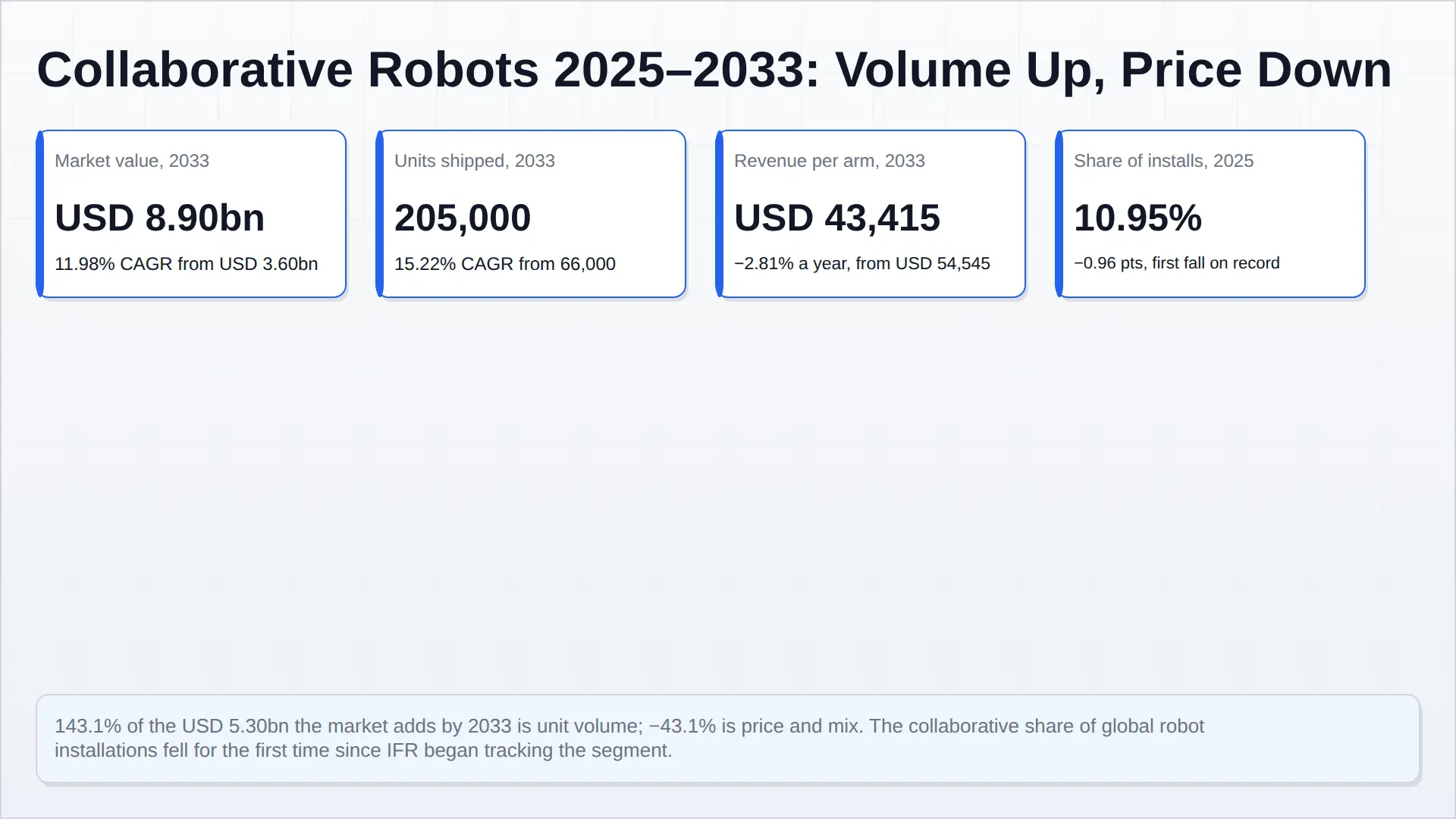
This is a market worth USD 3.60bn in 2025, reaching USD 8.90bn in 2033 at an 11.98% CAGR. It ships 66,000 arms in 2025 and 205,000 in 2033, growing units at 15.22%. And the blended revenue it collects per shipped arm falls from USD 54,545 to USD 43,415, at −2.81% a year.
| 2025 | 2033 | CAGR | |
|---|---|---|---|
| Market value | USD 3.60bn | USD 8.90bn | 11.98% |
| Units shipped | 66,000 | 205,000 | 15.22% |
| Revenue per unit | USD 54,545 | USD 43,415 | −2.81% |
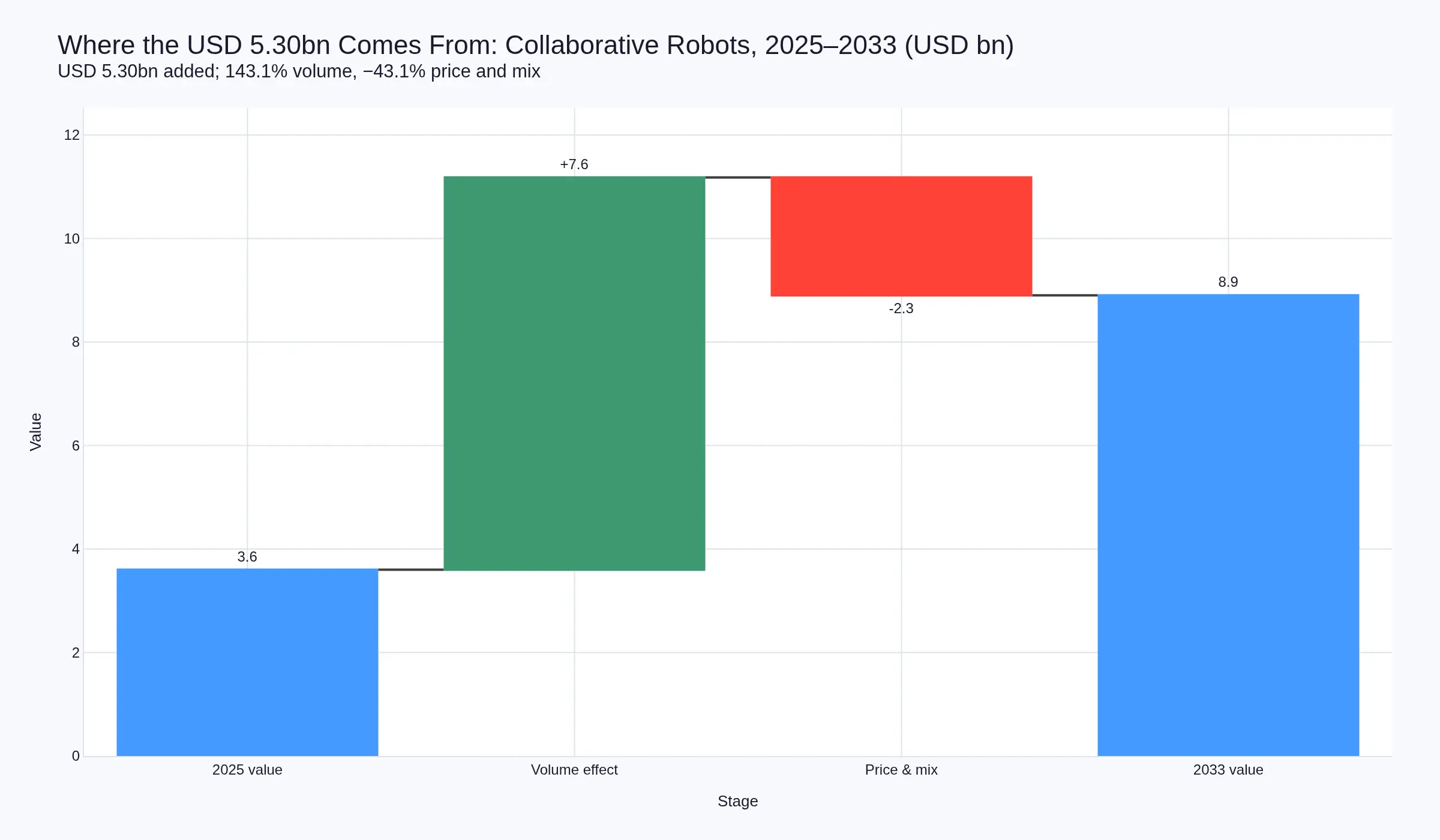
Decomposed, the USD 5.30bn the market adds by 2033 splits into a volume effect of +USD 7.58bn — 139,000 additional arms at the 2025 revenue per unit — and a price-and-mix effect of −USD 2.28bn. In share terms, 143.1% of the growth is units and −43.1% is price. The two effects reconcile to the total exactly, which is the test the split has to pass.
That inverted decomposition is the finding. Every other market in this segment grows by charging more for more capability; this one grows by shipping far more for less. Nothing else in Pheonix's automation coverage carries a negative price term.
What actually happened in 2025
In September 2026 the International Federation of Robotics reported 603,000 industrial robots installed in 2025, up 11%. It reported 66,000 collaborative robot installations — 11% of the total — and stated that for the first time since IFR began tracking the segment, collaborative growth (7%) was below the growth of the industrial robot market as a whole. The year before, IFR put cobots at 64,542 units out of 542,076, or 11.91%. Against 66,000 out of 603,000 — 10.95% — the collaborative share of global robot installations fell 0.96 percentage points.
Two of the three best-documented Western pure-plays lost revenue over exactly the window in which installations rose. Teradyne's robotics segment — Universal Robots plus MiR — went from USD 375.183m in 2023 to USD 308.295m in 2025, down 17.83%, with its loss before taxes widening from USD 54.252m to USD 99.367m. Doosan Robotics' robot-arm line went from KRW 45,927m in 2023 to KRW 19,891m in 2025, down 56.69%, taking group revenue from KRW 53,038m to KRW 32,978m. Over that same two years, global cobot installations rose 15.5%.
Units up 15.5%. The category leader's revenue down 17.8%. The challenger's arm revenue down 56.7%. Those three lines cannot describe a market that failed to arrive. They describe a market that moved its value somewhere the arm vendor does not bill for.
Why the arm has no price floor
The usual explanation — Chinese competition, price war, commoditisation — is true and insufficient. It explains the direction of the price, not the removal of the floor under it.
The floor was regulatory. The entire commercial proposition of the collaborative robot was that it was a machine you could put next to a person without a fence, safe by construction, purchasable and deployable by a factory that had no robotics engineer. That proposition had a normative home: ISO 10218, and in particular the technical specification written for it.
On 5 February 2025 ISO published ISO 10218-1:2025 and ISO 10218-2:2025. In the introduction to Part 2 the committee states the position without hedging: "the term 'collaborative robot' is not used in this document. Only the application can be developed, verified, and validated as a collaborative application."
Read that as a lawyer, an insurer or a procurement manager, and the category's price premium has no legal object to attach to. There is no such thing as a safe arm. There is only an application that has been validated as collaborative — and the validation belongs to whoever builds the cell. Under the Machinery Regulation (EU) 2023/1230, binding from 20 January 2027, an arm sold to an integrator is partly completed machinery, a category the Regulation covers explicitly and defines as an assembly missing only the components to connect it on site, the sources of energy, or the software for the specific application.
So the arm is a component. Components compete on cost.
The four questions this report answers
- Who captures the margin now? Value has migrated to the cell — end-of-arm tooling, safety sensing, fixtures, integration and commissioning. In a USD 54,545 average cell the arm is roughly half, and the half that is not the arm is local, labour-priced and inflation-linked.
- What does 15.22% unit growth actually rest on? Not on new categories of buyer. On payload: 30–50kg cobots now reach work that used to require a fenced industrial robot, while 3–5kg machines have become portable, one-handed tools. The ladder extended in both directions in eighteen months.
- Can the price fall forever? No — and the report says where it stops. A cobot cell bundled below USD 50,000, which the series crosses in 2028, stops being a capital project and becomes an operating expense. Below that line the payback argument changes shape and volume stops being price-elastic.
- What breaks the thesis? Humanoids. The low-payload cobot is the most exposed product in all of robotics to a humanoid that delivers the same reach and payload with more flexibility, and the report treats that as a live 2030–2033 substitution risk rather than a talking point.
How this report was built
The method is 70% secondary, 30% primary. The secondary layer is primary-source where it exists: IFR installation statistics, ISO and OJ standard texts, EUR-Lex, SEC and DART filings, and company product releases. The primary layer is Pheonix's own — customer and integrator conversations conducted through 2025 and 2026, exhibitor and systems-integrator interviews at automation trade events, and a structured survey of deployment economics at small and mid-sized manufacturers. Where a number is Pheonix's own bottom-up estimate rather than a disclosed figure, the text says so at the point of use.
Definition. Market value here is billed revenue for collaborative robot arms, their controllers and programming software, and the vendor-specified tooling and safety devices shipped with them. It excludes third-party systems-integration labour and end-user fixturing. That boundary is why revenue per unit is USD 54,545 and not the list price of an arm — the cell content is inside, the integration is outside.
Disclosure. The 66,000 unit figure is IFR's and is counted as it counts: installations of robots designed for collaborative operation. IFR does not verify that every one of those robots went into an application validated as collaborative — which, after 5 February 2025, is the only definition that has any legal meaning. The value series, the installed-base estimate and every share in this report are Pheonix bottom-up estimates built from disclosed vendor revenue plus a modelled long tail. The 2025 base is not a figure any vendor or association publishes.
Table of Contents
Full table of contents
- Executive summary and the rebuilt series
- The value, unit and revenue-per-unit series, 2025–2033
- The volume and price decomposition and why it reconciles
- What happened in 2025: 7% against 11%
- Market definition: what is inside the cell and what is outside
- Competitive landscape
- Four archetypes: the category creator, the diversified major, the price setter, the physical-AI entrant
- Teradyne’s robotics segment, 2023–2025: revenue down 17.83%, loss widening to USD 99.367m
- Doosan Robotics: arm revenue down 56.69% and the ONExia purchase
- Why a diversified major can price a cobot at a margin a pure-play cannot survive
- The Chinese price setters and a supply side of roughly 130 vendors
- Concentration, share and the HHI: fragmented, and staying fragmented
- The real competitor is the integrator
- Value chain and margin structure
- Seven layers from harmonic reduction to commissioning
- Two toll booths: strain-wave gearing and safety sensing
- Where the USD 54,545 goes, and why the arm’s share of it falls
- The commissioning fixed cost and the pilot trap
- The service annuity and a 440,000-unit installed base
- Price per payload-kilogram: the mechanism that actually sets the price
- Investment activity
- Neura Robotics and the up-to-USD 1.4bn round of June 2026
- What the capital is buying: models and data, not arm margin
- Doosan’s ONExia acquisition and Teradyne’s decision to absorb losses
- Valuation logic: physical-AI optionality against a commodity P&L
- Deal table and financing patterns
- Technology and innovation
- The payload ladder: 4kg to 50kg in eighteen months
- Payload granted by software licence: UR20 to 25kg, UR30 to 35kg
- The UR15, PolyScope X and the AI accelerator
- FANUC’s eleven variants and the one-handed welding cobot
- Force and torque sensing, hand guidance and the limits of each
- The honest limits of collaborative operation: pressure, dynamics, sharp edges, heat
- Mobile manipulation and the cell that walks
- What would restore pricing power
- Market risk
- Risk one: the premium has no floor
- Risk two: the pilot trap and stalled fleets
- Risk three: liability migration to the integrator and the certified-assessor bottleneck
- Risk four: the compliance wedge at 20 January 2027
- Risk five: humanoid substitution from below
- Risk six: component supply and strain-wave gearing
- Scenario table: 9.50% downside, 11.98% base, 15.00% upside
- Regulatory landscape
- ISO 10218-1:2025 and ISO 10218-2:2025: the deletion of the term
- What replaced it: the collaborative application and who validates it
- ISO/TS 15066 as a complement rather than the rule
- Regulation (EU) 2023/1230 from 20 January 2027 and partly completed machinery
- Recitals 54 and 55: self-evolving safety functions and the third-party route
- Commission Implementing Decision (EU) 2026/2015 and the harmonised standards
- The AI Act decoupling and what the Digital Omnibus changed
- Cost of compliance, and who pays it
- Sources, definitions and method
Competitive Landscape
Competitive landscape: four kinds of company and one commodity
The collaborative robot market has an odd property: its largest vendor by installed base is not its most profitable, and the companies that make the most money selling cobots treat the cobot as the smallest line item on the invoice.
Archetype one: the category creator that lost the price
Universal Robots created the commercial category and remains the largest installed base in it, with more than 100,000 arms shipped since 2008. Its owner, Teradyne, discloses the robotics segment — Universal Robots plus the MiR mobile-robot business — as a single line, and that line has gone the wrong way for two consecutive years: USD 375.183m in 2023, USD 364.848m in 2024, USD 308.295m in 2025 (Teradyne Form 10-K, segment schedule). That is down 17.83% across the two years. The segment’s loss before income taxes widened from USD 54.252m in 2023 to USD 77.552m in 2024 to USD 99.367m in 2025.
It matters to be precise about what those numbers do and do not say. They are not evidence that Universal Robots lost the technology argument. In the same period it shipped the UR20 and the UR30 and then raised their rated payloads to 25kg and 35kg in the top-lift position in September 2024 — delivered as a software update, at no charge, to arms already in the field (Universal Robots). In May 2025 it introduced the UR15, a 15kg arm running at 5 m/s on the new PolyScope X controller, aimed at the 10–15kg machine-tending and palletising work where a fenced industrial robot used to be the only answer.
That is a company executing its roadmap and losing revenue while doing it. Which is what a commodity does.
Note what the payload upgrade means commercially. The capability that most differentiates one arm from another — how much it can lift — was granted by licence, not sold as hardware. A vendor that can add ten kilograms of rated capacity with a firmware update has told the market that the marginal cost of the category’s main performance axis is approximately zero.
Archetype two: the diversified major for whom the arm is a door
FANUC competes across eleven collaborative variants spanning 4kg to 50kg, including the CRX-25iA at 30kg and the CR-35iB at 50kg — payloads that were outside the category’s scope a few years ago — and in December 2025 added the CRX-3iA, a machine light enough to be carried and set up by one person and pointed directly at the welding market (FANUC America). ABB, KUKA, Yaskawa and Kawasaki all sell collaborative arms as one line inside a catalogue that also contains drives, controllers, PLCs, safety technology, vision and a global service organisation.
The asymmetry that follows is the single most important structural fact in this market. A diversified major can sell a cobot at a gross margin a pure-play cannot survive, because the arm’s job is to open the account: it carries the controller platform, the safety hardware, the vision, the drives, the software licence and a decade of service. The pure-play has to recover its entire cost of capital from the arm alone.
So the price of a cobot is not disciplined by the market leader’s need to earn a return. It is disciplined by vendors for whom the arm is a customer-acquisition cost. This is the mechanism behind the negative price term in the series, and it is why the deflation should be read as structural rather than cyclical.
Archetype three: the price setters
The price of a five-to-ten kilogram collaborative arm is now set in China. Industry data reported by 21st Century Business Herald in July 2025 put domestic vendors’ share of Chinese six-axis-and-above collaborative robot sales above 90% in 2024, in a market where roughly 130 cobot vendors were competing globally at the end of that year; the same reporting describes price competition as normalised and new entrants as falling away (21st Century Business Herald, 29 July 2025).
Pheonix’s integrator interviews are consistent with the arithmetic. A 10kg-payload Chinese arm with a two-year warranty, a CE file and a European distributor landed at 35–45% below the equivalent Western arm in 2025 quotations, and the gap widened in the second half of the year. The German or Italian integrator buys it, because the integrator is paid for the cell and the end customer cannot tell the arm apart once it is inside one.
The clearest public confirmation is Doosan Robotics. Its annual report filed with DART in March 2026 splits revenue by product line: robot arms were KRW 45,927m in 2023, KRW 38,889m in 2024 and KRW 19,891m in 2025 — down 56.69% in two years — with the arm’s share of company revenue falling from 86.59% to 60.32% (Doosan Robotics annual report, DART). Total revenue went from KRW 53,038m to KRW 32,978m, and export revenue from KRW 29,581m to KRW 18,376m. The company’s response was structural: it acquired ONExia in September 2025, adding automation solutions and North American distribution, and merged Doosan Robotics Americas in December 2025. Buying the channel is what a component vendor does when the component no longer pays for the channel, and the report positions the company towards an industrial-humanoid strategy rather than an arm-volume strategy.
Archetype four: the physical-AI entrant that is not competing on arms
The fourth group does not compete for arm margin at all. Neura Robotics, whose up-to-USD 1.4bn round is examined in the investment chapter, sells a cognitive-robot platform in which the arm is an accessory to a perception and control stack. Its investors are not underwriting a hardware gross margin; they are underwriting a position in embodied AI. That adds one more supplier for whom the arm’s price is a decision variable rather than a revenue line.
Concentration: fragmented, and structurally so
On Pheonix estimates the top five vendors account for roughly 45% of arm revenue and no single vendor exceeds 12%. That is fragmented by any measure, and the market has become more fragmented as the Chinese cohort scaled. The consolidation now underway — fewer new entrants, more failures, more purchases of distribution — is consolidation of the long tail, not concentration at the top.
| Archetype | Representative | 2025 evidence | Pricing behaviour |
|---|---|---|---|
| Category creator, pure-play | Universal Robots / Teradyne | Robotics revenue USD 308.295m, −17.83% on 2023; segment loss USD 99.367m | Defends list price; loses volume at the bottom |
| Diversified automation major | FANUC, ABB, KUKA, Yaskawa, Kawasaki | Eleven FANUC variants from 4kg to 50kg | Prices to share; the arm opens the account |
| Price setter | Doosan Robotics and the Chinese cohort | Doosan arm revenue −56.69%; domestic share of Chinese six-axis+ above 90% | Sets the marginal price; absorbs the deflation |
| Physical-AI entrant | Neura Robotics | Up to USD 1.4bn raised, June 2026 | Subsidises the arm to win the platform |
The competitor that never appears in the share table
In a USD 54,545 average cell the arm is roughly half. The rest — end-of-arm tooling, safety scanners, fixtures, guarding where it survives, PLC integration, commissioning and the validation file — is bought locally, priced in local labour and captured by the systems integrator. The integrator is therefore the largest single competitor to the cobot vendor’s margin, and the vendor’s response has been to try to become one. That is what UR’s certified-ecosystem programme is, and it is what Doosan’s ONExia purchase is.
The strategic question is not who sells the most arms. It is who owns the validated application — because after 5 February 2025 that is the only element of the chain with a legal definition. The Global Robotic Arm report shows the same commodity logic one payload class up; the Industrial Software report shows who captures the value once the controller becomes a subscription.
Value Chain
Value chain and margin structure: where USD 54,545 actually goes
A collaborative robot is not a product; it is a stack that is assembled twice. Once in the factory, where components become an arm. Once at the customer site, where an arm becomes a cell. The margin sits in different places at each stage, and in 2025 the balance between them shifted decisively.
The seven layers
Layer one: motion components. Strain-wave (harmonic) reduction, cycloidal gears, frameless brushless motors, encoders, brakes and joint modules. This layer is the hardest to substitute and the least visible. A 6kg cobot contains six joints, each of which needs a reducer with near-zero backlash. A small number of Japanese, German and now Chinese suppliers dominate the strain-wave niche, and the Chinese joint-module supply base has been the single largest driver of cost reduction at the low payload end.
Layer two: arm assembly and controller. The vendor’s own value-add: kinematic design, joint modules, controller board, safety architecture, programming environment. This is where the famous names sit, and it is where the price is being destroyed.
Layer three: safety sensing. Force and torque sensors in the wrist and each joint, plus external 3D safety scanners and safety controllers. This is the layer that makes the application possible and the layer the arm vendor most wants to own, because it is where the residual technical moat lives.
Layer four: end-of-arm tooling. Grippers, vacuum generators, magnetic units, welding torches, dispensing valves, screwdrivers. A consolidating supplier niche with real gross margins, and almost entirely independent of the arm brand.
Layer five: programming and application software. The teach pendant or tablet environment, the wizard libraries, the welding and palletising packages, the simulation twin. Increasingly licence- and subscription-priced, and increasingly the only part of the arm vendor’s business with pricing power.
Layer six: integration and commissioning. The integrator designs the fixture, specifies the tooling, writes the cell logic, performs the risk assessment, validates the collaborative application and commissions. This is the largest single cost line in a real deployment and it is local, labour-priced and only loosely coupled to the price of the arm.
Layer seven: the service annuity. Spares, preventive maintenance, refurbished arms, training, software updates. It accrues to whoever holds the installed base, and it is the reason a shrinking arm revenue line can still be a strategically valuable position.
Two toll booths
Across those seven layers only two positions have genuine pricing power. The first is strain-wave reduction, because precision gearing at zero backlash is a materials and machining problem with a handful of qualified suppliers. The second is safety sensing and the certified validation that goes with it, because that is where liability attaches and where a generic component cannot simply be swapped in.
Neither toll booth belongs to the arm vendor by right. The first belongs to component suppliers. The second now belongs, legally, to whoever builds the application — which after ISO 10218-2:2025 is the integrator, not the arm manufacturer. That is the structural reason the arm’s share of the cell’s economics is falling and will keep falling.
Where the USD 54,545 goes
On Pheonix estimates, in a blended 2025 cell the split runs roughly as follows: arm hardware and controller ~41%, end-of-arm tooling and safety devices ~17%, software and licences ~7%, and vendor-attached service and support ~35%. Integration labour, which typically adds a further USD 25,000–60,000 depending on application, sits outside our market boundary and outside the vendor’s P&L.
Two things follow. First, the arm is not the majority of what the vendor bills; the tooling, the software and the service attached to it are, and those are the lines that have grown while the arm has deflated. Second, because the arm is only ~41% of the cell, a 20% cut in arm price reduces the customer’s total project cost by roughly 8% — which is why price cuts at the bottom of the market change volume only slowly, and why unit growth is being driven by payload reach rather than by discounting.
The commissioning fixed cost and the pilot trap
Commissioning is the least scalable cost in the chain. A single cobot deployed to do one task carries a fixed cost of engineering, risk assessment and validation that does not shrink with the arm’s price. Pheonix’s deployment survey found the same pattern repeatedly: the first cell in a plant costs three to five times the second, because the second reuses the risk assessment, the fixture design and the internal competence.
That produces the pilot trap that dominates the mid-market. A plant buys one cobot, gets a payback it likes, and stops — because the second unit requires a different application, a fresh validation and another integrator invoice. Roughly two thirds of the small and mid-sized plants in our survey panel that had deployed any cobot had deployed exactly one. Unit growth to 2033 therefore does not depend on persuading more plants to try a cobot; it depends on persuading the plants that already have one to buy the second, the fifth and the twentieth.
The service annuity and the installed base
Pheonix estimates the global collaborative installed base at approximately 440,000 arms at the end of 2025, built from IFR’s annual installation series and a modelled attrition rate. That base is the reason the service layer is 35% of market value and the reason a vendor can survive a halving of new-arm revenue: the annuity is attached to machines already on the floor.
It is also the reason the price of a new arm can fall faster than the market value does. The vendor’s economics increasingly resemble a razor-and-blades model in which the razor is sold near cost — except that the blades, the tooling, the software licences and the spares, are increasingly supplied by third parties. Whether the arm vendor can reattach them is the central commercial question of the next five years.
Price per payload-kilogram: the mechanism that sets the price
Cobots are not really priced per unit. They are priced per kilogram of payload, and that ratio has been falling faster than the headline price. A 10kg arm at USD 30,000 is USD 3,000 per payload-kilogram; a 30kg arm at USD 45,000 is USD 1,500; a 50kg arm at USD 60,000 is USD 1,200. Every payload increase granted by a software licence — UR20 to 25kg, UR30 to 35kg — is a step down that curve, taken without a change in list price.
That is the mechanism behind the −2.81% revenue-per-unit series. It is not a discount war in the ordinary sense; it is the price of capability falling per unit of capability delivered. It is also why blended revenue per arm crosses below USD 50,000 in 2028 while the market keeps growing: the customer is getting more machine for less money, and the volume response is what keeps the value line positive.
Investment Activity
Investment activity: the capital is not buying arm margin
If you read only the operating results, the collaborative robot market looks like a business in retreat. If you read the capital flows into it, it looks like a category on the edge of something. Both readings are correct, and the gap between them is the most useful thing in this chapter.
The round that reset the sector’s reference price
In June 2026 Neura Robotics disclosed a raise of up to USD 1.4bn, with a shareholder list that reads less like an industrial automation cap table and more like an AI infrastructure syndicate: Tether, Qualcomm, Amazon, NVIDIA, Bosch, Schaeffler and the European Investment Bank, with Tether described as the largest single shareholder (CNBC, 10 June 2026). The round is reported to value the company at approximately USD 7bn. Pheonix treats that valuation as reported and unconfirmed by the company; the size of the round is what the company disclosed.
The same reporting cites robotics companies raising USD 55.8bn globally in 2026 to that point. Whatever the precise figure, the direction is unambiguous: capital is entering robotics at a scale that has nothing to do with the price of an arm.
What that money is actually underwriting
Neura does not sell a cobot. It sells a cognitive robot: perception, world model, natural-language tasking, and a hardware family that includes collaborative arms as one form factor among several. Its investors are buying a position in embodied AI — the model, the dataset and the deployment footprint — not a hardware gross margin.
That matters for the collaborative robot market in two ways. First, it introduces a supplier for whom the arm’s price is a customer-acquisition cost, which puts further downward pressure on the price of the arm. Second, it establishes a valuation reference in which the hardware business is valued as a distribution channel for a software business — a lens that makes a pure-play arm vendor with USD 300m of revenue and a USD 99.4m operating loss look structurally unsaleable at any multiple.
The contrast is stark. Teradyne absorbed a USD 99.367m robotics loss before tax in 2025 and kept the business, because owning the largest installed base in collaborative robotics is the cheapest available route to a physical-AI deployment footprint. The loss is the price of the option. Doosan went the other way and bought distribution.
Doosan, ONExia and the acquisition of a channel
Doosan Robotics’ 2025 filing records the acquisition of ONExia in September 2025 — a US automation distributor — and the merger of Doosan Robotics Americas in December 2025, adding an automation-solutions line that contributed KRW 6,006m in the partial year. That is not a technology acquisition. It is the purchase of a route to the customer, made by a company whose arm revenue had halved.
Read alongside the same filing’s strategic pivot towards industrial humanoids, the logic is coherent: if the arm is a commodity, own the application engineering and the customer relationship, and use the humanoid narrative to raise capital for the next form factor. It is also, candidly, what a company does when its core product’s price is set by someone else.
The deals that did not happen
The absence of consolidation among the top five is itself a finding. In a fragmented market with a deflating price and a documented pure-play casualty, you would expect the diversified majors to buy the installed base cheaply. They have not, and the reason is visible in the arithmetic: FANUC, ABB, KUKA and Yaskawa can build a competitive arm themselves, and what they would be buying in a Universal Robots or a Doosan is a customer list they can reach through distribution anyway. The installed base is valuable to whoever owns it; it is not valuable enough to buy at a premium that includes a loss-making P&L.
| Date | Company | Event | Value | What it buys |
|---|---|---|---|---|
| Jun 2026 | Neura Robotics | Equity round, led by Tether with Qualcomm, Amazon, NVIDIA, Bosch, Schaeffler and the EIB | Up to USD 1.4bn; ~USD 7bn reported valuation | A cognitive-robot platform and an embodied-AI position |
| Sep 2025 | Doosan Robotics | Acquisition of ONExia; Americas merger in Dec 2025 | Not separately disclosed | US distribution and application engineering |
| 2023–2025 | Teradyne | Continued funding of the robotics segment through a widening loss | −USD 99.367m pre-tax in 2025 | Optionality on the largest collaborative installed base |
How a buyer should value this market
Three valuation frames are in use and they give wildly different answers.
The industrial frame values the business on arm revenue and gross margin, and produces a low multiple, because revenue is falling and margin is being competed away. On this frame the correct move is to shrink to the profitable niches: welding, machine tending, laboratory automation, where the tooling and the software package carry the margin rather than the arm.
The installed-base frame values the annuity — spares, service, software renewals, refurbishment — attached to roughly 440,000 arms in the field. On this frame a vendor with falling hardware revenue can be a stable cash business with a declining capital requirement, which is a perfectly respectable thing to own.
The physical-AI frame values the deployment footprint as a data and distribution asset and is willing to fund losses indefinitely. On this frame Neura’s USD 1.4bn and Teradyne’s USD 99.367m loss are the same trade at different scales.
The market’s problem is that these three frames are being applied simultaneously to companies that cannot satisfy all three. A pure-play arm vendor is priced on the first frame, funded by nobody, and told a story about the third. The practical consequence for anyone allocating capital to this segment in 2026 is that the interesting assets are the tooling and software layers — where gross margins are intact and the price of an arm is an input cost rather than a revenue line — not the arm assembly businesses that dominate the headlines.
Pheonix’s forecast is built on the middle frame. The USD 3.60bn to USD 8.90bn series assumes the installed base keeps compounding at 15.22% in units and that vendors hold a declining but real share of the attached software and service. The Predictive Maintenance report is the natural companion: monitoring and diagnostics is the service line that attaches to exactly this installed base, and it is priced on a completely different curve.
Technology & Innovation
Technology and innovation: the capability went up while the price went down
Nothing in the collaborative robot market is technologically stuck. The awkward fact at the centre of this report is that the technology got better in every measurable dimension during the exact period in which the revenue fell. Understanding why is the whole of the innovation story.
The payload ladder moved in both directions at once
Payload is the axis along which cobots are sold, because payload determines what work a machine is allowed to do. Between September 2024 and December 2025 that axis extended at both ends, and the effect was to collapse the space in which a mid-market collaborative arm had a defensible position.
At the top, Universal Robots raised the rated payload of the UR20 from 20kg to 25kg and the UR30 from 30kg to 35kg in the top-lift position, delivered through PolyScope software and free to existing owners (Universal Robots, 26 September 2024). FANUC sells eleven collaborative variants between 4kg and 50kg, including the CRX-25iA at 30kg and the CR-35iB at 50kg, and added the CRX-3iA in December 2025 — a machine built to be carried and deployed by one person and aimed at welding (FANUC America).
The top of the ladder is where the growth is. A 30–50kg collaborative arm competes directly with a fenced industrial robot in palletising, machine tending and heavy assembly, and it wins on floor space, on the cost of guarding and on changeover time. That is a genuine expansion of the addressable market and it is the reason Pheonix’s unit series reaches 205,000 by 2033 while revenue per arm falls.
The bottom of the ladder is where the margin is being destroyed. A 3–5kg arm that one person can carry to the workstation, teach by hand in an afternoon and redeploy next month is a tool, not a capital asset. Tools are bought on price.
Payload granted by licence is a pricing signal
The UR20 and UR30 upgrade deserves more attention than it received. A manufacturer does not hand out rated capacity for free unless the constraint was never mechanical — and if the constraint was never mechanical, then the differentiation between a 20kg and a 25kg arm is a validation decision, not a hardware one.
What that tells a buyer is that the marginal cost of the category’s principal performance variable is close to zero. What it tells a competitor is that matching the leader’s payload costs nothing but paperwork. Either way, the premium that used to attach to a heavier arm dissolves.
Programming is where the real innovation is — and where the value leaks
The UR15, launched in May 2025, is a 15kg arm running at up to 5 m/s on PolyScope X, the new controller platform, and it shipped alongside an AI accelerator built on NVIDIA Isaac and Jetson AGX Orin hardware. The point of that stack is not speed. It is the cost of getting a task from a human’s head into the machine.
Programming effort is the dominant hidden cost in a cobot deployment. Every hour of integrator time saved by a wizard, a vision-guided pick or a natural-language task specification is an hour the customer does not pay for. But — and this is the part the market has not priced — that saving accrues to the cell, not to the arm. A vendor that makes programming 30% cheaper has made the integrator’s quote 30% cheaper for the same hardware, and has given itself no additional claim on the value created.
This is the innovation paradox of the sector: the better the software gets, the harder it is for the software’s author to capture the gain, because the gain shows up as a lower total project cost and the project is priced competitively by integrators.
Force and torque sensing, and the limits of what it licenses
Joint torque sensing and hand-guided teaching are what make a cobot feel like a tool. They also create a specific and widely misunderstood capability boundary. Sensing that detects contact and stops the arm protects against a collision with a rigid, blunt, slow-moving body. It does not protect against a sharp edge, a hot workpiece, a pinch point in the tooling, or a part that is being carried with significant inertia.
The honest statement of the limit is this: a cobot is safe in a collaboration with a person only in the specific application that has been risk-assessed and validated, at the specific speeds, forces and tooling that application uses. The arm cannot carry that claim into the next application, and after 5 February 2025 it cannot even carry it into the same application without a fresh validation by the cell builder.
Pheonix’s integrator interviews converge on the same practical consequence. Roughly half of the cells our panel built in 2025 kept a light curtain or a scanner in the design even where the application would have permitted a genuinely collaborative operation, because the engineering cost of proving collaboration exceeded the cost of the guard. That is a direct, measurable tax on the collaborative proposition, and it is growing.
Mobile manipulation: the cell that walks
Mounting a collaborative arm on an autonomous mobile robot produces a machine that can move between workstations and serve several machines with one arm. This is the most interesting genuine innovation in the segment, and it is strategically awkward for arm vendors: it makes the arm a component of a mobile platform, reduces the number of arms needed per plant, and hands the system integration to whoever owns fleet management.
Teradyne owns both halves of this — Universal Robots for the arm and MiR for the platform — and has reported them as one segment since 2022. Yet the combined segment’s revenue fell in each of the last two years, which is the clearest available evidence that adjacency alone does not create pricing power.
What would restore pricing power
Three things, and only one of them is likely.
First, certified cell software. A vendor that could sell a validated, pre-certified application template — risk assessment included, safety functions included, tooling specified — would capture the integrator’s margin rather than supply into it. It requires the vendor to accept product liability for an application it did not physically build. Nobody in the market has been willing to do that.
Second, safety as a licence. Speed-and-separation monitoring driven by vision, certified to a performance level, sold as a subscription. This is where the AI investment could pay, and it is the most plausible route to a recurring revenue line that survives the collapse of arm margin.
Third, a payload or dexterity step-change that hardware competition cannot match. Historical evidence from this sector suggests any such step is matched within eighteen months at a 40% lower price. See the Humanoid Robot report for what happens to the pricing of a form factor when the capability step is large enough, and the Industrial Automation report for the platform economics that sit above all of this.
Market Risk
Market risk: six things that can go wrong, and one that probably will
The base case in this report is not a bullish one. An 11.98% value CAGR with a negative price term inside it is a forecast that the market grows while its unit economics deteriorate, and that is an uncomfortable thing to underwrite. The risks below are ordered by how much they would move the 2033 number, not by how often they are discussed.
Risk one: the premium has no floor
This is the base case risk and the highest-probability one. The revenue-per-arm series already assumes a −2.81% annual decline to USD 43,415. If the erosion runs at the rate implied by the observed two-year revenue collapse at Universal Robots and Doosan — closer to 10–15% a year on arm revenue — then value growth converges on unit growth minus a much larger deflation, and the 2033 market lands closer to USD 6bn than USD 9bn even with base-case volumes.
The mechanism is not a price war in the ordinary sense. It is the combination of three structural facts described earlier: the arm is now legally a partly completed component, its main performance axis costs nothing to extend, and its price is set by suppliers for whom it is a customer-acquisition cost. None of those three reverses on its own.
Risk two: the pilot trap and stalled fleets
Unit growth of 15.22% a year requires the installed base to compound, which requires existing owners to buy again. Pheonix’s deployment survey found roughly two thirds of small and mid-sized plants that had deployed any cobot had deployed exactly one, because the commissioning and validation cost of the second cell is not shared with the first.
If that ratio does not improve, the 2033 unit number is not 205,000. It is closer to 130,000–150,000, and the market lands in the bottom of the downside range entirely on volume rather than price. The variable that matters is not customer acquisition; it is the cost of the risk assessment.
Risk three: liability migrates to the integrator, and the integrator cannot carry it
ISO 10218-2:2025 places the validation of the collaborative application on the cell builder. That is a reasonable allocation of responsibility and a poor allocation of capability. The integrator population is small, unevenly qualified, and in most markets is a trade of firms with fewer than 50 employees. An integrator that gets a collaborative validation wrong is now the party holding the liability for a machine operating next to a person.
Two outcomes are possible and both slow the market. Either integrators price the risk into their quotes — raising the cost of the cell and reducing the return that justified the cobot in the first place — or insurers refuse to underwrite certain applications and a category of deployment simply stops. Pheonix expects the first in 2026–2027 and a hardening insurance market from 2028.
Risk four: the compliance wedge at 20 January 2027
The Machinery Regulation tightens at exactly the moment the installed base is largest. Every collaborative cell commissioned before that date was assessed against a harmonised standard set that is itself being replaced, and the technical file that supported it may not satisfy the new regime. See the regulatory chapter for the detail. The commercial risk is not that machines are withdrawn; it is that a large cohort of owner-operators discovers a documentation gap at the same time and defers new purchases while they fix it.
Risk five: the humanoid arrives underneath
This is the risk that would end the category rather than shrink it, and it should be stated plainly. The low-payload collaborative arm — 5–15kg, single task, fixed fixture — is the most exposed product in all of robotics to a humanoid that delivers the same reach and payload with more flexibility and no fixture design. A humanoid does not need a custom gripper, a fixture and a validated cell; it needs a task description.
Pheonix does not expect humanoids to take meaningful cobot volume before 2029, and does not put substitution into the base case before 2031 for reliability and cost reasons. But the direction of capital is unambiguous: the same investors funding embodied AI are funding the thing that obsoletes the fixed collaborative cell. If unit growth in the 2031–2033 window is materially below the series, this is why.
Risk six: component supply and strain-wave gearing
The least discussed and most mechanical risk. Precision strain-wave reducers are a concentrated supply chain, and every payload increase at the top of the ladder consumes reduction capacity. A shortage or a price increase in that one component would lift arm cost while the market is demanding lower arm prices, compressing the vendor’s already thin margin. It is also where a genuine, non-imitable moat might form — which is the upside.
Scenario table
The three scenarios differ mainly in what happens to price and to the repeat-purchase ratio. Unit growth is far more stable across them than revenue per arm, which is itself the point.
| Scenario | Value CAGR | 2033 value | What has to be true |
|---|---|---|---|
| Downside | 9.50% | USD 7.44bn | Price erosion accelerates; repeat purchases stall; the compliance wedge defers 2027 demand; humanoid substitution begins before 2031 |
| Base | 11.98% | USD 8.90bn | Units compound at 15.22%; price falls 2.81% a year; the service and software attach holds at roughly a third of value |
| Upside | 15.00% | USD 11.01bn | Certified cell software creates a defendable software line; 30–50kg arms take work from fenced industrial robots faster than expected; a strain-wave bottleneck gives incumbents pricing power |
Note what the scenario spread does and does not contain. It contains a great deal of uncertainty about price and relatively little about volume. That asymmetry is the market’s defining characteristic and the reason this report leads with a decomposition rather than a growth rate.
Regulatory Landscape
Regulatory landscape: how a standard deleted a product category
This is the chapter that explains the number at the top of the report. The collaborative robot did not lose its price premium because competitors undercut it. It lost it because the normative text that created the premium stopped using the word.
5 February 2025: the revision
ISO published ISO 10218-1:2025 and ISO 10218-2:2025 on 5 February 2025, revisions that had been in development for years and that replace the 2011 editions. Part 1 covers the safety requirements for the robot itself; Part 2 covers industrial robot applications and robot cells (ISO 10218-2:2025). The audience is explicit, and it is not only robot manufacturers: ISO lists health and safety bodies, users of robot applications and their employers, and service providers among those the standard is written for.
The committee’s own description of the revision is that it contains extensive changes addressing the latest safety challenges and technological advances, and that the changes are intended to enhance compliance and risk mitigation. The Association for Advancing Automation published an explanatory FAQ on the revision, which is the most accessible plain-language account of what moved (A3).
The sentence that matters
In the introduction to Part 2, the standard states its position without qualification:
“The term ‘collaborative robot’ is not used in this document. Only the application can be developed, verified, and validated as a collaborative application.”
That is not a drafting preference. It is a statement about where the safety case lives. Before this revision, the market’s operating assumption was that a collaborative robot was a category of machine — a machine designed to a specification that made it safe to work beside, and which therefore transferred a degree of safety assurance with the hardware. After this revision, there is no such category. There is a robot, which is a component, and there is an application, which is the thing that can be collaborative.
Every commercial consequence in this report follows from that sentence. If the only collaborative thing is the application, then the party that builds the application holds the responsibility, the validation file and the liability — and the party that sells the arm sells a component whose safety properties are contingent on someone else’s design work. A component cannot charge a category premium, because there is no longer a category for it to be in.
ISO/TS 15066, the technical specification that the market has spent a decade citing for its force and pressure limits, is described by ISO as complementary to the 10218 parts rather than superseded by them. It remains the reference for what a validated collaborative operation must demonstrate. What changed is who has to demonstrate it.
Regulation (EU) 2023/1230, from 20 January 2027
The European legal layer does the same thing in binding form. Regulation (EU) 2023/1230 replaces the Machinery Directive and applies from 20 January 2027 (EUR-Lex). Two of its provisions decide the commercial question.
First, the definition. The Regulation’s definition of machinery expressly includes an assembly that is missing only the components to connect it on site, the sources of energy and motion, or the software for the specific application. An arm shipped to a systems integrator is therefore partly completed machinery — a category the Regulation regulates, requires to meet the relevant essential health and safety requirements, and deliberately does not allow to be CE-marked as a complete machine. The CE mark, and with it the presumption of conformity, attaches to the cell.
Second, the software question. Recital 54 states that systems with self-evolving behaviour ensuring safety functions should be included in Annex I, and that conformity assessment of a safety component or a system with self-evolving behaviour ensuring safety functions should be carried out by a third party. Recital 55 then draws the line precisely: the third-party route applies only to systems with fully or partially self-evolving behaviour using machine learning, and not to software that is incapable of learning or evolving and is programmed only to execute certain automated functions.
Read those two recitals together and the sector’s next five years are visible. A force-limited cobot running deterministic safety logic does not attract the third-party assessment route, so the compliance burden on it stays light — which keeps the arm cheap. But a cobot whose safety functions depend on a learned model does attract it, which means the moment a vendor upgrades to AI-based safety, it takes on a third-party assessment regime for that function. The regulatory architecture therefore rewards keeping the arm dumb and pushing intelligence into the application — exactly where the value has already migrated.
The harmonised standards and the transition
Commission Implementing Decision (EU) 2026/2015 of 4 September 2026, published in the Official Journal on 7 September 2026, amends and repeals Implementing Decision (EU) 2023/1586 as regards harmonised standards for machinery, and cites EN ISO 10218-1:2025 and EN ISO 10218-2:2025 among them. The 2011 editions remain cited only until the new Regulation applies on 20 January 2027.
The practical effect is a narrow and awkward window. Between September 2026 and January 2027 a manufacturer can cite either standard set; after January 2027 only the 2025 editions support a presumption of conformity. Any cell commissioned in that window whose technical file was built on the 2011 text has a documentation exposure, and any cell built on an application validation that assumed the arm carried the safety case has a substantive one.
That is why the compliance risk in this report is dated to a specific month rather than spread over the forecast: Pheonix expects a measurable deferral of new collaborative deployments in the two quarters either side of 20 January 2027, as owner-operators reconcile technical files.
What compliance now costs, and who pays
On Pheonix estimates, a single collaborative cell in a European plant now carries USD 8,000–25,000 of validation cost — risk assessment, safety-function verification, documentation and the integrator’s engineering time — depending on whether the application is genuinely collaborative or merely fence-free. That is 15–45% of the price of the arm itself, and it is incurred by the party that builds the cell.
| Application | Typical validation cost (USD) | Share of arm price |
|---|---|---|
| Machine tending, guarded (not collaborative) | 8,000–12,000 | 15–25% |
| Pick-and-place, speed-and-separation monitored | 12,000–18,000 | 25–35% |
| Hand-guided assembly, power-and-force limited | 18,000–25,000 | 35–45% |
The distributional consequence is the story. A regulatory change that moved the safety case from the machine to the application transferred roughly USD 8,000–25,000 of cost per deployment from the arm vendor’s amortised engineering budget — where it is spread across thousands of units — to the integrator’s project P&L, where it is borne once per cell. That is why the integrator’s quote has been rising while the arm’s price has been falling, and why the winner in this market is whoever can industrialise the validation rather than whoever can build the cheapest arm.
Which returns the argument to where the competitive chapter left it. The regulatory landscape has not merely failed to protect the collaborative robot’s premium; it has reallocated the value to the validated application. A vendor that wants pricing power after 2027 has to sell one.