
Global Environmental Testing Market Report, Size, Share and Forecast 2026–2033
Global Environmental Testing Market Forecast Snapshot (2026???2033)
| Metric | Value |
|---|---|
| Market Size (2025) | USD 12.84 Billion |
| Market Size (2033) | USD 22.76 Billion |
| CAGR (2026???2033) | 7.41% |
| Largest Segment | Water Testing Services |
| Fastest Growing Segment | Air Quality & Emissions Testing |
| Leading End-Use Segment | Industrial & Manufacturing Sector |
| Key Trend | Advanced Analytical Technologies & Real-Time Environmental Monitoring |
| Regulatory Influence | Environmental Protection Regulations, Pollution Control Standards & Sustainability Compliance Requirements |
| Future Outlook | Growth Driven by Environmental Compliance, Sustainability Initiatives & Industrial Monitoring Demand |
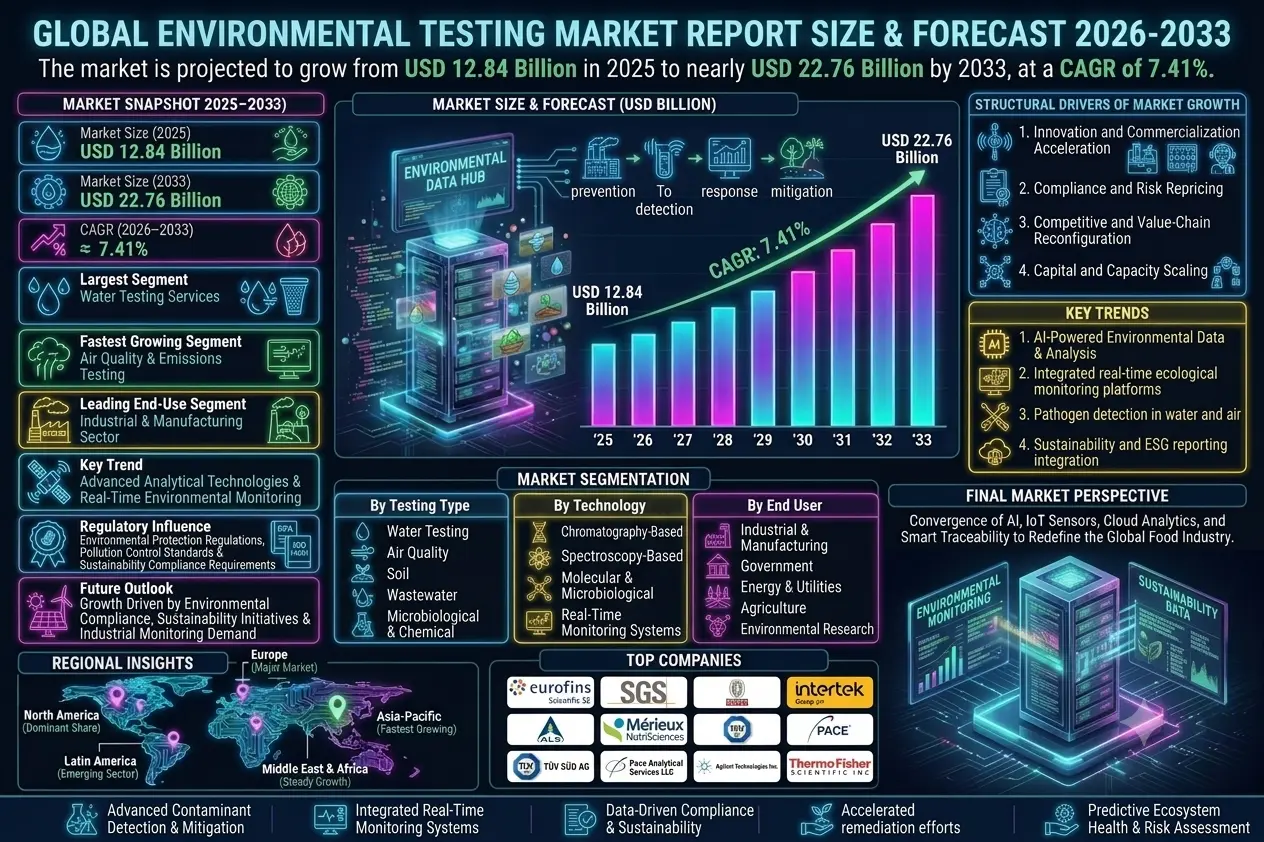
Global Environmental Testing Market Size & Forecast
The Global Environmental Testing Market is expected to witness steady growth during the forecast period from 2026 to 2033. The market was valued at USD 12.84 billion in 2025 and is projected to reach approximately USD 22.76 billion by 2033, registering a CAGR of 7.41%. The market growth is primarily driven by increasing environmental concerns, stringent government regulations, growing industrialization, rising pollution levels, and expanding sustainability initiatives across industries. Environmental testing services have become critical for assessing air quality, water safety, soil contamination, wastewater management, and hazardous substance monitoring to ensure environmental compliance and public health protection. In addition, advancements in analytical technologies, laboratory automation, and real-time monitoring systems are supporting long-term market expansion.Global Environmental Testing Market Overview
Environmental testing involves the analysis of environmental samples such as air, water, soil, sediment, and waste materials to detect contaminants, pollutants, and biological hazards. The market includes water testing, air quality testing, soil testing, wastewater analysis, microbiological testing, chemical analysis, and environmental monitoring services. These services are widely utilized across industrial facilities, government agencies, municipalities, energy companies, construction projects, agricultural operations, and environmental research institutions. The market is evolving from periodic laboratory-based testing toward integrated, real-time environmental monitoring and predictive analytics solutions.Structural Drivers of Market Growth
1. Innovation and Commercialization Acceleration
Rapid advancements in analytical instrumentation, molecular testing technologies, remote sensing systems, and automated laboratory workflows are transforming environmental testing capabilities. AI-enabled analytics and real-time monitoring platforms are improving detection accuracy and operational efficiency.Market Implications
Companies investing in advanced analytical technologies, digital monitoring systems, and laboratory automation are expected to strengthen market leadership.2. Compliance and Risk Repricing
Environmental regulations governing air emissions, water quality, hazardous waste disposal, and industrial pollution control are driving demand for testing services. Governments are increasingly enforcing strict environmental compliance and sustainability reporting requirements.Market Implications
Firms offering accredited, compliant, and scientifically validated testing services are likely to gain stronger market trust and long-term contracts.3. Competitive and Value-Chain Reconfiguration
The market is highly competitive as testing laboratories, environmental consulting firms, technology providers, and inspection service companies expand their offerings. Integration of environmental testing with digital compliance management platforms is reshaping value-chain dynamics.Market Implications
Companies focusing on comprehensive environmental monitoring and integrated compliance solutions may gain stronger competitive advantages.4. Capital and Capacity Scaling
Rising investments in environmental infrastructure, pollution control systems, laboratory facilities, and sustainability programs are supporting market growth. Increasing industrial expansion and climate-related environmental monitoring requirements are creating additional testing demand.Market Implications
Organizations scaling laboratory capacity, analytical capabilities, and digital monitoring infrastructure are expected to capture future opportunities.Market Segmentation Analysis
By Testing Type
1. Water Testing Services
This remains the largest segment due to growing concerns regarding drinking water safety, wastewater treatment, and industrial discharge monitoring.2. Air Quality & Emissions Testing
Fastest-growing segment driven by increasing air pollution concerns and stricter emission standards.3. Soil Testing
Widely utilized for agricultural productivity assessment and contamination analysis.4. Wastewater Testing
Strong demand from municipalities and industrial facilities.5. Microbiological & Chemical Testing
Critical for environmental safety, regulatory compliance, and risk assessment.By Technology
1. Chromatography-Based Testing
Largest segment due to high accuracy in chemical contaminant analysis.2. Spectroscopy-Based Testing
Widely used for environmental sample characterization.3. Molecular & Microbiological Testing
Growing demand for pathogen detection and biological contamination assessment.4. Real-Time Monitoring Systems
Fast-growing segment due to continuous environmental surveillance capabilities.By End User
1. Industrial & Manufacturing Sector
Largest segment due to environmental compliance and pollution control requirements.2. Government & Regulatory Agencies
Strong demand for environmental monitoring and policy enforcement.3. Energy & Utilities
Increasing adoption for emissions monitoring and resource management.4. Agriculture Sector
Growing utilization for soil quality and water management applications.5. Environmental Research Institutions
Important contributors to ecological studies and climate monitoring initiatives.Regional Market Dynamics
North America
North America dominates the global environmental testing market due to stringent environmental regulations, advanced testing infrastructure, and strong sustainability initiatives.Europe
Europe remains a major market supported by strict environmental policies, climate action programs, and industrial compliance requirements.Asia-Pacific
Asia-Pacific is the fastest-growing region due to rapid industrialization, increasing pollution concerns, and expanding environmental protection initiatives.Latin America
Latin America is gradually expanding due to growing environmental awareness and industrial monitoring requirements.Middle East & Africa
The region is witnessing steady growth driven by infrastructure development, resource management programs, and environmental sustainability investments.Competitive Landscape
The Global Environmental Testing Market is highly competitive with environmental laboratories, analytical service providers, and testing technology companies operating globally.Key Companies Operating in the Market Include:
- Eurofins Scientific SE
- SGS SA
- Bureau Veritas S.A.
- Intertek Group plc
- ALS Limited
- M??rieux NutriSciences
- T??V S??D AG
- Pace Analytical Services LLC
- Agilent Technologies Inc.
- Thermo Fisher Scientific Inc.
Strategic Outlook
The future of the environmental testing market will be shaped by digital monitoring technologies, AI-powered environmental analytics, laboratory automation, and sustainability reporting requirements. Real-time monitoring systems, cloud-based compliance platforms, and advanced analytical instrumentation will significantly improve environmental risk management capabilities. The rise of climate resilience programs, pollution control initiatives, and ESG-focused corporate strategies is expected to create strong long-term growth opportunities.Final Market Perspective
The Global Environmental Testing Market remains a vital segment within environmental protection, public health, and sustainability ecosystems. Rising regulatory scrutiny, environmental awareness, and technological advancements continue driving long-term market growth. Companies capable of delivering accurate, compliant, scalable, and technology-driven environmental testing solutions will be best positioned to capture future opportunities. The convergence of advanced analytics, digital monitoring, and environmental sustainability objectives is expected to redefine the future of the global environmental testing industry.Table of Contents
Table of Contents
- 1. Executive Summary
- 1.1 Global Environmental Testing Market Snapshot (2026???2033)
- 1.2 Market Size & Growth Overview
- 1.3 Key Market Highlights
- 1.4 Largest & Fastest-Growing Segments
- 1.5 Regional Performance Summary
- 1.6 Competitive Landscape Overview
- 1.7 Strategic Outlook Through 2033
- 2. Market Introduction & Overview
- 2.1 Definition of Environmental Testing
- 2.2 Scope of the Global Environmental Testing Market
- 2.3 Evolution of Environmental Monitoring & Analytical Technologies
- 2.4 Environmental Testing Value Chain Analysis
- 2.5 Regulatory & Compliance Framework
- 2.6 Emerging Trends in Sustainability & Environmental Monitoring
- 2.7 Role of Environmental Testing in Public Health & Pollution Control
- 3. Research Methodology
- 3.1 Primary Research Approach
- 3.2 Secondary Research Sources
- 3.3 Market Size Estimation Methodology
- 3.4 Forecasting Assumptions (2026???2033)
- 3.5 Data Validation & Triangulation
- 4. Market Dynamics
- 4.1 Market Drivers
- 4.1.1 Increasing Environmental Regulations & Compliance Requirements
- 4.1.2 Rising Pollution Levels & Environmental Concerns
- 4.1.3 Growing Industrialization & Urbanization
- 4.1.4 Expansion of Sustainability & ESG Initiatives
- 4.1.5 Advancements in Analytical Testing Technologies
- 4.2 Market Restraints
- 4.2.1 High Cost of Advanced Analytical Equipment
- 4.2.2 Complex Regulatory Certification Requirements
- 4.2.3 Shortage of Skilled Environmental Testing Professionals
- 4.3 Market Opportunities
- 4.3.1 Growth in Real-Time Environmental Monitoring Solutions
- 4.3.2 Expansion of Climate Change & Sustainability Programs
- 4.3.3 Increasing Demand for ESG Reporting & Compliance Services
- 4.3.4 Adoption of AI-Based Environmental Analytics Platforms
- 4.4 Market Challenges
- 4.4.1 Managing Large Volumes of Environmental Data
- 4.4.2 Ensuring Testing Accuracy Across Diverse Sample Types
- 4.4.3 Maintaining Compliance with Evolving Environmental Standards
- 4.1 Market Drivers
- 5. Global Environmental Testing Market Size & Forecast (USD Billion), 2026???2033
- 5.1 Market Revenue Analysis
- 5.2 CAGR Analysis
- 5.3 Demand-Supply Trends
- 5.4 Pricing Analysis
- 5.5 Investment Trends
- 5.6 Future Market Outlook
- 6. Market Segmentation Analysis (USD Billion), 2026???2033
- 6.1 By Testing Type
- 6.1.1 Water Testing Services (Largest Segment)
- 6.1.2 Air Quality & Emissions Testing (Fastest-Growing Segment)
- 6.1.3 Soil Testing
- 6.1.4 Wastewater Testing
- 6.1.5 Microbiological & Chemical Testing
- 6.2 By Technology
- 6.2.1 Chromatography-Based Testing (Largest Segment)
- 6.2.2 Spectroscopy-Based Testing
- 6.2.3 Molecular & Microbiological Testing
- 6.2.4 Real-Time Monitoring Systems (Fastest-Growing Segment)
- 6.3 By End User
- 6.3.1 Industrial & Manufacturing Sector (Largest Segment)
- 6.3.2 Government & Regulatory Agencies
- 6.3.3 Energy & Utilities
- 6.3.4 Agriculture Sector
- 6.3.5 Environmental Research Institutions
- 6.1 By Testing Type
- 7. Regional Market Analysis
- 7.1 North America (Largest Market)
- 7.2 Europe
- 7.3 Asia-Pacific (Fastest-Growing Market)
- 7.4 Latin America
- 7.5 Middle East & Africa
- 8. Competitive Landscape
- 8.1 Market Share Analysis
- 8.2 Competitive Benchmarking
- 8.3 Strategic Developments
- 8.4 Product Innovation & Environmental Monitoring Strategies
- 8.5 Partnerships, Acquisitions & Expansion Analysis
- 9. Company Profiles
- 9.1 Eurofins Scientific SE
- 9.2 SGS SA
- 9.3 Bureau Veritas S.A.
- 9.4 Intertek Group plc
- 9.5 ALS Limited
- 9.6 M??rieux NutriSciences
- 9.7 T??V S??D AG
- 9.8 Pace Analytical Services LLC
- 9.9 Agilent Technologies Inc.
- 9.10 Thermo Fisher Scientific Inc.
- 10. Strategic Intelligence & Pheonix AI Insights
- 10.1 Environmental Testing Demand Forecast Model
- 10.2 Pollution Monitoring Opportunity Analysis
- 10.3 Sustainability Compliance Growth Tracker
- 10.4 Environmental Risk Assessment Framework
- 10.5 Automated Porter???s Five Forces Analysis
- 11. Future Outlook & Strategic Recommendations
- 11.1 Expansion of Real-Time Environmental Monitoring Systems
- 11.2 Investment in Advanced Analytical Technologies
- 11.3 Growth Opportunities in ESG & Sustainability Compliance
- 11.4 Strengthening Environmental Data Management Capabilities
- 11.5 Long-Term Market Outlook (2033+)
- 12. Appendix
- 13. About Pheonix Market Research
- 14. Disclaimer
Competitive Landscape
Global Environmental Testing Market Competitive Intensity & Market Structure Overview
The global environmental testing market is highly competitive and moderately fragmented, comprising multinational testing laboratories, inspection and certification companies, environmental consulting firms, and analytical technology providers. Competitive intensity is primarily driven by laboratory accreditation, testing accuracy, regulatory expertise, technological capabilities, geographic coverage, and the ability to deliver comprehensive environmental compliance solutions.
Market participants compete across water testing, air quality monitoring, soil analysis, wastewater testing, microbiological assessments, and environmental risk management services. Increasing environmental regulations, industrial compliance requirements, and sustainability commitments are intensifying competition among service providers seeking to expand their testing portfolios and digital monitoring capabilities.
The market structure is evolving from traditional laboratory-based testing toward integrated environmental intelligence platforms that combine real-time monitoring, advanced analytics, cloud-based reporting, and predictive environmental risk assessment. Strategic acquisitions, laboratory network expansion, and investments in digital technologies are reshaping competitive dynamics across the industry.
Global Environmental Testing Market Competitive Intensity & Market Structure Current Scenario
Leading Global Environmental Testing Companies
Eurofins Scientific SE: One of the world’s largest testing service providers, offering comprehensive environmental, food, pharmaceutical, and industrial testing solutions through an extensive laboratory network.
SGS SA: A global leader in testing, inspection, and certification services with strong environmental monitoring, compliance verification, and sustainability assessment capabilities.
Bureau Veritas S.A.: Provides environmental testing, inspection, certification, and risk management services across industrial, infrastructure, and governmental sectors.
Intertek Group plc: A major quality assurance provider offering environmental analysis, emissions testing, laboratory services, and regulatory compliance support.
ALS Limited: A leading laboratory services company specializing in environmental testing, geochemistry, food analysis, and industrial monitoring applications.
M??rieux NutriSciences: Delivers environmental and microbiological testing solutions with strong expertise in safety, sustainability, and compliance-related services.
T??V S??D AG: A prominent testing and certification organization providing environmental assessments, emissions monitoring, and sustainability verification services.
Pace Analytical Services LLC: A leading environmental laboratory network focused on regulatory testing, sample analysis, and environmental compliance solutions.
Agilent Technologies Inc.: Supplies advanced analytical instruments and laboratory technologies widely used in environmental contaminant testing and monitoring applications.
Thermo Fisher Scientific Inc.: A major provider of analytical instruments, laboratory solutions, and environmental testing technologies supporting research and compliance activities worldwide.
Key Competitive Intensity & Market Structure Drivers
Stringent environmental regulations governing air emissions, water quality, hazardous waste management, and industrial pollution are increasing demand for accredited testing and compliance services.
The growing adoption of real-time environmental monitoring systems, AI-enabled analytics, and cloud-based reporting platforms is shifting competition toward technology-enabled environmental intelligence solutions.
Industrial sustainability initiatives and ESG reporting requirements are creating new opportunities for integrated environmental testing, auditing, and compliance management services.
Expansion of laboratory networks, geographic service coverage, and multi-disciplinary testing capabilities is becoming increasingly important for securing large-scale industrial and government contracts.
Advancements in analytical instrumentation, laboratory automation, and molecular testing technologies are raising performance standards and strengthening barriers to entry for smaller market participants.
Strategic Implications of Competitive Intensity & Market Structure
Companies with extensive laboratory infrastructure, global accreditation credentials, and advanced analytical capabilities are expected to maintain strong competitive positions across regulated industries.
Investment in laboratory automation, AI-powered analytics, and continuous environmental monitoring technologies is becoming critical for improving operational efficiency and service differentiation.
Organizations capable of delivering integrated testing, monitoring, consulting, and compliance management services are better positioned to capture long-term customer relationships and recurring revenue streams.
Strong regulatory expertise and the ability to support evolving sustainability reporting requirements provide significant competitive advantages in government and industrial markets.
Strategic acquisitions, partnerships, and regional laboratory expansion initiatives are enabling market participants to strengthen service portfolios and enhance global market presence.
Global Environmental Testing Market Competitive Intensity & Market Structure Forward Outlook
The competitive landscape of the global environmental testing market is expected to become increasingly technology-driven, with digital monitoring systems, predictive analytics, and automated laboratory operations playing a central role in future market development.
Testing providers are expected to accelerate investments in real-time environmental surveillance, cloud-based compliance management platforms, and AI-powered data interpretation tools to strengthen market competitiveness.
Emerging technologies such as remote sensing, Internet of Things (IoT)-enabled monitoring networks, digital environmental twins, and advanced molecular diagnostics are expected to transform environmental assessment capabilities.
Over the forecast period, companies that successfully combine scientific expertise, regulatory compliance, digital innovation, and global service scalability will be best positioned to lead the evolving global environmental testing market.
Value Chain
Global Environmental Testing Market Value Chain & Supply Chain Evolution Overview
The Global Environmental Testing Market is experiencing significant transformation driven by increasing environmental regulations, rising sustainability commitments, growing industrial monitoring requirements, and advancements in analytical testing technologies. The market???s value chain spans sample collection, laboratory testing, analytical instrumentation, data interpretation, compliance reporting, environmental consulting, and continuous monitoring services. This integrated ecosystem is reshaping how governments, industries, and organizations manage environmental risks and regulatory obligations.
A defining feature of the market is the growing convergence of advanced analytical sciences, laboratory automation, artificial intelligence, remote sensing technologies, and real-time environmental monitoring platforms. Environmental testing is increasingly evolving from periodic laboratory analysis toward continuous, data-driven environmental intelligence systems capable of delivering faster, more accurate, and actionable insights.
Supply chain complexity continues to increase due to stringent accreditation requirements, evolving environmental standards, specialized testing equipment needs, and expanding demand for high-precision analytical services. Market participants must coordinate across instrument manufacturers, sample collection providers, accredited laboratories, environmental consultants, software platforms, regulatory agencies, and industrial clients while maintaining data integrity, testing accuracy, and compliance assurance.
Industry stakeholders are investing heavily in laboratory modernization, cloud-based environmental monitoring systems, AI-powered analytics platforms, and advanced testing methodologies to improve operational efficiency and environmental decision-making. The value chain is evolving into a digitally connected, compliance-focused, and sustainability-driven ecosystem centered on environmental protection, risk management, and regulatory transparency.
Global Environmental Testing Market Value Chain & Supply Chain Evolution Current Scenario
Market-Specific Value Chain
- Environmental Assessment & Sample Collection: Field inspections, environmental surveys, air sampling, water sampling, soil collection, waste sampling, and contamination assessment.
- Analytical Instrumentation & Laboratory Infrastructure: Chromatography systems, spectroscopy equipment, molecular testing platforms, laboratory automation systems, and analytical software solutions.
- Laboratory Testing & Analysis: Chemical analysis, microbiological testing, toxicology assessment, contaminant detection, emissions testing, and environmental risk evaluation.
- Data Interpretation & Compliance Reporting: Environmental reporting, regulatory documentation, sustainability assessments, ESG compliance support, and environmental impact analysis.
- Environmental Monitoring & Digital Platforms: Real-time monitoring systems, cloud-based environmental management platforms, predictive analytics tools, and remote sensing technologies.
- End User Implementation: Industrial facilities, government agencies, utilities, municipalities, agricultural organizations, energy companies, construction firms, and environmental research institutions.
Company-to-Stage Mapping
- Environmental Assessment & Sample Collection: SGS SA, Bureau Veritas S.A., Intertek Group plc, ALS Limited.
- Analytical Instrumentation & Laboratory Infrastructure: Agilent Technologies Inc., Thermo Fisher Scientific Inc., laboratory automation providers, and analytical equipment manufacturers.
- Laboratory Testing & Analysis: Eurofins Scientific SE, Pace Analytical Services LLC, M??rieux NutriSciences, ALS Limited.
- Data Interpretation & Compliance Reporting: Environmental consulting firms, compliance specialists, sustainability advisory organizations, and regulatory reporting service providers.
- Environmental Monitoring & Digital Platforms: Environmental technology providers, monitoring platform developers, and industrial analytics solution providers.
- End User Implementation: Industrial enterprises, government agencies, utilities, agricultural organizations, construction companies, and environmental research institutions.
Key Value Chain & Supply Chain Evolution Signals in Global Environmental Testing Market
Expansion of Real-Time Environmental Monitoring Systems
Organizations are increasingly deploying continuous monitoring technologies for air quality, water quality, emissions management, and environmental risk assessment.
Growing Adoption of AI-Powered Environmental Analytics
Artificial intelligence and advanced analytics are improving data interpretation, predictive modeling, contamination forecasting, and regulatory compliance management.
Acceleration of Laboratory Automation and Digitalization
Automated workflows, robotics, and digital laboratory management systems are enhancing testing efficiency, throughput, and analytical accuracy.
Rising Demand for ESG and Sustainability Compliance Services
Corporate sustainability initiatives and ESG reporting requirements are increasing demand for environmental testing, auditing, and compliance verification services.
Advancement of High-Precision Analytical Technologies
Innovations in chromatography, spectroscopy, molecular diagnostics, and contaminant detection technologies are improving testing sensitivity and reliability.
Strengthening Environmental Regulatory Frameworks
Governments worldwide are implementing stricter environmental standards, creating greater demand for accredited testing services and monitoring programs.
Strategic Implications of Value Chain & Supply Chain Evolution
Investment in Advanced Analytical Capabilities
Organizations expanding high-precision testing capabilities and laboratory automation infrastructure will strengthen long-term competitive positioning.
Expansion of Digital Environmental Intelligence Platforms
Providers integrating monitoring technologies, cloud platforms, and predictive analytics will gain stronger market differentiation and customer engagement.
Optimization of Laboratory Networks and Operational Efficiency
Scalable laboratory infrastructure, regional testing networks, and workflow automation will improve service delivery and cost efficiency.
Strengthening Accreditation and Compliance Expertise
Maintaining internationally recognized certifications and regulatory compliance capabilities will be critical for customer trust and contract acquisition.
Development of Integrated Environmental Service Models
Combining testing, monitoring, consulting, reporting, and sustainability services will create higher-value customer relationships and recurring revenue opportunities.
Strategic Partnerships Across Environmental Ecosystems
Collaboration among laboratories, technology providers, industrial operators, and regulatory stakeholders will accelerate innovation and market expansion.
Global Environmental Testing Market Value Chain & Supply Chain Evolution Forward Outlook
Looking ahead, the value chain is expected to evolve into a highly connected, data-driven, and sustainability-focused environmental intelligence ecosystem supported by advanced analytical technologies and continuous monitoring capabilities.
Key Future Developments Include:
- Expansion of AI-powered environmental analytics and predictive risk management platforms.
- Wider deployment of real-time air, water, and emissions monitoring systems.
- Increased integration of laboratory testing services with cloud-based compliance platforms.
- Growth of ESG reporting, sustainability auditing, and environmental compliance verification services.
- Strengthening of global environmental regulations and pollution control standards.
- Advancement of automated laboratories and next-generation analytical testing technologies.
As the market evolves, competitive advantage will increasingly depend on the ability to combine analytical excellence, regulatory expertise, digital innovation, and operational scalability within a unified environmental management ecosystem.
Companies that successfully integrate advanced laboratory capabilities, intelligent monitoring systems, sustainability-focused services, and resilient testing networks will achieve stronger market positioning, enhanced customer value, and long-term growth in the Global Environmental Testing Market.
Investment Activity
Global Environmental Testing Market Investment & Funding Dynamics Overview
The Global Environmental Testing Market is witnessing strong investment activity driven by increasing environmental regulations, rising sustainability initiatives, growing industrial monitoring requirements, and expanding global focus on pollution control and public health protection. Governments, environmental agencies, testing laboratories, industrial enterprises, private investors, and technology providers are actively investing in advanced analytical laboratories, environmental monitoring infrastructure, laboratory automation systems, and real-time testing technologies.
Investment momentum is accelerating as organizations across industries seek to strengthen environmental compliance, ESG reporting capabilities, and sustainability performance. Capital allocation is increasingly focused on air quality monitoring systems, water testing infrastructure, digital compliance platforms, AI-powered environmental analytics, and next-generation laboratory technologies.
Additionally, growing investments in climate monitoring programs, smart environmental sensing networks, cloud-based environmental data platforms, and automated analytical workflows are creating substantial long-term opportunities across the global environmental testing ecosystem.
Global Environmental Testing Market Investment & Funding Dynamics Current Scenario
Currently, the market is experiencing significant capital inflows as environmental testing companies, laboratory service providers, inspection agencies, and analytical technology manufacturers expand their capabilities and global footprint. Industry participants are investing heavily in high-throughput laboratory facilities, advanced chromatography and spectroscopy platforms, digital monitoring technologies, and integrated environmental compliance solutions.
The market is attracting funding from institutional investors, infrastructure funds, environmental technology firms, government-backed sustainability programs, and strategic corporate investors seeking exposure to rapidly growing environmental services markets. Investment priorities increasingly focus on real-time monitoring systems, laboratory automation, emissions testing solutions, and predictive environmental intelligence platforms.
Furthermore, the industry is witnessing active mergers, acquisitions, strategic alliances, public-private partnerships, and technology collaborations aimed at strengthening analytical capabilities, expanding testing networks, and accelerating innovation across environmental monitoring applications.
Key Investment & Funding Dynamics Signals in Global Environmental Testing Market
- Increasing enforcement of environmental protection regulations and pollution control standards is driving investment across testing and monitoring infrastructure.
- Growing corporate focus on ESG compliance, sustainability reporting, and environmental risk management is accelerating capital deployment.
- Rising demand for air quality monitoring, emissions testing, and water safety assessment is creating significant investment opportunities.
- Strategic investments in AI-powered analytics, laboratory automation, and cloud-based environmental monitoring platforms are improving operational efficiency.
- Expansion of industrial manufacturing, energy production, and infrastructure development projects is increasing demand for environmental testing services.
- Partnerships between testing laboratories, technology providers, government agencies, and environmental consulting firms are strengthening market growth.
- Growing emphasis on scientific accuracy, accreditation standards, and regulatory compliance is reinforcing investor confidence.
Strategic Implications of Investment & Funding Dynamics in Global Environmental Testing Market
- Continuous investment in advanced analytical technologies and laboratory modernization programs is becoming essential for maintaining market competitiveness.
- Capital allocation toward real-time monitoring systems, digital compliance platforms, and environmental intelligence solutions will strengthen market positioning.
- Companies offering accredited, scalable, and scientifically validated testing services are expected to gain stronger market adoption.
- Strategic acquisitions and partnerships will accelerate service portfolio expansion, geographic penetration, and technology innovation.
- Investments in automation technologies, remote sensing systems, and predictive environmental analytics will remain key growth priorities.
- Compliance with environmental regulations, sustainability standards, and quality assurance requirements will continue influencing funding decisions.
- Organizations developing integrated end-to-end environmental monitoring and compliance ecosystems are expected to capture substantial long-term value.
Global Environmental Testing Market Investment & Funding Dynamics Forward Outlook
Looking ahead, the Global Environmental Testing Market is expected to maintain strong investment momentum driven by climate resilience initiatives, sustainability commitments, industrial compliance requirements, and increasing adoption of digital environmental monitoring technologies.
Future capital deployment will increasingly focus on AI-enabled environmental intelligence, continuous monitoring networks, advanced laboratory automation, cloud-based compliance platforms, and smart environmental sensing technologies.
As governments and industries continue prioritizing environmental stewardship, pollution reduction, and sustainability performance, investment activity is expected to expand across testing infrastructure, environmental analytics, and regulatory compliance solutions.
In conclusion, the Global Environmental Testing Market represents a resilient and innovation-driven investment landscape where advanced analytical technologies, real-time monitoring systems, sustainability initiatives, regulatory compliance, and environmental intelligence platforms will define future funding priorities, competitive dynamics, and long-term industry growth.
Technology & Innovation
Global Environmental Testing Market Technology & Innovation Landscape Overview
The Global Environmental Testing Market is undergoing significant technological transformation driven by advancements in analytical instrumentation, laboratory automation, artificial intelligence (AI), real-time environmental monitoring systems, remote sensing technologies, and digital compliance platforms. The market demonstrates strong innovation intensity as governments, industries, and environmental agencies increasingly prioritize environmental protection, pollution control, sustainability reporting, and regulatory compliance.
At the center of this transformation is the shift from traditional laboratory-based periodic testing toward integrated, continuous environmental monitoring ecosystems capable of delivering real-time insights into environmental conditions and potential risks.
A major innovation area is advanced analytical testing technology, where high-resolution chromatography, spectroscopy, mass spectrometry, and molecular diagnostic techniques are improving contaminant detection accuracy, sensitivity, and testing efficiency across air, water, soil, and wastewater samples.
The market is also witnessing rapid adoption of AI-powered environmental analytics, enabling automated data interpretation, predictive environmental modeling, anomaly detection, and risk assessment capabilities that improve decision-making and regulatory reporting.
Environmental testing providers are increasingly investing in laboratory automation systems, robotic sample preparation, digital workflows, and cloud-connected data management platforms to enhance operational efficiency and testing throughput.
Product innovation further includes IoT-enabled environmental sensors, remote monitoring networks, drone-based environmental inspections, satellite-based observation systems, and smart environmental surveillance platforms capable of delivering continuous environmental intelligence.
Additionally, sustainability-focused innovations such as carbon monitoring solutions, ESG reporting technologies, climate-risk assessment platforms, and resource-efficiency analytics are becoming increasingly important across industries and government agencies.
The convergence of advanced analytical technologies, AI-driven environmental intelligence, IoT monitoring networks, laboratory automation, cloud-based compliance systems, and sustainability analytics is redefining the future technology landscape of the global environmental testing market.
Global Environmental Testing Market Technology & Innovation Landscape Current Scenario
Currently, the Global Environmental Testing Market demonstrates strong innovation activity across analytical testing technologies, digital monitoring platforms, automated laboratory systems, and environmental data analytics. Organizations are increasingly adopting technology-driven solutions to improve environmental compliance and monitoring efficiency.
1. Advanced Analytical Instrumentation
High-performance chromatography, spectroscopy, mass spectrometry, and molecular analysis technologies are improving contaminant detection accuracy, sensitivity, and testing speed across multiple environmental applications.
2. Real-Time Environmental Monitoring Systems
Continuous monitoring solutions utilizing IoT sensors, wireless communication networks, and cloud-based analytics are providing real-time environmental data and operational visibility.
3. AI-Powered Environmental Analytics
Artificial intelligence and machine learning technologies are enabling predictive pollution modeling, automated data analysis, environmental risk forecasting, and compliance reporting automation.
4. Laboratory Automation & Digital Workflows
Automated sample handling, robotic testing platforms, and digital laboratory management systems are improving productivity, reducing human error, and enhancing testing consistency.
5. Remote Sensing & Geospatial Monitoring
Satellite imaging, drone-based inspections, and geospatial analytics are improving large-scale environmental surveillance and resource management capabilities.
6. Cloud-Based Environmental Compliance Platforms
Digital compliance management systems are enabling centralized environmental reporting, regulatory documentation, data integration, and audit readiness.
Key Technology & Innovation Landscape Signals in Global Environmental Testing Market
Several innovation signals are shaping the future development of the market:
1. Growing Adoption of Continuous Monitoring Solutions
Organizations are increasingly replacing periodic environmental assessments with real-time monitoring systems that provide continuous operational visibility.
2. Expansion of AI-Driven Environmental Intelligence
AI-powered analytics are improving predictive environmental management, pollution forecasting, and decision support capabilities.
3. Increased Demand for ESG & Sustainability Reporting Technologies
Corporate sustainability initiatives and ESG compliance requirements are driving adoption of environmental data management and reporting platforms.
4. Rise of IoT-Enabled Environmental Monitoring Networks
Connected sensor ecosystems are providing comprehensive environmental surveillance across industrial, municipal, and infrastructure applications.
5. Advancement of Molecular & Microbiological Testing
Innovative biological testing technologies are improving pathogen detection, contamination assessment, and environmental health monitoring.
6. Integration of Geospatial & Remote Sensing Technologies
Environmental monitoring programs are increasingly leveraging satellite, drone, and GIS technologies for broader and more accurate environmental assessments.
7. Growth of Automated Laboratory Infrastructure
Testing laboratories are investing in automation and digitalization to improve scalability, efficiency, and turnaround times.
Strategic Implications of Technology & Innovation Landscape in Global Environmental Testing Market
The evolving technology landscape is significantly reshaping competition across the environmental testing industry. Companies are increasingly competing on analytical accuracy, real-time monitoring capabilities, digital integration, predictive intelligence, compliance expertise, and operational scalability.
Organizations investing in advanced analytical instrumentation, AI-powered environmental analytics, laboratory automation, and cloud-based compliance solutions are expected to strengthen their market positioning.
Strategic collaborations between testing laboratories, environmental consulting firms, technology providers, software companies, and government agencies are accelerating innovation and market expansion.
The growing convergence of environmental science, digital technologies, AI analytics, IoT monitoring systems, and sustainability management platforms is creating significant opportunities for operational efficiency and competitive differentiation.
Additionally, increasing regulatory requirements for emissions control, water quality monitoring, hazardous substance management, and environmental reporting are encouraging continued investment in advanced testing and monitoring technologies.
Global Environmental Testing Market Technology & Innovation Landscape Forward Outlook
Looking ahead to 2026???2033, the Global Environmental Testing Market is expected to experience substantial technological advancement driven by intelligent monitoring systems, environmental digitization, sustainability initiatives, and regulatory modernization.
Future technological developments are likely to include:
1. Next-Generation Real-Time Monitoring Platforms
Advanced environmental monitoring systems will provide continuous multi-parameter analysis with improved accuracy, automation, and predictive capabilities.
2. AI-Driven Environmental Risk Prediction
Machine learning models will enhance pollution forecasting, climate-risk assessment, contamination detection, and environmental incident prevention.
3. Smart IoT Sensor Ecosystems
Highly connected sensor networks will enable comprehensive monitoring of air quality, water resources, soil conditions, and industrial emissions.
4. Autonomous Environmental Inspection Technologies
Drones, robotics, and remote sensing platforms will automate environmental assessments, reducing costs and improving coverage.
5. Digital Twin-Based Environmental Management
Digital twin technologies will support simulation-based environmental planning, resource optimization, and predictive sustainability management.
6. Advanced ESG & Sustainability Analytics
Integrated sustainability intelligence platforms will enhance environmental reporting, carbon accounting, and corporate ESG performance management.
7. Fully Automated Laboratory Operations
Next-generation automated laboratories will improve testing throughput, reduce operational costs, and support large-scale environmental monitoring programs.
In conclusion, companies capable of combining advanced analytical technologies, AI-powered environmental intelligence, real-time monitoring systems, laboratory automation, digital compliance platforms, and sustainability-focused solutions will be best positioned to lead the future evolution of the Global Environmental Testing Market.
Market Risk
Global Environmental Testing Market: Risk Factors & Disruption Threats Overview
The Global Environmental Testing Market operates within a highly regulated and scientifically driven ecosystem where regulatory compliance, analytical accuracy, technological innovation, and environmental accountability play critical roles. While the market is projected to experience steady growth driven by sustainability initiatives, pollution monitoring requirements, and environmental compliance mandates, it remains exposed to several operational, regulatory, technological, and economic risks that may influence industry performance.
One of the most significant risk factors is the evolving regulatory landscape. Environmental testing laboratories and service providers must continuously adapt to changing environmental protection laws, emissions standards, water quality regulations, and sustainability reporting requirements. Regulatory modifications can increase compliance costs and require substantial investments in laboratory upgrades and accreditation processes.
Data accuracy and testing reliability represent another major challenge. Environmental testing outcomes often influence regulatory decisions, legal proceedings, remediation projects, and public health initiatives. Any analytical errors, laboratory inconsistencies, sample contamination, or reporting inaccuracies can result in financial penalties, legal liabilities, and reputational damage.
Technological disruption is also reshaping the industry. Rapid advancements in real-time monitoring systems, AI-powered analytics, automation platforms, and remote sensing technologies are transforming traditional laboratory-based testing models. Organizations that fail to modernize their capabilities may face declining competitiveness and reduced market relevance.
Supply chain dependencies create additional risk. Environmental testing relies on specialized analytical instruments, laboratory consumables, calibration materials, reagents, and monitoring equipment. Global supply chain disruptions can affect laboratory operations, project timelines, and service delivery capabilities.
Furthermore, economic slowdowns and industrial production fluctuations may impact testing demand, particularly in sectors such as manufacturing, construction, mining, energy, and infrastructure development where environmental monitoring requirements are closely linked to operational activity.
Global Environmental Testing Market: Current Risk Scenario
The current market environment is characterized by increasing regulatory enforcement, growing environmental awareness, and rising demand for sustainability-focused monitoring services. However, organizations continue to face challenges related to operational efficiency, technological adaptation, and workforce availability.
Air quality and emissions testing, currently the fastest-growing segment, faces heightened regulatory scrutiny as governments strengthen climate policies and carbon reduction targets. Testing providers must continuously upgrade capabilities to meet increasingly complex monitoring requirements.
Laboratories are also experiencing growing pressure to deliver faster turnaround times, greater analytical precision, and real-time environmental insights. These expectations are increasing investment requirements for advanced instrumentation, automation systems, and digital reporting platforms.
Skilled workforce shortages represent another emerging challenge. Demand for environmental scientists, laboratory specialists, compliance experts, and analytical technicians continues to rise, creating recruitment and retention difficulties across the industry.
In addition, ESG reporting requirements and corporate sustainability commitments are increasing testing volumes while simultaneously raising expectations regarding data transparency, traceability, and reporting accuracy.
Key Risk Factors & Disruption Threats Signals
- Regulatory Compliance Complexity: Frequent updates to environmental regulations, emissions standards, and sustainability reporting requirements increase compliance burdens.
- Testing Accuracy & Quality Risks: Laboratory errors, sample contamination, and analytical inconsistencies may result in legal liabilities and reputational damage.
- Technology Disruption: Rapid adoption of AI-driven analytics, automation, and real-time monitoring systems may challenge traditional testing business models.
- Supply Chain Vulnerabilities: Dependence on specialized laboratory instruments, reagents, and testing materials may create operational disruptions.
- Industrial Activity Fluctuations: Economic downturns and reduced industrial output can negatively impact environmental testing demand.
- Workforce Shortages: Limited availability of qualified laboratory personnel and environmental specialists may constrain operational capacity.
- Cybersecurity & Data Management Risks: Increasing use of digital monitoring systems and cloud-based platforms introduces risks related to data security and system reliability.
Strategic Implications of Risk Factors & Disruption Threats
The evolving risk landscape is encouraging environmental testing providers to strengthen laboratory accreditation, quality assurance systems, and digital transformation strategies. Companies are increasingly investing in advanced analytical instrumentation, automation technologies, and AI-enabled environmental monitoring platforms to improve efficiency and testing accuracy.
Diversification of service portfolios is becoming increasingly important as organizations seek to balance regulatory testing services with sustainability consulting, environmental risk assessment, and real-time monitoring solutions.
Strategic investments in workforce development, technical training, and scientific expertise are helping companies address growing talent shortages while maintaining high analytical standards.
Organizations are also implementing robust cybersecurity measures and cloud-based compliance management systems to support secure environmental data management and regulatory reporting requirements.
Global Environmental Testing Market: Forward Risk Outlook
Looking ahead, the environmental testing market is expected to remain exposed to moderate-to-high regulatory and technological risks as governments continue strengthening environmental protection frameworks and sustainability expectations.
Real-time monitoring technologies, AI-powered environmental analytics, and automated laboratory systems are expected to improve operational efficiency and testing capabilities, but they will also require continuous investment and technical adaptation.
Climate change monitoring, carbon emissions tracking, water resource management, and ESG reporting requirements are likely to expand testing demand while increasing the complexity of compliance obligations.
Supply chain resilience, scientific expertise, digital infrastructure, and regulatory readiness will remain essential success factors for market participants seeking long-term growth and operational stability.
Overall, the Global Environmental Testing Market will continue to play a critical role in environmental protection, sustainability compliance, and public health management. Organizations that successfully combine scientific accuracy, regulatory compliance, technological innovation, and operational resilience will be best positioned to navigate future disruption threats and capitalize on emerging market opportunities.
Regulatory Landscape
Global Environmental Testing Market Regulatory & Policy Environment Overview
The regulatory and policy environment governing the Global Environmental Testing Market is primarily focused on protecting environmental resources, safeguarding public health, controlling pollution levels, and ensuring sustainable industrial development. Governments, environmental protection agencies, and international regulatory organizations have established comprehensive frameworks that require continuous monitoring and testing of air, water, soil, wastewater, and hazardous substances.
Environmental testing serves as a critical compliance mechanism that enables industries, municipalities, utilities, and infrastructure operators to demonstrate adherence to environmental standards and pollution control regulations. Regulatory requirements continue to expand as governments strengthen climate commitments, environmental protection programs, and sustainability initiatives across multiple sectors.
As environmental concerns become increasingly prominent worldwide, regulatory authorities are placing greater emphasis on scientific monitoring, data transparency, environmental risk assessment, and proactive pollution management, thereby increasing demand for accredited environmental testing services.
Global Environmental Testing Market Regulatory & Policy Environment Current Scenario
The current regulatory landscape is characterized by stringent environmental protection laws governing industrial emissions, wastewater discharge, drinking water quality, hazardous waste management, soil contamination, and ecosystem preservation. Regulatory agencies across major economies continue to strengthen enforcement activities and compliance monitoring requirements.
Air quality regulations have become increasingly rigorous as governments seek to address climate change, urban pollution, and public health concerns. Industrial facilities, power generation plants, transportation infrastructure, and manufacturing operations are required to conduct routine emissions monitoring and environmental reporting.
Water quality regulations remain a major driver of environmental testing demand. Public water systems, wastewater treatment facilities, industrial discharge operations, and agricultural activities must comply with strict contaminant thresholds and testing protocols designed to protect human health and aquatic ecosystems.
Environmental impact assessment requirements are also expanding globally, requiring comprehensive environmental testing before the approval of infrastructure projects, industrial developments, mining activities, and energy installations. These assessments generate significant demand for specialized environmental testing services.
In parallel, sustainability reporting frameworks and ESG disclosure requirements are encouraging organizations to strengthen environmental monitoring capabilities and improve transparency regarding environmental performance metrics.
Key Regulatory & Policy Environment Signals in Global Environmental Testing Market
- Environmental Protection Regulations: Comprehensive laws governing pollution prevention, environmental monitoring, and resource conservation.
- Air Quality & Emission Standards: Strict requirements for monitoring industrial emissions, greenhouse gases, and atmospheric pollutants.
- Water Quality Compliance Frameworks: Regulations requiring testing of drinking water, wastewater, and industrial discharge streams.
- Hazardous Waste Management Rules: Standards governing the identification, handling, disposal, and monitoring of hazardous materials.
- Environmental Impact Assessment Requirements: Mandatory testing and environmental evaluations for infrastructure and industrial development projects.
- ESG & Sustainability Reporting Standards: Increasing disclosure requirements related to environmental performance and compliance metrics.
Strategic Implications of Regulatory & Policy Environment
The strengthening of environmental regulations is creating sustained demand for testing laboratories, monitoring service providers, environmental consultants, and analytical technology companies. Compliance obligations continue to transform environmental testing into a critical operational requirement across numerous industries.
Accreditation, laboratory certification, and regulatory validation have become major competitive differentiators. Organizations increasingly prefer testing partners capable of delivering scientifically validated results that satisfy local, national, and international compliance requirements.
Growing environmental reporting obligations are encouraging companies to adopt continuous monitoring programs rather than periodic testing approaches. This transition is creating new opportunities for real-time monitoring systems, automated sampling technologies, and cloud-based compliance management platforms.
Industrial operators are increasingly integrating environmental testing into broader risk management and sustainability strategies. This trend is expanding the role of testing providers from traditional laboratory services toward comprehensive environmental intelligence and compliance support solutions.
Overall, regulatory compliance is becoming a strategic business priority, with organizations investing heavily in monitoring capabilities to reduce environmental risks, avoid regulatory penalties, and strengthen sustainability performance.
Global Environmental Testing Market Regulatory & Policy Environment Forward Outlook
Between 2026 and 2033, the regulatory environment for the environmental testing market is expected to become increasingly stringent, technology-driven, and data-centric. Governments are likely to introduce stronger pollution control measures, climate-related monitoring requirements, and environmental disclosure obligations.
Real-time environmental monitoring technologies are expected to receive greater regulatory support as authorities seek faster detection of environmental incidents and improved compliance visibility. Continuous monitoring may become mandatory across several high-risk industrial sectors.
Climate change mitigation policies, carbon reduction programs, and sustainability targets are expected to increase environmental testing requirements across energy, manufacturing, transportation, and infrastructure industries. Environmental data collection will become increasingly important for regulatory reporting and ESG performance measurement.
Regulators are also expected to promote greater standardization of testing methodologies, laboratory accreditation frameworks, and environmental data reporting systems to improve consistency and comparability across regions and industries.
Overall, the regulatory outlook remains highly favorable for long-term market expansion. Companies capable of delivering accredited, technology-enabled, scientifically robust, and compliance-focused environmental testing solutions will be best positioned to benefit from rising environmental accountability and sustainability-driven investment worldwide.