
Editorial Article
The Lid Is a Third of the Units, a Sixth of the Value and Four-Fifths of the Plastic
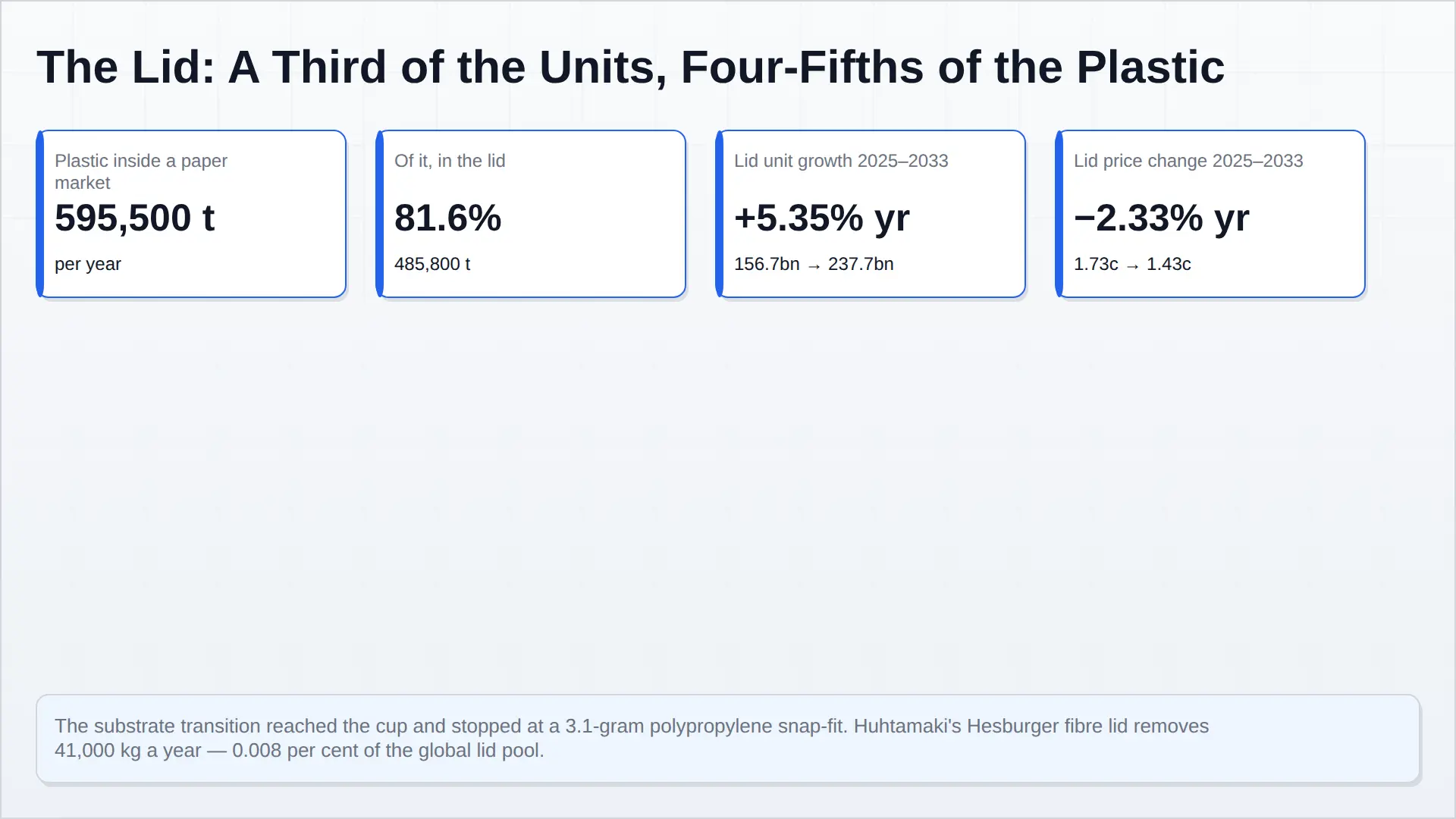
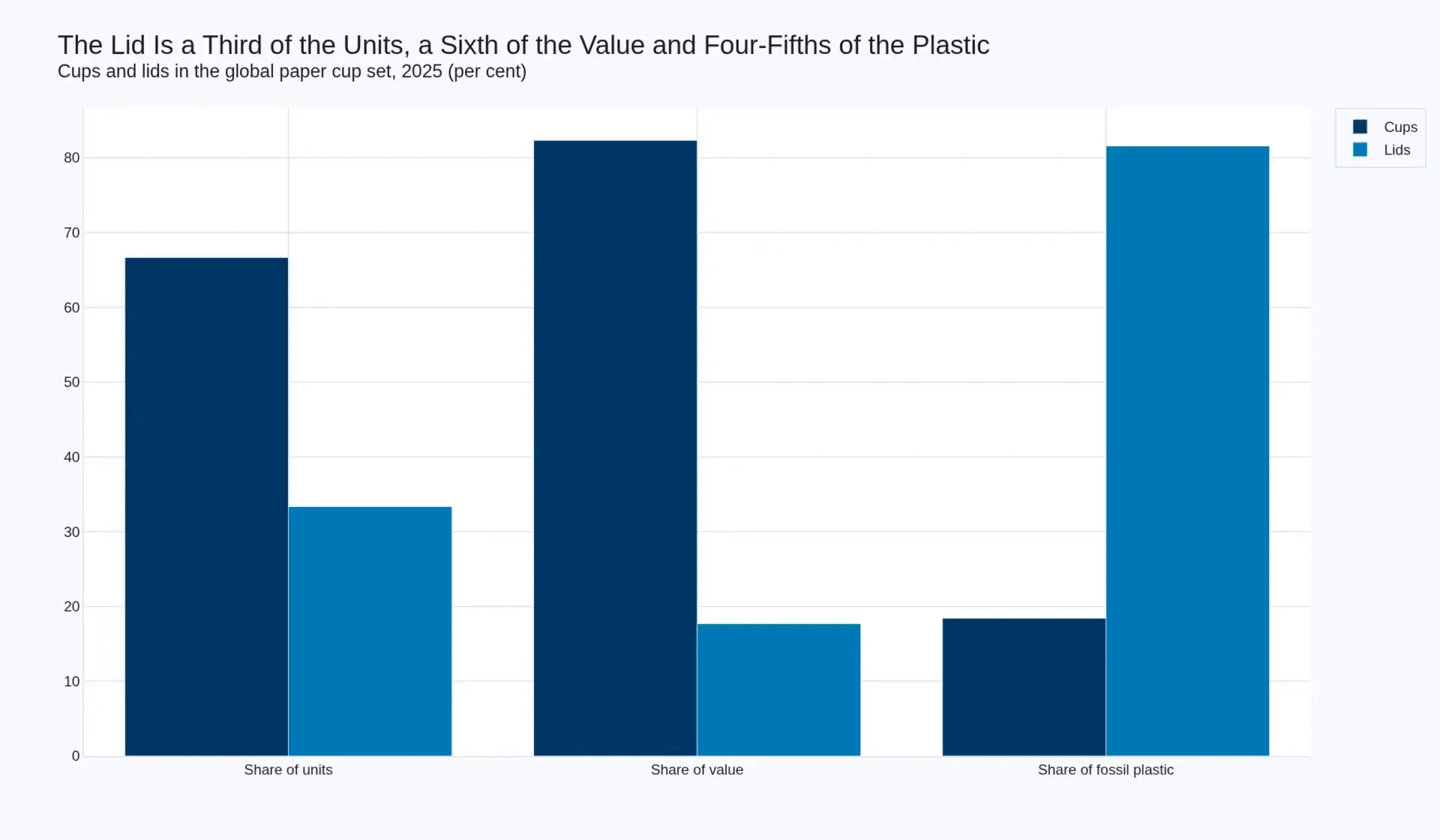
The substrate transition in foodservice packaging has a boundary, and it is 3.1 grams wide. A hot cup-and-lid set is 10.5 grams of board, 0.35 grams of coating and 3.1 grams of polypropylene. Multiply the lid by the 156.7 billion lids this market consumes in 2025 and you get 485,800 tonnes of plastic a year in a product line the industry calls paper. Add the coatings and it is 595,500 tonnes. The lid is 81.6 per cent of it.
The same set, in the units the market is actually counted in: lids are 33.4 per cent of the units and 17.7 per cent of the value. So the least valuable component is also the most plastic, the fastest growing in volume — 5.35 per cent a year against 3.41 for cups — and the fastest falling in price, at 2.33 per cent a year against 0.26.
Why the lid is harder than the cup
A cup is a truncated cone with a sidewall seam. Its tolerances are forgiving: a tenth of a millimetre of variation in the blank changes the cup’s feel and not its function, and there is no interface to fail. A lid is the opposite. It is a snap-fit that has to seat on every cup diameter a chain runs, hold a seal hot and cold, survive stacking under a filled tray, vent steam without leaking, and — in an increasing number of jurisdictions and accounts — show tamper evidence. Every one of those requirements is a dimensional specification, not a material preference.
That is why the conversion reached the cup first. Changing a cup’s material is a board and coating decision, and the board and coating supply has spent a decade solving it. Changing a lid’s material is a tooling and tolerance decision on a part that already has the least margin for error in the set.
What a fibre lid can actually claim
Huhtamaki’s fibre lid for Hesburger removes 41,000 kilograms of plastic a year. At 3.1 grams a lid, that is roughly 13.2 million lids. Set against 156.7 billion, it is 0.008 per cent of the pool.
That figure is not an argument against the product. It is the correct scale at which to read it: a rollout is one chain, in one market, on one cup diameter, with one set of hot-drink specifications. Converting the lid layer is a programme of hundreds of these, and by the tonnes it has barely begun.
The definition question, which is the real one
The obvious answer is a coated paper lid or an aqueous-dispersion barrier, and that is precisely where the chemistry meets the law. An acrylic dispersion is still a polymer. Under the EU Single Use Plastics Directive (2019/904), a cup coated with one is treated as a plastic-coated cup and carries the marking and the fee band that go with that status, whatever the marketing says. Huhtamaki specifies its lower-plastic board to reach at least 95 per cent fibre by weight — a legal threshold, not a claim about chemistry. The contest in barrier layers is coat weight against legal definition, and the legal definition is winning.
In the United States the grease-proofing question has already closed. The FDA’s February 2024 announcement ended PFAS use in food-contact grease-proofing, and 35 food-contact notifications became ineffective from January 2025. That is why our Europe PFAS-free food contact packaging market study now reads as the European half of a mechanism that has already finished in America — and why the next battleground is the closure, not the board.
Three published facts decide it, and none is resin price
- Recycling access. Residential access to recycling for single- and double-sided paper cups went from 5 per cent of the US population in 2015–16 to 20 per cent in May 2026. The number of North American mills accepting cups went from four in 2017 to 35.
- Fee modulation. Seven US states now carry packaging producer-responsibility statutes — California, Colorado, Maine, Maryland, Minnesota, Oregon and Washington — and each modulates producer fees by recyclability and recycled content. A lid that cannot be recycled with the cup it sits on is a fee, not a preference.
- Polymer intensity as a competitive metric. As the FIBC comparison in this cluster shows, a format can be trivial in units and dominant in polymer. At 33.4 per cent of units and 81.6 per cent of the plastic, the lid is that same pattern inside the cup set.
The money in the lid
Lid realisation falls from 1.73 to 1.43 cents across the forecast while lid units rise from 156.7 billion to 237.7 billion. Units plus 5.35 per cent, value plus 2.90 per cent. A part that grows in volume and deflates in price is a part every converter can mould and none can differentiate — and that is exactly what the disclosure pattern suggests. Where differentiation exists it is tooling and closure design, not resin, which is why the lid’s price line is the most competitive number in the whole market.
For the converter the arithmetic is uncomfortable in a specific way: the lid is where the units are, so it is where the capacity gets built, and it is also where the payback is most exposed to price. Our Global Paper Cups & Lids Market report carries the full investment model; against the global packaging market this is a small value pool with a large polymer footprint.
Three falsifiers
- A snap-fit fibre lid qualified at chain scale. Not a pilot in one market — a closure that seats on four cup diameters, holds a hot-drink seal through a delivery cycle, and is priced within a cent of polypropylene. If that exists by 2029, the plastic pool in this article halves.
- Cup recycling access above 40 per cent. Access is the whole basis of the paper cup’s regulatory position. At 40 per cent, paper stops needing the fibre-lid argument to win, and the converter’s incentive to spend on closure conversion falls rather than rises.
- Lid weight rising. Tamper-evident and tethered designs add grams per lid, and grams multiply by 156.7 billion. A 15 per cent weight increase would offset every fibre-lid rollout currently announced.
Sources and method
Unit counts and values are Pheonix’s own model, built from installed forming capacity and reconciled to disclosed converter segment revenue. Component weights are specification-level figures for a standard hot cup and lid set. Recycling access and end-market counts are Foodservice Packaging Institute data. Regulatory positions are FDA (February 2024) and EUR-Lex (Directive 2019/904; Regulation 2025/40). No third-party market-research estimate is used or cited anywhere in this article.
Disclosure. This article is approximately 70 per cent secondary research — published filings, regulator and industry-body data, and the report’s own modelled series — and 30 per cent primary work: open-ended interviews with converters, closure tooling suppliers and foodservice operators conducted for this research, together with the specification and shelf-life observations those conversations produced. The primary layer establishes mechanism and behaviour. It carries no market magnitude; every tonne and every penny above traces to a published source or to the model, which is shown so a reader can re-run it.
Frequently Asked Questions
How much plastic is in a paper cup and lid set?
A standard hot cup-and-lid set is 10.5 grams of board, 0.35 grams of coating and 3.1 grams of polypropylene. Across 470.0 billion units in 2025 the set contains 595,500 tonnes of plastic a year: 485,800 tonnes in the lids and 109,700 tonnes in the coatings. The lid is 81.6 per cent of that plastic.
Why has the substrate transition reached the cup but not the lid?
Because a cup is a truncated cone with forgiving tolerances, while a lid is a snap-fit that must seat on every cup diameter a chain runs, seal hot and cold, survive stacking, vent steam and increasingly show tamper evidence. Changing the cup is a board and coating decision. Changing the lid is a tooling and tolerance decision on the part with the least margin for error.
Is an aqueous-coated paper cup plastic-free?
No. An acrylic dispersion is still a polymer, and under the EU Single Use Plastics Directive 2019/904 a cup coated with one is treated as a plastic-coated cup, carrying the marking and the fee band that follow. Huhtamaki specifies its lower-plastic board to reach at least 95 per cent fibre by weight, which is a legal threshold rather than a chemistry claim.
What share of the market is lids?
Lids are 33.4 per cent of the units and 17.7 per cent of the value. They sell at 1.73 US cents each in 2025, falling to 1.43 by 2033, while units rise from 156.7 billion to 237.7 billion. Unit growth of 5.35 per cent against value growth of 2.90 per cent makes the lid the most competitive price line in the set.