
Editorial Article
Realisation Rises 0.80 Per Cent a Year in This Market and Not One Substrate Has Gained a Cent
There is a number in this market that reads like good news and is not. Realisation per unit — the money a converter actually gets for a container — rises from 10.89 US cents in 2025 to 11.62 cents in 2033. That is 0.80 per cent a year, compounding, in a business that has been described for a decade as deflationary.
Then you look inside the model and find that not one substrate has gained a cent. Polypropylene is held at 9.99 cents for the whole period. EPS at 5.81. PET at 14.53. Moulded fibre at 14.10. All five lines flat, on the explicit assumption that nobody in this market has pricing power — an assumption supported by the only two companies that disclose a relevant segment, both of which are earning eight to nine per cent operating margins where they earned fourteen to fifteen a year earlier.
So the average is rising while every component is frozen. That is not a market; it is a weighted average being re-weighted.
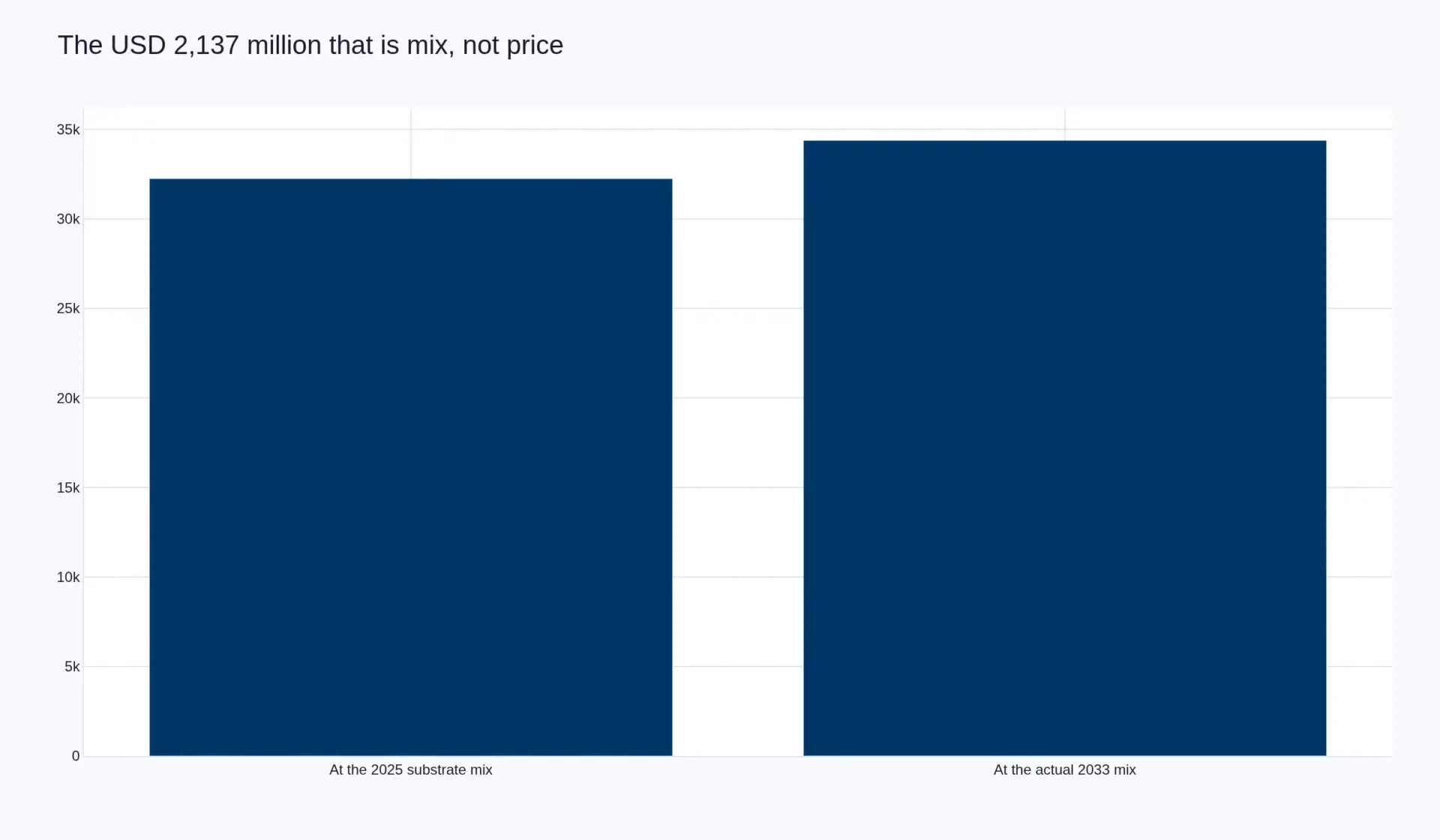
The decomposition
Grow the 2025 market to 296.0 billion units with the 2025 substrate mix held constant, and 2033 value is USD 32,246 million. The Global Foodservice Rigid Containers & Clamshells Market 2026–2033 forecasts USD 34,383 million.
The gap is USD 2,137 million — 6.2 per cent of the 2033 market — and it exists only because the mix changed. Nothing was sold for more. One container replaced another.
The two that matter sit at opposite ends of the ladder. EPS realises 5.81 cents and is shrinking at 5.5 per cent a year, from 36.9 billion units to 23.4. Moulded fibre realises 14.10 cents and is growing at 8.0 per cent, from 41.8 billion units to 77.4. Move units from the first bucket to the second and the blended figure moves by arithmetic alone.
That is why a reader who wants to understand this market should stop looking at the growth rate and start looking at the share table. The growth rate is a residual.
Why that is bad news dressed as good
Rising realisation looks like pricing power. It is the opposite. It is the price of compliance being passed into the product mix by statute, and the converter is carrying the working capital, the tooling and the qualification while earning a margin that has halved.
Follow the money through a single line. A nine-inch fibre clamshell realises 14.10 cents against 9.99 for the polypropylene equivalent — 41 per cent more. But the material cost is almost identical: 3.57 cents of pulp against 3.41 cents of resin. The premium is capital recovery, drying energy, lower line output and the qualification work that a newer process requires.
And the capital is not small. A moulded-fibre line costs about USD 2.56 million — the figure disclosed for Pulp Moulded Products’ Keswick, Ontario line in October 2026 — and produces fewer containers a year than a thermoformer costing less. Capital per annual unit of capacity: 8.5 to 12.8 cents for fibre, 4.4 to 5.7 for thermoforming, 3.5 for a cup line.
Run the payback. At 14.10 cents and the 9.2 per cent operating margin the cost stack reconciles to, a 25 million unit fibre line earns about USD 324,000 a year on USD 2.56 million of capital — 7.9 years. At 12.60 cents, once capacity has arrived and price has given way, it earns USD 290,000 and takes 8.8 years. A thermoformer at 9.99 cents on 40 million units earns USD 368,000 on USD 1.75 million: 4.8 years.
That difference, not the technology, is why fibre capacity gets built in small increments, with public co-funding, next to a customer who has already signed. It is a payback problem wearing a sustainability costume.
The constraint that decides which half wins
Both halves of this market are constrained, and by different things. Fibre is constrained by cost and by barrier. Plastic is constrained by feedstock.
The feedstock numbers are now measurable. NAPCOR’s 2024 PET Recycling Report puts the US PET bottle recycling rate at 30.2 per cent, down from a revised 32.5 per cent in 2023 and above the prior decade’s 29.5 per cent average, with North American bottle collection at 39.2 per cent. Against that, PET thermoform recovery reached 264 million pounds in the US and Canada, up 52 per cent year on year.
Read those together and the position is clear. Collection was built around the bottle, not the clamshell, and 52 per cent growth off a small base is still a small base. A deli container is mostly virgin resin because the material that could become it is being collected in a different format, at a different reclaimer.
Polypropylene is worse: there is no food-grade recycled PP of consequence at commercial scale, small rigid PP items are poorly collected, and a mixed-colour container is a sortation problem before it is a recycling one. Which matters because the recycled-content requirement arriving in Europe in 2030 lands on exactly that substrate — and if it cannot be met, the substitution that follows is not into fibre but into PET, a different and more expensive outcome than the base case assumes.
What to watch
Three numbers, one quarter apart from the accounts and two from the regulations.
Blended realisation, twice a year. If it goes flat while the substrate mix is still shifting, the mix effect is being conceded in price rather than captured — and the value forecast is too high. That is the first falsifier in the report.
Fibre capacity announcements with a named customer attached. Announcements without a contract are a signal that the payback arithmetic has beaten the regulatory case.
Any state fee schedule that reads mass as well as recyclability. Seven states now run packaging EPR — California, Colorado, Maine, Maryland, Minnesota, Oregon and Washington — and all of them charge per tonne on a recyclability-modulated basis. A mass signal in that formula would invert the whole substitution within a compliance cycle, and it would do it without changing a single word of the material bans.
Sources
- Pheonix Research, Global Foodservice Rigid Containers & Clamshells Market Report 2026–2033.
- NAPCOR, 2024 PET Recycling Report, published 10 December 2025.
- Graphic Packaging International, third-quarter 2026 results and segment schedules.
- Huhtamaki Oyj, half-year financial report 2026.
- Pulp Moulded Products / FedDev Ontario, capacity announcement, 2 October 2026.
- Pheonix Research, Global Paper Cups & Lids Market 2026–2033, for the opposite case — realisation falling 0.94 per cent a year.
Research basis is approximately 70 per cent secondary and 30 per cent primary. The primary layer establishes mechanism and specification behaviour and carries no magnitude. No competitor market-research estimate is cited or used as an input.
Frequently Asked Questions
Why does realisation per unit rise if no substrate gains a cent?
Because the mix moves, not the price. All five substrate lines are modelled at flat realisation to 2033: polypropylene 9.99 US cents, PET 14.53, moulded fibre 14.10, EPS 5.81. But EPS is shrinking at 5.5 per cent a year and fibre is growing at 8.0 per cent, so the weighted average rises from 10.89 to 11.62 cents — 0.80 per cent a year — without any supplier gaining a cent.
How much of the 2033 market is mix rather than genuine growth?
Hold the 2025 substrate mix constant and grow the market to 296.0 billion units: 2033 value is USD 32,246 million. The actual forecast is USD 34,383 million. The difference is USD 2,137 million, or 6.2 per cent of the 2033 market, and it exists only because units moved from 5.81-cent EPS containers to 14.10-cent moulded-fibre ones. It is a regulatory mix shift being booked as market growth.
What does a moulded-fibre line cost per unit of capacity?
About 8.5 to 12.8 US cents per annual unit of capacity, against roughly 4.4 to 5.7 for thermoforming and 3.5 for a cup line. A moulded-fibre line costs about USD 2.56 million — the figure disclosed for Pulp Moulded Products' Keswick, Ontario line — and produces fewer containers a year than a thermoformer costing less. At a 14.10 cent realisation the fibre line repays in 7.9 years; a thermoformer at 9.99 cents repays in 4.8.
Which substrate is actually constrained, fibre or plastic?
Fibre is constrained by cost and barrier; plastic by feedstock. On feedstock, NAPCOR reports a 30.2 per cent US PET bottle recycling rate in 2024 and PET thermoform recovery of 264 million pounds, up 52 per cent year on year off a small base. Food-grade recycled polypropylene barely exists at commercial scale, which matters because the recycled-content requirement arriving in Europe in 2030 lands on exactly that substrate.