
Editorial Article
The Ban Removed the Lightest Container in the Market. The Replacement Weighs 2.4 to 3.2 Times More.
An expanded polystyrene clamshell weighs thirteen grams. That is the whole reason it existed. It held heat better than anything else, it cost less than anything else, and it used less material than anything else — and that last fact is the one nobody says out loud when a legislature bans it.
Twelve US states now restrict EPS foodservice containers: California, Colorado, Delaware, Maine, Maryland, New Jersey, New York, Oregon, Rhode Island, Vermont, Virginia and Washington. The instruments differ enormously. California binds producers and attaches a recycling-rate test that has not been met; most of the others bind the restaurant directly. New Jersey’s exemption for raw meat and fish trays runs to May 2027, Maine’s to July 2027. But the effect on the object is the same everywhere, and the object is what this article is about.
Because the container that gets removed is the lightest one in the market, and the container that replaces it is not close.
The arithmetic nobody puts in the impact assessment
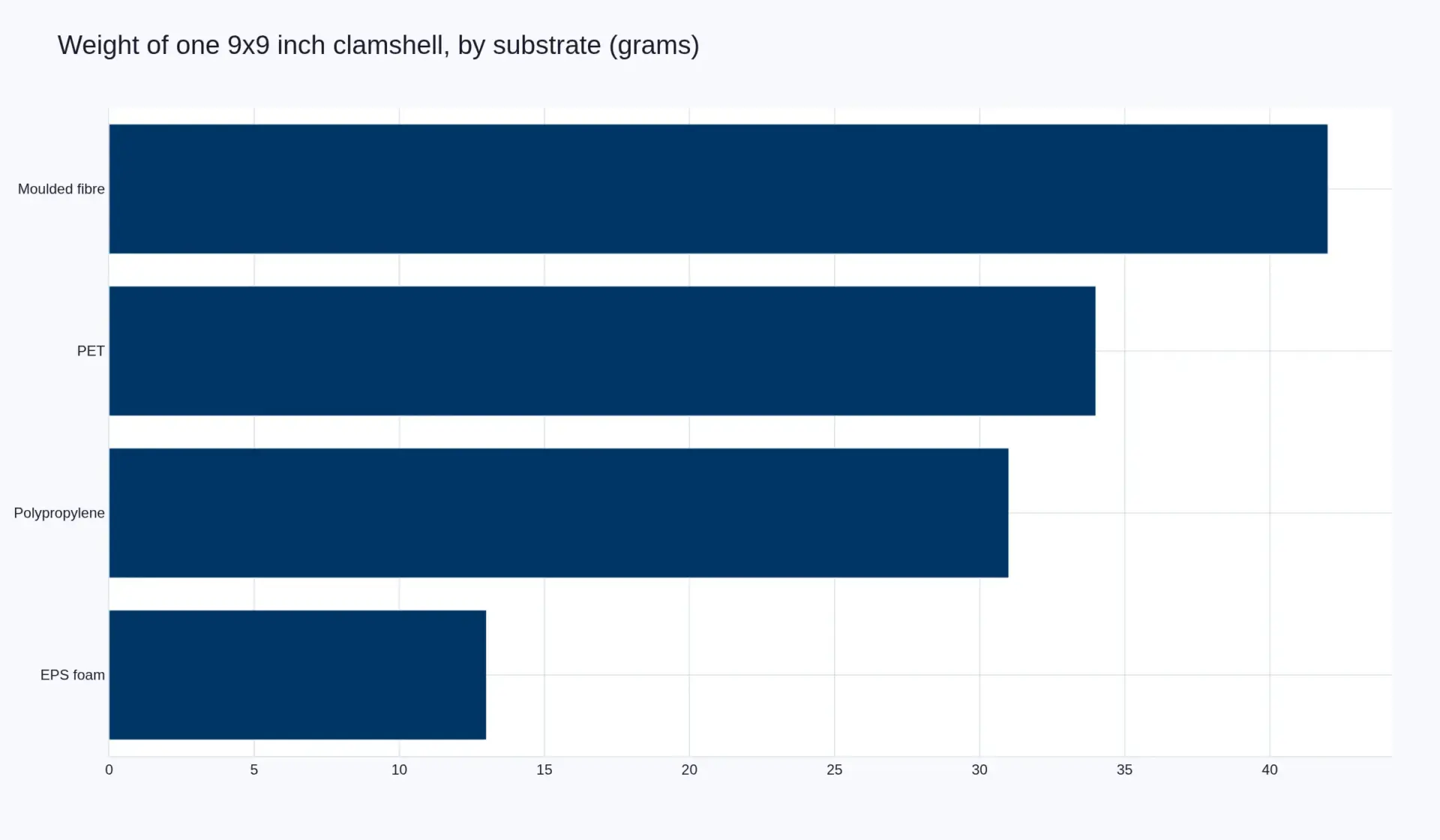
Take a nine-inch clamshell, the standard takeaway format, and weigh it in each substrate. EPS: 13 grams. Polypropylene: 31. PET: 34. Moulded fibre: 42.
Now apply that to the pool. The Global Foodservice Rigid Containers & Clamshells Market 2026–2033 puts the EPS pool at 36.9 billion units in 2025, out of a total market of 246.0 billion. Convert all of it to moulded fibre — the substrate most chains have chosen as the compliant answer — and the market takes out roughly 480,000 tonnes of plastic and adds about 1.07 million tonnes of container mass.
That is a 14.3 per cent increase in everything that has to be manufactured, palletised, trucked and collected, to remove less than half a million tonnes of plastic. Convert the same pool to polypropylene instead and the addition is 664,000 tonnes — smaller, but still an increase.
Two things follow, and they are the reason this is worth writing down rather than asserting.
First, the substitution raises mass while lowering plastic. Any model that shows both falling together is wrong, and it is a common error in this category because the metrics that get reported are plastic reduction and recyclability, never total tonnage.
Second, the cost lands on a line item that is invisible until it is not. Freight is 11.4 per cent of realisation in this market — containers ship as air, and a 42-gram container nests worse than a 13-gram one. Resin is 34.1 per cent. So the substitution moves both, in opposite directions, and the net effect shows up as a container that costs 14.10 US cents instead of 5.81.
The fee schedule charges for the thing the ban created
Seven states now operate packaging extended producer responsibility regimes: California (SB 54), Colorado (HB 22-1355), Maine (LD 1541), Maryland (SB 901), Minnesota (HF 3911), Oregon’s Plastic Pollution and Recycling Modernization Act, and Washington (SB 5284).
Every one of them levies a producer fee per tonne, modulated by recyclability and recycled content.
Read that sentence twice against the arithmetic above. The material statute is written against a substrate and rewards the recyclable answer. The fee statute is written against mass and rewards the recyclable answer too — but it charges by the tonne, and the recyclable answer is the heavy one. A converter who complies with the ban and complies with the fee schedule is paying a per-tonne charge on two and a half times the tonnage he used to ship, for the privilege of a better recycling grade on a stream that may not collect his container.
This is not an argument against the statutes. It is an argument that two instruments were designed in different rooms by different people with different metrics, and the party standing between them is the converter. It is also, incidentally, the reason the margin evidence looks the way it does.
What it costs the accounts
Two companies disclose enough to check this against. Graphic Packaging’s Americas Paperboard Packaging segment — which carries foodservice containers alongside cups, lids and CPG cartons — earned an operating margin of 8.94 per cent in the third quarter of 2026 against 15.06 per cent a year earlier, on sales that were flat at USD 1,476 million. Nine-month margin: 8.40 per cent against 14.28.
Huhtamaki’s Foodservice Packaging segment ran at an 8.3 per cent adjusted EBIT margin in the first half against 9.0 per cent, and booked a EUR 16 million impairment explicitly tied to production footprint optimisation — the accounting term for closing capacity that is no longer needed.
Neither company lost share to a rival. Both are paying for a substrate transition they cannot price through, because the customer specifies a container to a fixed unit cost and the incumbent’s cost base is being re-based by regulation rather than by competition.
Why fibre does not simply win
The obvious reading is that fibre takes the market. It does not, and the reason is capital rather than chemistry.
A moulded-fibre line costs about USD 2.56 million — the figure disclosed for Pulp Moulded Products’ new line and automated pressing cell at Keswick, Ontario in October 2026, a project supported by a CAD 1.5 million FedDev contribution. It produces fewer containers a year than a thermoformer that costs less. Capital per annual unit of capacity comes out at 8.5 to 12.8 US cents, against roughly 4.4 to 5.7 for thermoforming and 3.5 for a cup line.
That is why the 41 per cent price premium for fibre is not margin. The material cost is almost identical — 3.57 cents of pulp against 3.41 of polypropylene in the same container. The premium is capital recovery, drying energy, lower line output and the qualification work that goes with a newer process.
And it is why fibre capacity only gets built where something underwrites it: a customer contract, a public co-funding contribution, or a commencement date that makes the customer’s decision for them. Dart’s Lancaster, Pennsylvania plant reaching full operational capacity in October 2026 — after Mason, Michigan in 2019 — is the signal that a plastic and foam company now runs wet and dry moulded fibre in the same portfolio. It is also, at that scale, a hedge rather than a bet.
What would make this wrong
Three observations, in order of how quickly they would arrive.
Fibre realisation falling faster than the 14.10 to 12.60 cents path the report assumes. Capacity arriving ahead of demand would take share quickly and add value slowly, and the market would land near its slow case while units ran at base.
Any large jurisdiction writing a fee schedule that reads mass as well as recyclability. That inverts the entire substitution: polypropylene at 31 grams becomes the compliant answer on the metric that costs money, and the fibre share path flattens within a compliance cycle.
And the quiet one: EPS share holding above 13 per cent of units in 2028. The base has it at 15.0 in 2025 falling to 7.9 by 2033, and that slope depends on enforcement and on the exemption list not widening.
Sources
- Pheonix Research, Global Foodservice Rigid Containers & Clamshells Market Report 2026–2033 — unit base, realisation ladder, mass check, scenario band.
- Graphic Packaging International, quarterly results and segment schedules, third quarter 2026.
- Huhtamaki Oyj, half-year financial report 2026.
- Pulp Moulded Products / FedDev Ontario, capacity announcement, 2 October 2026.
- Dart Container, moulded-fibre capacity announcement, Lancaster, Pennsylvania, 13 October 2026.
- State statutes: Cal. Pub. Res. Code (EPS food service ware); Colo. HB21-1162; 16 Del. C. ch. 30Q; 38 M.R.S. §1571–1572; Md. Environment Code; N.J. P.L.2020, c.117; N.Y. Environmental Conservation Law; Or. ORS 459A; R.I. General Laws; Vt. Stat. Ann. tit. 18; Va. Code; RCW 70A.245.
Research basis is approximately 70 per cent secondary and 30 per cent primary, the primary layer establishing mechanism and specification behaviour rather than magnitude. No competitor market-research estimate is cited or used as an input.
Frequently Asked Questions
Does banning polystyrene foam containers reduce packaging?
It reduces plastic mass and raises total material mass. An EPS clamshell weighs about 13 grams; a polypropylene one of the same size weighs 31 and a moulded-fibre one 42. On Pheonix's model, converting the entire 36.9 billion unit EPS pool to moulded fibre removes roughly 480,000 tonnes of plastic and adds about 1.07 million tonnes of container mass — a 14.3 per cent increase in everything that has to be manufactured, palletised, shipped and collected.
Why does the replacement container cost two and a half times more?
Not because of material. Pulp costs about 3.57 US cents in a nine-inch fibre clamshell against 3.41 cents of polypropylene in the equivalent plastic one. The roughly 41 per cent difference in price — 14.10 cents against 9.99 — is capital recovery, drying energy, lower line output and qualification cost. A moulded-fibre line costs about USD 2.56 million and produces fewer containers a year than a thermoformer costing less, which puts capital per annual unit at 8.5 to 12.8 cents against 4.4 to 5.7.
How many US states restrict EPS food containers?
Twelve states have statewide restrictions: California, Colorado, Delaware, Maine, Maryland, New Jersey, New York, Oregon, Rhode Island, Vermont, Virginia and Washington. They differ in who they bind — California binds producers and attaches a 25 per cent recycling-rate test, while most others bind the food service business directly — and in their exemptions. Raw meat, poultry, fish and egg trays are carved out in several states, with New Jersey's exemption running to May 2027 and Maine's to July 2027.
Do extended producer responsibility fees reward the heavier container?
They charge for it. Seven states operate packaging EPR regimes — California, Colorado, Maine, Maryland, Minnesota, Oregon and Washington — and all of them levy a producer fee per tonne, modulated by recyclability and recycled content. Because the recyclable substitute is two and a half times heavier, a converter who complies with both the material ban and the fee schedule pays a per-tonne charge on substantially more tonnage for a better recycling grade.