
Editorial Article
A Code Is a Stronger Moat Than a Patent: Why Conventional Ultrasonic Still Holds 41 Per Cent of Its Market
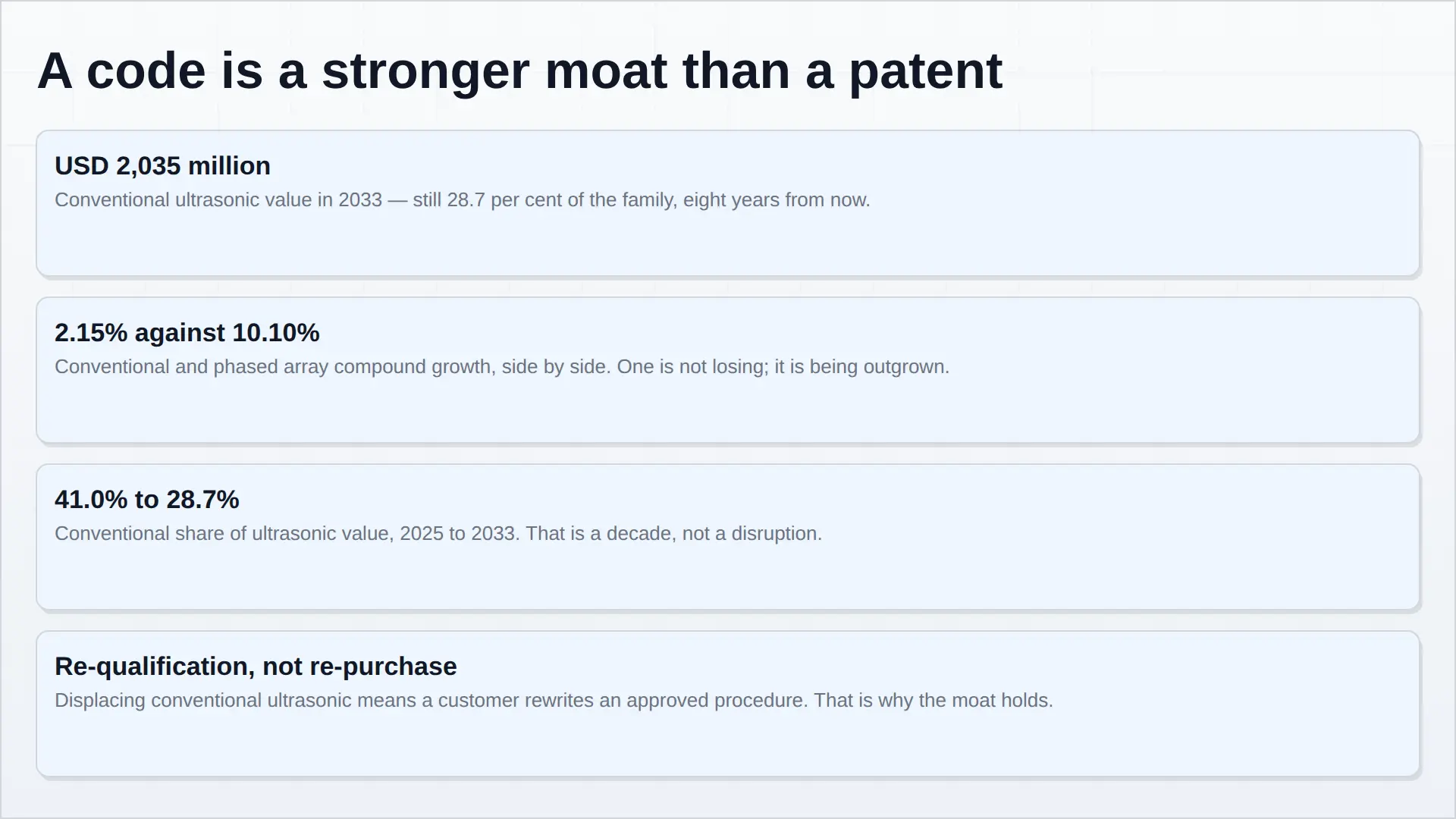
Conventional ultrasonic testing is the largest single technique in the largest method family in non-destructive testing, and it is growing at less than a third of that family’s rate. It is also going to still be the largest single technique in 2033, holding USD 2,035 million of a USD 8,403 million family — 28.7 per cent of it, eight years from now.
Both facts belong to the same explanation, and it is the most commercially useful thing in Pheonix Research’s Global Ultrasonic NDT Equipment Market Report, Size, Share and Forecast 2026–2033. Phased array is not replacing conventional ultrasonic. It is being added around it, and the reason is that displacing conventional ultrasonic does not require a customer to prefer a better instrument. It requires them to rewrite an approved procedure.
Two businesses inside one family
| Technique | 2025 (USD m) | 2033 (USD m) | CAGR | Share 2025 → 2033 |
|---|---|---|---|---|
| Phased array (PAUT) | 1,688 | 3,644 | 10.10% | 34.0% → 43.4% |
| Conventional (flaw detectors, thickness gauges) | 2,035 | — | 2.15% | 41.0% → 28.7% |
| Air-coupled, EMAT and other advanced | — | — | 12.60% | — |
| Total ultrasonic | 4,964 | 8,403 | 6.80% | 100% |
Phased array is 34.0 per cent of 2025 value and 56.9 per cent of the family’s growth. The advanced techniques together take 67.2 per cent of the increment. Conventional ultrasonic grows at 2.15 per cent — a rate that, compounded, roughly doubles nothing, ever — and yet retains the largest single share of value in 2033.
That is not inertia in the pejorative sense. It is a specific, describable mechanism, and suppliers who understand it can plan around it in a way that suppliers who treat it as customer laziness cannot.
A code is a stronger moat than a patent
Conventional ultrasonic — a single-element probe on a flaw detector or a thickness gauge, read as an A-scan by a qualified operator — is written into the inspection infrastructure of every industrial jurisdiction. It appears in written practices, in procedure qualification records, in national annexes to international standards, in customer specifications that were themselves written from those documents, and in the training and certification syllabi that produce the people who run it.
None of that is a technical argument. A phased array set produces an image instead of an A-scan, records it, allows the scan to be re-read by a second qualified person, and covers more of the weld in less time. On capability, PAUT wins almost everywhere a customer is willing to pay for it. That is why it grows at 10.10 per cent.
But to use it in place of a specified conventional technique, a customer must re-qualify the procedure. That means writing a new technique sheet, demonstrating it on a reference block with known defects, having it witnessed or approved, and re-training the operators — and then persuading an end client, a regulator or an insurer to accept the substitution on an asset that is already in service. The instrument is the cheap part of that exercise. The approval is the expensive part, and it is paid in months rather than money.
So the customer buys the phased array set for the new work, where the procedure is being written from scratch and PAUT can be specified in, and keeps the conventional flaw detector for the installed base, where the procedure already exists. Both instruments sit in the same van. That is what 10.10 per cent and 2.15 per cent look like from the inside.
The commercial consequence: where the money is
Sixty per cent of this family’s growth is not more instruments. USD 2,067 million of the USD 3,439 million increment — 60.1 per cent — is price and mix. Instruments placed rise from 148,000 to 188,900 a year at 3.10 per cent; realised spend per instrument rises to USD 44,484 at 3.59 per cent.
That decomposition is the whole commercial argument. A supplier that holds a large conventional installed base has a business growing at about 2.15 per cent on units and rather better than that on revenue, because conventional instruments keep being replaced and the replacement is rarely the cheapest model. A supplier with a strong PAUT position has a business growing at 10.10 per cent on units, and taking share of a technique mix that moves 34.0 per cent of the family to 43.4 per cent over eight years.
Both are defensible. They have almost nothing in common. The conventional business is a replacement and consumables business with a certification moat; the phased array business is a capability business with a training requirement attached. A group that owns both and manages them to the same growth target will underinvest in one and overprice the other.
What breaks the moat
Two things, and neither is a competitor’s product launch.
The first is a code revision that retires a technique rather than permitting a new one. Where a standards body moves a method from accepted to deprecated for a defined defect type, the re-qualification cost is paid once by the industry and the installed base migrates. That is a slow, lumpy, documentable event, and it is worth watching for specifically rather than waiting to observe it in shipment data.
The second is the disappearance of the people who can run the old method. Conventional ultrasonic is a skill expressed through an operator’s hands and ears — reading an A-scan is a trained judgement. PAUT encodes that judgement in an image, which means a less experienced operator can be supervised by a more experienced reviewer, and one reviewer can look at ten times the volume. In a market where the qualified person is the scarce input, that asymmetry compounds faster than any code cycle.
The end markets explain why both techniques survive anyway. Oil and gas is the largest buyer at 24.0 per cent and the slowest large one, because its inspection demand is set by interval codes and paid for on billable hours: the buyer is price-sensitive and the method is fixed. Aerospace is 15.0 per cent and is where phased array earns its premium, because composite and bonded structure cannot be inspected by a single-element probe at all. Capability barriers hold. Preferences do not.
The technique split, instrument counts and realised spend per instrument are modelled in the Global Ultrasonic NDT Equipment Market Report 2026–2033.
Frequently Asked Questions
How big is conventional ultrasonic still going to be in 2033?
USD 2,035 million in 2033, or 28.7 per cent of the ultrasonic family, against 41.0 per cent in 2025. It grows at 2.15 per cent a year while phased array grows at 10.10 per cent.
Why doesn't phased array simply replace conventional ultrasonic?
Because conventional ultrasonic is embedded in written practices, procedure qualifications and national annexes. Replacing it requires a customer to re-qualify an approved procedure, which costs months of approval work rather than the price of an instrument.
How much of ultrasonic growth is price rather than volume?
USD 2,067 million of the USD 3,439 million increment — 60.1 per cent. Instruments placed rise from 148,000 to 188,900 a year at 3.10 per cent, while realised spend per instrument rises 3.59 per cent to USD 44,484.
Which end markets keep each technique alive?
Oil and gas at 24.0 per cent, where inspection is set by interval codes and paid for on billable hours, and aerospace at 15.0 per cent, where composite and bonded structure cannot be inspected with a single-element probe — the segment where phased array earns its premium.