
Editorial Article
Machine Vision Passes the CMM in 2028. The Reason Is Not Accuracy.
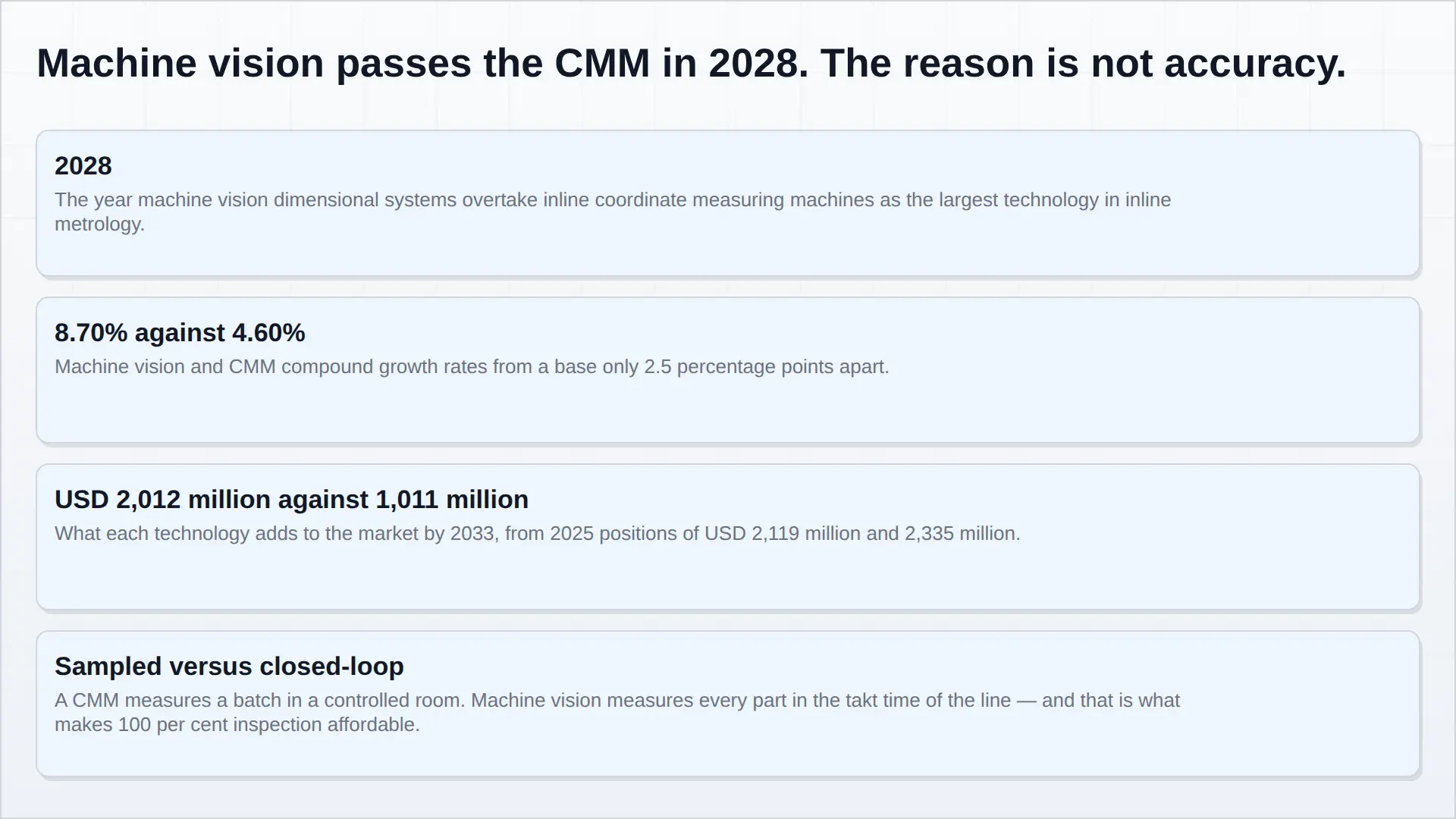
Machine vision becomes the largest technology in inline metrology in the middle of 2028. It does so from second place, on a base 2.5 percentage points smaller than the coordinate measuring machine it passes, and it does so without ever being the more accurate instrument.
A good CMM is more accurate than a machine vision system. It will still be more accurate in 2028. That is the point: the largest technology transition in this market is not being decided on accuracy, which is the axis the incumbents compete on. It is being decided on where the measurement happens and how many parts it can be taken on.
Pheonix Research’s Global Inline Metrology Market Report, Size, Share and Forecast 2026–2033 models the market at USD 8,650 million in 2025, reaching USD 14,158 million in 2033 at 6.35 per cent.
The two lines that cross
| Technology | 2025 (USD m) | 2025 share | CAGR | Added by 2033 | 2033 share |
|---|---|---|---|---|---|
| Inline CMM and multisensor cells | 2,335 | 27.0% | 4.60% | 1,011 | 23.6% |
| Machine vision dimensional systems | 2,119 | 24.5% | 8.70% | 2,012 | 29.2% |
The second-largest technology adds USD 2,012 million over the forecast window. The largest adds USD 1,011 million. By 2033 machine vision holds 29.2 per cent of the market and the CMM 23.6 per cent, and machine vision’s share of the total increment is 36.5 per cent against the CMM’s 18.3 per cent.
Two growth rates, 4.60 and 8.70 per cent, applied to two bases 216 million apart, put the crossover in the middle of 2028. Nothing dramatic has to happen for that to hold. Both technologies have to keep behaving as they have been behaving.
A CMM measures a batch. Vision measures a line.
The coordinate measuring machine is the most consequential metrology instrument of the twentieth century, and the way it works has not changed: a granite table, air bearings, a controlled thermal environment, a probing head, and a part brought to it, fixtured, measured and removed. It is a measurement-room instrument. The room exists because the measurement requires conditions the production floor cannot supply.
That is a structural constraint with a commercial consequence. Because bringing a part to the room costs time, you sample. Because you sample, you cannot close the loop. A process cannot be steered by a measurement taken on four parts a shift, because the drift it needs to catch happens in the parts you did not measure.
Machine vision inverts every term. No fixture, because the part is where it is. No batch, because the camera is in the line. Every part, not a sample, because there is no marginal cost to the hundredth image. And a result inside the takt time of the line, which means the result can act on the process that produced it rather than being filed as a record that it did.
The accuracy gap is real and is narrowing from the vision side every year as sensor resolution improves and the software that fits a model to an image gets better. But the crossover does not depend on that gap closing. It depends on the fact that a sampled measurement cannot be closed-loop at any accuracy, and 100 per cent inspection became affordable as sensor cost fell.
What the incumbents have already told us
The most instructive thing about this transition is that the CMM manufacturers saw it coming and positioned for it. Every significant CMM incumbent in this market has spent roughly a decade acquiring or building measurement software, because the value in CMM hardware — granite, bearings, structure — is a mature, well-understood, competitively supplied business with 4.60 per cent growth and no pricing power worth the name.
That strategy is correct, and it does not save the CMM’s share. What it does is move the incumbent’s revenue from the instrument into the measurement, where the same software can sit on top of a vision cell, a multisensor cell or a CMM and earn a licence regardless of which one the customer bought. The companies that survive this crossover are the ones whose revenue is attached to the measurement decision rather than to the box containing the probe.
It is also why the interesting competition in this market is now in applications rather than in hardware. A vision system that measures a machined casting in line is doing a different job from a CMM — it is checking a process, not certifying a part — and the software that makes that job tractable is where the differentiation sits. Nobody buys a camera because of its camera.
Where the crossover actually lands
Geographically, in Asia-Pacific, which is 38.5 per cent of 2025 value and takes 49.4 per cent of the increment — half the world’s growth in one region, because that is where the production line is being built and where the inspection is specified alongside it rather than retrofitted to it. Europe grows 4.55 per cent on a dense installed base; a machine that is already in the measurement room is harder to displace than a decision that has not been made yet.
By end market, in automotive and electric vehicles, which is the largest buyer at 26.0 per cent and the most cyclical in this cluster. That matters more here than in a code-mandated inspection market, and it is the honest caveat on the whole forecast: nothing in this report is bought because a regulation says it must be. It is bought because a line is being built or a quality problem is being solved, and both of those are discretionary decisions with a capital approval attached.
So the crossover in 2028 is not a forecast about technology. It is a forecast about where quality control budgets are being spent: on a sampled certificate of a part, or on a closed-loop signal from a process. On the current mix, the second is winning 36.5 per cent of the market’s growth against the first’s 18.3 per cent.
The technology splits, end-market structure and regional increments are modelled in the Global Inline Metrology Market Report 2026–2033.
Frequently Asked Questions
When does machine vision overtake the CMM?
The middle of 2028, from 24.5 per cent of 2025 value against the CMM's 27.0 per cent, on growth of 8.70 per cent against 4.60 per cent. By 2033 machine vision holds 29.2 per cent and the CMM 23.6 per cent.
Is machine vision more accurate than a CMM?
No. A good CMM is more accurate and will remain so. Machine vision wins on sampling: it measures every part in the takt time of the line, which makes 100 per cent inspection affordable and allows the measurement to act on the process rather than be filed as a record.
How much does each technology add by 2033?
USD 2,012 million, against USD 1,011 million for the CMM — 36.5 per cent of the total increment versus 18.3 per cent, from a base only USD 216 million smaller in 2025.
Where does the growth land geographically?
Asia-Pacific, which is 38.5 per cent of 2025 value and takes 49.4 per cent of the increment, because the production line is being built there and inspection is specified alongside it rather than retrofitted to it.