
Editorial Article
Visual Inspection Is the Cheapest Method in Non-Destructive Testing. It Is Also the Fastest Growing.
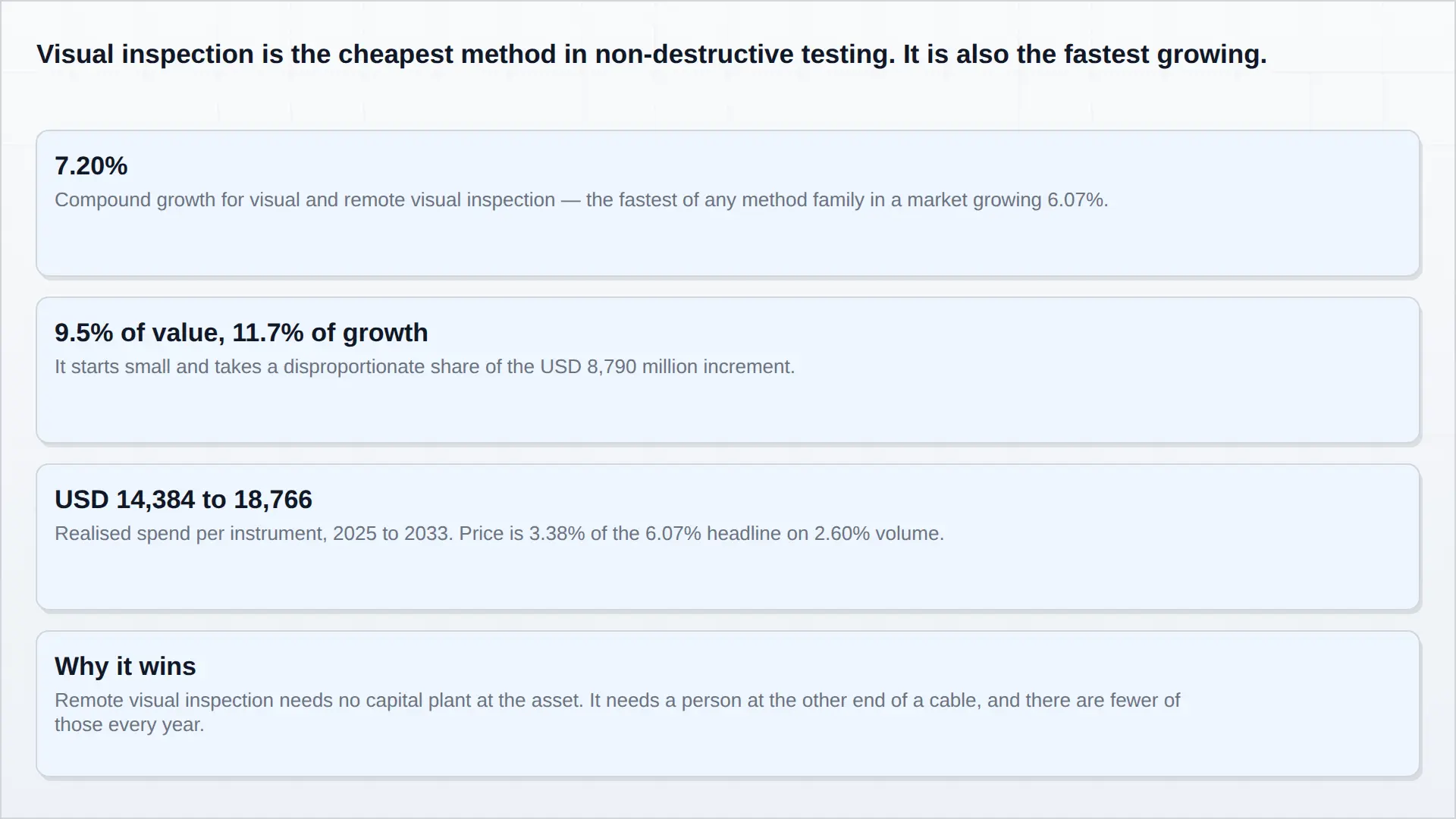
The cheapest method in non-destructive testing is outgrowing every expensive one. Visual and remote visual inspection grows at 7.20 per cent a year to 2033 in Pheonix Research’s model — faster than ultrasonic at 6.80 per cent, faster than radiography at 6.19 per cent, and faster than a market compounding at 6.07 per cent. On a 9.5 per cent share of 2025 value, it takes 11.7 per cent of the USD 8,790 million the market adds.
That single fact breaks the story most suppliers tell themselves about this market. The version of the story that travels is that capability wins: that phased array displaces conventional ultrasonic, that digital radiography displaces film, that the customer pays more for a better instrument. That story is largely true inside each family. It is not what is happening across them.
What is happening across them is that the family requiring the least capital and the least skill to deploy is capturing a disproportionate share of growth, in a market where 62.1 per cent of the increment is price and mix rather than additional instruments.
Why the cheapest method wins the share
Remote visual inspection is not cheap because it is crude. A modern video borescope with a 3D phase measurement tip is a precision instrument with a five-figure price tag, and the measurement software behind it is not trivial. But it has one property no other method shares: it does not require the asset to be opened, emptied, cooled, cleaned or brought to a machine. It goes where the inspection needs to happen, through a port, and comes back with an image.
Compare that with what radiographic inspection of a pipe weld actually costs. Radiography needs a source — an X-ray tube or, in field work, often a radioactive isotope — which means exclusion zones, radiation safety officers, permits and, in many jurisdictions, a licensed radiographer on site. Digital detector arrays remove the film and the chemistry but not the source, the exclusion zone or the licence. The instrument is the small part of the bill.
That is the arithmetic that decides where inspection happens. A method that requires mobilising a controlled area is used where a specification demands it. A method that requires putting a cable into a hole is used everywhere else, including in places no one previously inspected at all.
The constraint that makes it urgent
The second force is labour, and it is directional rather than cyclical. Inspection is a hands-and-eyes occupation that cannot be recruited at the rate assets are being built, and every method that concentrates the scarce qualified person on the interpretation — rather than on the set-up, the source, the chemistry and the travel — scales further on the same headcount.
This is where the visual family’s growth and the equipment count tell different stories, and the equipment count is the honest one. Instruments placed across all methods rise from 1.02 million in 2025 to 1.25 million in 2033, at 2.60 per cent a year. Realised spend per instrument rises from USD 14,384 to USD 18,766, at 3.38 per cent. So visual inspection’s 7.20 per cent is not being delivered by putting vastly more cameras in the field. It is being delivered by the cameras and their software becoming the more valuable part of the inspection, at roughly the same rate as the rest of the market — on a base small enough for share to move.
The tell is in the tail of the table
| Method family | Compound growth to 2033 | Share of 2025 value | Share of the increment |
|---|---|---|---|
| Visual and remote visual | 7.20% | 9.5% | 11.7% |
| Ultrasonic | 6.80% | 34.0% | 39.1% |
| Radiographic | 6.19% | 28.6% | 29.4% |
| Magnetic particle | 3.90% | 7.4% | 4.9% |
| Penetrant | 3.40% | 6.3% | 3.8% |
Two methods carry growth above their weight — visual and ultrasonic. Three carry growth below it. The ones below it are the two consumable-and-technique families and, marginally, radiography, which is being pulled down by the film it is still converting away from rather than by any weakness in the digital detectors replacing it.
The ones above it have nothing in common except this: they are the methods where a stored image is the native output. Ultrasonic phased array stores a scan. Remote visual stores a video. Both can be re-read by someone who was not on site, attached to an asset record, and compared with the last one. Neither depends on a fluorescence that has faded by the time the question is asked.
Visual inspection’s advantage is that it gets this property for almost nothing. It does not have to justify a capital programme; it has to justify a camera and a person. In a market where the buyer is increasingly a third party accepting evidence rather than an inspector performing a test, a method that produces an image without producing a radiation safety plan is not the cheap option. It is the efficient one.
What a supplier should take from it
If you sell into the visual family, the danger in this forecast is that it flatters you. A 7.20 per cent family growth rate is a good market, but the family rate is not the business rate: the increment is in software, measurement and the ability to turn an image into a decision, and the hardware that produces the image is on a cost curve that runs downwards. The value in this method is not in the borescope. It is in what the customer does with the file afterwards.
If you sell into ultrasonic or radiography, the lesson is less comfortable. The competitor taking share from you is not always the next technique up. Sometimes it is the cheapest method in the market, deployed by a customer who has decided that a recorded image from inside the pipe, taken today, is worth more than a more rigorous examination that cannot be scheduled until the shutdown.
Both readings come from the same number. Sixty-two per cent of this market’s growth over eight years is price and mix, and the mix is moving toward methods that store what they saw.
The method-by-method model behind these figures is in the Global Non-Destructive Testing Equipment Market Report 2026–2033.
Frequently Asked Questions
Which method family is growing fastest in non-destructive testing?
Visual and remote visual inspection, at 7.20 per cent a year to 2033, against 6.80 per cent for ultrasonic, 6.19 per cent for radiographic and 6.07 per cent for the market as a whole.
Is visual inspection growing because it is cheap?
Only partly. Its advantage is that it does not require a controlled area, a licensed radiographer or an asset shutdown — so it is deployed on inspections that other methods cannot reach at all, and it produces a stored image that a third party can re-examine.
What share of the market does visual inspection hold?
9.5 per cent of 2025 value, rising to a disproportionate 11.7 per cent of the USD 8,790 million the market adds between 2025 and 2033.
Does the growth mean more instruments are being sold?
Not primarily. Instruments placed across all methods rise from 1.02 million a year in 2025 to 1.25 million in 2033 at 2.60 per cent, while realised spend per instrument rises 3.38 per cent — 62.1 per cent of the market's growth is price and mix.