
Editorial Article
51.41 Per Cent of the Base Pays for 64.87 Per Cent of the Growth
There is a way of reporting a market that makes it disappear. Quote the growth rate, compare it to the parent, note that it is fractionally faster, and move on. Tubeless tyres grow at 5.7 per cent a year against 4.66 per cent implied for the construction-defined tyre market they sit inside. That sentence is true and it is nearly useless, because a rate comparison between a half of a market and the whole of it cannot show you where the value goes.
Here is the arithmetic that can.
| Measure | 2025 | 2033 | Change |
|---|---|---|---|
| Tubeless tyres | USD 186.3 bn | USD 289.7 bn | +USD 103.4 bn at 5.67% |
| Construction tyre market | USD 362.4 bn | USD 521.8 bn | +USD 159.4 bn at 4.66% |
| Tubeless share of that market | 51.41% | 55.52% | +4.11 points |
| Tubeless share of the absolute growth | — | — | 64.87% |
| Growth rate relative to the market | — | — | 1.217× |
Read the fourth row and the second row together. A component that is barely half the market by value is carrying very nearly two-thirds of its growth in dollars. USD 103.4 billion of the USD 159.4 billion the tyres market adds by 2033 is tubeless. The remaining USD 56.0 billion is everything else — the bias-built, tube-type construction that the rest of the segment’s reports describe.
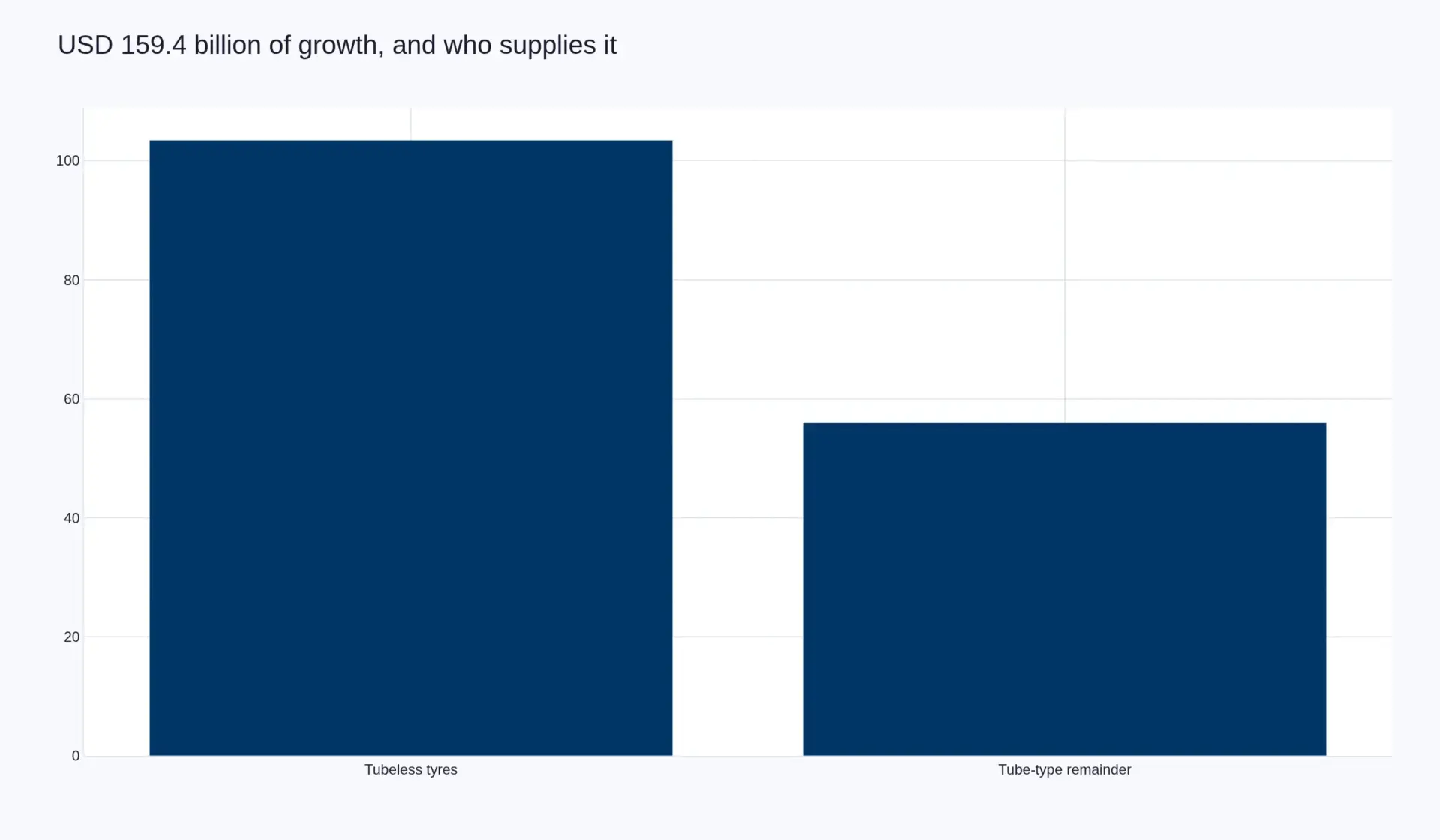
Why the share gain is small and the contribution is not
The two facts are consistent, and the consistency is the interesting part. A 4.11 point gain in share across eight years is a drift. It is not a displacement, and any narrative that describes this as a technology converting a market has misread its own numbers. But a small share gain applied across a large base still moves a great deal of money, and the market it is applied to is itself growing at 4.66 per cent. Expose a component to a slow share drift and attach it to a base that compounds, and the absolute contribution ends up out of all proportion to the rate.
The ratio is 1.217 times the market’s own growth rate. In a category where most participants sell into both constructions simultaneously, that is the number a capacity decision actually rests on: not which tyre is growing, but which tyre absorbs the growth.
The residual is the story, not the increment
What makes the share arithmetic move slowly is what sits in the other 44.48 per cent in 2033. It is not an audience waiting to be persuaded. It is tube-type construction concentrated in the applications where the wheel has not changed — off-highway machinery, agricultural equipment, industrial handling, and a large part of the two- and three-wheeler fleet whose rims are still spoked. Those wheels are not being converted; they are being used, maintained and eventually scrapped along with the machine they were built onto. The residual therefore decays at the pace of fleet replacement, which is slow and highly uneven across applications.
This is the reason the underlying report declines to describe the market as converting. Nothing in the arithmetic requires buyers to change their minds. It requires wheels to be replaced, and it requires the replacement to carry the bead-retention profile that makes a tubeless tyre possible in the first place. Everything downstream — the OEM specification, the price premium, the aftermarket mix — follows from that, and none of it leads.
So when the market is quoted at USD 289.7 billion in 2033, the number is not a forecast of preference. It is a projection of the vehicle park, priced at the tyre construction the park can physically accept.
Sources and method
- Global Tubeless Tyres Market 2026–2033, Sections 5 and 6, which carry the endpoint values and the decomposition this article restates.
- No figure here is quoted from prose. The shares and ratios are computed from the two endpoint pairs — 186.3 to 289.7 against 362.4 to 521.8 — and give 51.4073, 55.5194 and 64.8683 per cent, with the rate ratio at 1.2175.
Frequently Asked Questions
Why does a 5.7 per cent CAGR matter if the market it sits in grows at 4.66 per cent?
Because the point is not the rate, it is the contribution. Tubeless is 51.41 per cent of the construction tyre market in 2025 and it absorbs 64.87 per cent of that market's absolute growth over the period — USD 103.4 billion of USD 159.4 billion. A rate one point higher, applied to half the base, moves two-thirds of the money.
How much share does tubeless actually gain?
4.11 percentage points in eight years, from 51.41 per cent of the USD 362.4 billion construction market in 2025 to 55.52 per cent of USD 521.8 billion in 2033. That is a slow drift rather than a displacement, which is what the underlying mechanism predicts.
Does the growth mean buyers are switching from tube-type?
Only indirectly. Tubeless share rises as wheels with the required bead-retention profile replace wheels without one, so the switch is an event in the vehicle park rather than a purchase decision. The residual tube-type volume is concentrated where wheels are not being replaced at the same rate — off-highway, agricultural, industrial and much of the two- and three-wheeler fleet.
What is the risk in quoting the headline CAGR alone?
It hides the composition. A market growing at 5.7 per cent against a parent growing at 4.66 per cent sounds like a footnote; in absolute terms it is the majority of the value created in the segment. Undecomposed rates make the smaller, faster component look marginal when it is the thing doing the work.