
Editorial Article
The Only Frontier Left Is a Two-Wheeler, and It Converts at the Rim
The conversion story in tyres ends, for practical purposes, at one wheel: the spoked wheel on a two-wheeler. Everywhere else the question is either closed or frozen, and knowing which is which is the difference between a forecast and a wish.
In the developed passenger car park the question is closed, because the rims were replaced decades ago. In off-highway machinery, agricultural equipment and industrial handling it is frozen, because those wheels are not being replaced on a cycle that would change anything by 2033 and because the operating conditions favour a construction the operator already knows. What is left as a live commercial question is the two-wheeler — large enough in volume to matter, cheap enough to convert that conversion is an actual decision rather than a specification event, and still, in most of the world, built on a wheel that cannot hold air on its own.
Why a spoked wheel cannot hold air
On a traditional spoked wheel the spokes are tensioned through the rim bed. The nipples penetrate it — they have to, because that is how the wheel is built and trued — and air escapes through the penetrations. This is not a defect that can be designed out of a spoked wheel at no cost; it is what a spoked wheel is.
ETRTO states the consequence in a single recommendation: an inner tube must still be fitted to that type of wheel, because that type of wheel is rarely completely airtight. There is no tyre that fixes this from the inside. Sealant inside a tyre finds the penetrations and escapes through them; the leak is in the wheel, not the tyre.
Three ways to make a wheel airtight, and only one of them is a tyre decision
A cast or forged alloy wheel. No penetrations, so airtight by construction, with the bead-retention profile moulded in as part of the casting. This is the wheel that arrives already tubeless-capable, and the tyre simply follows it.
A sealed rim bed. Rim tape or sealant applied over the nipple heads converts an existing spoked wheel into a wheel that can hold air. It is the cheapest conversion available in this market by a wide margin — cheaper than a new wheel, cheaper than a new tyre — and it is a wheel job, performed before the tyre is fitted.
Remaining tube-type. Which is not a failure to convert. For a large part of the commuter two-wheeler fleet it is the correct answer at the price point, because a tube costs very little, is replaced at the roadside by anyone, and does not require the rim bed to have been sealed correctly by somebody else.
That third option is the one the conversion narrative usually omits, and it is the reason conversion arrives in steps rather than as a wave.
The steps track the wheel, not the tyre
Conversion shows up first wherever the wheel is already cast — scooters, and the premium end of the motorcycle market — and the tyre supplier’s role there is almost passive: the wheel arrived able to hold air and a tubeless tyre was the obvious fitment. It shows up later, or not at all, where the wheel is spoked and the buyer is price-sensitive, because the seal is an added cost at the point of sale against a benefit that shows up later and only if the seal was done properly.
And a sealed spoked wheel is a compromise rather than an equivalence. The seal is a maintenance item, and a bead that will not seat is a worse roadside problem than a tube, because a tube can be replaced by the side of the road and a leaking rim bed cannot. Trade practice reflects that asymmetry: the seal is only as good as the person who applied it, and the consequence of a poor one is a slow leak in a wheel the rider believes is tubeless.
Which is why the frontier is small
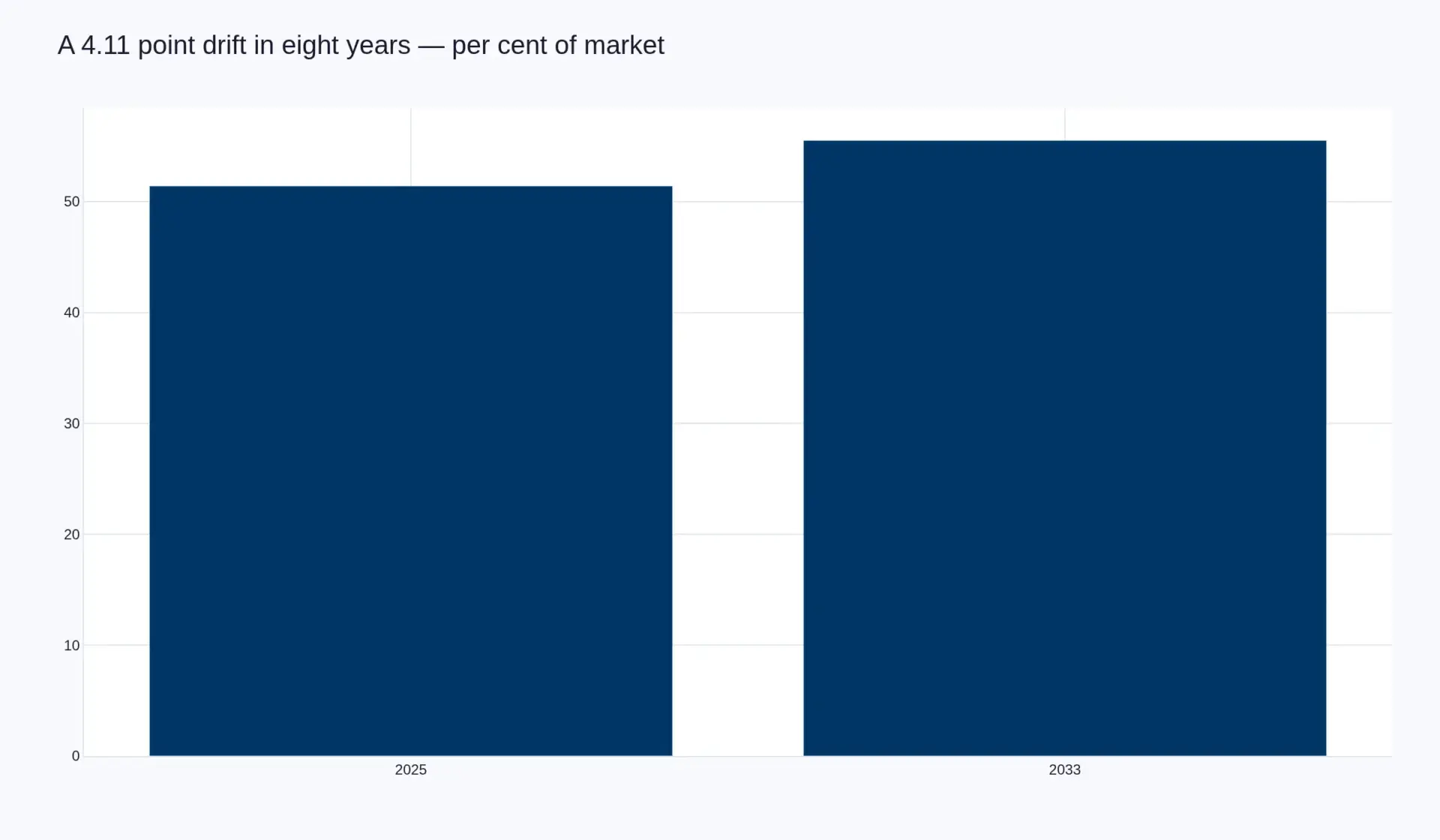
This is the point at which the two-wheeler stops being the frontier and becomes the margin. The market’s boundary is set by the wheel population, and the wheel population is set by what OEMs fit and what fleets replace. Two-wheeler conversion moves the 2033 number; it does not decide it. Tubeless tyres reach USD 289.7 billion in 2033 from USD 186.3 billion in 2025 at 5.7 per cent, and the part of that journey that depends on a rider choosing differently is genuinely small.
The cheapest conversion left in this market is a roll of rim tape. It is also, for that reason, the one least likely to appear in a forecast as a technology adoption.
Sources
- ETRTO Recommendations — the rule that an inner tube must always be fitted with spoked wheels because that type of wheel is rarely completely airtight. This is the sentence the article turns on.
- ETRTO Standards Manual, for the rim profiles a sealed spoke bed has to reproduce.
- Global Tubeless Tyres Market 2026–2033, Section 10, the Asia-Pacific and spoked-wheel residual chapter.
Frequently Asked Questions
Why can a spoked two-wheeler wheel not be made tubeless with a tyre alone?
Because the leak is in the wheel. The spokes are tensioned through the rim bed, so the nipples penetrate it and air escapes through those penetrations. ETRTO's recommendation reflects it directly — an inner tube must still be fitted to a spoked wheel, because that type of wheel is rarely completely airtight. Sealant inside the tyre finds the penetrations and leaves through them.
What is the cheapest way to convert a two-wheeler to tubeless?
Sealing the rim bed — rim tape or sealant over the nipple heads — or fitting a cast alloy wheel that is airtight by construction with the bead-retention profile moulded in. Both are wheel jobs done before the tyre is fitted, and both cost less than a new wheel or a new tyre. The tyre only participates once the wheel can hold air.
Is a sealed spoked wheel equivalent to a cast wheel?
No. The seal is a maintenance item and its quality depends on who applied it, and a leaking rim bed is a worse roadside problem than a tube, because a tube can be replaced by the side of the road and a bad seal cannot. That asymmetry is why trade practice treats sealing as a compromise rather than an equivalence.
Does two-wheeler conversion decide the size of the tubeless market?
It moves the 2033 figure at the margin rather than setting it. The market's boundary is the wheel population, and the wheel population is set by what OEMs fit and what fleets replace. Tubeless reaches USD 289.7 billion in 2033 from USD 186.3 billion in 2025 at 5.7 per cent, and only a small part of that depends on riders choosing differently.