
Editorial Article
Removing the Tube Deletes Two SKUs and a Labour Line
Every tyre-change bill has a shape, and the two constructions produce different ones. On a tube-type assembly the bill includes a tube; often a flap or a strip of rim tape; and the labour of fitting an assembly that has an inner tube inside it, which is slower and more delicate than fitting one that does not. On a tubeless assembly none of those lines exist.
That is a value-per-tyre effect, it recurs at every tyre change on every vehicle in the tube-type park, and it is completely invisible in an undecomposed value figure. Which is the point.
Two parts and a labour line
The tube is a separate part number. It is billed as a consumable whenever the assembly is opened, and it is replaced outright when it is injured — pinched during fitting, or damaged by the object that punctured the tyre in the first place. A tubeless tyre is repaired on the tyre: a plug or a patch to the casing, and the wheel goes back on the vehicle. There is no tube to replace, because there is no tube.
So the difference is not “one fewer component in the bill of materials”. It is a whole revenue line that exists in one construction and not in the other, sitting inside the same service event, repeated across an installed base of wheels that will not change until the vehicles do. Tire dealers and fitting bays see this before anyone else does, which is why the primary research behind this market leans on them rather than on procurement departments.
Why the report refuses to publish a volume series
The market is sized at USD 186.3 billion in 2025, reaching USD 289.7 billion in 2033 at 5.7 per cent, and it carries no units. That omission is deliberate and worth defending, because the alternative would have been worse.
A units figure for tyres requires two things that are not disclosed in a usable form: a price per tyre, and a mix split across the vehicle classes the industry sizes separately. Neither is published. Estimate them and the volume series inherits the estimate; publish the series and the estimate becomes invisible. A number that is 60 per cent assumed, presented to one decimal place, is not more informative than an absent number — it is less, because it looks like evidence.
The value figure does not have that problem in the same way. It is anchored to disclosed revenue and to observed price points, which is a floor under it that a units series built on an invented average price would not have.
What the value side does show
Value can grow without units growing much at all, because the tyre taking share is also the tyre carrying more content. A sensor is bonded to an inner liner, and a tube-type construction does not have an inner liner to bond it to. A self-supporting run-flat sidewall has no cavity to house a tube, so the run-flat format is structurally tubeless. The connected, sensor-embedded and run-flat reports in this segment total USD 35.3 billion — 18.95 per cent of this base, as an upper bound before overlaps between those categories are netted out.
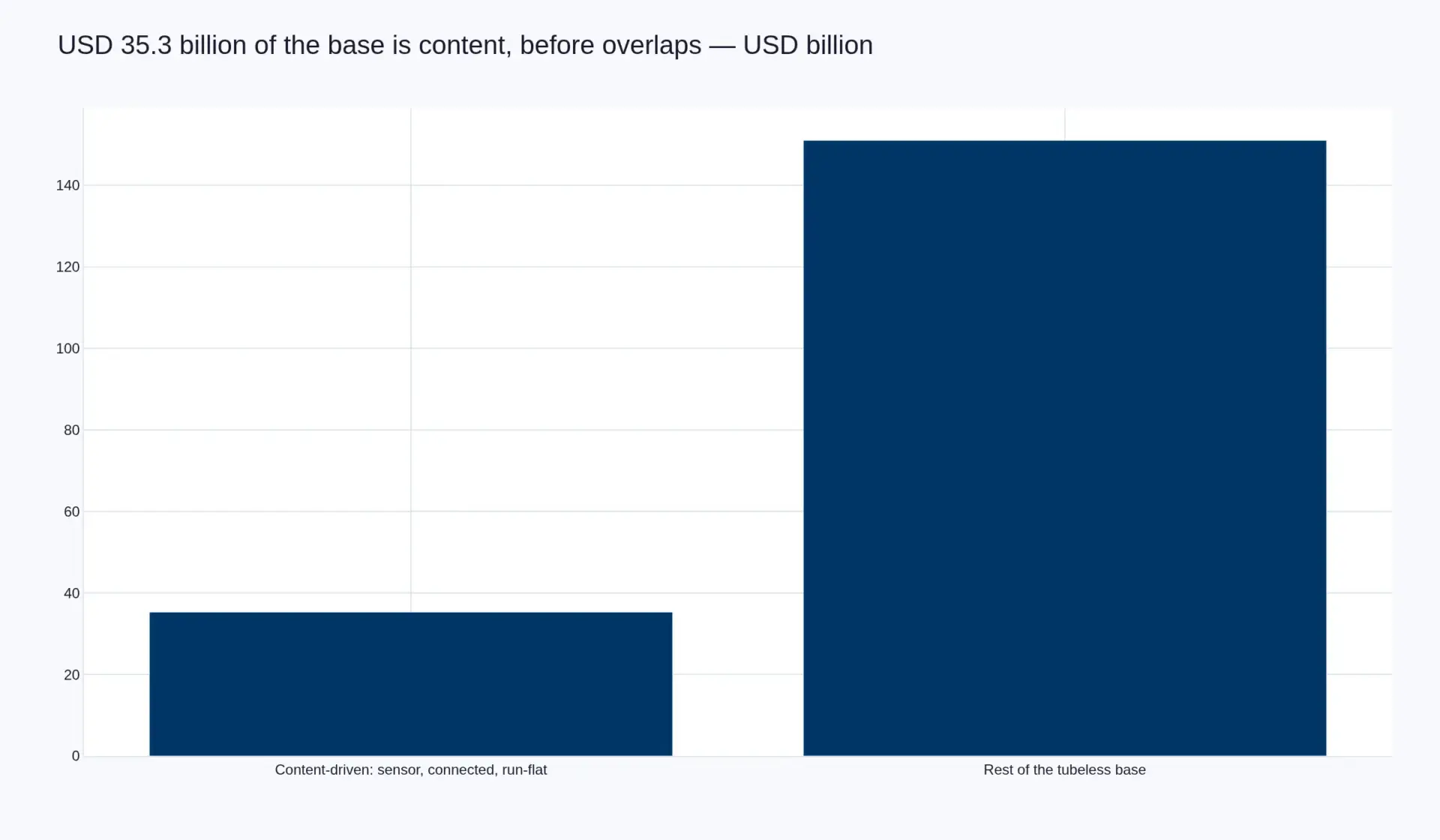
That is a content story sitting on top of a construction story, and the two are easy to confuse. The construction change is slow and driven by wheels. The content change is faster and driven by what gets built into tyres that are already tubeless. Both push value up; only one of them requires anybody to choose anything.
The question a converter actually asks
For a distributor or a fitting bay, the useful version of this market is not the CAGR. It is what happens to the bill when the construction changes: which lines disappear, which labour minutes come out, which repairs move from the tube to the casing, and how much of that saving the channel keeps rather than passes through. Those are the numbers that decide whether a fitting bay wants the park converted quickly or slowly — and they are the reason the answer is not always the one a technology narrative would suggest.
Sources
- Global Tubeless Tyres Market 2026–2033, Sections 5 and 14 — the volume disclosure and the value-chain chapter on the tube as a service-line consumable.
- ETRTO Recommendations on tyre fitting and removal, for the fitter-side handling difference between the two assemblies.
- The report publishes no units series, deliberately, and Section 5 states why: a units figure would require an invented price per tyre multiplied by an invented C1/C2/C3 mix. That refusal is the subject of this article, not a gap in it.
Frequently Asked Questions
What is actually removed from the service bill when a tyre goes tubeless?
A tube as a separate part number, often a flap or rim tape, and the labour of fitting an assembly with an inner tube inside it. The tube is billed as a consumable whenever the assembly is opened and replaced outright when injured. On a tubeless assembly those lines do not exist, and the repair moves onto the casing.
Why does the report publish no volume series for this market?
Because a units figure needs a price per tyre and a mix split across vehicle classes, and neither is disclosed in a usable form. Estimating them means the volume series inherits the estimate while looking like measured data. Value is anchored to disclosed revenue and observed price points, which is a floor a units series built on an invented average price would not have.
How can value grow if the number of tyres does not grow much?
Through content. A sensor is bonded to an inner liner, and a tube-type construction has no inner liner to bond it to; a self-supporting run-flat sidewall has no cavity for a tube. The connected, sensor-embedded and run-flat categories in this segment total USD 35.3 billion — 18.95 per cent of the base as an upper bound before overlaps.
Does the change help the fitting bay or the distributor?
It depends on which lines they keep. The construction change removes a consumable and some labour minutes, but it also removes a cheap, high-frequency part and moves repair onto the casing. Whether that is margin or margin given away is a channel question, not a market question — and it is why some parts of the trade are in no hurry.