
Editorial Article
UN Regulation 141 Lets a Truck Skip TPMS — so Heavy Converted Commercially Before Regulatorily
The passenger car sequence is the one everyone knows: a regulation required tyre pressure monitoring, monitoring needs a sensor, a sensor needs an inner liner to be bonded to, and an inner liner is something a tube-type construction does not have. Regulation, the story goes, pushed the tube out.
That story is mostly wrong, and the instrument that shows it is the one governing the pressure rather than the tyre. UN Regulation No. 141 has equivalence clauses that allow a tyre pressure refill system or a central tyre inflation system to stand in for a monitoring system entirely. A truck fleet can comply by fitting a system that keeps the tyre inflated rather than one that tells the driver it is not.
What the regulation is actually about
R141 governs tyre pressure, not tyre construction. It is interested in whether the vehicle can detect and signal a pressure problem, and it is indifferent to how the tyre holds its air — which is consistent, because the regulation has no mechanism to reach the rim. The one instrument that did change the developed market, the TPMS mandate under Regulation (EC) No 661/2009, is written around a diffusion loss detected over cumulative driving time. That is a trend instrument, designed for a slow leak.
A slow leak is precisely the tubeless failure mode. A tube does not fail by diffusion; it fails by tearing, usually suddenly and usually because something got into it. So the regulation that is cited as the reason tubes disappeared is a regulation whose detection logic describes the failure mode of the technology that replaced them — and which permits an inflation system to substitute for the detection entirely.
Heavy converted for a different reason
In the heavy fleet the sequence ran the other way round, and it ran on commercial arithmetic rather than on a rulebook. A tubeless truck tyre is repairable on the casing and retreadable, and both of those change the cost per kilometre over a life that is measured in multiple retreads. Fleet purchasers calculate that; regulators did not have to require it. By the time the pressure rules arrived, the construction decision had already been made on the balance sheet.
That inversion is the useful lesson for anyone modelling this market off a regulatory calendar. The instrument that binds the participants is not a regulation at all: it is the ETRTO rim table, a private standard that specifies which bead-retention profile a wheel must carry. It binds because fitting a tubeless tyre to a wheel without the profile is unsafe, and no amount of compliance paperwork changes that. A private standard with safety behind it is a harder constraint than a public rule with an equivalence clause.
What follows for the forecast
Two things follow, and they both remove something a reader might expect to find.
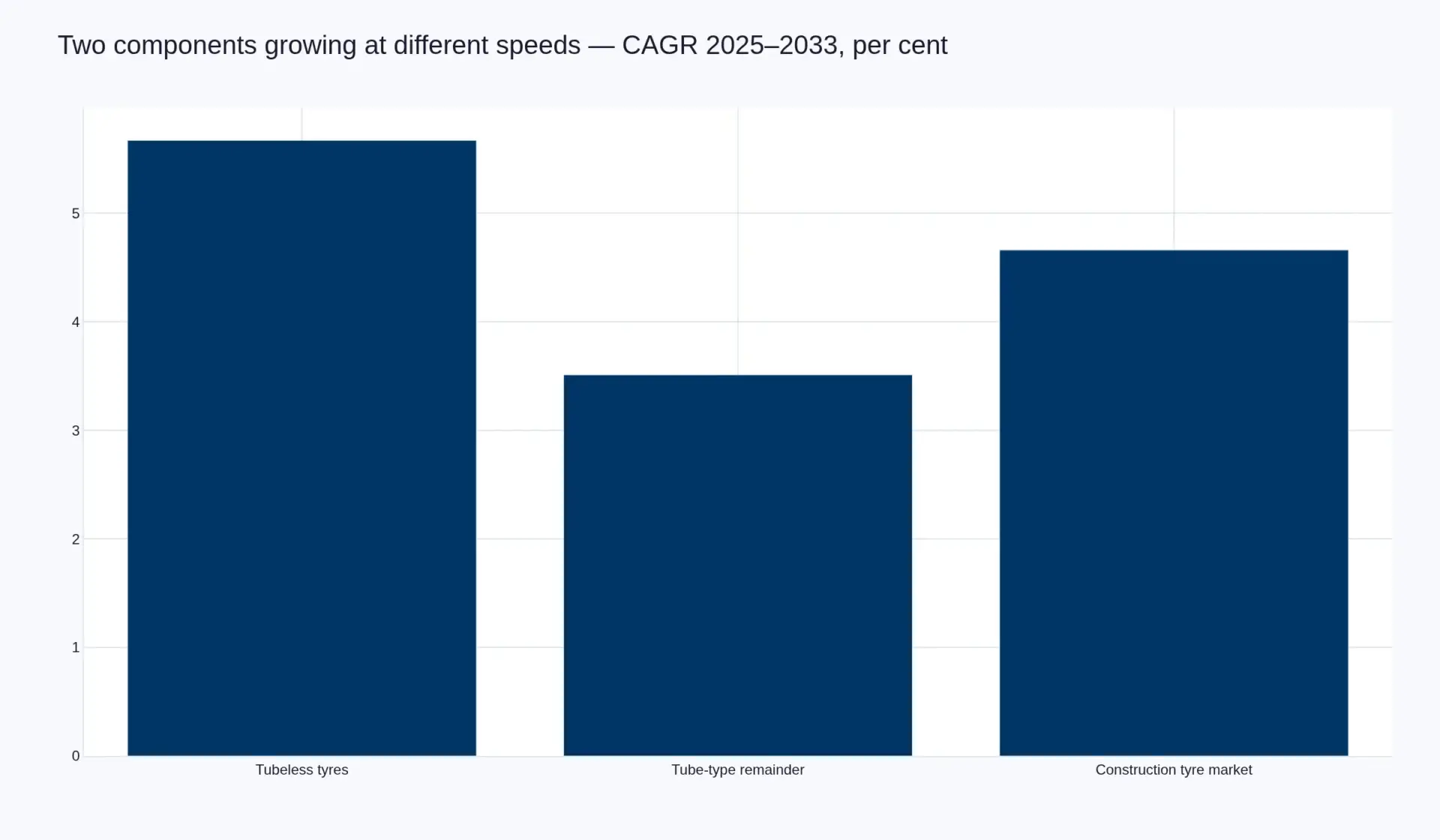
First, there is no regulatory catalyst to model. No instrument in force pushes the tube out of the wheel, so there is no date on which a compliance deadline converts a pool of tube-type volume. The transition proceeds at the speed of wheel replacement — 5.7 per cent a year for tubeless, against 3.51 per cent for the remainder.
Second, the substitution logic cuts the other way in the applications where it matters most. Central tyre inflation exists because it is operationally useful in exactly the segments that will keep tube-type constructions longest, and its acceptance as an equivalence means the pressure rule imposes no construction requirement there. The regulation is compatible with the residual, not hostile to it.
The rule that would change the market
It is worth being concrete about what a binding regulation would look like, because nothing in force resembles it. A rule aimed at the wheel rather than the tyre — requiring that wheels in service be airtight, or that replacement wheels carry a specified bead-retention profile — would attack the actual constraint. So would anything that shortened vehicle life or paid for early scrappage, because that accelerates the mechanism the market actually runs on.
Neither exists. Which leaves this market in the unusual position of being large, growing, entirely comprehensible, and almost completely immune to the lever that analysts habitually reach for first.
Sources
- UN Regulation No. 141 — 5.1.1 and its two equivalence paragraphs: 5.1.1.1 deems a Tyre Pressure Refill System equivalent where the Annex 4 criteria are met, and 5.1.1.2 does the same for a Central Tyre Inflation System. In both cases the text states that a TPMS is not required to be installed. Annex 3 carries the puncture, diffusion and malfunction tests.
- Regulation (EU) 2019/2144, Article 5(1) and 5(2) — the obligation now in force, which replaced the earlier instrument from 5 July 2022.
- Regulation (EC) No 661/2009, Article 9(2) — the original M1 requirement, repealed 5 July 2022. Cited here for the sequence, not as current law.
- FMVSS 138, the United States counterpart, which sets detection thresholds but likewise does not require any particular tyre construction.
- ETRTO Standards Manual and Recommendations — the private instrument that does bind fitment, and the one this article argues is the real constraint.
- Global Tubeless Tyres Market 2026–2033, Section 18, the regulatory chapter.
Frequently Asked Questions
What does UN Regulation 141 actually require?
It governs tyre pressure rather than tyre construction, and its equivalence clauses allow a tyre pressure refill system or a central tyre inflation system to stand in for a monitoring system entirely. A fleet can comply by keeping the tyre inflated rather than by detecting that it is not.
Why is the TPMS mandate not the reason tubes disappeared?
The TPMS mandate under Regulation (EC) No 661/2009 detects a diffusion loss over cumulative driving time — a trend instrument for a slow leak, which is the tubeless failure mode. A tube tends to fail by tearing rather than diffusion, so the rule's detection logic is not aimed at the technology it is credited with removing.
How did the heavy fleet convert before the regulation did anything?
Because a tubeless truck tyre is repairable on the casing and retreadable, which changes cost per kilometre across a life measured in multiple retreads. Fleet purchasers calculate that directly, so the construction decision was made on the balance sheet before the pressure rules arrived.
What kind of regulation would actually move this market?
A rule aimed at the wheel rather than the tyre — requiring wheels in service to be airtight, or specifying a bead-retention profile on replacement wheels — or anything that shortened vehicle life and paid for early scrappage. Neither exists; the binding instrument today is the ETRTO rim table, a private standard backed by safety rather than by compliance.