
Global Rutile Market Report, Size, Share and Forecast 2026–2033: The Price Fell 22 Per Cent and the Ore Was Not the Reason
Rutile is the titanium feedstock that cannot respond, and for two years the price behaved as though the product could not be sold.
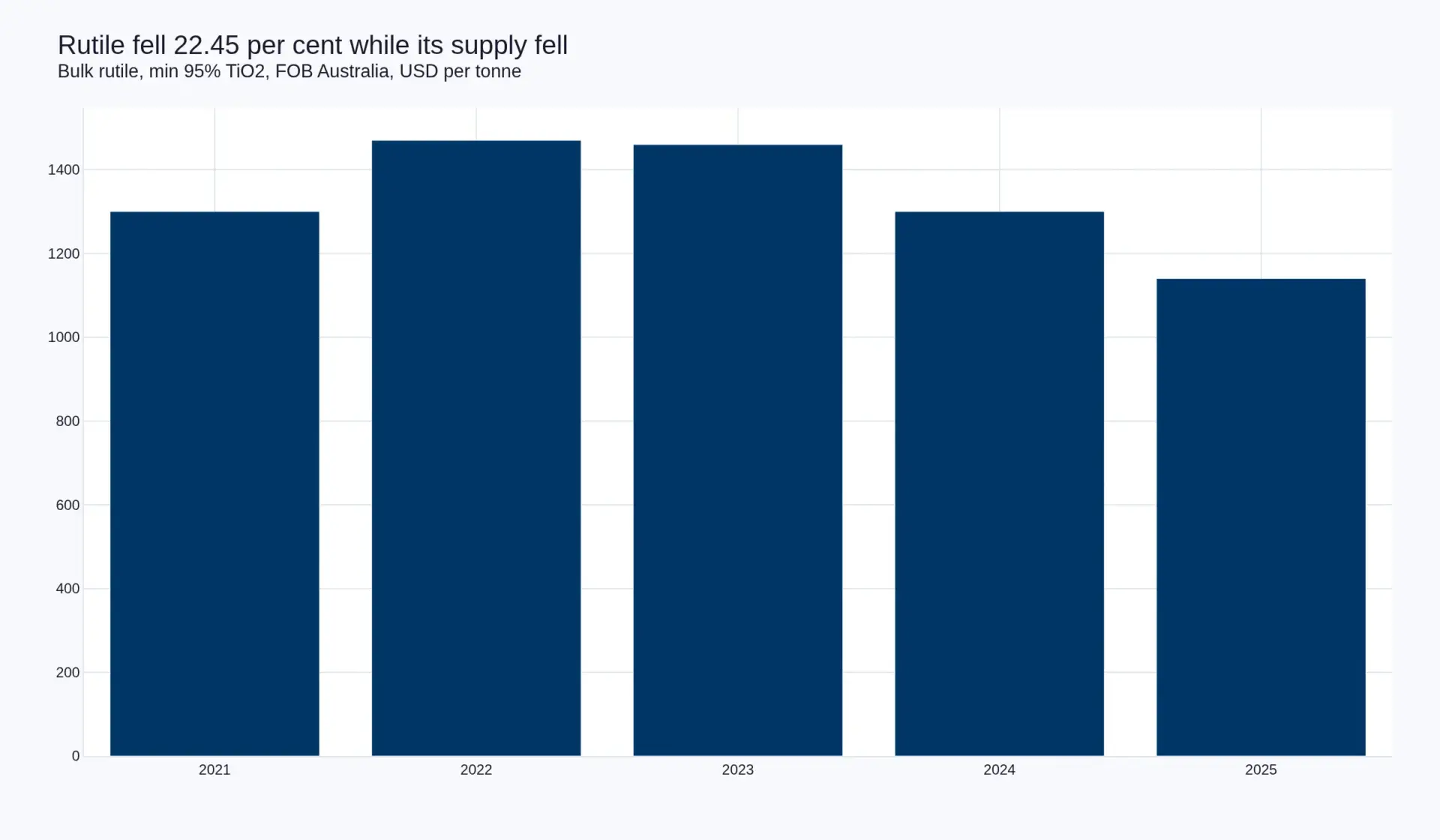
Bulk rutile at a minimum of 95 per cent TiO2, FOB Australia, cleared at USD 1,140 a tonne in 2025. That is 22.45 per cent below the 2022 assessment of USD 1,470. Over the same window, world rutile mine production moved from 460,000 to 450,000 tonnes of contained TiO2. A supply base in structural decline was priced as though it were in surplus.
The global natural rutile market was USD 550.8 million in 2025, across 473,684 tonnes of bulk product. It reaches USD 843.6 million by 2033 at a 5.47 per cent compound annual rate — an increment of USD 292.8 million, a multiple of 1.532x.
| Channel | 2025 volume (kt) | 2025 realised price (USD/t) | 2025 value (USD m) | Share | 2033 value (USD m) | CAGR 2025–33 |
|---|---|---|---|---|---|---|
| TiO2 pigment feedstock, chloride route | 274.7 | 1,140.00 | 313.2 | 56.86% | 494.4 | 5.87% |
| Welding electrode coatings | 104.2 | 1,231.20 | 128.3 | 23.29% | 180.5 | 4.36% |
| Titanium metal and sponge | 37.9 | 1,276.80 | 48.4 | 8.78% | 75.1 | 5.65% |
| Ceramic, refractory and other | 56.8 | 1,071.60 | 60.9 | 11.06% | 93.6 | 5.52% |
| Total | 473.7 | 1,162.80 | 550.8 | 100.00% | 843.6 | 5.47% |
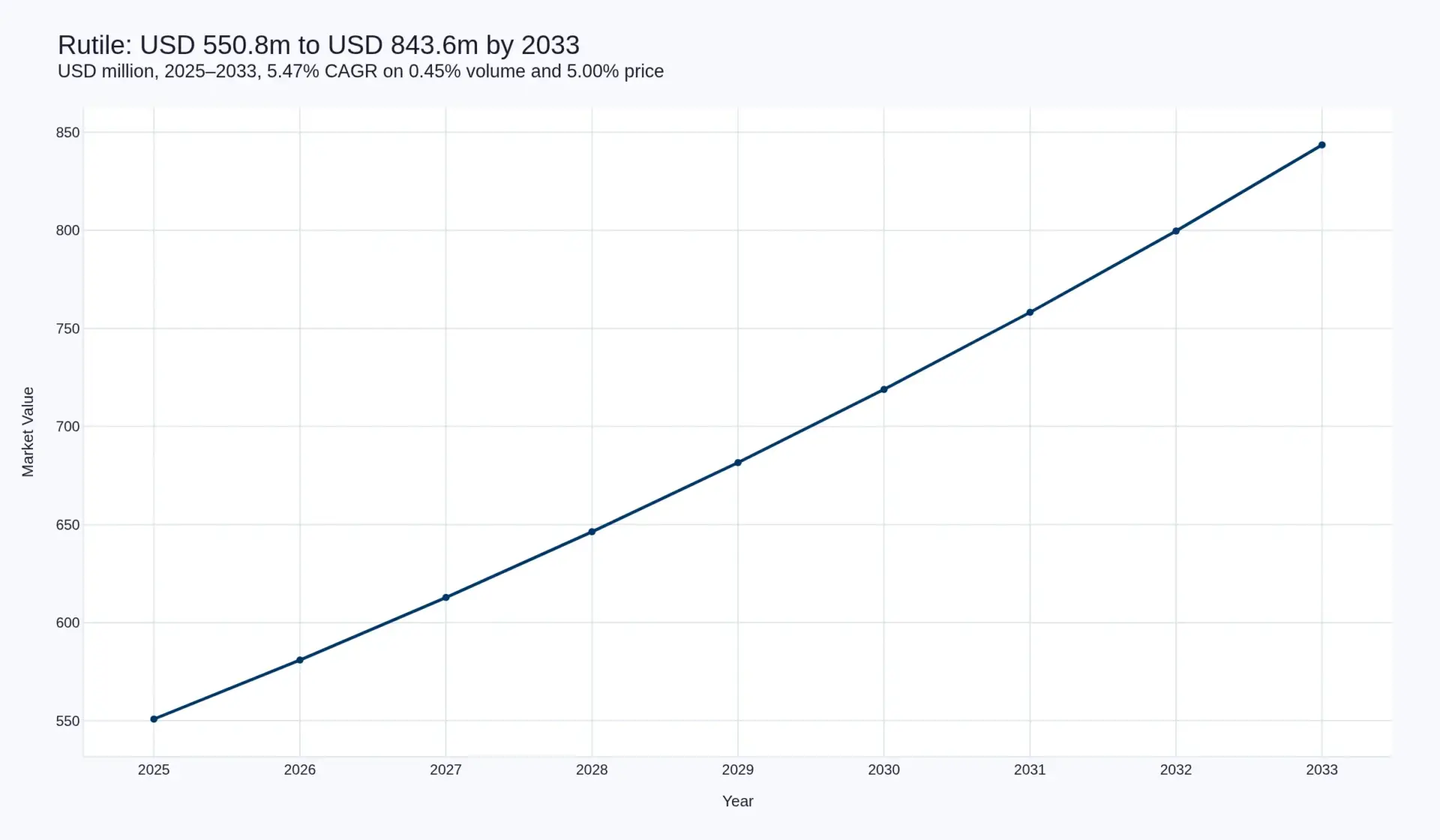
Volume supplies 0.45 points of the rate and realised price 5.00. It is close to the inverse of a mined commodity in growth: rutile tonnage rises 3.66 per cent across eight years, from 473,684 to 491,008 tonnes, because it cannot rise faster. The value comes from the recovery of a price that was never about the ore.
Why the price fell, and why the fall was a customer event
Iluka Resources' half-year to June 2026 is the clearest evidence in the sector. Rutile production fell 27.81 per cent, from 35.6 to 25.7 thousand tonnes. Rutile sales rose 34.63 per cent, from 20.5 to 27.6 thousand tonnes. Synthetic rutile production was nil, against 113.1 thousand tonnes a year earlier, and synthetic rutile sales fell 48.08 per cent to 36.5 thousand tonnes. Both synthetic rutile kilns sit idle, with restart “subject to market conditions,” and the 110 thousand tonnes contracted for 2026 will be serviced from inventory.
The company's own explanation is not a demand collapse. It is “loss of sales to Venator and rebalancing of other contracts.” US apparent consumption of titanium mineral concentrates rose 10 per cent in 2025. The ore did not lose its buyers; one buyer left the register, and the tonnes that had been contracted to it had to find a home at whatever price cleared.
The turn has already begun. Iluka's realised rutile price ran USD 1,110 in the December 2025 quarter, 1,252 in March 2026 and 1,256 in June 2026 — 13.15 per cent in two quarters off the trough, with the supply base still depleting and both kilns still dark.
The two spreads that are structural, and the one that is not
Rutile's premium over ilmenite, both FOB Australia, was 2.77x in 2022 and 2.85x in 2025. Rutile's premium over 80–95 per cent TiO2 chloride slag was 1.30x. Both multiples held while the underlying prices fell by roughly a fifth. The spread is set by grade and by chloride-route eligibility, and it does not move with the cycle. The level moves, and the level is set by pigment demand.
On 473,684 tonnes, the premium over chloride slag is worth USD 123.2 million a year — 22.36 per cent of the market. The premium over ilmenite is worth USD 350.5 million, or 63.64 per cent. Nearly two-thirds of the value of this market is a grade premium, which is why a producer's reserve grade, and not its tonnage, is the number that matters.
Scope, stated before it is asked for
473,684 tonnes is natural rutile crossing a commercial boundary at the price paid, FOB Australia basis, on a min-95-per-cent-TiO2 specification. It reconstructs from 450,000 tonnes of contained TiO2 reported by the USGS at a 95 per cent grade — the same product, expressed the way the price is quoted rather than the way production is reported.
Three things are deliberately outside this number, and the ladder back up is given so a reader can reconcile rather than take either figure on trust. Synthetic rutile — Iluka's own contracted book alone is 110 thousand tonnes a year — is a manufactured upgrade, not a mined one. Chloride slag, of which Tronox alone operates 410,000 tonnes of capacity, competes for the same chloride-route duty. And ilmenite, at 9,400,000 tonnes in 2025, is the base of the titanium mineral market of which rutile is 4.57 per cent of the tonnage. Add synthetic rutile and chloride slag and this becomes a multi-billion-dollar report about a different product with a different price mechanism. This report stays on the mined, depleting, grade-premium product, and says so.
What the report prices
The forecast is built bottom-up: volume from named operations and their reserve life, price from the grade spread and the demand cycle on top of it. The 5.00 per cent price recovery to USD 1,718 a tonne blended by 2033 is a return to 16.87 per cent above the 2022 assessment in nominal terms — which is not a boom forecast for a feedstock whose supply cannot respond, and is the conservative case against a straight extrapolation of the 13.15 per cent two-quarter recovery now underway.
The downside is named and does not require a collapse: if chloride slag and synthetic rutile take the growth tonnage, the volume line flattens to zero and the 2033 market is USD 808 million at 4.91 per cent. If pigment demand contracts as the Chinese anti-dumping duties settle, the price recovery stalls at 2 per cent and the market is USD 665 million at 2.38 per cent. Both are inside the model, not bolted on afterwards.
Articles on this market
- Rutile Fell 22 Per Cent While Its Supply Fell. The Ore Was Not the Problem. — why a 22.45 per cent price fall arrived in a depleting market, what Iluka's half-year shows about who actually moved it, and how to split a 5.47 per cent rate into 0.45 points of volume and 5.00 of price.
- The Same Tonne of Titanium Is Worth 2.85 Ilmenites — the grade premium priced: USD 350.5 million of a USD 550.8 million market is the spread over ilmenite, what a rejected parcel is worth, and why only one of the two multiples is at risk.
Methodology and disclosure
This report is built on two research layers and it names both, because a figure without its method is an assertion.
The secondary layer carries every number in this report. It comprises the USGS Mineral Commodity Summaries series for titanium mineral concentrates, from which the production volumes, country split, the FOB Australia price series and the import-reliance figures are taken; Iluka Resources' 2026 half-year results and its quarterly production reports, which supply the production, sales, realised price and synthetic rutile operating status; Tronox's 2025 Form 10-K, which supplies the 832,000-tonne feedstock capacity breakdown; Nordic Mining's quarterly interim report for the independent confirmation of rutile supply decline; and the published disclosures of Base Resources and Rio Tinto for asset status. Freight indications are drawn from standard dry-bulk route assessments.
The primary layer establishes why the price behaves as it does, and it carries no number of its own. It comprises producer, trader and technical interviews across the Australian, African and European channels; buyer-side procurement interviews in chloride pigment, welding consumables and titanium sponge; and a buying-criteria exercise that establishes which specification attributes a chloride reactor will pay for and which it will reject. Where this report says a spread is structural rather than cyclical, that judgment comes from the primary layer. Where it says a number, the number comes from the secondary layer. The two are never blended without attribution.
No competitor market-research estimate is cited anywhere in this report. Where a published third-party figure conflicts with this reconstruction, it has been excluded rather than reconciled, and the reconstruction is stated with its method so a reader can test it.
How the base was reconstructed, and how to reconcile it
The USGS reports world rutile production as 450,000 tonnes of contained TiO2. The price assessment is quoted per bulk tonne at a minimum 95 per cent TiO2 specification. Those are the same product expressed two different ways, and multiplying one by the other directly understates the market because a 95 per cent product contains less than a tonne of TiO2 per tonne sold. This report converts at the assessment grade: 450,000 ÷ 0.95 = 473,684 tonnes of bulk product. That conversion is disclosed because it is the difference between a USD 513 million figure and the USD 550.8 million used here, and a reader should be able to see exactly where the 7.4 per cent sits.
Deliberately excluded, with the ladder upward stated: synthetic rutile (Iluka's contracted book alone is 110,000 tonnes a year, and industry capacity exceeds 240,000 tonnes); chloride slag (Tronox alone operates 410,000 tonnes); ilmenite (9,400,000 tonnes in 2025, against which rutile is 4.57 per cent of tonnage); and captive production consumed within an integrated producer's own pigment plant at transfer prices. Adding synthetic rutile and chloride slag produces a multi-billion-dollar chloride-feedstock market with a different price mechanism, driven by the acid and energy economics of upgrading rather than by reserve depletion. This report does not do that, because the product would stop being the subject.
Forecast method
Volume is built from named operations, their disclosed production and their reserve life, then aggregated to 491,008 tonnes by 2033 — a 3.66 per cent increase across eight years, or 0.45 per cent a year. Price is modelled as the grade spread held constant on top of a demand-driven level, recovering from USD 1,162.80 blended in 2025 to USD 1,718.00 in 2033, a 5.00 per cent annual rate and 16.87 per cent above the 2022 assessment in nominal terms. The two compound to 5.47 per cent. Channel shares shift modestly over the period — pigment feedstock from 56.86 to 58.61 per cent, welding from 23.29 to 21.40, metal and sponge from 8.78 to 8.90, ceramic and other from 11.06 to 11.10 — and the 2033 channel values are allocated from the modelled total against those shares so the parts reconcile to the whole exactly.
What this report does not do
It does not disclose plant-level capacity for privately held producers, and it does not attribute market share to individual companies by volume where that share is not separately reported. It does not model the pigment market, which is a different report about a different product with a different price. And it does not forecast the outcome of the Rio Tinto divestment, which is a transaction and not a trend.
Sources
- USGS, Mineral Commodity Summaries — Titanium Mineral Concentrates, 2021–2026 editions (production, country split, price series, import reliance).
- Iluka Resources, 2026 Half-Year Results and quarterly production and sales reports, 2025–2026 (production, sales, realised price, synthetic rutile status, customer commentary).
- Tronox Holdings, Form 10-K for fiscal 2025 (titanium feedstock capacity by product).
- Nordic Mining ASA, Q4 2025 interim report (rutile supply commentary).
- Base Resources, project and mine-life disclosures (Kwale, Toliara).
- Rio Tinto, titanium assets divestment disclosures (Richards Bay Minerals, QIT Madagascar Minerals).
- Pheonix Research primary research programme, 2026 — producer, trader, technical and buyer-side procurement interviews; specification and buying-criteria exercise.
Table of Contents
- 1. Executive summary and the headline model
- 2. Scope: what is being counted, and the ladder up to titanium feedstock
- 3. Competitive landscape: four producers, three jurisdictions, one depleting reserve base
- 4. Value chain: from heavy mineral sands to a chloride-route pigment plant
- 5. Investment activity: idle kilns, a divestment and the first new mine in a decade
- 6. Technology and innovation: grade, route eligibility and why 95 per cent is a price floor
- 7. Market risk: customer concentration, substitution and the acid variable
- 8. Regulatory landscape: critical minerals designation, export control and monazite
- 9. Methodology, sources and disclosure
Competitive Landscape
Four producers, three jurisdictions, and a reserve base that is being mined out faster than it is being replaced
World rutile mine production in 2025 was 450,000 tonnes of contained TiO2, and it is close to the most concentrated supply base of any bulk mineral feedstock. Australia 200,000 tonnes, Sierra Leone 110,000, South Africa 100,000 — those three countries hold 91.11 per cent of world output. Everything else, Canada, Kenya, Ukraine, India, Madagascar, Brazil and Mozambique combined, accounts for roughly 40,000 tonnes.
| Producer | Principal rutile assets | Position |
|---|---|---|
| Iluka Resources | Jacinth-Ambrosia and Cataby (Western Australia); Sierra Rutile (Sierra Leone) | The reference seller. Sets the published price assessment the market transacts against, and the only producer operating a synthetic rutile upgrade at scale — currently idle. |
| Rio Tinto | Richards Bay Minerals (South Africa); QIT Madagascar Minerals | The largest single holder of titanium feedstock capacity in the world by tonnage, and a seller of the division rather than an operator of it. The divestment process is the sector’s live consolidation event. |
| Tronox | Western Australia, South Africa, Sierra Leone | Vertically integrated from mine to pigment — 832,000 tonnes of feedstock capacity, of which only 182,000 tonnes is rutile and leucoxene. It is a pigment company that happens to mine, and it buys and sells feedstock against its own internal balance. |
| Base Resources | Kwale (Kenya); Toliara (Madagascar, development) | The marginal Atlantic-Indian Ocean supplier. Kwale’s mine life is running down; Toliara is the replacement and carries a political risk premium. |
Two structural observations follow. First, the marginal tonne is now African, not Australian. Sierra Leone and South Africa together supply 210,000 tonnes — 46.67 per cent of world output — and both carry sovereign risk that Australian tonnage did not. Second, the reserve base is depleting at the top of the cost curve, not the bottom. The Australian operations are mature and high-grading to sustain grade; the African operations are the growth margin. A buyer’s delivered cost therefore depends more on which jurisdiction its tonne came from than on which producer sold it.
Trade flow, and why it matters more than a growth rate
US rutile imports are sourced 51 per cent from Australia, 20 per cent from South Africa, 18 per cent from Sierra Leone and 11 per cent from Canada. US synthetic rutile imports are 78 per cent from Sierra Leone and 21 per cent from China. That is an unusual shape: the United States has no domestic rutile production of consequence and depends on three jurisdictions for more than four-fifths of the mined product, while its upgraded product comes from a single West African source and one Chinese processor.
For a trader this is the operative map. Route eligibility — which mine, which port, which chain of custody — determines the delivered cost of a tonne far more than the FOB assessment does, because the 1.30x spread over chloride slag is not available on every parcel. It is available on parcels whose grade and impurity profile a chloride-route plant will accept, and that is a function of where the ore was separated, not what it was sold as.
Concentration on the buying side is worse than on the selling side
There are four producers of consequence. There are far fewer buyers. The chloride-route pigment industry is a handful of plants in North America, Europe and East Asia, and one of them leaving the register moved the global price by more than a fifth. That asymmetry — many more sellers than buyers, and no such thing as a spot market of last resort — is the single most important fact about this market and the reason its price history looks the way it does.
Value Chain
From a dredge in the dunes to a chloride-route reactor: where the USD 1,140 is actually earned
Rutile is not mined. It is separated — and the separation step is where the economics of the whole chain are decided.
The chain has five stages. Dredging or dry mining lifts heavy mineral sands at grades measured in single-digit percentages. A wet concentrator plant rejects the silica and clay and produces a heavy mineral concentrate carrying rutile, ilmenite, zircon, leucoxene and monazite together. Dry mill separation — magnetic, electrostatic and gravity stages in sequence — splits that concentrate into its saleable products, because each mineral responds differently to a magnetic field and a charge. Upgrade, if the product is synthetic rutile or slag, applies heat and reductant to raise TiO2 content. Consumption happens in a chloride-route pigment reactor, a welding electrode extruder, a Kroll-process sponge plant, or a ceramic kiln.
The arithmetic that governs everything
Rutile is a small fraction of the ore body. At a heavy mineral concentrate grading 20 to 30 per cent and a rutile fraction within that concentrate of 8 to 15 per cent, a tonne of rutile product requires on the order of 25 to 60 tonnes of ore to be moved, concentrated and separated. At USD 1,140 a tonne, the gross revenue per tonne of ore mined is between USD 19 and USD 46. Every input — diesel, dredge power, water, the reagent regime, the mining lease — is consumed at ore-body scale while revenue accrues at product scale.
That ratio explains the shape of the industry better than any demand forecast. It is why rutile supply cannot respond to a price signal within a decade: a new mine requires a defined heavy mineral sands province, a mining lease, a wet plant, a dry mill and a mineral separation plant, and the whole of it is justified on the strength of a product that is a few per cent of what comes out of the ground. It is also why existing producers high-grade their ore bodies when the price falls — cutting tonnes to protect grade and margin — which is exactly what Iluka’s 27.81 per cent production decline in the first half of 2026 represents.
Where the margin sits
Not in mining. Mining is a cost centre. The margin sits at dry mill separation, because that is the step at which a mixed concentrate becomes four products with four different prices, and at grade control, because the 2.85x spread over ilmenite is earned by delivering a specification rather than a mineral.
Two consequences follow, and both are visible in the market’s behaviour. First, the integrated producers — Tronox most completely — can move margin between the mining and pigment ends of their own balance sheet, which makes their reported feedstock price uninformative as a market signal. Second, a standalone miner without an upgrade step sells into whichever of the four consuming channels will take its specification, and its realised price is therefore a function of its impurity profile. The USD 1,071.60 realised in the ceramic and refractory channel against USD 1,140.00 in chloride pigment is not a market discount. It is what a parcel that a chloride reactor will not take is worth.
The upgrade step is the swing
Synthetic rutile exists to turn ilmenite into something a chloride plant will accept, and it is the reason the boundary of this market is where it is. When the kilns run, an extra 110,000 to 240,000 tonnes of chloride-grade feedstock enters the pool each year and competes directly with mined rutile. When they are idle — as both of Iluka’s were through the first half of 2026 — the pool is smaller and mined rutile carries the whole chloride demand. The single largest short-term influence on rutile’s realised price is not a mine. It is whether two kilns in Western Australia are lit.
Investment Activity
Idle kilns, a divestment, and the first new capacity in a decade arriving in the wrong product
Three capital decisions define the next five years of this market, and none of them is a demand forecast.
1. Rio Tinto is selling the largest titanium feedstock position in the world
The divestment of Rio Tinto’s titanium assets — Richards Bay Minerals in South Africa and QIT Madagascar Minerals — is the sector’s live consolidation event, and it does something no price forecast can: it puts 100,000 tonnes of South African rutile onto the block at a valuation set by whoever wants a chloride-grade reserve. A strategic buyer pays for reserve life and specification. A financial buyer pays a multiple of cash flow at a cyclical trough. The gap between those two numbers is the single largest source of uncertainty in the 2027–2029 supply picture, because the outcome determines whether those tonnes are optimised for grade and specification or for cash extraction.
2. Iluka has chosen margin over volume, and is holding the capital option open
Both synthetic rutile kilns idle, production cut 27.81 per cent, sales up 34.63 per cent — that is a company selling down inventory into a recovering price rather than chasing tonnes. The important part is the option it preserves. 110,000 tonnes of contracted 2026 synthetic rutile will be serviced from inventory, which means the contracts exist, the customers exist, and the restart decision is a price trigger rather than a market-existence question. When the kilns relight, roughly 110,000 to 240,000 tonnes of chloride-grade product re-enters the pool in one move. That is the largest single supply swing available in this market, and it is a management decision rather than a geological one.
3. The new capacity is ilmenite, and that is the point
Nordic Mining’s Engebø operation in Norway is the highest-profile new mineral sands development in Europe, and its products are ilmenite and garnet — not rutile. The company’s own quarterly commentary nevertheless confirms the thesis from the opposite direction: “The supply of natural rutile continues to decline due to resource depletion and lack of new large scale projects.” A new mine can be financed, permitted and built in the current cycle. It just cannot be a rutile mine, because the world’s known large rutile provinces are already in production and their grades are falling.
That is the investment case in one line: capital is flowing into the substitute, not the product. Ilmenite and slag capacity is expanding. Rutile capacity is contracting. The price spread between them has held at 2.85x and 1.30x through a full down-cycle, and the only mechanism that would close it is a technology change in the chloride reactor that has not happened in three decades.
The vertical integration penalty
Tronox’s own disclosure is the most useful single number in this section. Of 832,000 tonnes of titanium feedstock capacity — 182,000 tonnes rutile and leucoxene, 240,000 tonnes synthetic rutile and 410,000 tonnes slag — natural rutile is 21.88 per cent. One of the four producers of consequence, vertically integrated from mine to pigment and therefore the most insulated participant in the market, is structurally short the one feedstock it cannot make. It buys rutile on the market, and so does everyone else who is not Iluka.
What an investor should watch, in order
First, the Rio Tinto outcome — it sets the reserve valuation for every subsequent transaction. Second, the Iluka restart trigger — it sets the near-term supply balance, and the company publishes production and realised price quarterly, so the signal is public and timely. Third, US and EU anti-dumping decisions on Chinese TiO2 pigment — they determine whether Western chloride-route plants run, and those are the plants that buy rutile. Fourth, sulphuric acid pricing — the quiet transfer mechanism described in the technology section. Note what is not on this list: a global GDP forecast.
Technology & Innovation
Ninety-five per cent is not a purity claim. It is a price floor, and the technology that sets it is thirty years old
The specification that defines this market — rutile, bulk, minimum 95 per cent TiO2 — is an assay convention, not a purity grade. Natural rutile out of a dry mill runs 94 to 96 per cent TiO2 with iron, zircon and silica as the balance. What makes it valuable is not the headline number. It is what is absent: rutile carries very low magnesium oxide and calcium oxide, and those two impurities are what a chloride-route reactor cannot tolerate.
This is the whole technology story of the market, and it is worth stating plainly. A sulphate-route pigment plant will digest ilmenite at 45 to 55 per cent TiO2 and manage the iron as copperas waste. A chloride-route plant needs a feedstock low enough in alkaline earths that the fluidised bed does not slag, and it pays for that chemistry rather than for the titanium. The 2.85x multiple over ilmenite and the 1.30x multiple over chloride slag are the price of an impurity profile, and they are stable because the chemistry behind them is stable.
The three upgrade routes, and why only one of them is scarce
Synthetic rutile, made by the Becher process, reduces ilmenite to metallic iron and re-oxidises the titanium, then leaches out the iron. It yields 90 to 94 per cent TiO2 with chloride-acceptable chemistry from a 55 per cent feedstock. Upgraded slag, produced in an electric arc furnace, reaches 85 to 95 per cent and is the volume substitute — Tronox operates 410,000 tonnes of slag capacity, five times its own rutile and leucoxene output. Natural rutile needs no upgrade at all, which is precisely why it is the scarce link: it arrives at specification, from a mine, and no amount of capital can convert an ilmenite reserve into one.
That asymmetry is what the market misprices in a downturn. When pigment demand softens, every producer can idle an upgrade kiln and let inventory carry the contract — Iluka did exactly that, at nil synthetic rutile production in the first half of 2026. No rutile miner has the same option. Its product is its ore, and its ore is its reserve, and idling a mine is not a decision a listed company takes to manage a quarter.
The acid variable, which is now a rutile tailwind
Iluka names rising sulphuric acid prices as one of three swing factors on its own feedstock demand, and the mechanism is direct: sulphuric acid is the dominant reagent cost in the sulphate route and a minor one in the chloride route. As acid gets more expensive, the sulphate-route plants that consume ilmenite at 50 per cent grade become relatively less competitive against chloride plants that consume high-grade feed. A higher acid price is therefore a transfer of feedstock demand from ilmenite to rutile, and it is the only one of the three named swing factors that operates in rutile’s favour without requiring demand to grow at all.
Welding is the quiet second market, and it does not substitute
Rutile’s second-largest use, at 23.29 per cent of value, is as the flux coating on welding electrodes. It is not a pigment feedstock and it does not compete with chloride slag on chemistry. It competes on arc stability, slag detachability and bead appearance, and those are functions of a mineralogy that synthetic substitutes have never fully matched at cost. The specification premium is real — USD 1,231.20 realised against USD 1,140.00 in chloride pigment — and it is defended by the fact that a welding consumable is a certified product: change the flux and you requalify the electrode.
Where the next technology shift will come from
Not from the mine. It will come from the chloride reactor’s tolerance — incremental improvements in bed chemistry, chlorine recovery and fines handling that let a plant accept a slightly lower-grade feed without slagging. Every percentage point of impurity tolerance a pigment plant gains is a percentage point of the rutile premium that moves to slag. That is the long-run risk to this market’s price structure and it is a grinding, decade-long one, not an event.
Market Risk
Four buyers, four mines, and a price that can move a fifth on a single contract
This market’s risk profile is unusual for a bulk mineral and it is worth stating without softening: a single customer leaving the register moved the global price 22.45 per cent. That is not a demand shock. It is what happens in a market with four producers, a handful of buyers and no exchange to clear the imbalance. Every risk below is a variation on that same structural fact.
| Risk | Mechanism | Direction and materiality |
|---|---|---|
| Customer concentration | Chloride-route pigment capacity is concentrated in a few plants; the loss or idling of one removes a contracted tonnage that must be re-placed at whatever price clears. | High. Already realised once. A second Venator-scale exit is a further 10–15 per cent price event. |
| Upgrade re-entry | Idle synthetic rutile kilns restarting adds 110,000–240,000 tonnes of chloride-grade product to the pool in one decision. | High, near-term. The single largest downside trigger in 2027–2028. |
| Trade remedies | Anti-dumping duties on Chinese TiO2 pigment determine whether Western chloride plants run — and they are the rutile buyers. | Medium. Supportive if duties hold; a settlement removes the support. |
| Sovereign risk | Sierra Leone and South Africa supply 46.67 per cent of world rutile. Both have a history of fiscal, licensing and logistics interruption. | Medium–high. A single-country disruption is 20–25 per cent of global supply. |
| Mine life exhaustion | Kwale is running down; Australian operations are high-grading. Reserve replacement is not keeping pace with depletion. | Supportive to price, negative to volume. Already in the model as 0.45 per cent volume growth. |
| Substitution at the reactor | Incremental chloride-process impurity tolerance shifts specification demand from rutile to slag. | Low per year, compounding. The structural threat to the 1.30x premium. |
The two downside cases, priced
Substitution case — USD 808 million by 2033 at 4.91 per cent. Chloride slag and synthetic rutile take the growth tonnage, rutile volume flatlines at 473,684 tonnes, and the price recovery runs at 4.45 per cent rather than 5.00. This is not a bear case in any dramatic sense; it is what happens if the market does everything right and the product simply loses share of a growing pool.
Demand-contraction case — USD 665 million by 2033 at 2.38 per cent. Pigment demand contracts as anti-dumping duties settle and Chinese chloride capacity displaces Western plants, the price recovery stalls at 2 per cent, and volume declines 1 per cent a year as producers high-grade. Neither of these requires a geological surprise. Both are inside the model.
What is not a risk, despite being cited as one
Resource depletion is not a risk to this market. It is the market’s support. The sector’s own commentary — Nordic Mining’s confirmation that natural rutile supply continues to decline for lack of new large-scale projects — describes the reason the price will recover, not a threat to it. The risk sits entirely on the demand side and on the substitute’s supply side. Anyone modelling depletion as a downside has the mechanism backwards.
Freight is a smaller variable than it looks, and that matters for traders
At USD 1,140 a tonne, rutile is a high-value-density cargo: ocean freight from Western Australia to Northwest Europe in the order of USD 40–60 a tonne is 3.5 to 5.3 per cent of product value. Compare ilmenite at USD 400 a tonne on the same route, where the same freight is 10 to 15 per cent of value. The grade premium partly pays for its own logistics, which is why rutile trades globally and ilmenite trades regionally — and why a trader’s arbitrage in this product is a specification arbitrage, not a freight one.
Regulatory Landscape
Critical minerals designation on one side, mine-level licensing on the other, and very little in between
Rutile sits in an unusual regulatory position: it is treated as a strategic material by consuming governments and as an ordinary mining lease by producing ones. The gap between those two treatments is where the compliance cost sits.
1. Designation as a critical material
Titanium appears on the United States’ critical minerals list and on the European Union’s critical raw materials list, in both cases on the metal and defence-supply logic rather than the pigment logic. The practical effects are three: eligibility for upstream financing and offtake support in the US and EU, faster permitting treatment for projects that qualify, and — the one that changes market structure — a policy preference for non-Chinese supply chains that tilts procurement toward Australian, African, Canadian and Norwegian tonnage.
For a producer this is a financing advantage. For a buyer it is a documentation burden: a critical-minerals designation is the entry point for origin and chain-of-custody requirements that do not yet exist for titanium but are being built for adjacent materials.
2. Mine-level licensing, which is where projects actually die
Three regimes govern the producing jurisdictions, and each has a different failure mode. In Australia, the Environment Protection and Biodiversity Conservation Act process is the binding constraint on expansion, with approval timelines measured in years and conditions that attach to water, tailings and rehabilitation. In South Africa, the Mineral and Petroleum Resources Development Act governs the right to mine and carries social and labour plan obligations and a beneficiation expectation that sits directly on feedstock exports. In Sierra Leone, the Mines and Minerals Act framework has been the subject of repeated fiscal review, and the sovereign’s take has moved more than once in a decade.
The pattern: the regulatory risk in this market is not a product regulation, it is a jurisdiction selection. A tonne of rutile from Jacinth-Ambrosia and a tonne from Sierra Rutile are the same specification and carry entirely different compliance risk, and the market does not currently price that difference into the FOB assessment.
3. Monazite and naturally occurring radioactive material
Rutile is separated from a heavy mineral concentrate that also contains monazite, which carries thorium and uranium and is therefore regulated as naturally occurring radioactive material. Handling, transport and storage licensing attaches to the separation plant and to the residue, not to the rutile product — but the licence is a condition of operating the dry mill, and it is one of the reasons a mineral separation plant cannot be built quickly or cheaply. For a buyer, this is the technical reason the supply base cannot respond to price: the constraint is a licence, not an ore body.
4. Trade remedies, and the one regulation that actually moves the price
Anti-dumping duties on Chinese TiO2 pigment are the regulation with a direct line to the rutile price, and Iluka names them as one of three swing factors on its own demand. The mechanism runs through plant operating rates: duties that keep Western chloride-route pigment plants running keep rutile demand intact; a settlement that lets Chinese chloride capacity take share closes the plants that buy the product.
5. What is not yet regulated, and should be watched
Rutile is not covered by conflict-minerals due diligence regimes that apply to tin, tantalum, tungsten and gold. There is no mandatory chain-of-custody obligation on a rutile cargo today. Given the critical-minerals designations above, and the direction of travel in EU and US supply-chain legislation, that absence should be treated as a window rather than a permanent condition — and a producer that can document origin and separation today will be the one that absorbs a future requirement without repricing its tonne.
The compliance cost, quantified
Across the producing base, licensing, rehabilitation bonding, NORM management and social-plan obligations add an estimated USD 35 to 60 a tonne to the delivered cost of rutile — 3.1 to 5.3 per cent of the 2025 assessment. That is a real number and a small one. It is small because the value of the product is high and the tonnage is low: the same obligations applied to ilmenite at USD 400 a tonne would be 8.8 to 15 per cent of value, which is why compliance-heavy jurisdictions remain competitive in rutile and uncompetitive in ilmenite.