
Editorial Article
India Built a 462-Kilometre Fence. The Attack Went Over It 1,200 Times.
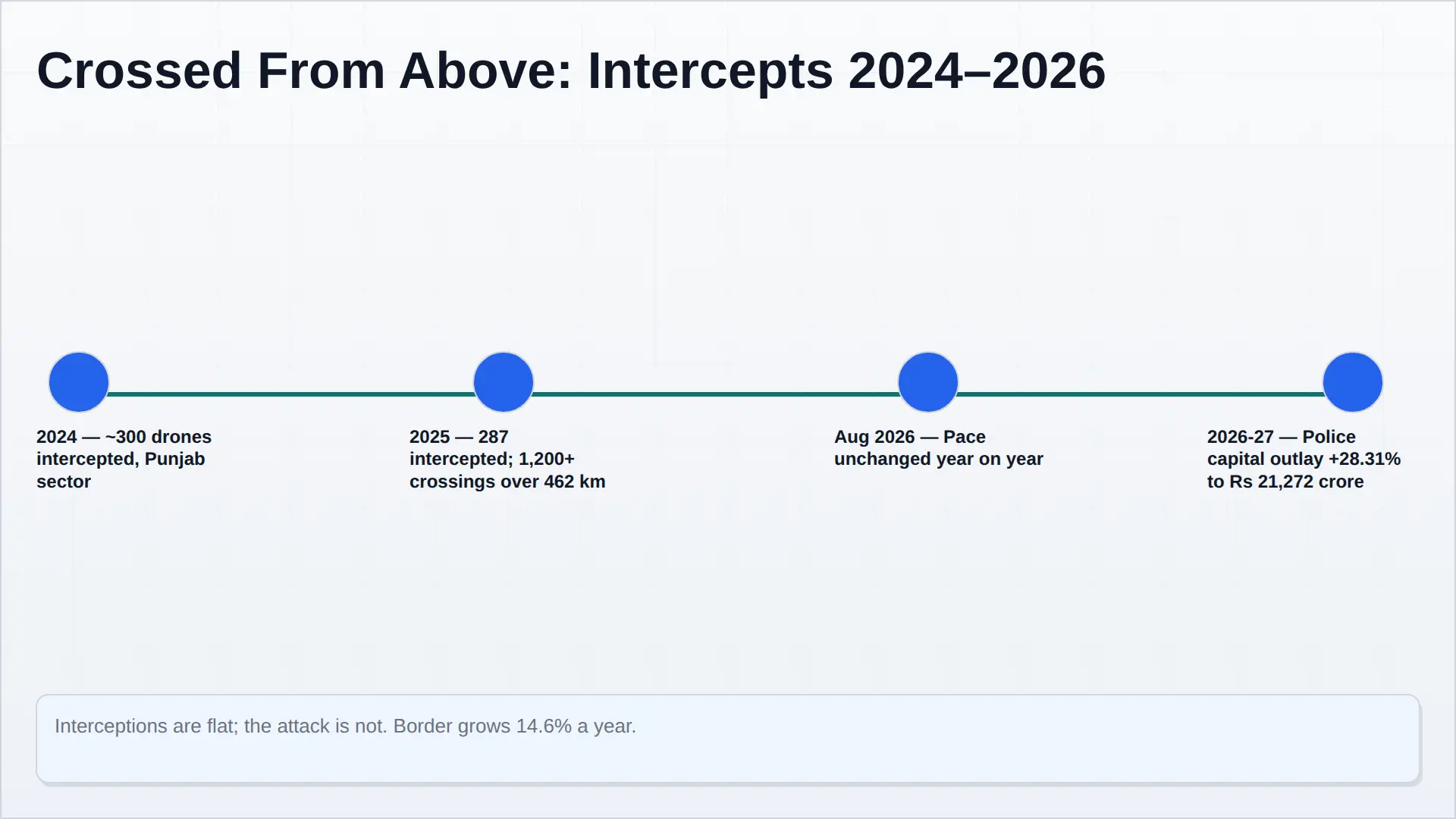
Roughly 300 drones were intercepted along the Punjab sector in 2024. Two hundred and eighty-seven in 2025. The pace through August 2026 was similar. Over the same two years the 462-kilometre barrier those aircraft were flying over was crossed more than 1,200 times — about 1.3 crossings per kilometre per year.
Read as a security failure, that is a story about a fence. Read as a procurement decision, it is a story about buying the wrong class of asset. A physical barrier controls a two-dimensional surface. A drone makes the third dimension the attack surface, and the third dimension has no fence in it. What follows from that is not “spend more”. It is that the value in Indian border security migrates from the layer that has dominated capital spending for two decades to the layer that decides what a contact is — and the budget mix has already begun to say so.
The barrier is a control surface, and the attack found the ceiling
A border fence does one thing extremely well: it converts a diffuse line into a finite set of crossings, and then concentrates surveillance and interception at those crossings. It is a funnel, not a wall. Its economics depend entirely on the attacker being forced through the funnel.
Everything about a small multirotor defeats that logic. It removes the requirement to cross at a gate, it removes the requirement to cross at zero speed, and it removes the requirement to leave a track in the ground. It is also cheap in a way that civil engineering is not: a payload-carrying multirotor is consumer electronics with a battery, an airframe and a flight controller, priced like consumer electronics. A kilometre of physical barrier is surveyed civil works, land acquisition, road access, lighting, power and maintenance. The defender is paying capital-construction prices for a control surface the attacker no longer has to touch.
None of this makes the barrier useless. It makes it a sensor platform and a delay mechanism rather than the security line. The 1,200 crossings did not happen because the fence was badly built. They happened because 462 kilometres of barrier is a perimeter, and a perimeter has an above.
The substitution arithmetic that governs the rest of this market
India’s security market has a cost floor that is unusually well documented, because the incumbent technology is people and their price is statutory. The private security industry’s wage floor is Rs 15,500 a month, so a guard-year costs roughly Rs 1,86,000 — about USD 1,992 at Rs 93.36. A surveillance camera, by the time it is deployed in volume, costs on the order of Rs 2,675.
One guard-year therefore buys 69.5 cameras. A round-the-clock post needs three guards, so it buys 208. That ratio, not the threat level, is what reprices a guarded kilometre — and it applies just as hard to a fence line, where the alternative to a counter-drone capability is more people watching more screens.
It is also why the honest version of that number matters. Industry disclosure implies roughly Rs 1,00,000 of revenue per person employed in private security, against a Rs 1,86,000 statutory annual wage — 54 per cent of the floor. If the observed cost of guarding really is that low, the substitution ratio is 37.5 cameras, not 69.5. The direction survives; the magnitude halves. A reader pricing a border investment off “69” should carry the caveat with it.
Why detection, and not interception, is the contested layer
Counter-drone procurement invites a hardware answer — jammers, spoofers, net guns, high-energy radio-frequency effectors, interceptor drones. All of them work, and all of them share one property: they consume an expensive round every time they are used, against a target that is cheap and expendable. A defender who pays a lakh of rupees per engagement to stop a payload worth more than the airframe has not changed the attacker’s economics at all.
The layer that actually reprices the exchange is detection and classification. And detection is hard for a specific set of physical reasons. A multirotor is small in radar cross-section, slow, and flies low enough that ground clutter and terrain returns swamp conventional radar. Radio-frequency detection works only while the aircraft is under live control, and fails entirely against a pre-programmed or inertial route. Acoustic arrays hear it, but on a 462-kilometre line the array density required is prohibitive. No single sensor produces a usable false-alarm rate at border scale, and a false alarm at a border is not a nuisance — it is a patrol dispatched and a real crossing missed.
The economic answer is fusion: radar returns, RF, acoustic and electro-optical tracks merged into one track picture, with a classifier that says bird, not quadcopter before anyone is dispatched. That is software, and software is where the incremental contract value is going. In Pheonix Research’s model of the Indian market, the decision layer rises from 18 per cent to 27 per cent of project value between 2025 and 2033 while the sensing layer falls from 34 per cent to 26 per cent. Sensing does not shrink in absolute terms. It shrinks as a share, because the expensive part of a modern border project is no longer the thing that looks at the sky. It is the thing that decides what it is looking at.
The number that would settle this is not published
Interception counts measure the defender’s activity. They do not measure the attacker’s throughput. A flat interception count against a rising crossing count is a deteriorating position; a flat interception count against a falling successful-crossing rate would be a good one. The second number — successful crossings — is not in the public domain, which means any argument built on interception counts alone is an argument built on half a ledger.
So we read the budget instead, on the grounds that a government’s revealed preference is a better indicator than its press releases. On that measure the direction is unambiguous: capital outlay under the Police head rises 28.31 per cent in 2026-27, from Rs 16,579.19 crore to Rs 21,272.47 crore, against a 9.44 per cent rise in the Ministry of Home Affairs’ total allocation to Rs 2.55 lakh crore. Capital growing roughly three times faster than the budget is not a hedge. It is a decision about what kind of capability the ministry intends to own.
At Rs 21,272.47 crore, that capital line is about 8.3 per cent of the ministry’s total allocation. The remaining 91.7 per cent is overwhelmingly establishment cost — pay, pensions, and the fixed overhead of ten million people in uniform and in private security. That is the real story in the demand for grants. The part of the budget that can be reallocated is small, which is precisely why it moves faster.
Where the L1 tender breaks the thesis
India’s default procurement rule is lowest-eligible-bid. For a hardware box, L1 selects competently: the specification is written, the bidders converge, and the cheapest compliant offer is a defensible answer. For a fusion and command layer, L1 selects for the opposite of what the buyer wants, because the thing being bought — detection probability at a stated false-alarm rate, in a specific terrain, against a specific threat — cannot be inspected at delivery and cannot be compared across bidders on a price sheet.
An L1 tender on a counter-drone programme therefore systematically collapses the project back to its sensors: cameras, radars and jammers have datasheets, and datasheets compare. The integrator then wins by assembling the cheapest compliant set, and the fusion software is where the margin gets cut to protect the bid. This is the single most common way an ambitious border programme delivers a system that detects everything and identifies nothing.
The procurement fix is specific and unglamorous: buy cost per confirmed detection and cost per successful interdiction, with the false-alarm budget written into the contract as a service level, and with a multi-year availability commitment that prices the maintenance of the model rather than the delivery of the box. That is a different contract form, and it is only possible where the buyer has the analytical capacity to audit a detection rate. Building that capacity is cheaper than building another 100 kilometres of fence.
There is a structural reason to expect Indian primes to be able to serve it. Bharat Electronics’ own production account shows materials at roughly 53 per cent of cost and employee cost at about 11 per cent — a mix in which value is added by engineering and integration rather than by fabrication. A prime with that cost structure should be selling fusion, not fence.
The market this produces
Pheonix Research’s model puts India’s homeland security market at USD 8.14 billion in 2025, rising to USD 20.05 billion by 2033 at 11.93 per cent — 2.463 times in eight years — on volume of 11.6 million to 22.9 million devices at 8.87 per cent. Value per device rises 24.78 per cent, from Rs 65,517 to Rs 81,754, which is the same statement as the decision-layer shift expressed in rupees per unit.
Inside the market, border security grows at 14.6 per cent, cyber at 15.8 per cent and aviation at 7.8 per cent. Border and cyber together account for Rs 61,036 crore of the Rs 1,11,216 crore the market adds by 2033 — 54.88 per cent of the increment. This is what a market looks like when the defended asset changes from a line on the ground to a stream of transactions and a volume of sky.
Three things that would falsify this
- Interceptions fall sharply without a reported fall in successful crossings. That would indicate a capability gap rather than a shift in where value sits — the defender losing the detection contest, not repricing it.
- A single-sensor solution achieves a defensible false-alarm rate at border scale. If radar, RF or acoustic alone can hold a usable detection curve over hundreds of kilometres, the fusion layer’s premium collapses and the sensing layer takes the value back.
- The barrier is re-engineered with an integrated sensor layer at a lower cost per kilometre than discrete counter-drone deployment. Physical infrastructure that embeds detection turns the fence back into the platform, and the money returns to civil works.
Method and scope
About 70 per cent of what supports this argument is secondary: the Ministry of Home Affairs demand for grants for 2026-27, Press Information Bureau releases on border management and the smart-border programme, Bharat Electronics’ integrated annual report, published interception figures, and Pheonix Research’s own India homeland security model, from which the size, growth rates, segment splits and the decision-layer shift are drawn. Roughly 30 per cent is primary work conducted by Pheonix Research: structured interviews with border-security systems integrators and counter-drone OEMs, open-ended interviews with surveillance and command-and-control practitioners, sessions with the defence and internal-security community at industry conferences and exhibitions, and a practitioner survey covering sensor fusion, false-alarm tolerance, tender specification practice and maintenance economics. Where the primary work does not support a number, we have not stated one.
The market total excludes defence procurement, uniformed pay and pensions, and private guard wages. Including them would roughly treble the figure and tell a security buyer nothing about the equipment market they are actually purchasing from.
Sources
- Ministry of Home Affairs, Demand for Grants 2026-27 and annual report — mha.gov.in
- Press Information Bureau, border management and internal security releases — pib.gov.in
- Parliament of India, Departmentally Related Standing Committee on Home Affairs reports — sansad.in
- Defence Research and Development Organisation, counter-drone and surveillance programme publications — drdo.gov.in
- Bharat Electronics Limited, Integrated Annual Report — bel-india.in
- Pheonix Research, India Homeland Security Market Report 2026–2033; Global Military Drones Market 2026–2033; India Video Surveillance Market 2025–2033; Global Police and Law Enforcement Equipment Market 2025–2033; Global Sensors Market 2026–2033
Figures are rounded. Growth rates and the decision-layer shares are Pheonix Research model outputs, not reported statistics; interception counts are as published and should be read as a measure of defender activity rather than attacker throughput.