
Editorial Article
The Battery Is $10,800. The Premium Is €83,000.
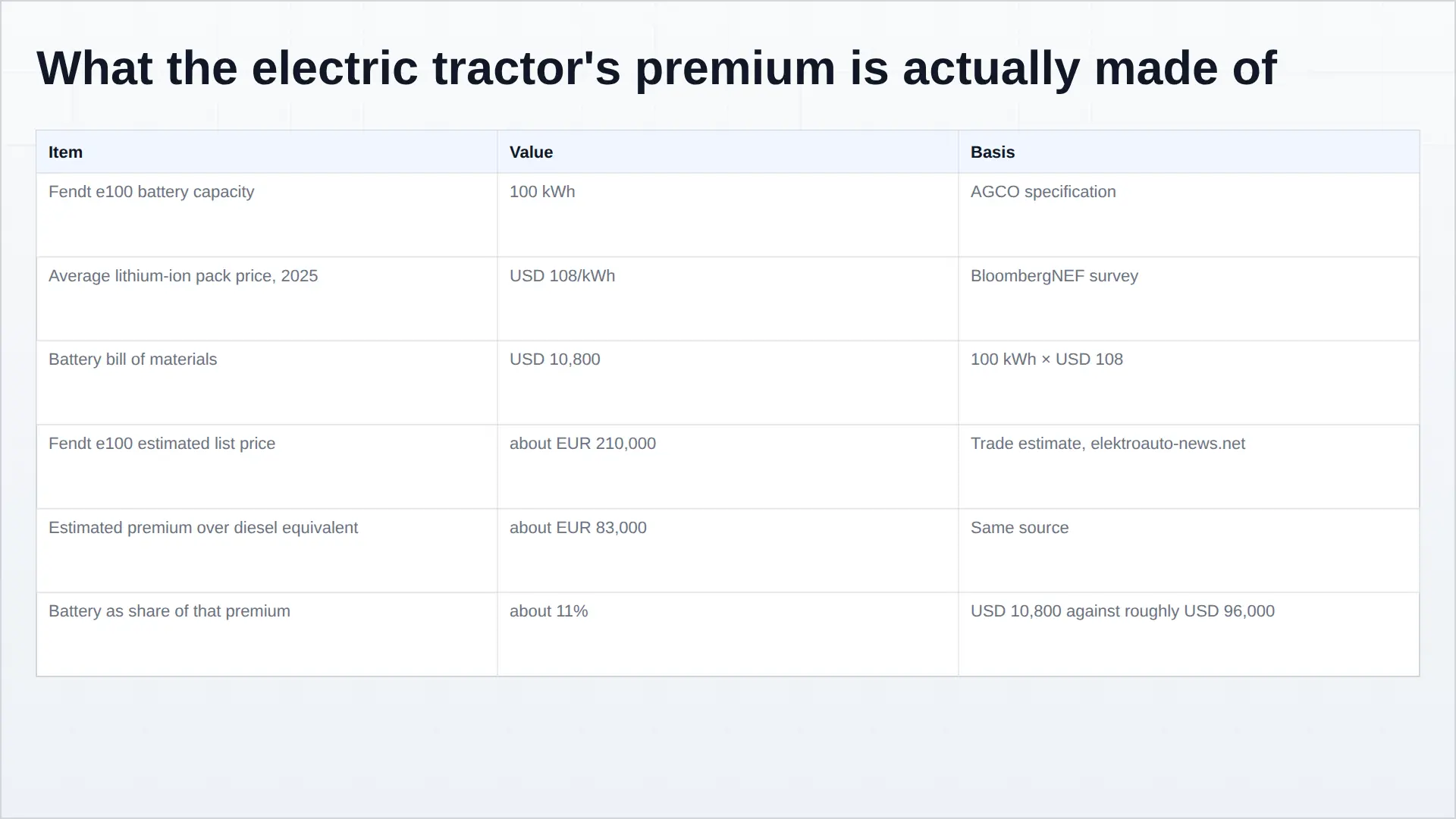
AGCO does not publish a list price for the Fendt e100. German trade coverage estimates it at around EUR 210,000 against roughly EUR 127,000 for the diesel equivalent — a premium of about EUR 83,000 for the same chassis, the same hydraulics and the same 75 to 90 horsepower.
The battery in that machine holds 100 kilowatt-hours. At the 2025 average lithium-ion pack price of USD 108 per kilowatt-hour, those cells cost about USD 10,800. Call it EUR 9,300.
Which means the single component everyone blames for the price of an electric tractor accounts for roughly one eighth of the premium being charged for it. Even if you triple the pack cost to account for packaging, thermal management, a second pack and a manufacturer’s markup, you have explained a third of the gap. The other two thirds are something else, and finding out what they are tells you when this market gets cheap.
Three things that are not cells
Volume. A diesel tractor line spreads its tooling, its type approval and its engineering across tens of thousands of units a year. A battery-electric line spreads the same fixed costs across hundreds. Nothing about that arithmetic is specific to tractors — it is the ordinary economics of low-volume manufacturing, and it is the largest single line item in the premium.
Certification. In India, a manufacturer needs certification to AIS 168 to register a tractor, and then a separate test through the Sub-Mission on Agricultural Mechanization to make a farmer eligible for subsidy. Two approvals, two systems, and the subsidy routes through the slower one. As of May 2025 only three firms held AIS 168 — AutoNxt, Shree Marut E-Agrotech and TI Clean Mobility, all startups, none of them an incumbent. The cost of that queue is not a cost of goods. It is a cost of time, and it is recovered per unit while volumes are small.
Margin to fund a service network. This is the one nobody puts in a teardown. A tractor has to be repairable within hours during a six-week seasonal window, and the network that provides that assurance does not exist yet for electric machines. Someone has to pay for it. At low volume, that someone is the buyer, through the price.
Put those three together and the premium stops looking like a materials problem. It is a scale problem wearing a materials problem’s clothes.
The India case makes the same point in a different currency
A 45 horsepower electric tractor in India sells for INR 15.5 to 16 lakh. The diesel equivalent sells for INR 7 to 8 lakh. That is roughly double, on a machine whose pack is far smaller than the Fendt’s — which is the tell that the premium is not tracking battery capacity at all. If it were, a 30-something kilowatt-hour Indian tractor would carry a far smaller premium than a 100 kWh German one.
And the subsidy written to close that gap does not close it. Andhra Pradesh offers 5 per cent on electric tractors costing INR 8 lakh or less, while most electric tractors cost more than INR 8 lakh — the ceiling sits below the price of the product it was written for. Haryana offers 50 per cent up to INR 5 lakh, the most generous scheme in the country, and no electric tractor had claimed it between its notification in May 2022 and the middle of 2025. A subsidy that cannot be reached is not a price reduction. It is an administrative object.
What this means for the price curve
If the premium were driven by cells, you could forecast it: watch lithium, watch the pack price survey, model the decline. Because it is driven by volume, certification and service, the forecast has to be built from different variables — build rates, homologation counts, and whether one certification becomes sufficient for subsidy.
That is a much faster set of variables. Pack prices fell 8 per cent in 2025, which is a good year. A certification regime that recognised AIS 168 for subsidy eligibility could remove an entire approval cycle in a single administrative decision, and cost nothing. A single Indian state correcting a price ceiling from INR 8 lakh to something a product actually costs would convert an unclaimed scheme into a live one overnight.
The reason this matters commercially is that the incumbents are positioned to win the moment the premium compresses. AGCO can sell an electric Fendt through a dealer network that is already paid for. Deere has said the technology is ready below 150 horsepower and has three prototypes waiting. The company that can absorb the current premium is the company that will capture the volume when the premium falls — and the trigger for that fall is not a better cell.
Watch the certification queue, not the lithium price. The battery was never the expensive part; it was just the part that was easy to see.
A note on the numbers: AGCO does not publish list prices, and the Fendt figure above is a trade-press estimate, not a disclosed price. The pack price is BloombergNEF’s 2025 survey average of USD 108 per kilowatt-hour. Related research: Global Electric Tractor Market Report, Size, Share and Forecast 2026–2033.
Frequently Asked Questions
How much does the battery in an electric tractor actually cost?
About USD 10,800 at the 2025 average pack price of USD 108 per kilowatt-hour for a 100 kWh pack. That is roughly an eighth of the estimated EUR 83,000 premium the electric version carries over its diesel equivalent, so the battery explains only a fraction of the price difference.
If not the battery, what makes electric tractors so expensive?
Low production volume, which spreads tooling and certification costs across hundreds of units instead of tens of thousands; the cost of homologation, which in India means AIS 168 certification plus a separate agricultural mechanisation test; and the margin needed to fund a service network for electric machines that does not exist yet.
What would make electric tractors cheaper fastest?
Watch homologation and build rates. Because the premium is driven by volume and certification rather than by cells, a single administrative change — such as recognising AIS 168 certification for subsidy eligibility, or raising Andhra Pradesh's INR 8 lakh price ceiling — could compress it faster than any battery cost curve.
Are the Fendt prices in this article official?
No. AGCO does not publish list prices for the Fendt e100 family, and the figures used here are trade-press estimates for the machine and its diesel equivalent. The battery pack price is BloombergNEF's 2025 survey average, which is a published figure.