
Editorial Article
The Hump Is the Invention: A Tubeless Tyre Is a Rim Specification
B.F. Goodrich announced a production tubeless tyre on 11 May 1947. The patents followed in 1952, and within three years the tyre was standard equipment on most new American cars. Michelin’s radial, patented in 1948, was a tubeless design from the outset. Every account of this category starts with that sequence, and then spends the rest of its length talking about the tyre. That is the wrong object to be talking about.
A tubeless tyre is not a tyre with a component deleted. It is a tyre plus a wheel specification — and the specification, not the tyre, is what had to be solved first and what still draws the boundary of the market in 2033.
What the wheel has to do that the tube used to do
An inner tube is a pressure vessel. It sits inside the tyre, holds the air, and pushes the tyre’s bead outward against the rim flange. Take it away and the tyre casing becomes the pressure vessel, which means the bead has to stay seated against the rim on its own, under load, with nothing inflating it into place.
The difficulty is geometric rather than chemical. A rim has a drop-centre well — the recess in the middle of the rim bed that exists so that a tyre can be pushed over the flange during mounting. Under a transverse load, a cornering force pushes the bead sideways, and if nothing obstructs it the bead can walk into that well. Once it does, the seal between bead and rim is gone and the assembly deflates at once. A tube could not do this, because there was nothing to migrate.
The fix is a raised profile on the rim, outboard of the well, that the bead cannot climb over. The trade calls it the hump. ETRTO standardised a family of them: the hump (H), the flat hump (FH), the extended hump (EH2) and EH2+.
Why EH2 and EH2+ exist at all
These designations are not styling. They are graduated amounts of bead retention, and the higher grades exist because of what happens after the tyre is punctured. A self-supporting run-flat sidewall carries the vehicle’s load at zero pressure, which puts a bending moment through the bead that an inflated tyre never applies to it. That is why the run-flat generation arrived with rim requirements attached rather than as a tyre-only product: the wheel had to be EH2 or EH2+ before the tyre meant anything. The tyre was the easy half.
Which makes this a market of wheels, not of tyres
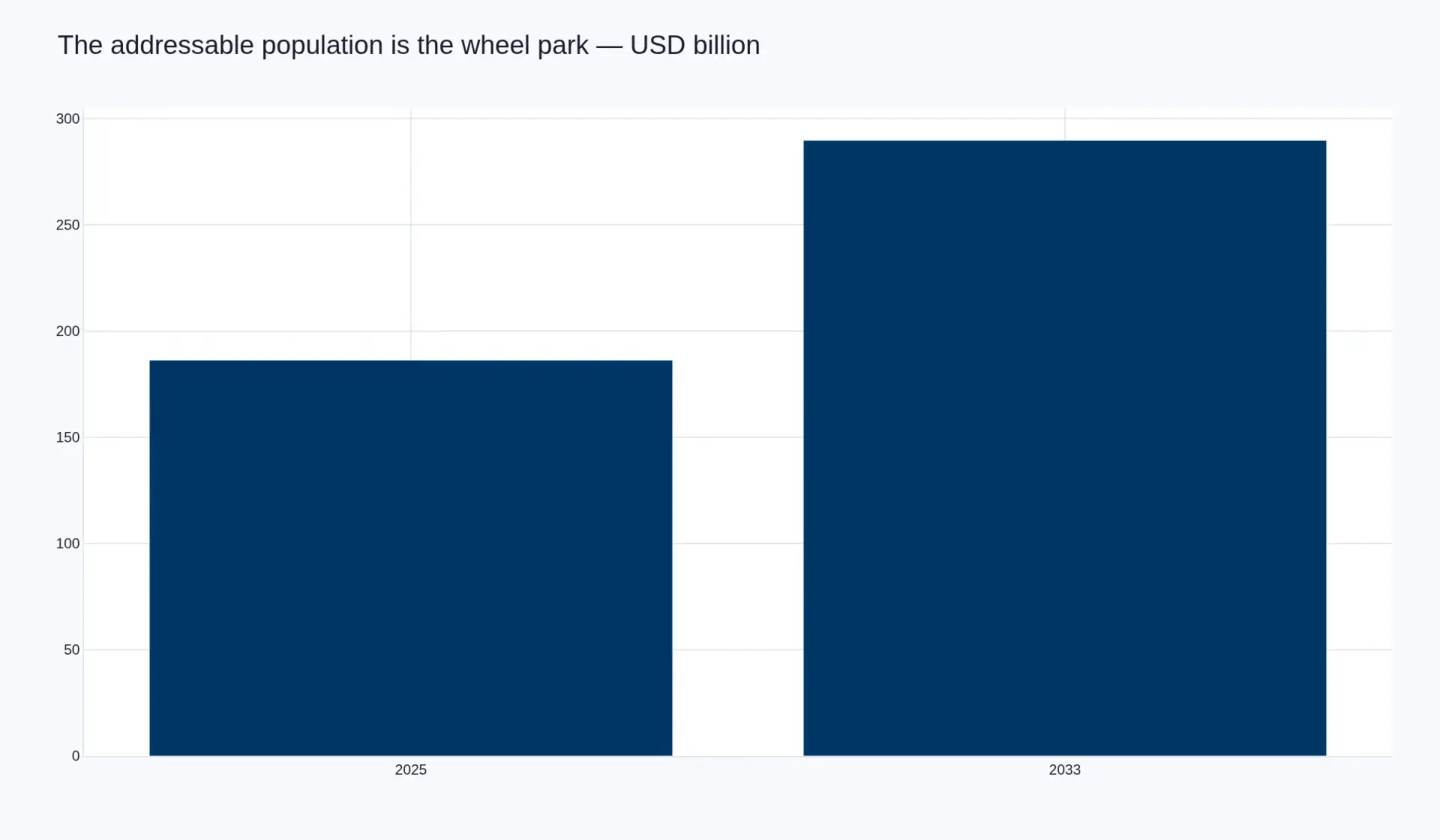
Follow that through and the commercial consequence is not technical at all. A tyre manufacturer cannot sell this market into existence. It can build the best tubeless tyre in the world and it will not convert a single vehicle whose rim lacks the profile, because fitting it would be unsafe rather than merely suboptimal. The addressable population on any given date is the population of wheels with the geometry — and wheels are replaced with vehicles, not with tyre changes.
That mechanism explains the market’s actual numbers rather than the other way round. Pheonix sizes tubeless tyres at USD 186.3 billion in 2025, reaching USD 289.7 billion in 2033 at 5.7 per cent. That is 51.41 per cent of the USD 362.4 billion construction-defined tyre market at the start of the period and 55.52 per cent at the end — a 4.11 point share gain in eight years. Four points is not a conversion wave. It is the arithmetic of a wheel population turning over, and it is what you would expect from a technology whose adoption event is a vehicle replacement.
The standards body says it in one sentence
The clearest evidence that the rim is the binding constraint comes from ETRTO itself, in a recommendation that reads almost as a footnote: an inner tube must still be fitted to spoked wheels, because that type of wheel is rarely completely airtight. On a traditional spoked wheel the spokes are tensioned through the rim bed, so the nipples penetrate it, and air leaves through the penetrations. No tyre can seal that from the inside. The wheel has to be sealed first.
Everything the category’s growth narrative treats as a demand question — what buyers prefer, how OEMs specify, what premium the channel can hold, how the product is marketed — sits downstream of a piece of geometry that a rim either has or does not have. The hump is a mid-century answer to a mid-century problem, and it will still be deciding the edge of a USD 289.7 billion market in 2033.
Sources
- ETRTO Standards Manual, rim tables: 5° drop-centre rims, and the bead-retention contours H, FH, EH2 and EH2+.
- ETRTO Recommendations — the two rules this article rests on: tubeless tyres must be fitted on air-tight rims, and an inner tube must always be fitted with spoked wheels.
- European Patent EP0170085A1, safety rim with an axial bead-retaining hump — Michelin, filed 3 July 1985, granted 4 November 1987.
- Modern Tire Dealer passenger tyre technology timeline.
- Global Tubeless Tyres Market 2026–2033, Section 4, the mechanism chapter.
Frequently Asked Questions
What actually makes a tyre tubeless?
A tubeless tyre carries its own air, but only on a rim with a bead-retention profile — the family ETRTO standardises as the hump, flat hump, extended hump, EH2 and EH2+. Without that geometry the bead can migrate into the drop-centre well under cornering load and the assembly deflates immediately.
Why can a tubeless tyre not simply be fitted to any wheel?
Because the safety of the assembly depends on the rim holding the bead, not on the tyre alone. An inner tube pressed the bead against the flange; with the tube gone, a raised profile on the rim has to do that work. Fitting tubeless to a rim without it is an unseating risk, not a performance compromise.
What is EH2+ and why does it exist?
EH2+ is the most aggressive bead-retention profile in ETRTO's hump family, specified for wheels that will carry self-supporting run-flat tyres. A deflated sidewall transmits a bending moment through the bead that an inflated tyre never applies, so the rim has to retain it harder. That is why run-flat arrived as a wheel requirement attached to a tyre.
Why do spoked wheels still need inner tubes?
Because on a traditional spoked wheel the spokes are tensioned through the rim bed and the nipples penetrate it, so the wheel is rarely airtight. ETRTO's own recommendation states that an inner tube must still be fitted to that type of wheel. Sealing the rim bed with tape or sealant is the prerequisite; the tyre cannot do it.