
Editorial Article
The Severe End Left the Tube: Why Topical Drug Delivery Grows at 6.45 Per Cent While Dermatology Grows at Double That
There is a version of the topical drug delivery story that writes itself: skin disease is common, populations are ageing, patients prefer creams to injections, and therefore the market grows quickly. The number says otherwise. The global topical drug delivery market is USD 186.20 billion in 2025 and USD 306.90 billion in 2033 — 6.45 per cent a year, USD 120.70 billion of new revenue, 39.33 per cent of terminal value that does not exist today.
Six and a half per cent is a respectable rate for a mature industrial market. It is a strange rate for a category sitting inside dermatology, where the most visible company in the world grew net sales 17.7 per cent at constant currency last year. This piece argues that the gap is not an anomaly to be explained away. It is the structure of the market, stated in one number, and understanding it changes what you should measure.
The arithmetic, and why the shape matters more than the rate
A compound rate is the wrong unit for planning, because it distributes growth evenly across eight years when the market does not. Held in dollars, this forecast is back-loaded.
| Year | Market value, USD bn | Increment, USD bn |
|---|---|---|
| 2025 | 186.20 | — |
| 2026 | 198.20 | 12.00 |
| 2027 | 210.98 | 12.78 |
| 2028 | 224.58 | 13.60 |
| 2029 | 239.05 | 14.47 |
| 2030 | 254.46 | 15.41 |
| 2031 | 270.86 | 16.40 |
| 2032 | 288.32 | 17.46 |
| 2033 | 306.90 | 18.58 |
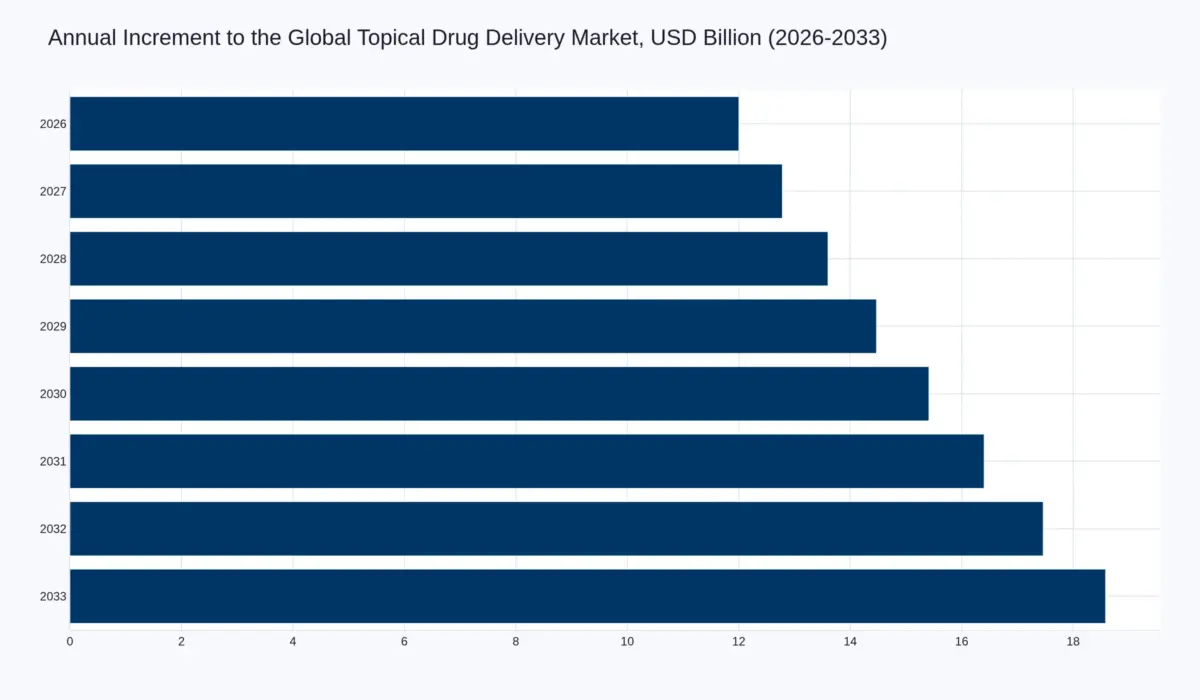
The first year adds USD 12.00 billion and the last adds USD 18.58 billion. That asymmetry is the practical content of the forecast: the average increment of USD 15.09 billion a year has to be re-earned every year in new prescriptions, new switches and new patches, and the tolerance for a slow year narrows as the base grows.
Two exits, one mechanism
The moderate rate is usually attributed to something clinical — that topicals are old technology, or that the easy patients are already treated. The more useful explanation is that two populations have left the route, and both exits were payer events rather than scientific ones.
The severe end left first, upward. Injectable biologics now take the patients with the highest revenue per head in psoriasis and atopic dermatitis, and the evidence for that migration sits in the accounts of the company with the most to lose from it. Galderma’s 2025 net sales reached USD 5,207 million, up 17.7 per cent at constant currency, with Core EBITDA of USD 1,211 million at a 23.3 per cent margin — and Therapeutic Dermatology grew 50.2 per cent on the back of Nemluvio (nemolizumab), an injectable, which contributed USD 452 million in its launch year. A payer will fund a biologic in severe disease because it wins on efficacy and on total cost against uncontrolled disease. That is the reimbursement logic, and it is why the value moved.
The mild end left second, downward. In February 2020 the US Food and Drug Administration approved diclofenac sodium topical gel 1% for over-the-counter sale as Voltaren Arthritis Pain, the first prescription-strength topical NSAID to make that switch in the United States. It was granted on data in hand and knee osteoarthritis, and on guidelines — the 2019 American College of Rheumatology recommendations, and OARSI’s position that topical NSAIDs are preferred to oral analgesics for knee osteoarthritis — that had already moved in its favour. A switch is also a payer decision, but in the other direction: the consumer becomes the payer, the price per unit falls, and the unit base grows.
Put those two together and you have the mechanism. A prescription topical survives where a third party will reimburse a cheap product rather than fund something more expensive, in a population not sick enough for a biologic and not well enough to self-treat. That is a large population. It is not a high-value one per head.
What is left is large, chronic and unglamorous
Inside the route, semi-solid formulations — creams, ointments, gels, lotions, foams — still carry the largest share of value, and they do so as maintenance therapy: psoriasis between flares, eczema between flares, acne over years, fungal and barrier conditions, localised musculoskeletal pain. The patients are numerous and the therapy is chronic, which is what makes the pool 186 billion dollars wide. The price per prescription is low and falling, which is what keeps the rate at 6.45 per cent.
Two regional facts complete the picture. North America holds the largest share on branded pricing and the depth of its retail aisle. Asia Pacific grows fastest — not because any payer there raises a price, but because more patients reach a clinician, and because the Indian and Chinese manufacturing base supplies semi-solids to the rest of the world. In a market with this structure, growth is a diagnosis and distribution story, not a pricing story.
The moat is a test, not a patent
The most interesting thing about this market is that it is fragmented and stays fragmented. The largest pure-play dermatology company in the world, at USD 5,207 million of net sales, is 2.80 per cent of the pool. Thousands of formulations compete, several dozen suppliers contest each class, and yet consolidation has not happened. The reason is not brand loyalty. It is that entry into the generic tier is gated by evidence rather than by capital.
The FDA classifies topical products other than topical solutions as complex products, because they are typically locally acting and their formulations are often complex. An abbreviated new drug application therefore cannot lean on systemic pharmacokinetics; it has to demonstrate local bioequivalence against the reference product through in vitro permeation testing and in vitro release testing. The agency’s October 2022 draft guidance on permeation studies sets out how that comparison is run, with the standard caveat that it is not for implementation. Because the method is specified product by product, the burden is not a class-wide barrier that a portfolio can amortise. It is a per-product analytical programme.
That has an unusual consequence for a small-molecule market: the barrier to copying a topical is not the molecule, it is the test. A cream is a commodity. A cream that permeates within the acceptance window of the reference, reproducibly and across batches, is not — and the money required to prove it survives patent expiry, because every entrant spends it again. It is also why a liquid solution, with a lighter analytical burden, erodes in price faster than a semi-solid, and why the returns on topicals are earned by some laboratories as well as by some brands.
There is a corollary that gets almost no attention. An abbreviated application is written against a reference listed drug, so if the reference product is withdrawn or restricted to limited distribution, the route to market closes for reasons that have nothing to do with science. In a market without a dominant player, that single administrative dependency is a larger determinant of who can enter than any patent.
The patch exception
One part of this route escapes its pricing ceiling: transdermal patches. They are the fastest-growing class in the model for a structural reason rather than a technological one — a patch makes a systemic claim, so it is priced against the oral or injectable therapy it replaces, not against a cream. That is why patch assets and patch technology attract multiples that cream portfolios do not, and why the most strategically advantaged position in the entire market belongs to a company whose franchise is patches.
The microneedle question sits just behind it. Coated and dissolving arrays are already at scale in cosmetic and diagnostic use; therapeutic arrays with a pharmaceutical claim remain few, because coating uniformity across millions of projections has not been solved economically at volume. If it is solved, it does not create a new market — it reprices this one.
What would break the forecast
None of the three ways this forecast fails requires a scientific failure, which is what makes them worth watching.
A cheap, harmonised permeation standard. If in vitro permeation testing becomes routine and inexpensive, the per-product evidence burden that protects incumbents collapses, generic semi-solids erode faster than the model assumes, and the value line bends down.
Biologics moving further down the severity curve. Every label expansion into moderate disease permanently removes patients from the topical layer. This is the largest single threat to the pool, and it is not a competitive threat from another cream.
A switch wave. The remaining prescription topical analgesics and low-potency corticosteroids are switchable in principle. Each switch converts prescription revenue into retail revenue at a lower unit price: more volume, less value.
What this piece does not claim
It uses a value model and nothing more. There is no unit, tonnage or prescription-count series behind these figures, so no revenue-per-patient arithmetic is offered and none should be inferred: the segment and regional statements above are rankings, not shares. And the market’s scope is doing real work in the number — published third-party estimates for the same phrase differ by more than a factor of two, because some include dermocosmetics, some count only prescription products, and some treat patches as devices rather than as a drug delivery route. This figure prices finished-dose products administered topically, including ophthalmic, otic, nasal, vaginal and rectal applications, and excludes injectables, oral solids, pulmonary inhalers and non-medicated cosmetics.
The conclusion is narrower than the headline. Topical drug delivery is not a growth story that disappointed; it is a maintenance business that is being measured with growth-story expectations. The number to watch is not the size of the pool. It is the size of the residual population that still needs a tube — and the analytical cost of proving a new one works.
Frequently Asked Questions
How large is the topical drug delivery market in 2033?
It is USD 306.90 billion in 2033, up from USD 186.20 billion in 2025. That is a 6.45 per cent CAGR, a multiple of 1.65 times and a net addition of USD 120.70 billion, of which 39.33 per cent of terminal value is new revenue. The figures are a Pheonix value model covering finished-dose products administered by the topical route.
Why did the severe end of dermatology move off the skin?
Both exits are reimbursement events. Injectable biologics now take the severe end of psoriasis and atopic dermatitis because a payer will fund a therapy that wins on efficacy and total cost in severe disease. Over-the-counter switches take the mild end because the consumer becomes the payer at a lower price per unit. A prescription topical survives where a third party will reimburse a cheap product for a population that is neither sick enough for a biologic nor well enough to self-treat.
Why has the topical market not consolidated?
Because the barrier is the evidence package, not the molecule. The FDA treats topical products other than topical solutions as complex products, so an abbreviated application must demonstrate local bioequivalence through in vitro permeation and in vitro release testing against the reference product, on a method specified product by product. That cost recurs for every entrant and survives patent expiry, which is why the market has stayed fragmented rather than consolidating.
What would falsify the 6.45 per cent forecast?
If in vitro permeation testing becomes cheap and harmonised, the per-product evidence burden that protects incumbents falls and generic semi-solids erode faster. If biologics keep expanding into moderate disease, patients leave the topical layer permanently. And if the remaining prescription topical analgesics and low-potency corticosteroids switch to over-the-counter sale, value moves from prescription pricing to retail pricing. None of the three requires a scientific failure.