
Global Veterinary Point-of-Care and Rapid Animal Diagnostics Market Report, Size, Share and Forecast 2026-2033
The global veterinary point-of-care and rapid animal diagnostics market is valued at USD 3,150.0 million in 2025 and is forecast to reach USD 5,922.9 million by 2033, a compound annual growth rate of 8.21 per cent. Test volume rises from 262.5 million to 430.0 million tests at 6.36 per cent, and realised revenue per test from USD 12.00 to USD 13.77 at 1.74 per cent.
That headline conceals the only thing worth knowing about this market. It is not one category growing at one rate. It is two layers moving in opposite directions, and the smaller of them is the one the category is named after.
Instrument-attached consumables — the chemistry, haematology, immunoassay and blood-gas reagents that only run inside a specific manufacturer's analyser — are USD 2,300.0 million in 2025 and reach USD 5,002.4 million in 2033 at 10.20 per cent. Rapid lateral-flow assays — the strip tests the word "rapid" in the title refers to — are USD 850.0 million and reach USD 920.4 million at 1.00 per cent. Of the USD 2,772.9 million the market adds over eight years, USD 2,702.4 million, or 97.5 per cent, comes from the consumables layer. The rapid-test layer adds USD 70.4 million.
This is not an inference from a category estimate. It is disclosed. In its full-year 2025 results, IDEXX Laboratories — the largest single supplier in this market — reports IDEXX VetLab consumables up 13.7 per cent organic, rapid assay products down 3.3 per cent organic, reference laboratory services up 5.9 per cent organic, and CAG diagnostics capital instruments up 49.3 per cent organic. The most valuable company in the category is selling nearly half again as many analysers, filling them with reagents growing at double digits, and watching its strip tests shrink.
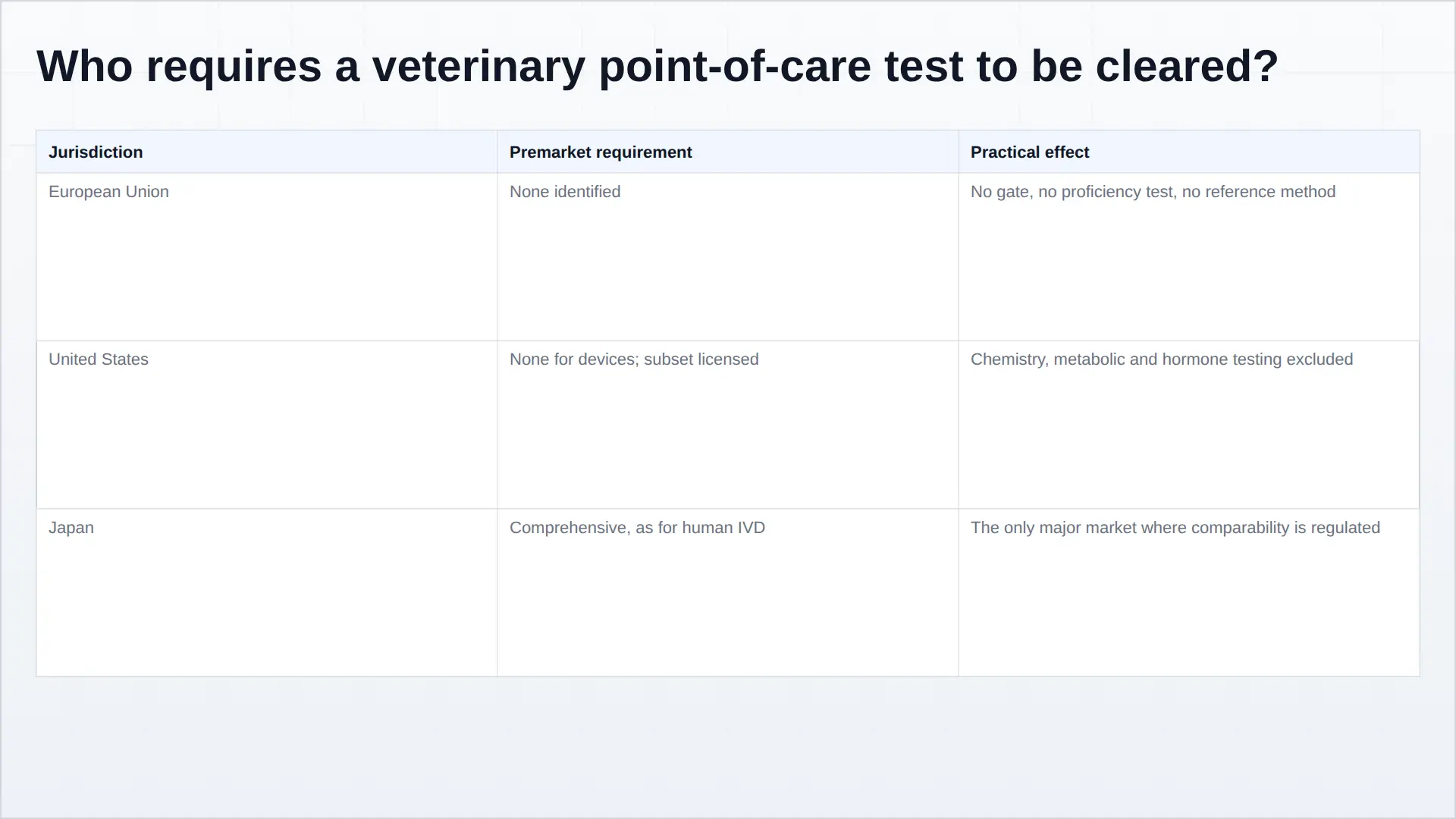
Why the consumables layer compounds is a regulatory fact, and it is the spine of this report. In-clinic veterinary diagnostics is the one layer of animal health that no regulator requires anyone to clear. The FDA states plainly that it does not require submission of a 510(k), PMA, or any pre-market approval for devices intended for animal use, and that manufacturers of animal devices are exempt from establishment registration, device listing and post-marketing reporting. The USDA's Center for Veterinary Biologics does license a subset — but its own 2024 memorandum of guidance excludes, in terms, serum chemistries, metabolic diseases, or hormone level test kits, and declines jurisdiction over results that do not characterise an aetiologic agent to genus or family. A mastitis test reporting "gram positive" is out of scope by name. A cross-jurisdictional review published by the World Organisation for Animal Health found the regulatory position ranges from no regulation in the European Union to oversight in Japan comparable to the regime for human in vitro diagnostics.
The consequence is mechanistic. Where no regulator sets a reference method and no external proficiency programme enforces comparability, the number that decides whether a result is normal — the reference interval — is proprietary to the platform that produced it. A canine creatinine of 1.6 mg/dL is normal or abnormal depending on which analyser generated it, and is not transferable to a rival's box. That is the switching cost: not the price of the reagent but the loss of the patient's own history. It is why the analyser is placed at a low or nominal price and the consumable carries the margin, and why instruments grew 49.3 per cent organic in a single year — that is a placement programme, and every placement is a multi-year reagent annuity.
And the lock-in does not show up in price. Of the growth, USD 2,010.0 million (72.5 per cent) is more tests and USD 762.9 million (27.5 per cent) is a dearer test. Realised price compounds at only 1.74 per cent, and IDEXX's own disclosure explains why: consumables grew 13.7 per cent against premium instrument installed-base growth of 12 per cent, implying per-instrument revenue growth of roughly a point and a half. The moat defends volume, not pricing power. A competitor cannot win by being cheaper, because a cheaper result is not comparable with the patient's history — so the incumbent does not need to raise the price, it only needs to keep the box.
That also explains the decline the category does not like to discuss. A lateral-flow strip sits in no instrument and generates no reference interval, so it has no switching cost and competes on price alone. It is the one layer that behaves like a commodity, and it is shrinking at the largest supplier in the market.
Reconciling with the parent market. Pheonix's existing Global Veterinary Care report models total veterinary care at USD 98.60 billion in 2025 growing at 6.70 per cent. Point-of-care diagnostics at 8.21 per cent, reference laboratory at 5.9 per cent and total care at 6.70 per cent are consistent: the in-clinic channel is taking share from the central laboratory, but not by replacing it. IDEXX grew reference-laboratory revenue 5.9 per cent organic while growing in-clinic consumables 13.7 per cent — both positive. Point-of-care is functioning as a triage layer that generates referrals to the reference lab rather than a substitute for it, which is why a cannibalisation model of this market will be wrong.
The value base is a construct and we say so. Only one supplier discloses at this granularity. The 2025 point is built from IDEXX's disclosed point-of-care-attributable revenue of USD 2,046.0 million — VetLab consumables of USD 1,496.8 million, rapid assay products of USD 349.0 million and diagnostics capital instruments of USD 200.2 million — at an estimated 65 per cent share of the global in-clinic and rapid diagnostics market, with the balance distributed across Zoetis, Antech and Heska, Virbac and the specialist tail. The defensible band is USD 2.80 billion to 3.55 billion. We publish the sensitivity rather than the point alone: hold realised price flat at USD 12.00 and 2033 is USD 5,160.0 million at 6.36 per cent; hold volume flat and it is USD 3,615.8 million.
What this market is really selling. Not diagnosis. Comparability. In a regulated in-vitro diagnostics market, comparability is supplied by the regulator and is free to everyone. Here it is supplied by the installed base and is the barrier to entry. The category's growth rate is therefore a function of how fast analysers can be placed on benches, and its risk is that the moment any jurisdiction imposes proficiency testing or a reference method on in-clinic chemistry, the switching cost that justifies the annuity disappears. Nothing on the current regulatory calendar does that.
Table of Contents
Competitive Landscape
Competitive Landscape
The shape of the field
This is an oligopoly with one unusually dominant node. IDEXX Laboratories (Q1758392) generated USD 4,303.7 million of revenue in 2025 across all its activities, of which USD 3,953.3 million was Companion Animal Group. The point-of-care-attributable component — VetLab consumables of USD 1,496.8 million, rapid assay products of USD 349.0 million and diagnostics capital instruments of USD 200.2 million — totals USD 2,046.0 million. Against a global in-clinic and rapid diagnostics market of USD 3,150.0 million, that is an estimated 65 per cent share for a single supplier.
We state that share as an estimate because it is one. It is derived, not published, and the derivation is set out in the methodology. What is not an estimate is the direction: the largest supplier is growing its in-clinic consumable line at 13.7 per cent organic in a market we model at 8.21 per cent, which means it is gaining share as well as growing.
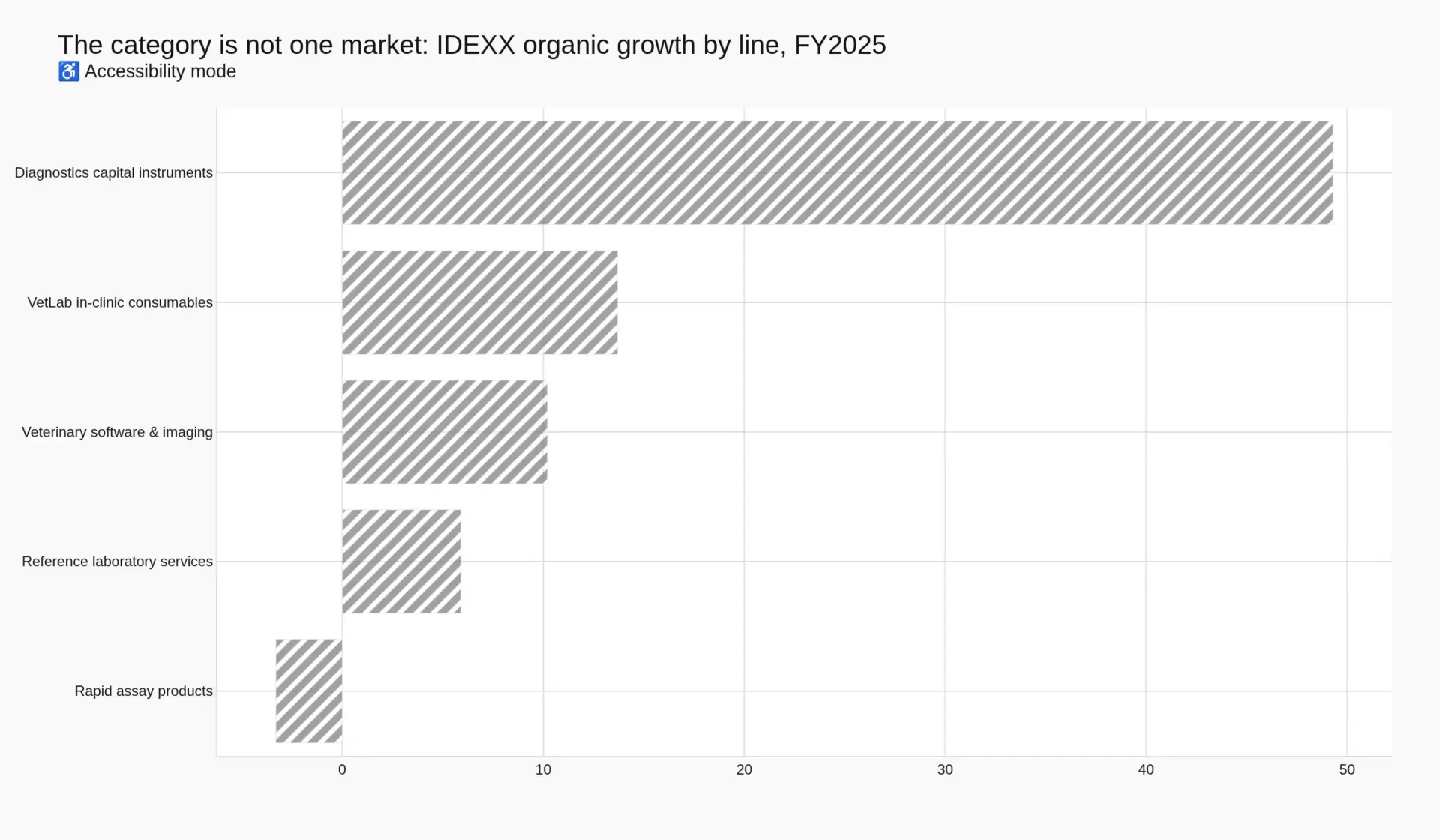
The four credible challengers, and what each is actually doing
Zoetis (Q8073337) is the largest animal health company in the world with 2025 revenue of USD 9.5 billion, but it is a therapeutics business that owns diagnostics, not the reverse. Its 2026 guidance of 3 to 5 per cent organic operational growth is a whole-company figure and should not be read as a diagnostics growth rate. Its diagnostic strategy has recently leaned toward the reference laboratory rather than the bench: in November 2025 it acquired Veterinary Pathology Group, a diagnostic laboratory group with multiple locations across the UK and Ireland. That is a central-laboratory asset, not a point-of-care one, and it puts Zoetis in the lane that is growing at 5.9 per cent.
Mars, Incorporated (Q695087) is the structurally interesting one, and it is not a diagnostics company at all. Through Mars Petcare’s Science & Diagnostics division it owns Antech Diagnostics, a reference laboratory, imaging and telemedicine business, and since June 2023 it also owns Heska (Q30281769), a point-of-care diagnostics and informatics platform. Mars therefore holds both halves of the boundary this report is about — the central laboratory and the bench — inside one privately held company that publishes nothing. It is the only owner in the market positioned to observe, in its own consolidated numbers, whether point-of-care cannibalises or feeds the reference laboratory. That figure is not available to anyone outside Mars.
Thermo Fisher Scientific (Q643674), bioMérieux (Q2904021) and Virbac (Q3560575) compete at the edges rather than the centre. Thermo Fisher and bioMérieux bring human in-vitro diagnostics credibility and reference-laboratory supply into animal health without owning a veterinary benchtop franchise. Virbac participates through a portfolio that is mostly therapeutics with veterinary diagnostics attached.
Boehringer Ingelheim (Q699532) and Elanco Animal Health (Q30280160) are therapeutic franchises that use diagnostics as an attachment to a drug sale, particularly in parasiticides and vaccines. Neither is building a bench. Neogen (Q17114199) is the closest thing to a specialist in the food-safety and animal-safety adjacency, but its disclosed lines sit either side of this market rather than inside it: its food safety portfolio is oriented to pathogen and natural-toxin detection in the food chain rather than to clinical chemistry in the consulting room.
Companies named and deliberately not linked
Four firms named in this chapter carry no entity link, because Wikidata does not hold a company item for them and we will not point at something close. Bionote is the most important of the four: a Korean rapid-test specialist with a genuine international veterinary footprint and, by our reading of the field, the most credible independent supplier in the lateral-flow layer. Ring Biotechnology, Gold Standard Diagnostics and Woodley Equipment are named for the same reason. Their absence from the reference graph is a gap in the reference graph, not a judgement about their relevance.
Two near-misses we refused. Wikidata returns three IDEXX items: the operating company and separately IDEXX Laboratories (France) and IDEXX Laboratories (Germany), both registered subsidiaries. For Heska, the search returns two items labelled Heska and Heská that are family names, plus a fourth that is a village in India, before it returns the company at Loveland, Colorado. Linking to any of those would have produced a plausible-looking citation pointing at a surname. We checked the descriptions rather than the ranking.
What competition actually turns on
Not assay performance. A modern in-clinic chemistry analyser is accurate enough for veterinary use across every credible vendor, and no clinician chooses a platform on the coefficient of variation of a creatinine assay. Competition turns on three things, in order.
Placement capital. Whoever can finance the boxes on the benches wins the consumable stream. That is why instrument revenue at the market leader grew 49.3 per cent organic in a year, and why an under-capitalised challenger with a better analyser still loses.
Workflow integration. The analyser is one node in a practice management system that already holds the patient record, the appointment, the invoice and the history. Integration is sticky in a way chemistry is not.
Interpretative authority. The reference interval, and increasingly the algorithmic flag, is the vendor’s own. This is the most durable advantage of the three and the least discussed.
What we refuse to publish
No market-share table. Only IDEXX discloses at this granularity, so any share column for the other nine would be a guess dressed as a database. We publish one derived estimate, label it as derived, and refuse the rest.
No regional split. The model carries no geography. The qualitative reading — that North America is the largest in-clinic market and the most penetrated — is stated as a judgement, not a number.
The competitive structure we do assert is oligopolistic, with high competitive intensity that manifests as capital competition rather than price competition, and a tier-one population of ten that we have verified entity by entity.
Value Chain
Value Chain and Pricing Architecture
Where the money actually sits
There are two ways to buy a veterinary diagnosis and they are not the same business. A practice can send a sample to a reference laboratory and receive a result on someone else’s instrument, or it can run the sample on its own bench and receive a result on its own instrument. The first is a service sold at a price. The second is a platform sold as an annuity, and it is the second that compounds.
The boundary matters because the two halves are growing at different speeds and the difference is not marginal. In its full-year 2025 results, IDEXX Laboratories (Q1758392) reports reference laboratory diagnostic and consulting services of USD 1,424.1 million, up 6.6 per cent reported and 5.9 per cent organic, against VetLab consumables of USD 1,496.8 million, up 14.8 per cent reported and 13.7 per cent organic. The in-clinic consumable line is now larger than the reference laboratory line at the same company, and it is growing more than twice as fast.
That single comparison restates the market. Total veterinary care, as Pheonix models it in the Global Veterinary Care Market report, grows at 6.70 per cent. Point-of-care diagnostics grows at 8.21 per cent. Reference laboratory testing grows at roughly 5.9 per cent. The ordering is not an accident of estimation; it is what the disclosed lines say, and it tells you where share is moving.
The instrument is the contract
A clinical chemistry analyser placed on a veterinary bench is not sold like a piece of equipment. It is sold like a printer. The capital price is set low, discounted, bundled or given against a commitment, and the margin is recovered on the consumable that only that box can accept. The human diagnostics market does the same thing, which is why Pheonix’s IVD Reagents and Consumables report is titled The Instrument Is a Financing Arrangement. The mechanism transfers intact to animals.
What differs is the evidence for how hard the annuity is being pushed. IDEXX reports CAG diagnostics capital instruments of USD 200.2 million, up 51.8 per cent reported and 49.3 per cent organic, and simultaneously reports premium instrument installed base growth of 12 per cent. A near-doubling of instrument revenue against a 12 per cent installed-base increase means the average transaction value per placement is rising sharply — larger configurations, multi-module benches, or a mix shift toward higher-specification platforms. Either way, the direction is unambiguous: the largest supplier in this market placed far more diagnostic capacity in 2025 than it did in 2024, and every unit placed is a reagent contract with a multi-year tail.
That is why we model instrument-attached consumables at 10.20 per cent while the rapid-test layer grows at 1.00 per cent. The forward growth is being bought now, on capital budgets, and it converts to consumable revenue over the following three to seven years.
Why the annuity holds: the reference interval
A chemistry result is a number. A diagnosis is a number judged against a range. That range is the reference interval — the central 95 per cent of values observed in a defined healthy population — and in veterinary medicine it is a commercial asset in a way it is not in human medicine.
The reason is regulatory, and it is examined in full in the regulatory chapter. In human laboratory medicine, a result carries meaning across platforms because accredited laboratories participate in external proficiency testing and because assays are cleared against a declared measurand. None of that is mandatory in veterinary in-clinic testing. So the reference interval travels with the analyser. A canine creatinine of 1.6 mg/dL is within range or outside it depending on whose instrument produced it and whose reference population it was derived from.
The practical consequence is a switching cost that is not financial. Changing analyser means re-baselining every patient’s history, re-educating every clinician on a new set of ranges, and rewriting the practice’s own interpretative habits. The cost is administrative and clinical, and it is far larger than the per-test price difference a challenger can offer. This is why the discount strategy that works in a commodity assay does not work here.
The price is disciplined by the standard, not by the market
Where a test is pinned to a published reference method, reagents become comparable and price converges. Pheonix has documented that mechanism twice in adjacent categories: in the Dehydrated Culture Media and Microbiology Reference Materials market, where ISO 11133 fixes performance against named control strains, and in Food Plant Hygiene Monitoring and ATP Verification, where the absence of any statutory threshold is precisely what allows the price to hold.
Veterinary in-clinic chemistry sits closer to the second case than the first. There is no reference method binding one analyser’s result to another’s.
But the pricing outcome here is the opposite of the ATP market, and the difference is instructive. In ATP testing, unfalsifiability produced price capture of roughly a third of growth. In veterinary point-of-care, the realised price grows only 1.74 per cent a year. Of the USD 2,772.9 million added between 2025 and 2033, USD 2,010.0 million — 72.5 per cent — is simply more tests, and USD 762.9 million — 27.5 per cent — is a dearer test.
The lock-in is therefore doing a different job from the one usually claimed for it. It is not extracting price. It is preventing leakage. A vendor that already owns the interpretation does not need to raise the reagent price; it needs only to keep the box, because every box carries a consumable stream whether or not the price rises. IDEXX’s own arithmetic says as much: consumables grew 13.7 per cent against 12 per cent installed-base growth, implying roughly a point and a half of per-instrument revenue growth. Growth is being bought with placements, not harvested with price.
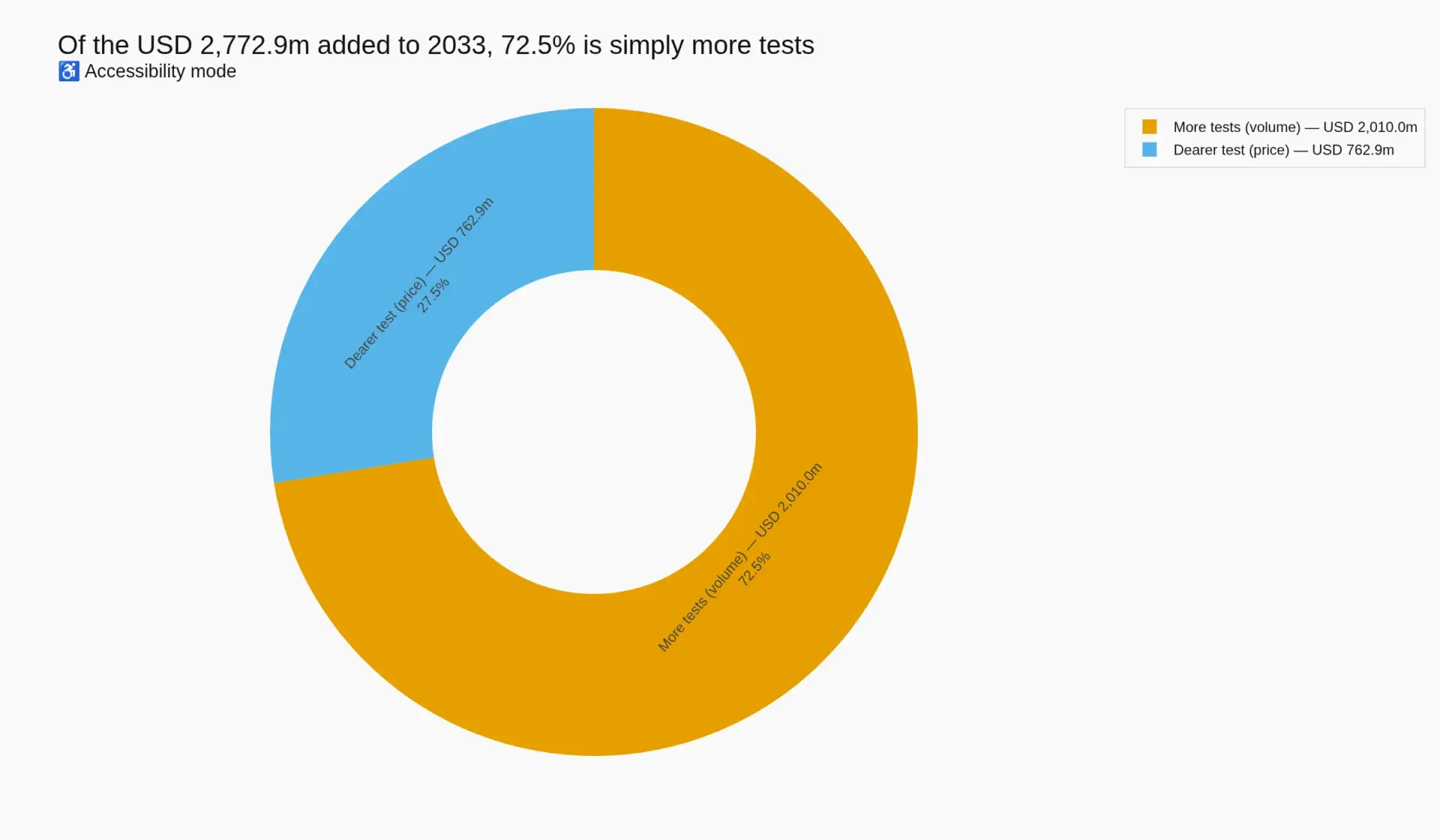
The split, stated plainly
| Layer | 2025 (USD m) | 2033 (USD m) | CAGR | Share of absolute growth |
|---|---|---|---|---|
| Instrument-attached consumables | 2,300.0 | 5,002.4 | 10.20% | 97.5% |
| Rapid lateral-flow assays | 850.0 | 920.4 | 1.00% | 2.5% |
| Total | 3,150.0 | 5,922.9 | 8.21% | 100% |
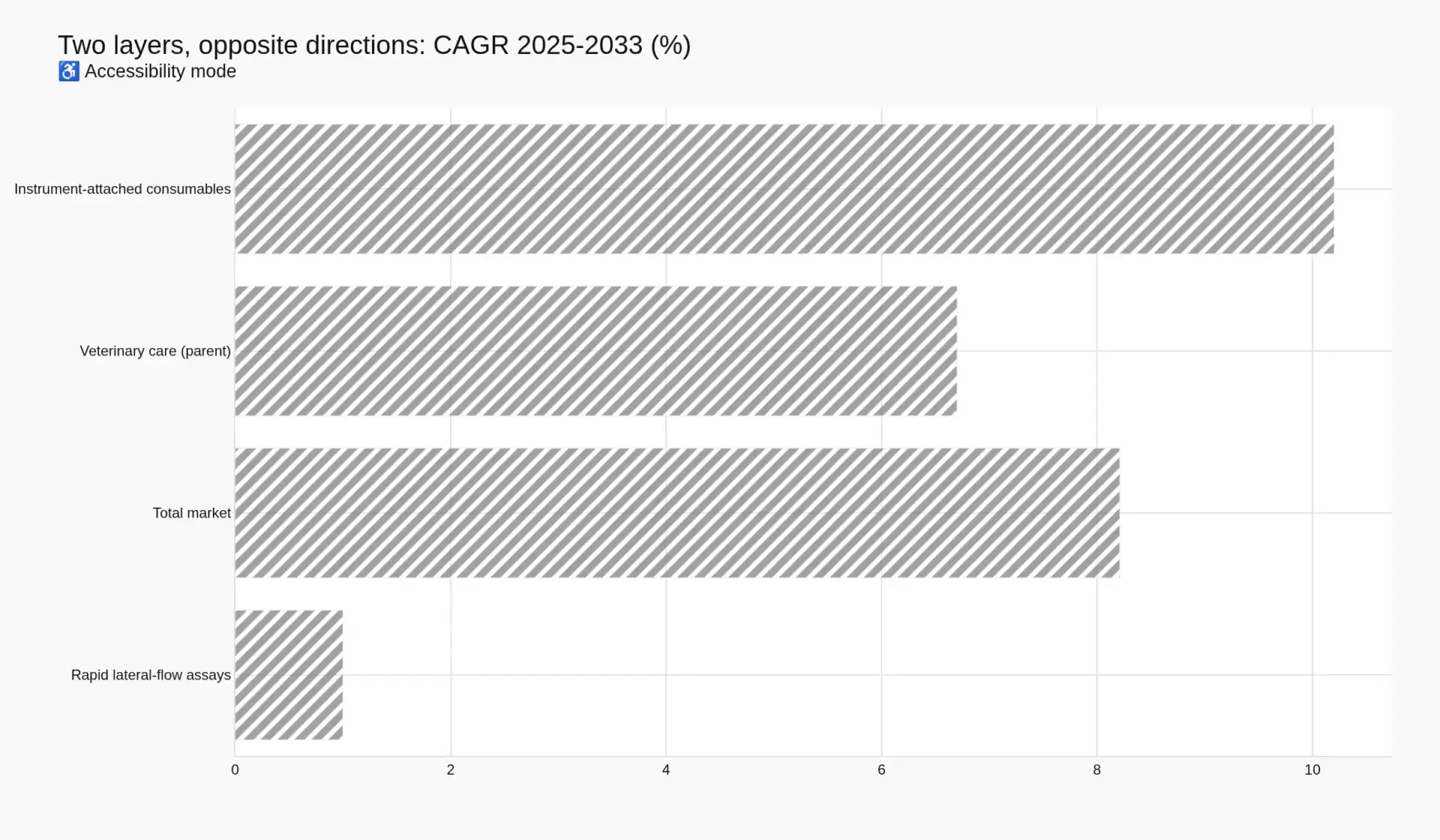
Everything about how this market should be valued follows from that table. The category’s name points at the row that is not growing.
Investment Activity
Investment Activity and Ownership
Two owners, opposite conclusions
The most instructive fact about capital allocation in this market is that two of the best-informed owners in animal health reached opposite conclusions about diagnostics within the same eighteen months, and both were arguably right.
Mars, Incorporated (Q695087) bought Heska (Q30281769) for USD 120.00 per share, a transaction valued at approximately USD 1.3 billion, announced 3 April 2023 and completed 13 June 2023. Mars disclosed the premium two ways: approximately 23 per cent over Heska’s closing price on 31 March 2023, and approximately 38 per cent over the sixty-calendar-day volume-weighted average price. The gap between those two figures is itself informative — it says the market had marked Heska down materially in the two months before the bid, and Mars paid for the platform rather than for the price.
What Mars said it was buying is unambiguous, and it is the clearest statement of the thesis in this report from any market participant: the acquisition would let Mars Petcare’s Science & Diagnostics division expand its diagnostic offerings and broadly promote point-of-care veterinary diagnostics to the global pet healthcare community. A company that already owned Antech, a reference laboratory business, chose to add the bench.
Zoetis (Q8073337) went the other way in November 2025, acquiring Veterinary Pathology Group, a diagnostic laboratory group across the UK and Ireland. That is a reference-laboratory asset. Zoetis is buying the 5.9 per cent lane and Mars bought the 13.7 per cent lane, and neither has published enough to say which was the better trade.
Why the instrument line is the real investment signal
Acquisitions make headlines; placements make the market. IDEXX (Q1758392) reports CAG diagnostics capital instruments of USD 200.2 million in 2025, against USD 131.9 million in 2024 — up 51.8 per cent reported and 49.3 per cent organic — while premium instrument installed base grew 12 per cent. The organic growth figure is the one to use, because it strips out currency and acquisition effects and leaves the underlying placement programme.
That is capital being deployed onto other people’s premises. An analyser placed on a veterinary bench is an asset the supplier may own, lease or discount, and its return is collected through consumables over the following years. The ratio we watch is instrument revenue growth against installed-base growth, because the difference between the two is the leading indicator of the consumable curve three to five years out. On 2025 numbers that ratio is roughly four to one, which is why we model instrument-attached consumables at 10.20 per cent rather than at the 8.21 per cent headline.
The capital intensity question
We characterise capital intensity as medium, which is lower than the human in-vitro diagnostics market and much lower than reference laboratory testing. The reason is that the vendor does not need to own a laboratory, a cold chain or a specimen logistics network to serve a bench. The heavy asset in this market is the installed base itself, and it is distributed across tens of thousands of customer premises.
That has a consequence for who can enter. The barrier is not manufacturing capacity — a chemistry cartridge is not a difficult thing to produce — but the working capital to place instruments ahead of the consumable revenue they generate. It is a financing barrier rather than a technical one, which is why the credible challengers in this market are either large enough to carry a placement book or patient enough to grow one clinic at a time.
What the transaction record does and does not tell us
We publish no transaction multiple for this market. The Mars–Heska deal is the only transaction in the category with a disclosed price, and Heska’s trailing revenue at announcement is not in our evidence set, so any multiple would be a fabrication with a decimal point. We would rather state the gap than fill it.
We also note, because it is a real signal about private capital’s view of the sector, that the reference-material and food-safety adjacency has already seen a comparable pattern of strategic buyers paying for reference assets rather than for assays — Pheonix documented the same instinct in the Food Authenticity and Adulteration Testing market, where the reference library rather than the instrument was the durable holding.
The direction of travel
We record rising investment trend and yes on recent M&A activity, and we expect consolidation to continue along the boundary rather than within it. The logic is that the two halves of the market — the bench and the central laboratory — are complements in clinical practice and substitutes in a spreadsheet, and an owner holding only one of them is exposed to a mix shift it cannot see. Mars is the only participant that has solved this. It is also the only one whose numbers we cannot read.
The investment conclusion we draw is narrow and we will not stretch it: capital in this market is being allocated to placement and to ownership of the reference layer, not to assay development. Nothing in the disclosed record suggests a buyer is paying for a better test. Both buyers in this chapter paid for position.
Technology & Innovation
Technology and Innovation Landscape
From assay to platform
The innovation story in veterinary diagnostics is usually told as an assay story: better biomarkers, earlier detection, more species validated. That is not where the commercial change is happening. The change is that diagnosis has moved from a test you buy to a platform you occupy, and the platform, not the assay, now determines who earns.
The clearest evidence is in the disclosure rather than the literature. In 2025, at the largest supplier in this market, IDEXX grew in-clinic consumables 13.7 per cent organic, placed instruments at 49.3 per cent organic growth, and shrank its rapid assay products by 3.3 per cent organic, from USD 359.8 million to USD 349.0 million. The strip test — the archetypal rapid diagnostic — is contracting inside the company that sells more of them than anyone.
This is not a demand failure. It is a form-factor failure, and it is structural.
Why the strip loses and the cartridge wins
A lateral-flow strip is a complete diagnostic in a disposable. It needs no capital, no calibration, no consumable other than itself, and no proprietary reader — lateral flow is by design a self-contained immunochromatographic device. Those are excellent properties for a customer and terrible properties for a vendor. Because the strip carries no platform, it carries no switching cost. A practice can change strip supplier between one box and the next at essentially zero administrative expense, because there is no reference interval to re-baseline and no workflow to relearn. What is left is price.
An instrument-attached assay inverts every one of those properties. The reagent is useless without the box; the box holds the reference intervals; the intervals hold the interpretation; and the interpretation is what the clinician is actually buying. The vendor’s position is defensible not because the chemistry is difficult but because the reference range is private.
Read that way, the 3.3 per cent decline is what a commodity looks like when it is adjacent to a monopoly. It is also a warning for anyone planning to enter this market with a superior strip: the better mousetrap loses to the worse platform.
Where the technical innovation is actually going
Three technical directions matter, and all three deepen the platform rather than substituting for it.
Consolidation onto fewer benches. The direction of travel is a single analyser running chemistry, electrolytes, haematology and immunoassay from one sample, rather than three boxes from three vendors. Each module added to a benchtop raises the consumable revenue per patient visit and raises the cost of switching away. This is the mechanism behind instruments growing at 49.3 per cent while the installed base grew 12 per cent — the average placement is getting larger.
Blood gas and critical-care testing. Point-of-care testing in human medicine grew fastest where the result changed a decision within minutes — point-of-care testing in emergency and critical care. The veterinary equivalent is the emergency practice and the surgical suite, and it is the most defensible consumable in the category because the sample cannot be sent out. A reference laboratory cannot compete for a result that is needed during anaesthesia.
Multiplexing at the point of care. Where a single sample can be interrogated for several targets at once, the revenue per sample rises without a corresponding rise in labour. Pheonix documented the same mechanism in the Food Allergen Testing and Control market, where multiplexing compressed analyte-level pricing while raising panel value. The veterinary version compresses the cost per analyte and raises the cost per patient, which is the same trade in the vendor’s favour.
The data layer, and why it is not yet the moat
The obvious next platform is the data: longitudinal results, population-level reference intervals by breed and age, and the algorithmic flagging of a value that is normal against the general population and abnormal for this patient. Every large supplier is building it. None has yet made it the basis of competition, for a reason that is regulatory rather than technical — without a cleared assay and a shared measurand, a model trained on one platform’s results cannot be validated against another’s, and a reference interval derived from a proprietary dataset is not a scientific standard but a commercial one.
The company that solves this first does not merely gain a feature. It converts its installed base into an evidence asset, which is the mechanism Pheonix identified in the Food Authenticity and Adulteration Testing market, where the reference library rather than the assay turned out to be the durable asset. The same logic applies here with more force, because the veterinary reference interval is already proprietary and merely awaits scale.
What the innovation profile looks like
We characterise innovation intensity as high and patent activity as moderate, and the asymmetry is the point. The chemistry is not especially novel — dry-slide and wet-chemistry methods are decades old and largely off-patent. The defensibility sits in the closed consumable interface, the reference interval and the workflow integration, none of which require a strong patent to protect. A market where the moat is a proprietary normal range rather than a patented molecule generates less patent activity than its margins would suggest, and that is exactly the pattern here.
Technology maturity we place at growth rather than mature. The individual assays are mature; the platform consolidation is not, and the consolidation is what the growth rate is measuring. We do not expect a step change in assay performance to move this market. We expect the continued replacement of three benches with one, and the continued migration of strip-based testing onto instruments, to move it at roughly the rate we have modelled.
The corollary is a genuine two-sided exposure, and we state it rather than resolve it. Every strip converted to a cartridge raises the value captured by the platform owner and removes a low-cost alternative from the market. That is good for the incumbents and bad for the price of veterinary care. If any jurisdiction ever decides that in-clinic chemistry should be comparable across platforms, the technical work required is modest and the commercial damage to the annuity model would be severe.
Market Risk
Market Risk and the Growth Reconciliation
The reconciliation you asked for
Pheonix now publishes two overlapping models. The Global Veterinary Care Market report places total veterinary care at USD 98.60 billion in 2025, reaching USD 165.80 billion in 2033 at 6.70 per cent. This report places in-clinic and rapid diagnostics at USD 3,150.0 million reaching USD 5,922.9 million at 8.21 per cent. A reader comparing the two is entitled to ask why the component grows faster than the whole, and to expect an answer rather than an assurance.
Three numbers have to be consistent at once: total veterinary care at 6.70 per cent, point-of-care diagnostics at 8.21 per cent, and the reference laboratory — the nearest substitute — at approximately 5.9 per cent, being the organic growth rate IDEXX reported for its reference laboratory diagnostic and consulting services in 2025.
They are consistent, and the reason is that point-of-care is not substituting for the central laboratory. If it were, the reference laboratory would be shrinking; it grew 5.9 per cent organic. Both halves of the boundary grew in the same year, the bench faster than the laboratory. That is the signature of a market expanding rather than a market reallocating: an analyser on the bench raises the number of tests a practice runs per visit, and a share of those findings are then referred out for confirmation on a larger panel. IDEXX’s own explanation of its United States growth — increased diagnostic frequency, including early benefits from an aging pet population — describes exactly that.
The boundary is therefore additive, not cannibalistic. That is the assumption this forecast rests on, and we state it so it can be attacked.
There is, however, a genuine inconsistency inside this report and we have not hidden it. A total market growing at 8.21 per cent with a component inside it growing at 5.9 per cent requires the third component — therapeutic and other veterinary care — to grow below 6.70 per cent. That is arithmetically possible and clinically plausible: diagnostics is a smaller, faster-growing slice of a large, slower animal health business. But it does mean a reader cannot take 6.70 per cent, 8.21 per cent and 5.9 per cent and treat them as three independent estimates of the same thing. They are not. They are three different perimeters.
Risk one: the forecast is above the disclosed anchor on price, and that is deliberate
The largest supplier grew in-clinic consumables at 13.7 per cent organic in 2025. We model the whole consumables layer at 10.20 per cent. That is below the disclosed read, not above it, because the reported figure belongs to a company taking share inside a market growing more slowly, and because 2025 included an instrument placement surge at 49.3 per cent that cannot recur indefinitely. We consider 10.20 per cent the conservative end. A reader who thinks the leader’s rate is the market rate would get a materially higher answer.
The price assumption is where we are most exposed. Realised revenue per test grows only 1.74 per cent a year, which is close to nothing, and IDEXX’s own arithmetic supports it: 13.7 per cent consumable growth against 12 per cent installed-base growth implies about a point and a half per instrument. If we are wrong and the market is actually extracting price, we have understated it. If we are wrong in the other direction — if pricing turns negative as instrument placements subsidise consumables — the market still grows, but the mix shifts further toward volume and the margin pool thins.
Risk two: placement saturation
Instrument revenue grew 49.3 per cent organic while the installed base grew 12 per cent. That is an extraordinary ratio, and the mechanism behind it is not stated by the company. Two readings are available. Either the average placement is getting larger — a consolidation from three benches to one, which is structural and durable — or the company is buying placements with discounting and bundling, which is a pull-forward and not durable.
We cannot distinguish between them from the outside, and we flag it rather than choose. If it is pull-forward, the consumable curve we have modelled is roughly two years early and the 2033 point is lower than USD 5,922.9 million. This is the single assumption in the model we would most like an insider to confirm.
Risk three: the regulator who is not there today
Discussed in full in the regulatory chapter and restated here because it is a risk, not a curiosity. The margin in this market rests on the reference interval being private. A premarket-clearance requirement, an external proficiency programme, or a designated reference method for one common analyte would convert a private asset into a public one. No such measure is proposed anywhere. That is why the risk is unpriced.
Risk four: the reference laboratory counterattacks
The reference laboratory is not passive. It is growing at 5.9 per cent, it holds the broader menu, and it is where the difficult result goes. Its structural advantage is that a laboratory can achieve comparability across platforms in a way a distributed bench cannot, because it can run controls and calibrators at scale. If reference laboratories begin marketing validated comparability against in-clinic analysers, they attack the one claim the bench cannot make.
Risk five: the livestock and antimicrobial-resistance channel
The companion-animal business is where the consumable revenue is. The antimicrobial resistance agenda is where the policy pressure is, and it points the other way: pen-side testing in livestock to justify not using an antibiotic is a public good with a thin consumable stream behind it, sold to customers — commercial farms — who are far more price-sensitive than a pet owner.
If policy support for livestock pen-side diagnostics expands, unit volumes rise and realised price falls. That would move this market toward the dynamics of the rapid-test layer, which grows at 1.00 per cent, rather than the platform layer. It is the one plausible route by which the market grows faster in units and slower in value than we have modelled.
The sensitivities, published rather than hidden
| Scenario | 2033 value (USD m) | CAGR |
|---|---|---|
| Base | 5,922.9 | 8.21% |
| Realised price held flat at USD 12.00 | 5,160.0 | 6.36% |
| Volume held flat at 262.5 million tests | 3,615.7 | 1.74% |
| Rapid layer converges on consumables growth | 6,172.9 | 8.79% |
The last row is the one worth watching. If lateral flow finds a platform — a reader, a cartridge, a data layer that creates the same switching cost as an analyser — the 1.00 per cent assumption is wrong and the total moves up. The first row is what happens if the analyst is right and the vendor is not.
What would falsify this report
Three observations, in order of decisiveness. A decline in IDEXX in-clinic consumable organic growth below reference-laboratory organic growth in any two consecutive quarters would mean the boundary has flipped and this report has the direction wrong. A published proficiency-testing scheme for veterinary in-clinic chemistry in any major jurisdiction would mean the moat is being regulated away. And a stabilisation or return to growth in rapid assay products at the market leader would signal that the strip has found a platform, which is the scenario that makes this forecast too low rather than too high.
Regulatory Landscape
Regulatory Landscape
The absence is the finding
This is the one major category in animal health where the question “what did the regulator require before this product reached the market?” has, in most jurisdictions, the answer “nothing”. That is not an oversight we have inferred. It is published policy, in the regulator’s own words.
The US Food and Drug Administration states it without qualification: “The FDA does not require submission of a 510(k), PMA, or any pre-market approval for devices intended for animal use.” It goes further. Manufacturers who exclusively make or distribute animal devices “are not required to register their establishments or list animal devices with FDA and are exempt from post-marketing reporting.” The agency retains authority to act against a misbranded or adulterated product, and it says so, but that is enforcement after the fact. There is no gate.
What the USDA does license, and what it names as outside its jurisdiction
The USDA APHIS Center for Veterinary Biologics is the one body in the United States that does license veterinary diagnostics, and its scope is narrower than the existence of that authority suggests. Veterinary Services Memorandum 800.73, reissued 12 January 2024, sets out the current position and is unusually candid about its own limits.
CVB asserts active oversight only over products that claim to diagnose “the presence or absence of an infectious agent, a biological intoxication, or the immune status of an animal”, and that identify the agent to a minimum of genus for bacteria and family for viruses. That is the licensing net. Everything outside it is not licensed, and the memorandum lists the exclusions explicitly.
Paragraph 3.6, in full: “CVB does not have regulatory jurisdiction over some diagnostics such as serum chemistries, metabolic diseases, or hormone level test kits.”
Read that against the revenue. Serum chemistry is the largest single consumable line in an in-clinic analyser. Metabolic and hormone assays — thyroid, cortisol, the panels a practice runs most often — are the second. The regulator has named the two most valuable things in this market and disclaimed jurisdiction over both, in a single sentence.
The exclusions continue. Paragraph 6.1.8 states that diagnostics producing a general disease result without characterising the organism to the required level are not being considered for licensing, and gives the example: “a test for mastitis where the cause is reported as ‘gram positive,’ or ‘coliform’ bacteria.” Mastitis is the single most economically important disease in the dairy industry and the most common reason a large-animal practice runs an in-clinic test. A test that reports the useful answer — gram positive — is out. A test that reports the genus is in. The commercial incentive that creates is perverse and entirely predictable: sell the version the customer needs, and take it outside the licence.
Two further exclusions matter. Paragraph 6.1.2 confirms that laboratory services and tests developed in-house by diagnostic laboratories are not licensed where they are not transferred or sold — so the in-house assay an increasing number of reference laboratories offer escapes the net entirely. And paragraph 6.1.5 excludes any product where “the method is completely electronic or chemical, and the device itself does not have any biological material incorporated”, which captures a good deal of dry-chemistry and electrochemical detection.
The memorandum is explicit that this is a choice rather than a boundary error. Paragraph 3.4: “CVB has used regulatory discretion to limit the scope of diagnostic regulatory oversight to focus on areas which present the most risk to the animal agriculture industry.” The discretionary logic is sound — foreign animal disease and zoonoses are the risks worth policing. The consequence is that policing concentrates on low-cost infectious-agent detection and leaves high-value clinical chemistry alone.
Three jurisdictions, three different worlds
The most useful comparative evidence is a peer-reviewed review published in the World Organisation for Animal Health’s Scientific and Technical Review (Potockova, Dohnal and Thome-Kromer, 2020, DOI 10.20506/rst.39.3.3171). Its central finding is worth quoting because it is the whole regulatory chapter in one sentence: the level of surveillance “is strikingly different, ranging from no regulation (EU) to comprehensive regulation, which is comparable to the procedures for the regulation of human in vitro medical devices (Japan).”
| Jurisdiction | Premarket requirement for veterinary point-of-care tests | Practical effect |
|---|---|---|
| European Union | None identified | No gate, no proficiency requirement, no reference method |
| United States | None for devices; subset licensed as veterinary biologics (infectious-agent detection) | Chemistry, metabolic and hormone testing outside the net by name |
| Japan | Comprehensive, comparable to human IVD procedures | The only major market where comparability is regulated |
The same review records the American position precisely: point-of-care products are “not subject to any compulsory pre-market clearance” and “all issues are addressed late in the post-marketing phase, which is in direct contrast with the comprehensive pre-market control of POCT products for human use.”
Why the asymmetry between human and animal is the whole story
The human in-vitro diagnostics market, which Pheonix covers in the Global In Vitro Diagnostics report, runs the identical chemistry through a clearance regime, a declared measurand and external proficiency testing. A creatinine is a creatinine across platforms because a regulator required it to be. The Clinical Chemistry and Urinalysis market is built on that assumption.
The veterinary version of the same product is built on the opposite one. No clearance, no declared measurand, no proficiency testing. So the reference interval cannot be a shared standard. It becomes a private asset belonging to whoever defined the reference population, and that private asset is the barrier to entry, the switching cost and the reason a cheaper analyser does not win.
We note the parallel to a finding Pheonix has already published twice in food safety: in Dehydrated Culture Media and Microbiology Reference Materials, where ISO 11133 makes performance comparable against named strains by design, and in Food Plant Hygiene Monitoring and ATP Verification, where the deliberate absence of any statutory threshold is what allows the price to hold. The mechanism is the same in all three: whoever writes the reference writes the price.
What would have to change, and what it would cost
The commercial model of this market rests on an absence, and absences are cheaper to legislate than presences. We therefore set regulatory complexity low and the approval pathway as minimal formal approval — not because the market is lightly touched but because the touch is close to zero — and we flag that as the largest single risk in the report.
Three interventions would each damage the annuity. A requirement for premarket clearance of in-clinic analysers would impose a comparability standard the vendor’s private reference interval no longer owns. A proficiency-testing obligation, on the human laboratory model, would reveal inter-platform variation that the market currently does not publish. A reference-method designation for a single common analyte — creatinine, glucose, total protein — would give a challenger something to be measured against.
None of these is on any published regulatory agenda in any jurisdiction we reviewed. That is the point. The risk is not priced because nothing has been proposed, and a market whose margin depends on a silence should be honest that it depends on a silence.