
Global Magnetic Mill Liners Market Report, Size, Share and Forecast 2026–2033: Six Hundred Mills and a Category Nobody Sizes
Magnetic mill liners are a real, installed, commercially functioning product category of roughly USD 37.8 million in 2025 that no market report sizes, because the spend is recorded as a mill lining and the technology is described two different ways by the two suppliers that dominate it.
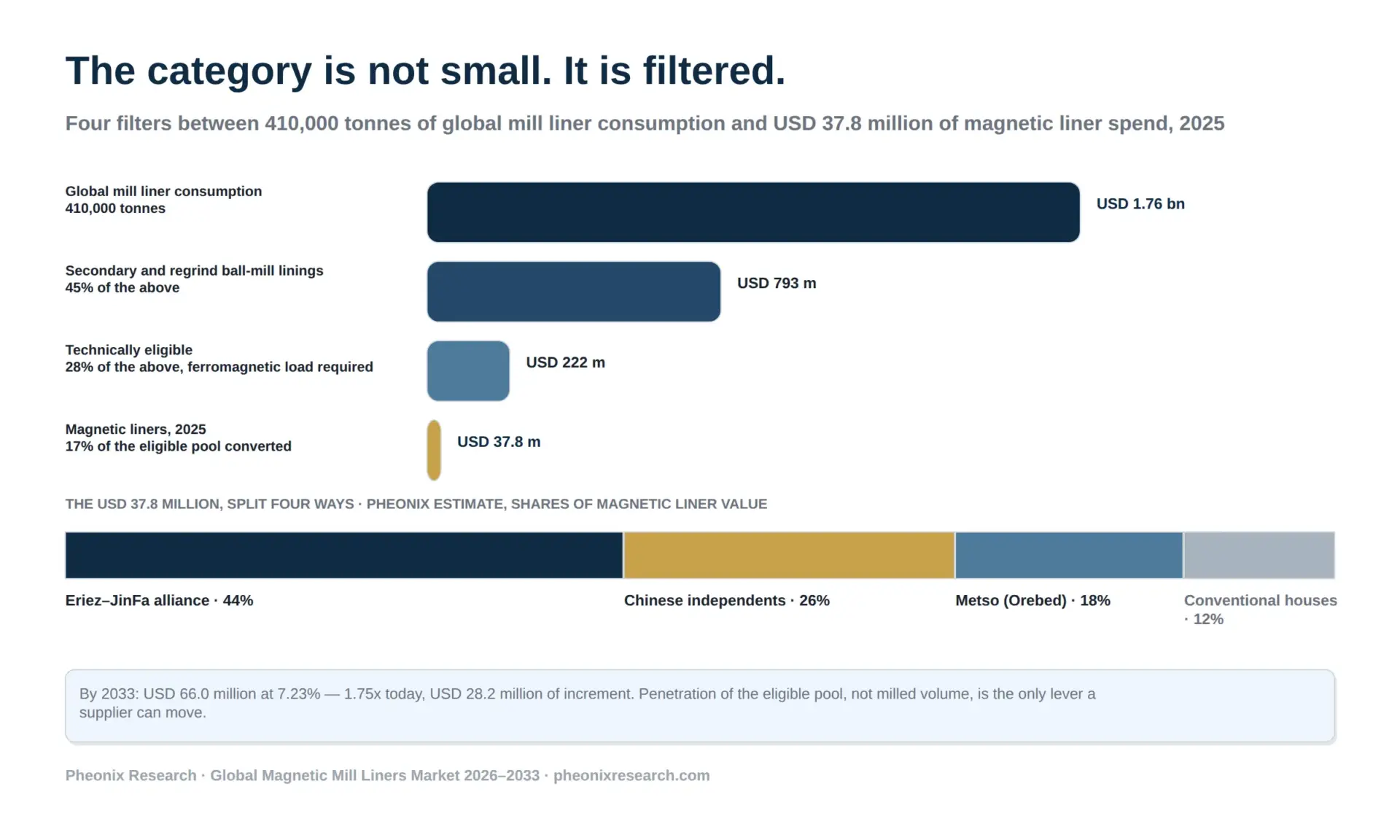
This report builds the number from the mill upward. Global mill liner consumption of approximately 410,000 tonnes at a blended USD 4,300 per tonne gives a USD 1.76 billion market. Secondary and regrind ball mills take about 45% of that spend, or USD 793 million. Roughly 28% of that pool — USD 222 million — sits in circuits where the mill load is ferromagnetic or where ball-chip damage downstream is a material cost, which is the condition the mechanism needs. Magnetic liners held about 17% of that eligible pool in 2025: USD 37.8 million, equivalent to more than 600 installed applications at roughly USD 63,000 of annualised spend each.
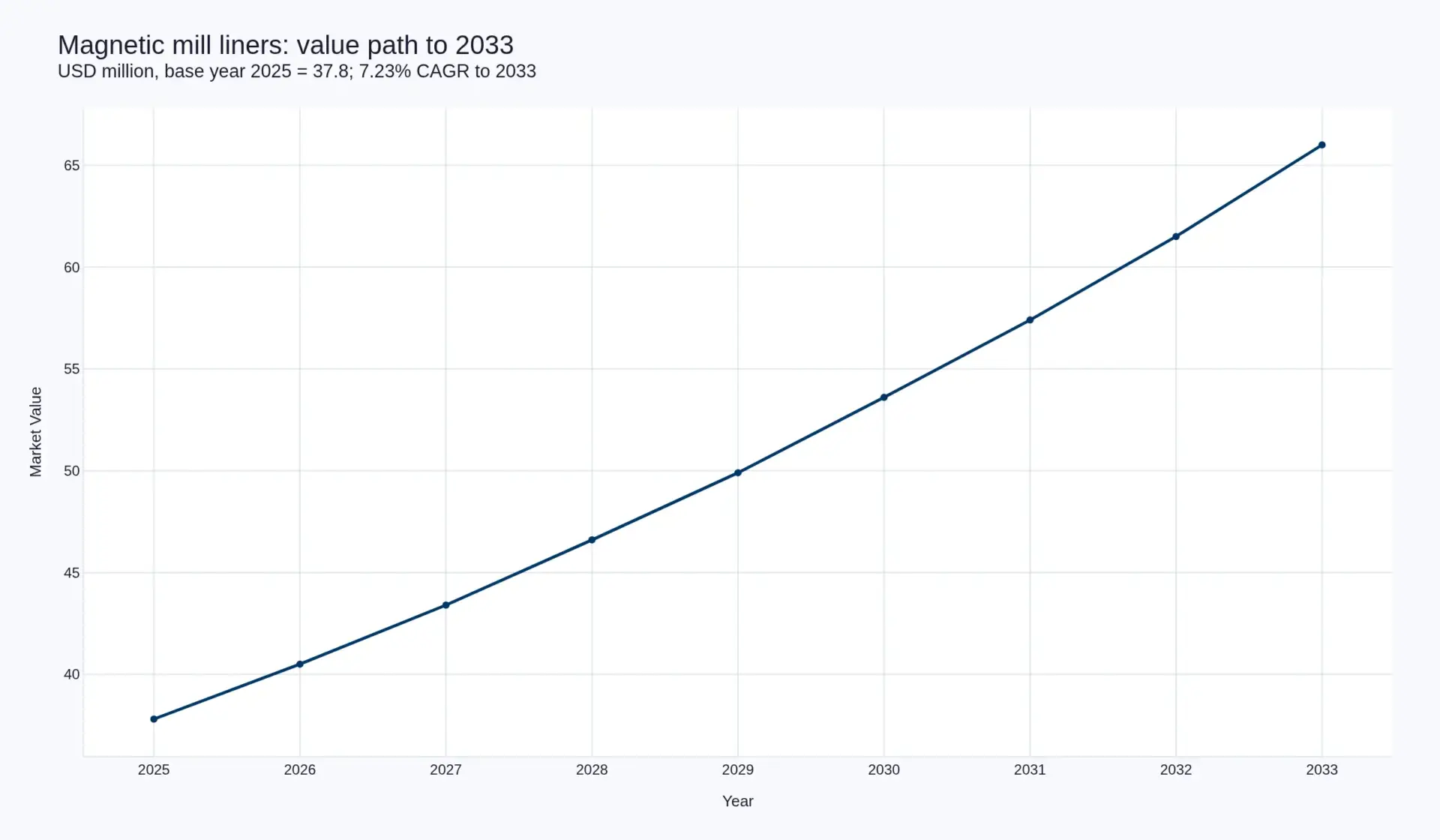
The market reaches USD 66.0 million in 2033, a 7.23% compound annual growth rate and an increment of USD 28.2 million. Growth comes mostly from penetration of the eligible pool — 17% to roughly 24% — rather than from mine output, which is close to flat in copper and iron ore and rising only slowly in gold. Realised price moves about 1% a year and volume about 6%, from 3,150 tonnes to 5,020 tonnes.
Three things determine who captures that increment. First, the mechanism is metallurgy-dependent: in a non-magnetic ore with clean media and low chip generation, a magnetic liner has nothing to hold and no cost case, which caps the addressable pool at roughly a quarter to a third of ball-mill liner spend regardless of commercial effort. Second, mill availability, not liner price, is the buying criterion, which favours whoever can shorten and space out relines. Third, the magnet content puts the category inside China's April 2025 export licensing regime for medium and heavy rare earths — a margin and lead-time exposure rather than a volume one, but a real one.
Eriez, through its 2005 alliance with JinFa, and Metso with Orebed hold the technology positions; ME Elecmetal, Bradken and Tega dominate mill linings overall but treat magnetics as a portfolio niche; a Chinese long tail competes on installed price. There have been no consolidation events in the category, and on this evidence none is imminent: the strategic asset is application engineering and relining service, not capacity.
The market that is counted inside another market
There are more than six hundred mills in the world running a liner that is held to the shell by magnetism and wears on the ore it attracts rather than on the metal it is made of. Eriez says so itself: the metal magnetic mill liner has been "installed in over 600 applications throughout the mining industry worldwide", and the longest-serving unit has been in service for more than a decade. Six hundred installations is not a laboratory curiosity. It is an installed base.
And yet no market report sizes it. Ask for the magnetic mill liner market and you will be offered the mill liner market, or the magnetic separation equipment market, and neither is the same thing. The mill liner studies count foundry tonnage and ignore the mechanism; the separation studies count magnets sold as machines and never reach the mill floor. The spend sits in between, booked as a wear part on a relining work order.
That is the finding this report is built around, and it shapes everything that follows. The category exists, it is commercially real, and it is bounded on both sides by definitions that leave it out. So we have sized it the only way it can honestly be sized — from the mill upward.
What the product actually is, and why one name covers two technologies
Two physically distinct products are sold under the same idea, and conflating them is the single most common error in commentary on this segment.
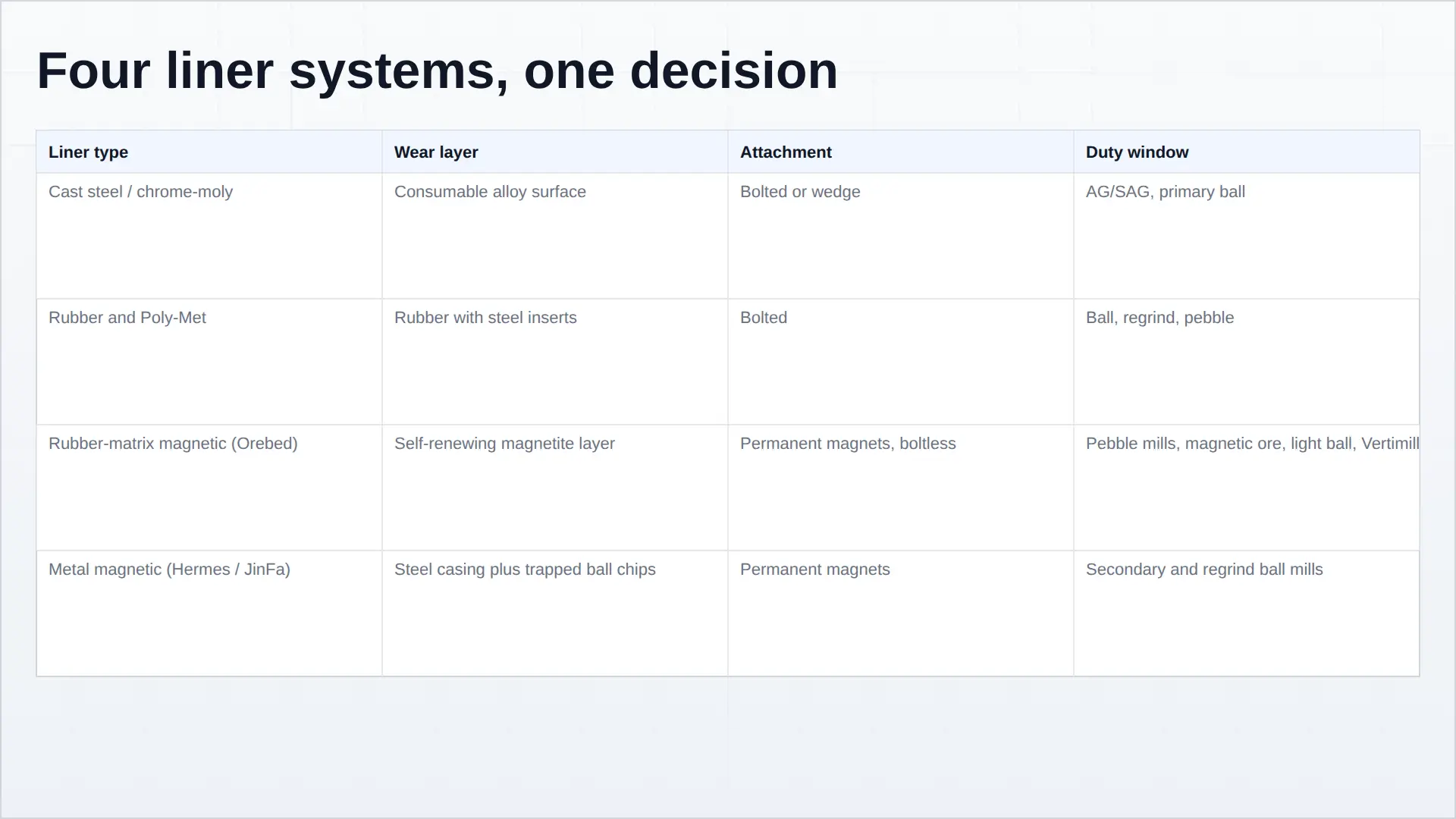
The first is a magnetic wear layer. Eriez's Hermes liner is a wear-resistant alloy casing around permanent magnets. The magnet holds the liner to the shell, and it also retains ball chips and magnetic minerals against the face of the liner, building a sacrificial layer that takes the abrasion instead of the casting. The company describes pieces around 300 mm long and 17 kg, movable by hand, lining both shell and mill heads. The commercial logic is not the price of the liner. It is that the protection layer renews itself, the total liner thickness is lower than a conventional set — which buys working volume inside the same shell — and ball chips that would otherwise circulate and damage pumps, cyclones and piping are held inside the mill.
The second is magnetic attachment. Metso's Orebed, patented in the 1970s, embeds powerful permanent magnets in a matrix of abrasion-resistant rubber. There are no bolts. The magnetic force attracts ferromagnetic material in the mill load, which forms a continuous, self-renewing wear layer with a wave profile. Metso positions it narrowly and honestly: pebble mills on magnetic ore, light-duty ball mills, and Vertimills.
Both products rely on the same physics — hold the liner with a magnet and let the ferromagnetic fraction of the charge become the wear surface — but they solve different problems. Orebed removes the bolt holes and the installation labour from a rubber lining. The metal magnetic liner replaces the consumable casting with a thin, long-lived composite that also cleans the mill circuit. One is a fastening innovation. The other is a wear-material substitution. They compete for the same relining slot and they do not compete on price per kilogram.
Why conventional sizing fails, and what we did instead
A category that is bought through a maintenance budget has no shipment statistics. There is no customs code for "magnetic mill liner". The casters report mill liners; the magnet houses report separators and magnets; the mills report a relining cost inside a plant operating expenditure line that nobody disaggregates publicly. Three routes are available and only one of them survives contact with the evidence.
Route one — sum the suppliers. Eriez does not disclose liner revenue. Metso reports mill linings inside a Minerals aftermarket line that was 60% of a segment with EUR 5,240 million of 2025 group sales, and does not split Orebed out of it. The Chinese suppliers are private. A bottom-up supplier sum is therefore not a sum at all; it is a guess with a spreadsheet around it.
Route two — extrapolate the mill liner market. This is what the published studies do, and it fails because the ratio of magnetic to conventional is not stable across regions or ore bodies. It is a function of ore mineralogy, not of mill count.
Route three — reconstruct demand from the mill. This is the route we took. The chain runs: tonnes of ore milled, by region and ore type; liner metal consumed per tonne milled; the share of that consumption accounted for by secondary and regrind ball mills, where the magnetic mechanism is applicable; the share of those mills whose ore chemistry makes the mechanism work; and observed penetration of that eligible pool. Every link in the chain is either disclosed or measurable, and the arithmetic is auditable. Pheonix primary research.
On that build, global mill liner consumption in 2025 was approximately 410,000 tonnes at a blended realised price of about USD 4,300 per tonne, a market of roughly USD 1.76 billion. Secondary and regrind ball mills account for about 45% of that spend — SAG and AG mills consume more metal per mill but there are fewer of them, and rod and other duty makes up the remainder. That gives a ball-mill liner pool of about USD 793 million. Of that, roughly 28% sits in circuits where the load is ferromagnetic or where ball-chip damage to downstream equipment is a material cost — the technically eligible pool, about USD 222 million. Magnetic liners held approximately 17% of it in 2025.
That is USD 37.8 million. It is a small number, and it is the correct one. Six hundred installations at an average annualised spend of roughly USD 63,000 per installed mill is the same arithmetic arrived at from the other end.
The forecast: 7.23% to 2033, and where it comes from
The market reaches USD 66.0 million in 2033, a compound annual growth rate of 7.23% and an increment of USD 28.2 million — 1.75 times the 2025 base. That decomposes into three drivers that move at different speeds, and the decomposition matters more than the headline.
- Milled volume, about 2.4% a year. Copper mine production was 23.0 million tonnes of contained metal in 2025, flat on 2024, with Chile at 5.3 million and Peru at 2.7 million, both down. Iron ore held at 2.6 billion tonnes. Gold reached 3,300 tonnes. Head grades are the reason milled tonnage grows faster than metal output: the same metal takes more rock, and more rock takes more liner.
- Penetration of the eligible pool, about 3.8% a year. This is the real growth engine, and it is supply-led rather than demand-led. Magnetic liners move from 17% to roughly 24% of the eligible pool as Chinese capacity widens the price band and as operators who have run a first unit extend to a second and third.
- Realised price, about 1.0% a year. Moving from USD 11,988 per tonne in 2025 to USD 13,147 in 2033, against a volume path from 3,150 tonnes to 5,020 tonnes. Magnet content and alloy are the inflationary components; assembly labour is not.
The regional shape is a mineralogy map, not a mining map
Magnetic liner demand does not track where ore is mined. It tracks where the ore, or the grinding circuit, is ferromagnetic — and secondarily where mill availability is expensive enough to justify a premium wear part. That produces a distribution that looks odd next to global mining output: South America is over-weighted relative to its share of world copper because Chilean and Peruvian porphyry circuits combine high throughput with heavy ball-chip generation, and China is over-weighted relative to its share of mined metal because it is where most of the liner manufacturing capacity and a large share of the domestic iron and magnetite milling base sit.
| Region | 2025 (USD m) | Share | 2033 (USD m) | Share |
|---|---|---|---|---|
| South America | 11.7 | 31% | 19.8 | 30% |
| China | 9.1 | 24% | 17.2 | 26% |
| North America | 5.7 | 15% | 9.2 | 14% |
| Africa | 4.5 | 12% | 8.6 | 13% |
| Australia and Oceania | 3.4 | 9% | 5.9 | 9% |
| Europe and CIS | 2.3 | 6% | 3.3 | 5% |
| Asia excluding China | 1.1 | 3% | 2.0 | 3% |
| Total | 37.8 | 100% | 66.0 | 100% |
Africa is the other region worth naming. Copper output from Congo reached 3.2 million tonnes in 2025, up from 2.99 million, and Zambian output rose too. Those circuits are new, they run high availability targets, and they are being equipped now — which makes them the fastest-growing region in the forecast even from a small base.
What this market is really competing for
A mill liner competes on one number that almost never appears in a supplier's brochure: mill availability. A relining stops the mill, and if the mill is the bottleneck in the circuit, the cost of the stop is measured in tonnes of concentrate not made. Everything else — price per kilogram, wear life, installation safety — is downstream of how often the mill has to be stopped and how long the stop takes.
This is why the metal magnetic liner's lower total thickness matters commercially. A thinner lining is a larger effective mill diameter, which is throughput, and a lighter component is a faster and safer reline, which is availability. It is also why Metso's no-bolt rubber system can charge a premium for a product that is, on paper, a rubber lining. Neither argument is about wear rate. Pheonix primary research.
And it is why substitution risk in this category is high in both directions. Steel and rubber are not inferior products; they are the incumbent, they are understood by every maintenance superintendent in the industry, and they are supplied locally. A magnetic liner has to beat them on cost per tonne ground, not cost per kilogram bought.
How to read the rest of this report
The five chapters that follow take the build apart. The Mining segment overview sets the operating context these mills sit in, and the ore-supply work underneath it is where the volume driver lives: our reports on lithium, nickel, cobalt, graphite and manganese describe the tonnages that become grinding demand, and the Brazil vanadium study is the closest thing in our catalogue to the ore-to-consumable linkage this report depends on. None of them is about liners. All of them set the volume, and that distinction is exactly the reason this report exists separately.
Table of Contents
Table of contents
- The market that is counted inside another market
- What the product actually is, and why one name covers two technologies
- Why conventional sizing fails, and what we did instead
- The forecast: 7.23% to 2033, and where it comes from
- The regional shape is a mineralogy map, not a mining map
- What this market is really competing for
- Competitive landscape
- Six hundred installations and three supply models
- What the incumbents actually own
- Share of the eligible pool, not share of the market
- The Chinese price band and what it does to the top end
- Where the next unit comes from
- Value chain
- Four links: magnet, alloy, design, reline
- Where the gross margin sits
- Inventory, lead time and the relining window
- The service crew as the real moat
- Investment activity
- Capex is going into capacity, not into new categories
- What the listed comparables tell us about returns
- Why there have been no consolidation events
- What a buyer would actually be buying
- Technology and innovation
- The self-renewing wear layer, explained properly
- Ball-chip retention and the downstream cost it removes
- Working volume, mill diameter and throughput
- Magnet grade, heavy rare earths and the design trade-off
- What is not yet solved
- Market risk
- Five risks, ranked by what they would actually do
- Substitution: the incumbent’s advantage
- Ore-body risk: the mechanism is metallurgy-dependent
- Concentration risk on the magnet side
- What would falsify this forecast
- Regulatory landscape
- Export controls on medium and heavy rare earths
- Critical minerals policy and the demand it creates
- Mine safety and relining regulation
- Compliance burden relative to product value
- Frequently asked questions
Competitive Landscape
Six hundred installations and three supply models
The competitive structure of this category is unusual and it is the reason the category is so poorly understood. There are not many suppliers competing for a defined market. There are three different supply models occupying the same relining slot, each with a different cost base, a different route to the customer, and a different idea of what it is selling.
The technology licensor plus Chinese manufacturing model. Eriez, a magnetic separation house based in Erie, Pennsylvania, formed a strategic alliance in 2005 with JinFa Industrial Trading, a subsidiary of China Metallurgical Mining Corporation, which had decades of experience with magnetic mill liners. The division of labour is explicit in the company’s own literature: Eriez brings the magnetics and the customer relationship, JinFa brings the liner. The alliance provides engineering services across selection, design to a specific mill’s features, and in-plant installation assistance, and it publishes discrete-element-method simulation work for a 16.5 by 37.5 foot mill. The result is stated plainly: more than 600 applications worldwide, with the longest-serving liner in service for over ten years.
The OEM-integrated model. Metso developed and patented a magnetic lining system in the 1970s and has designed magnetic linings for more than forty years. Orebed embeds permanent magnets in abrasion-resistant rubber, needs no bolts, and relies on the mill load to build its own wear layer. Metso sells it through an OEM channel that also supplies the mill, the crushers, the screens and the service contract — which means it can be specified at the design stage of a concentrator rather than sold into a maintenance budget afterwards. Metso’s 2025 numbers show why that channel matters: group sales of EUR 5,240 million, orders received of EUR 5,471 million, adjusted EBITA of EUR 829 million at 15.8%, with aftermarket at 54% of group sales and 60% of the Minerals segment. Wear parts are the recurring half of that business.
The price-led long tail. A large number of Chinese manufacturers sell metal magnetic liners and rubber-matrix magnetic liners, frequently through trading intermediaries and increasingly through English-language product sites. They compete on installed price, on delivery time, and on willingness to copy a design for a mill the incumbent does not have drawings for. Their quality is not uniform and neither is their engineering support, which is precisely the gap the two technology holders sell against.
What the incumbents in mill linings actually own
The conventional liner houses dominate the USD 1.76 billion mill liner market and are almost absent from this niche. Their capacity is the clearest available proxy for the scale of the parent category:
- ME Elecmetal operates 10 manufacturing plants and 2 service centres in 7 countries with 140,000 tonnes of global foundry capacity and 600,000 tonnes of grinding media capacity. Its Rancagua plant in Chile alone is rated at 32,000 tonnes of mill and crusher liners.
- Bradken runs foundries and workshops rated at 20,000 tonnes a year at Chilca in Peru (castings up to 7,000 kg single piece, mill liners up to 12 metres), 30,000 tonnes at Coimbatore in India, 30,000 tonnes at Edmonton, 10,080 tonnes at Merlimau in Malaysia and 20,000 tonnes at Xuzhou in China, plus composite liner capacity at Lima.
- Tega Industries earned INR 14,301 million of its INR 16,387 million FY2024-25 revenue from consumables — wear-resistant grinding mill liners, hydrocyclones and conveyor components — an 87% share, at an EBITDA margin of about 21%, with 21% of revenue from India and 79% international.
Add those three to the Chinese liner base and the global mill liner capacity comfortably exceeds half a million tonnes a year. None of that capacity is dedicated to magnetic liners. It is the reason the parent market can be sized from capacity and the niche cannot: the niche runs on a fraction of a percent of it, in mills selected one at a time.
Share of the eligible pool, not share of the market
Reported market shares in this category are misleading in a specific way. Because the pool of convertible mills is fixed by ore mineralogy, a supplier’s share of the magnetic category is a poor guide to its competitive position; what matters is its share of the mills that could convert and have not.
| Supplier group | 2025 share of magnetic liner value | Basis of position |
|---|---|---|
| Eriez / JinFa alliance | 44% | Metal magnetic liner, 600+ installations, engineering and selection service |
| Chinese independents | 26% | Installed price, delivery speed, willingness to design to undocumented mills |
| Metso (Orebed) | 18% | OEM specification at design stage, boltless rubber, narrow duty positioning |
| Conventional houses (composite and magnetic programmes) | 12% | Existing reline relationships, portfolio bundling |
Pheonix estimate. Shares are of magnetic liner value, not of the mill liner market, and are derived from installation counts, disclosed capacity and installed-price differentials rather than from audited segment reporting, which does not exist.
The Chinese price band and what it does to the top end
The long tail’s real function in this market is not to take share from Eriez at existing accounts. It is to set the floor under what a mill will pay for a magnetic liner, and in doing so to change which mills are worth approaching at all.
At the top end, the technology holders sell a package: mill survey, design, simulation, installation assistance, and a wear-life commitment. At the bottom, a Chinese supplier sells a set of magnet-cased pieces to a drawing. For a large porphyry copper circuit where a failed reline costs a week of throughput, the package wins. For a 3,000 tonne per day iron ore concentrator in Hebei or a small polymetallic mill in Inner Mongolia, the package is overhead and the drawing wins. The consequence is that the top end’s addressable share of the global pool is smaller than the pool itself, and the honest measure of the commercial opportunity is the number of mills where a stoppage is expensive. Pheonix primary research.
Where the next unit comes from
Conversion in this category is sequential within an account rather than parallel across a market. A mill that has run a magnetic liner for two years and has not had to reline it becomes the reference for the next mill in the same plant, and then for the sister operation in the same group. That is why the installation count is the single most valuable asset any supplier in this category holds, and why a competitor’s 600 installations are harder to attack than a 44% share would suggest.
The three sources of new units, in order of reliability: an existing account’s second and third mill; new concentrator builds in copper and gold, weighted to Africa and Central Asia; and brownfield mill upgrades where a circuit change has already forced a reline decision. None of these is a market you can size with a growth rate. All of them are visible in the mill population, which is why this report counts mills and not customers.
Value Chain
Four links: magnet, alloy, design, reline
The value chain for a magnetic mill liner is short in the physical sense and unusually long in the intellectual one. Four links matter, and the third of them carries the pricing power.
- Magnet material. Sintered permanent magnets — samarium-cobalt or neodymium-iron-boron — supply the force that holds the liner and attracts the wear layer. This is the only link in the chain where a mill liner inherits the economics of a different industry, and it is where the geopolitical exposure enters.
- Alloy casing and casting. The wear-resistant alloy shell around the magnet is a foundry product with the same supply base as conventional liners, and it is the link most exposed to alloy and energy costs.
- Design and application engineering. A magnetic liner is designed to a specific shell: mill diameter, length, head geometry, charge, ore mineralogy, target grind. This is engineering labour rather than manufacturing, it is not reproducible without the mill’s data, and it is what the customer is actually paying a premium for.
- The reline. Installation is a scheduled shutdown with a crew, a sequence and a safety plan. In this link a supplier sells availability rather than a product, and it is where an incumbent’s advantage is strongest.
Where the gross margin sits
Our reconstruction of the cost stack for a supplied magnetic liner set, at 2025 prices, splits the delivered cost roughly as follows. The numbers are Pheonix estimates built from installed-price ranges and disclosed foundry economics, not from supplier accounts, which are not published.
| Cost element | Share of delivered cost | Comment |
|---|---|---|
| Magnet material | 24-30% | Grade-dependent; heavy-rare-earth-free designs trade force density for supply simplicity |
| Alloy casing and casting | 26-32% | Same foundry base as conventional liners; energy and alloy input exposed |
| Design and application engineering | 12-18% | Where the premium is defended; near-zero marginal cost on repeat mills |
| Assembly and freight | 10-14% | Liner sets are bulky relative to value; sea freight dominates for cross-region supply |
| Installation supervision and service | 8-12% | Cost to serve, but the principal source of retention |
| Supplier gross margin | 18-26% | Wide band across the technology holders and the Chinese long tail |
Two things follow from that stack. First, a supplier that wins on magnet cost alone has at most a few points of gross margin to play with, which is why the Chinese long tail cannot fund the engineering link and why it does not try. Second, the design link is where returns are highest and where the barrier is highest, because it depends on accumulated mill data rather than on capital. Pheonix primary research.
Inventory, lead time and the relining window
This is the least discussed and most operationally constraining feature of the chain. A liner set is designed for one shell. It cannot be pooled across mills, it cannot be sold to a different customer, and it cannot be produced to stock. The mill’s relining date is set by wear and by the plant’s shutdown calendar, which means the supplier’s production slot has to match a date chosen by the customer.
Typical lead times from design freeze to delivery run to a quarter or more once freight is included, and the design freeze itself depends on a mill survey the plant has to schedule. Every stage in that sequence is inside the customer’s shutdown planning horizon, which is why liner suppliers live or die on delivery reliability rather than on price, and why a mill will pay a premium to a supplier it believes will hit the date.
The site logistics are equally specific. Eriez describes liner pieces around 300 mm long and 17 kg, which can be carried and placed by hand. That is a different reline from one involving castings that need a crane and a rigging plan, and it changes both the crew size and the safety exposure. In a remote operation where the relining contractor has to be flown in, the difference in labour days is a direct cost the maintenance budget sees.
The service crew as the real moat
Ask what protects the incumbents in this category and the answer is not the patent position. Metso’s original magnetic lining patent dates to the 1970s and has long since expired; the metal magnetic liner design has been produced in China for decades. What is not replicable is the combination of an installation count, the mill data that comes with it, and a crew that has relined the same design several hundred times.
That is what makes the category resistant to a well-funded entrant. A new supplier can buy magnets, commission a casting, and copy a drawing. It cannot buy six hundred reference mills, and without them it cannot answer the only question a maintenance superintendent asks: what happened at the last mill that looked like mine? Pheonix primary research.
The chain therefore rewards a particular kind of company: one with a foundry and a magnetics capability and an engineering team that travels. Eriez, which does magnetics and formed an alliance for the manufacturing, is the clearest example. Metso, which owns the mill and the service contract, is the other. The conventional liner houses have the foundry and the relationships, which is why they keep a watching programme in the category without committing capacity to it.
Where this chain connects to the rest of the mining economy
Everything upstream of the liner is a mine. The tonnage that has to be ground is set by ore supply, and that is documented in our coverage of the Mining segment and its commodity reports — lithium, nickel, cobalt, graphite and manganese. None of those studies is about wear parts, and all of them set the volume this chain converts into liner spend.
The downstream link is the one the supplier rarely prices. Ball chips and magnetic debris discharged from a mill circulate in the grinding circuit and damage pumps, cyclones and piping. Eriez states that its liner adsorbs the chips to its surface and prevents their discharge while the protection layer forms. A maintenance manager who has replaced a cyclone cluster because of tramp steel understands that saving better than any wear-rate table, and it sits in a different budget from the liner. That is a genuine cross-budget argument for a premium product, and it is chronically underused in how this category is sold. Pheonix primary research.
Investment Activity
Capex is going into capacity, not into new categories
The capital being deployed around this category is almost entirely conventional liner capacity and magnet supply. Nobody is building a dedicated magnetic mill liner plant, because the volume does not justify one: at 3,150 tonnes a year the whole global category is a few weeks of output for a single mid-sized foundry.
What is being built is the parent capacity, and the geography of that build tells you where the mills are. ME Elecmetal runs 10 plants and 2 service centres across 7 countries with 140,000 tonnes of foundry capacity and 600,000 tonnes of grinding media capacity, with its Chilean plant at Rancagua rated for 32,000 tonnes of mill and crusher liners — a direct read on where the densest consuming concentrators sit. Bradken’s footprint spans Chilca in Peru at 20,000 tonnes, Coimbatore at 30,000, Edmonton at 30,000, Xuzhou at 20,000 and Merlimau at 10,080, plus a composite liner facility in Lima. That is capital following ore, and ore is what a liner consumes.
The more consequential investment is in magnet material and magnet security. That is not a liner investment at all; it is a decision made inside the rare earth supply chain, and it is the one place where this niche is exposed to capital allocation it does not control.
What the listed comparables tell us about returns
There is no pure-play listed magnetic liner business, so the closest observable benchmark is the wear-consumable segment of the mill liner industry, and Tega Industries’ FY2024-25 annual report is the most useful single document in the category. Revenue from operations rose about 11% from INR 14,927 million to INR 16,387 million. Consumables — wear-resistant grinding mill liners, hydrocyclones and conveyor components — contributed INR 14,301 million, or 87% of group revenue, and grew 10.8%. EBITDA margin was about 21%. Revenue split 21% India and 79% international.
Two sentences in that report matter more than the financials. The first explains the growth: performance was “underpinned by sustained demand from mining customers, particularly in gold and copper, as declining ore grades increased consumable usage.” That is an operator-connected supplier stating the exact demand mechanism this report is built on — falling grade raises tonnes milled per unit of metal, and tonnes milled is what consumes liner. It is the single best independent corroboration of our 2.4% milled-volume growth assumption, and it comes from a company paid on the outcome.
The second is structural: the business is 79% international and expanding in South America, Africa and Australia. The consumable model works by following the mills, not by owning them, which is why the returns look the way they do — mid-twenties gross margin, low-twenties EBITDA, and a working-capital burden that rises with distance because every liner set is a bespoke shipment. Pheonix primary research.
The aftermarket mix is the strategic prize
The reason a wear part attracts capital at all is visible in Metso’s 2025 annual report: aftermarket was 54% of group sales and 60% of the Minerals segment, against group sales of EUR 5,240 million and orders of EUR 5,471 million. Equipment sales are cyclical and lumpy; the installed base that follows them is an annuity. A mill liner is the purest form of that annuity — it is consumed on a schedule, it cannot be substituted without a shutdown, and it renews for the life of the mill, which is measured in decades.
That is why the OEM channel is strategically stronger in this category than the installation count alone implies. A supplier that specifies a magnetic lining at the design stage of a concentrator owns the relining slot for twenty years. A supplier that sells into a maintenance budget has to win the slot again at every reline.
Why there have been no consolidation events
On the evidence available, there has been no meaningful merger or acquisition activity in the magnetic liner category. The reasons are structural rather than accidental.
- The targets are sub-scale. The Chinese long tail consists of businesses whose enterprise value is denominated in a few million dollars, for whom a cross-border acquisition costs more in diligence and integration than the asset is worth.
- The value is in relationships, not plant. Buying a liner company buys a customer list and a set of mill drawings. Both walk out of the door if the engineering team does, which makes the asset hard to underwrite.
- The technology holders do not need to buy. Eriez holds its position through an alliance rather than ownership of manufacturing, which is a cheaper way to hold a niche. Metso holds its position through the mill itself.
- The conventional houses can wait. ME Elecmetal, Bradken and Tega can enter at any point by committing foundry time. Acquiring a niche they can replicate is not an attractive use of capital.
The corollary is that the category is likely to stay structurally as it is through the forecast period: two technology positions, one OEM-integrated alternative, and a price-led tail. That is an assumption in the forecast, and it is the one most likely to be wrong if a Chinese consolidator decides to buy scale rather than build it. Pheonix primary research.
What is pulling capital into the consuming industry
The demand side has its own investment cycle, and it turned in late 2025. The US Final 2025 List of Critical Minerals, published on 7 November 2025, added copper alongside lead, potash, rhenium, silicon and silver, with boron, metallurgical coal, phosphate rock and uranium also added. Copper becoming a listed critical mineral is a financing event before it is anything else: it changes which projects are eligible for strategic capital, offtake support and permitting attention in the largest liner-consuming commodity in the world.
For a category that depends on new concentrators being built to add units, that matters more than any liner-specific investment decision. The mills that will consume the 2033 volume are being financed now.
Technology & Innovation
The self-renewing wear layer, explained properly
The idea underneath every product in this category is that the wear surface should be made of the material being processed rather than of metal the supplier has to sell you. Both Eriez’s Hermes metal magnetic liner and Metso’s Orebed work on the same principle and describe it in nearly the same words. A permanent magnet holds the liner to the shell. That magnet also attracts the ferromagnetic fraction of the mill charge — magnetite in the ore, or the steel chips abraded off the grinding media — and holds it against the liner face. The accumulated layer becomes the wear surface. Because the layer is continuously replenished, the underlying liner is not subjected to direct mechanical wear, and what wears instead is ore that was going to be ground anyway.
The differences are in the execution. Eriez uses a wear-resistant alloy casing of upgraded hardness with magnets inside, sized at roughly 300 mm and 17 kg per piece and applied to both shell and heads. Metso embeds magnets in a matrix of highly abrasion-resistant rubber, eliminates the bolts entirely, and forms its wear layer with a wave profile that also helps lift the charge. One is a metal composite competing against cast liners. The other is a rubber lining that dispenses with fasteners. Both are protected less by patents at this point than by the application data accumulated in getting them to work.
Why the mechanism only works where the load is ferromagnetic
This is the technical fact that governs the entire commercial geography of the category, and it is routinely glossed over. The self-renewing layer needs material the magnet can hold. That material comes from two places, and each has an implication.
Magnetite in the ore. In iron ore and in magnetite-bearing polymetallic deposits the layer forms from the ore itself, which is why Metso positions Orebed specifically at pebble mills on magnetic ore and why the Chinese iron ore milling base is such a large share of global installations.
Ball chips from the grinding media. In a porphyry copper sulphide circuit the ore is not strongly magnetic, and the layer forms instead from steel abraded off the balls. That is why the metal magnetic liner, which traps chips at the shell, is the product that fits hard-rock copper, and why Eriez describes the liner as preventing chips from discharging into the circuit. It is also the mechanism’s hidden dependency: anything that reduces chip generation reduces the supply of wear material. A move to ceramic or high-chrome media, or to a rubber-lined fine-grinding circuit with inert media, removes the feedstock the liner needs.
That dependency is why the eligible pool in this report is roughly 28% of ball-mill liner spend rather than the whole of it, and why the addressable population is a mineralogy map rather than a mining map. Pheonix primary research.
The thinner lining is a throughput argument, not a wear argument
Both technology holders make a claim that is easy to read past. Eriez states that the thickness of the magnetic liner plus its protection layer is less than that of a conventional liner, resulting in greater working volume. Metso states that thin liners give a greater mill working diameter. These are the same claim, and it is the strongest one in the category.
Grinding mill throughput is a function of the energy applied to the charge, and energy input scales with the effective diameter of the mill. A lining that occupies less of the internal volume leaves more room for charge and more diameter for the same shell. On a large mill, a few centimetres of shell height is a permanent capacity gain that costs nothing to operate. It is also a benefit that shows up in the throughput line of a plant budget rather than the maintenance line, which is why it is disproportionately valuable in operations where the mill is the bottleneck and much less valuable where it is not.
There is an energy argument underneath it. Comminution accounts for roughly 25% of final energy consumption at an average mine site, and possibly up to 1% of total final energy consumption globally, on the CEEC mining energy analysis. Anything that raises the efficiency of the mill’s power draw has a cost of capital larger than a wear-part saving.
Design quality dominates material choice
One caution belongs in any technology chapter about mill liners, and the technical literature is unambiguous about it. Liner and lifter geometry govern wear rates more than the material in the liner does. A paper in the Journal of the Southern African Institute of Mining and Metallurgy on total primary milling cost documents a plant that converted from overflow to an aggressive grate discharge design and saw grinding media wear rise from less than 400 g/t to 1,200 g/t — three times — with breakage and spalling of both balls and liners, before converting back. The same body of work records roughly 30% less media wear in overflow configuration than in grate discharge for the same alloy.
The implication for this category is important and commercially awkward: a magnetic liner installed into a badly designed discharge or lifter arrangement will underperform, and the supplier will be blamed for a geometry problem. The technology holders that keep their reputations are the ones that insist on a mill survey before quoting — which is exactly the behaviour this report treats as a moat rather than as overhead.
Magnet grade, heavy rare earths and the design trade-off
The magnet inside a mill liner operates in a hostile place: elevated temperature, continuous vibration, and a shell that flexes under load. Two magnet families are used. Samarium-cobalt retains its properties at higher temperature and resists demagnetisation, which is why it appears in demanding applications and why it is explicitly named in China’s 2025 export control schedule. Neodymium-iron-boron offers more force per unit of material and cost, but requires dysprosium or terbium to hold coercivity at temperature — and those are also on the controlled list.
That produces a live design trade-off that most of the industry has not had to confront until recently: specify the maximum magnetic force and accept heavy rare earth exposure, or design around it with a larger magnet volume, different geometry and more alloy, accepting thicker pieces and higher material cost. The second route is the one a supplier takes when lead time and licence risk matter more than magnet cost. It is a materials engineering problem that this niche inherited from the wider magnet industry, and it is now a competitive variable. Pheonix primary research.
What is not yet solved
- Remaining-life measurement. There is no standard in-situ method for measuring the protection layer’s thickness on a running mill. Relines are scheduled on observation, historical pattern and production risk, not on measurement — which caps how confidently a supplier can guarantee an interval.
- Application to large SAG duty. Impact-dominated grinding with coarse charge scrubs and disrupts the accumulated layer. The category has stayed in secondary and regrind ball mills for a reason, and no evidence we reviewed suggests that has changed.
- Non-magnetic ore with low chip generation. No design fix exists, because the mechanism has nothing to hold.
- Design data for undocumented mills. A large share of the world’s older ball mills have no reliable shell drawings, which is precisely the segment the Chinese long tail serves and the technology holders cannot economically survey.
- Quality consistency across the long tail. Magnet grade, casing alloy and dimensional tolerance vary widely between suppliers selling near-identical product descriptions.
The realistic technology read, then, is that the mechanism is proven and mature in its niche, the next gains come from materials and measurement rather than from new physics, and the constraint on growth is application engineering capacity rather than invention. That is a growth-stage technology with a metallurgical ceiling, which is what the forecast assumes.
Market Risk
Five risks, ranked by what they would actually do
The risks in this category are not the usual ones. Demand is not the problem — the mills exist, they grind, and they reline on a schedule that does not depend on sentiment. The risks are technical, geological and supply-side, and they act on the size of the addressable pool rather than on the level of activity.
| Risk | Likelihood | Impact on the forecast |
|---|---|---|
| Metallurgical ineligibility limits the pool | Certain — already embedded | Caps the addressable pool at roughly a quarter to a third of ball-mill liner spend |
| Media substitution removes the ball-chip feedstock | Medium, rising | Could remove a meaningful slice of the non-magnetite pool after 2030 |
| Rare earth export licensing | High exposure, medium probability of escalation | Margin and lead time, not volume |
| Commodity cycle deferring new concentrators | Medium | Slows unit additions; partly offset by grade decline raising consumption intensity |
| Quality failure in the long tail | Medium | Reputational damage to the mechanism itself at a subset of mills |
Substitution: the incumbent’s advantage
Substitution risk in this category is high, and it runs in the direction that is usually overlooked. The threat is not that a magnetic liner is replaced by something more advanced. It is that cast steel and rubber — products every maintenance superintendent has run for thirty years, supplied locally, understood by every crew — remain good enough at most mills, and that a premium wear part has to prove itself at every single reline.
Cast liners are not standing still either. Higher-hardness alloys, chrome-moly and bi-metallic castings, and composite rubber-and-steel systems such as Poly-Met have all improved. The comparison a mill actually makes is not magnetic versus obsolete; it is magnetic versus a well-supported conventional system with a known wear curve and a local supplier who answers the phone.
The category’s defence is the two arguments this report keeps returning to — fewer and shorter relines, and a thinner lining buying working volume — plus the circuit benefit of keeping chips out of the pumps and cyclones. A supplier that leads with wear life alone is arguing on the incumbent’s ground. Pheonix primary research.
Ore-body risk: the mechanism is metallurgy-dependent
The single largest constraint on this market is not commercial. It is that the self-renewing layer needs ferromagnetic material to form, and most of the world’s ore does not provide it. In magnetite-bearing deposits the layer forms from the ore. In sulphide porphyry copper, which is the largest single body of grinding demand on earth, it forms from steel abraded off the balls.
That second source is more fragile than the first, and its fragility is the most under-priced risk in the category. Chip generation is a function of media metallurgy, mill design and operating practice. A plant that moves to ceramic media in fine grinding, adopts high-chrome balls that chip less, or changes discharge configuration, changes the supply of the material the liner wears on. The magnet does not stop working; the protection layer becomes thinner, and the wear rate on the casing rises toward that of a conventional liner. The commercial consequence is a set that underperforms its reference case at exactly the account where the supplier was most confident.
No supplier can control this, which is why the honest addressable pool is a mineralogy number and why we have not extrapolated penetration beyond roughly a quarter of ball-mill liner spend in 2033. Pheonix primary research.
Concentration risk on the magnet side
Magnetic liners use permanent magnet material, and permanent magnet material is the most geographically concentrated industrial input in this report. One technology position is explicitly an alliance between a US magnetics company and a Chinese manufacturer — an arrangement that has worked for two decades and that sits directly across the fault line described in the regulatory chapter. The other is an OEM whose magnet sourcing is not disclosed.
Two exposures follow. The first is cost and lead time: export licensing on samarium, dysprosium and terbium items from April 2025 lengthens and complicates the magnet leg of a supply chain that was built to deliver a liner set against a customer’s shutdown date. The second is strategic: an alliance structure in which the manufacturing and much of the magnet content sit in one jurisdiction is a structure that a change in trade policy can reprice quickly.
Against that, the magnet is not the majority of the cost stack — our build puts magnet material at 24-30% of delivered cost — so an adverse move compresses margin rather than eliminating the product. That is why this report treats rare earth exposure as a profitability and reliability risk, not a volume risk.
The commodity cycle, and why it bites less than expected
New concentrators are the source of genuinely new units, and new concentrators follow capital availability in copper and gold. A deferral cycle slows that pipeline. But the mechanism that drives consumable demand runs the other way in a downturn: falling head grades and cut grades force more tonnes through the mill to make the same metal, and Tega’s own account of FY2024-25 states that declining ore grades increased consumable usage. Wear parts are one of the few parts of the mining supply chain that a cost-cutting operator cannot defer without stopping production.
The asymmetry is worth stating plainly: a copper price collapse would hurt the 2031-2033 unit additions and would barely touch the replacement demand for the existing 600-mill base. Since roughly two-thirds of the forecast sits in replacement and penetration of existing mills, the forecast is more resilient to a cycle than a demand-led market would be.
What would falsify this forecast
Three developments would move the number materially, and none of them is in the base case.
- Upside: an OEM bundles magnetic lining as standard. If a major mill OEM specified a magnetic lining as the default on new secondary ball mills rather than as an option, penetration of the eligible pool would move several points in a single product cycle rather than one account at a time. That would put the 2033 figure above USD 80 million.
- Upside: guaranteed intervals become possible. A credible in-situ measurement of the protection layer would let a supplier warrant a relining interval instead of describing a mechanism. Given that availability is the buying criterion, that converts a technical story into a financial one.
- Downside: ceramic media takes secondary grinding. If the chip source that sustains the layer in non-magnetic ore declines faster than we assume, the eligible pool shrinks rather than grows, and the forecast flattens toward the low forties by 2033.
What would not falsify it: a published market size appearing for the category. The most likely source would be a supplier disclosing liner revenue, which would confirm the level but would not change the mechanism, the pool or the penetration.
Regulatory Landscape
Export controls on medium and heavy rare earths
The only regulation that materially reaches this product is Chinese export control on rare earth items, and it arrived in 2025. Announcement No. 18 of 2025, issued on 4 April 2025 by the Ministry of Commerce and the General Administration of Customs, imposed export control on a defined list of medium and heavy rare earth related items under the Export Control Law and the dual-use items regulations.
Two entries on that list matter here. The samarium schedule covers samarium metal, samarium-containing alloys, samarium targets and explicitly samarium-cobalt permanent magnet materials, along with samarium oxide and samarium-containing compounds. The dysprosium schedule covers dysprosium metal and alloys, dysprosium targets, and explicitly dysprosium-containing NdFeB permanent magnet materials. The announcement is also clear that the controlled permanent magnet materials include magnets and magnetic powders, and that exporters must apply to the competent commercial authority for a licence.
For a magnetic mill liner that is not a peripheral matter. One of the two viable magnet families in the product — samarium-cobalt — is named outright. The other, neodymium-iron-boron, is caught wherever dysprosium or terbium is used to hold coercivity at operating temperature, which is the standard way to make an NdFeB magnet survive a mill shell. The product is a wear part; its magnet content is a controlled dual-use item.
The practical consequences are three, and none of them is a supply cut-off. Licence applications add lead time to a component that a liner supplier is trying to deliver against a shutdown date. Documentation and compliance cost land on a product selling at roughly USD 12,000 a tonne. And the design incentive shifts: a heavy-rare-earth-free magnet design with more magnet volume and a different geometry becomes commercially rational even at higher material cost, because it removes a licence step from the critical path. Pheonix primary research.
Critical minerals policy and the demand it creates
On the demand side, the regulatory direction is expansionary. The US Final 2025 List of Critical Minerals, published in the Federal Register on 7 November 2025, added copper, lead, potash, rhenium, silicon and silver to the 2022 list, with boron, metallurgical coal, phosphate rock and uranium also added following consultation. Copper’s inclusion is the relevant one for this report: it is the largest single liner-consuming commodity, and critical mineral designation changes which projects can access strategic capital, offtake support and permitting attention.
Similar designations exist in the EU and Canada. The net effect on this category is indirect but real — policy that accelerates copper and magnetite project development accelerates the installation of the mills that consume liners, and it is one of the reasons the forecast does not assume a flat unit pipeline despite flat metal output.
Mine safety, relining and manual handling
There is no product-specific approval pathway for a mill liner, and this report treats the compliance regime as compliance-driven rather than licensed: a liner is a wear part, not certified equipment, and it enters a mine under the operator’s own engineering and safety standards. What regulation touches is the reline itself.
Relining is confined-space work with heavy components, and manual handling rules in most mining jurisdictions have tightened rather than loosened. This is one of the few places where a magnetic liner’s physical form is a regulatory advantage rather than only an operating one. Eriez specifies pieces around 300 mm long and weighing about 17 kg that can be moved by hand, installed on both shell and heads; Metso’s boltless system removes the bolting work from the sequence entirely. Against castings that require cranes and rigging plans, both change the risk assessment, the crew size and the training requirement.
A supplier that can demonstrate a lower manual-handling exposure and a shorter confined-space duration is selling into a safety budget as well as a maintenance budget. That argument is worth more in jurisdictions with active regulator attention than in those without. Pheonix primary research.
Compliance burden relative to product value
The final regulatory observation is about proportion, and it is a competitive force rather than a cost.
A mill liner set is a low-ticket, high-criticality item. A magnetic liner carries a magnet content that may require export licensing, a supply chain that spans at least two jurisdictions, and a customer that increasingly asks for critical-minerals provenance as part of its own disclosure obligations. That combination of low value and high documentation is a structural disadvantage for small suppliers and a structural advantage for the two technology holders, both of which already operate cross-border compliance functions.
The regulatory regime therefore reinforces the market structure this report describes: concentrated at the top, price-led at the bottom, and with the middle of the market — competent regional suppliers without compliance scale — the most exposed position in the category.