
Editorial Article
On 1 July 2026 the Tachograph Reaches the Van — and the Compliance Software Goes With It
On 1 July 2026 a van stops being a van, legally speaking. From that date, light commercial vehicles between 2.5 and 3.5 tonnes operating in international transport must carry a second-generation smart tachograph, and their drivers fall within the scope of Regulation (EC) No 561/2006 on driving times and rest periods. It is the first time that vehicle class has been subject to either obligation, and it is the single most consequential date in the fleet management calendar this decade.
The reason it matters commercially is not the number of vehicles. It is who operates them. International light commercial work is dominated by fleets of five to fifty vehicles — owner-drivers, regional couriers, specialist carriers running parts across borders — which are precisely the operators that have never bought compliance software because they have never needed it. On 1 July they need it, they need it by a fixed date, and they cannot meet it with a spreadsheet.
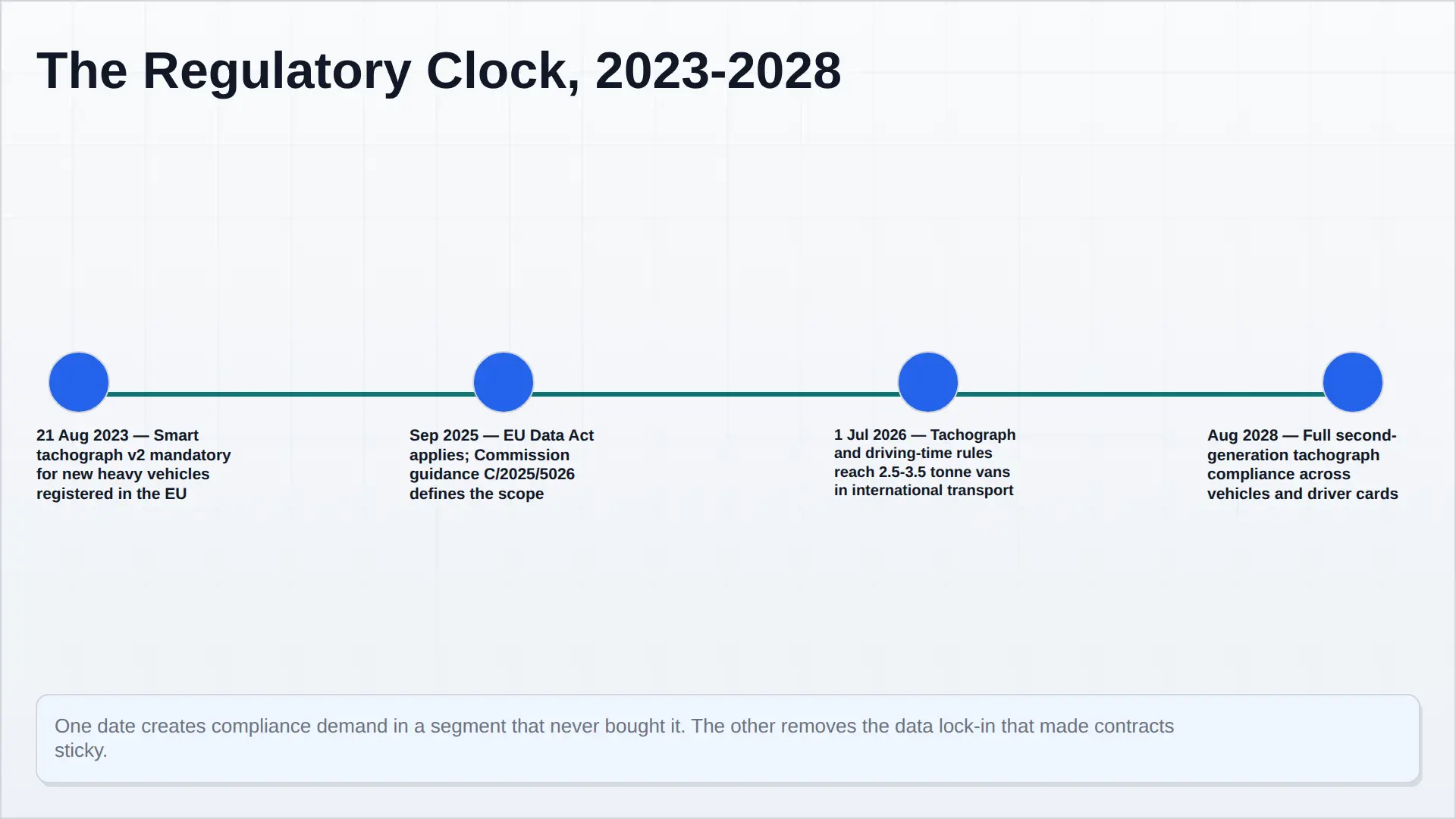
What actually changes on the day
Three obligations arrive together. The vehicle must be fitted with a second-generation smart tachograph, which means a device that records position and distance automatically, communicates remotely for enforcement purposes, and interfaces with the intelligent transport system. The driver must hold and use a driver card. And the operator must be able to produce driving-time and rest records that satisfy an inspector, which in practice means analysis software and an archive that survives an audit.
The enforcement context has already hardened. Authorities across the EU were required to have remote early detection equipment in place by 18 August 2024, which means a non-compliant vehicle can be identified at a distance, before any physical check. The heavy-duty timeline that precedes the van date is instructive about how the Commission sequences these things. New heavy vehicles registered from 21 August 2023 had to have the second-generation unit. Retrofits of analogue and digital tachographs were required by 31 December 2024, and retrofits of first-generation smart tachographs by 18 August 2025. Full compliance across vehicles and driver cards follows by August 2028.
Each of those dates produced a demand spike, and each spike was captured disproportionately by suppliers with an existing relationship with the operator. Which is the commercial point: this is not a market that is won on the day. It is won in the eighteen months before, by whoever is already in the depot.
The precedent is the US electronic logging device mandate
Europe is not inventing this. The United States went through the equivalent transition under 49 CFR Part 395 Subpart B, where the electronic logging device mandate has applied since 18 December 2017, with grandfathering for automatic on-board recording devices ending on 16 December 2019. The aftermath is the most useful evidence available about what a compliance mandate does to a fleet software market, and it does two things.
First, it converts a discretionary purchase into a non-discretionary one, which is why compliance revenue in this market behaves defensively during downturns: an operator can defer a vehicle, but not a legal obligation. Second, and more importantly, it creates a platform. The FMCSA’s MCMIS snapshot of 30 October 2026 records 2,132,941 motor carriers, 9,561,824 drivers and 8,571,319 power units — an installed base that began as hours-of-service compliance and became the beachhead for video safety, maintenance scheduling, fuel reconciliation and insurance.
The lesson the European van mandate will repeat is that compliance buys the account and the adjacent products earn the margin. A supplier that sells a tachograph and stops there has won a one-off hardware transaction with a five-year tail and no expansion path.
What the operator is really buying
The trap in a deadline-driven purchase is buying the box and calling it compliance. The obligation is not to fit a device; it is to be able to demonstrate, months later and under inspection, that driving time and rest were recorded, analysed and acted upon. The device produces raw records. The analysis produces the defence.
That distinction has a price consequence that is easy to miss. A device is a commodity — a GNSS receiver and a modem — and its cost is collapsing. A workflow that holds two years of driver-hours records, flags infringements before they accumulate, and produces an evidence pack on demand is not a commodity, and it is where the recurring revenue sits. Operators who buy on device price discover eighteen months later that they have the cheap device and no analysis.

Who is positioned to take the demand
The compliance specialists with an existing European van presence are the obvious beneficiaries. Geotab, which reports more than 5.8 million subscriptions, sells through a reseller and installer network that is well suited to a deadline affecting thousands of small fleets rather than a few large ones. Webfleet, acquired by Bridgestone for EUR 910 million in 2019 with over 1.2 million vehicles in EMEA at the time, reaches the van operator through the tyre and service relationship. Michelin occupies the same position.
The pure-play software camp approaches it differently. Samsara closed the year to 31 January 2026 with USD 1,889.9 million of annual recurring revenue growing 30% at a 77% gross margin, and its model depends on selling the safety and maintenance stack alongside the compliance record. Powerfleet, with more than 1.8 million subscribers after its combination with MiX Telematics closed on 2 April 2024, and Trimble bring existing European carrier bases. Verizon Connect and Corpay reach the small fleet through connectivity and fuel respectively.
And then there is the channel that does not need to win a retrofit decision at all. Ford Pro reported USD 66.3 billion of revenue and USD 6.8 billion of EBIT in 2025 with 1.3 million paid subscriptions growing 53%. Daimler Truck sits in the same position in heavier vehicles. The van coming off a European production line in 2026 is increasingly born connected, which means the retrofit window created by the mandate is also the last clean land-grab before factory-fit becomes the default.
The practical sequence before July
For an operator in scope, the sequence is short and unforgiving. Establish whether the vehicles genuinely fall in scope — the test is weight class plus international operation, not ownership. Confirm the unit will be a second-generation smart tachograph rather than a first-generation device that only satisfied the August 2025 retrofit deadline. Ensure driver cards are applied for, since card issuance is a queue and not a purchase. Choose the analysis layer before the hardware, because the analysis is the part that answers an inspector. And write the data clause into the contract now rather than at renewal, because since 12 September 2025 the operator has a statutory right to take its vehicle data elsewhere and most contracts have not caught up with that fact.
That last point is the one most operators will miss, and it is the subject of the second half of this argument: the same eighteen months that created this demand also removed the lock-in that used to capture it. A deadline is a terrible reason to sign a five-year agreement with no exit.
Companies referenced
Geotab (Q18164878) · Bridgestone / Webfleet (Q179433) · Michelin (Q151107) · Samsara (Q79543668) · Powerfleet (Q15109885) · Trimble (Q2297063) · Verizon Communications (Q467752) · Corpay (Q16838618) · Ford Motor Company (Q44294) · Daimler Truck (Q1157624)
Sources
Regulation (EC) No 561/2006 on driving times and rest periods, as amended; EU smart tachograph regulations governing second-generation units, retrofit deadlines of 31 December 2024 and 18 August 2025, remote early detection by 18 August 2024, and full compliance by August 2028; 49 CFR Part 395 Subpart B (United States electronic logging device mandate, compliance from 18 December 2017, grandfathering to 16 December 2019); FMCSA MCMIS registration statistics, snapshot of 30 October 2026; Samsara fourth quarter and full fiscal year 2026 results, 5 March 2026; Powerfleet and MiX Telematics business combination closing announcement, 2 April 2024; Bridgestone Europe completion of the TomTom Telematics acquisition, 1 April 2019; Ford fourth quarter and full year 2025 earnings; Pheonix Research, Global Fleet Management Market Report, 2026–2033.
Frequently Asked Questions
Which vehicles are affected on 1 July 2026?
Light commercial vehicles between 2.5 and 3.5 tonnes operating in international transport must carry a second-generation smart tachograph from 1 July 2026, and their drivers fall within Regulation (EC) No 561/2006 on driving times and rest periods. Neither obligation has applied to this vehicle class before.
What is the heavy-duty timeline it extends?
New heavy vehicles registered from 21 August 2023 required the second-generation unit. Retrofits of analogue and digital tachographs were due by 31 December 2024 and of first-generation smart tachographs by 18 August 2025. Enforcement authorities had remote early detection equipment by 18 August 2024, and full compliance across vehicles and driver cards follows by August 2028.
Why is the device not the same as compliance?
The device produces raw records. Compliance is the ability to demonstrate, under inspection and months later, that driving time and rest were recorded, analysed and acted on. Buying the unit without the analysis layer leaves the operator with an audit exposure and a one-off hardware transaction that earns the supplier nothing recurring.
Does the operator have a right to its own vehicle data?
Yes. Since 12 September 2025 the EU Data Act gives the operator — the user of the connected vehicle, not the manufacturer — the right to access the data it generates and to direct it to a third party. Operators should write data portability and exit terms into the contract at signature rather than discovering them at renewal.