
Editorial Article
The EU Data Act Gave Fleet Operators Their Own Vehicle Data — and Removed the Reason Fleet Software Was Sticky
The EU Data Act has been applicable since 12 September 2025, and its most important sentence for anyone in fleet management is structural rather than technical: the right to the data belongs to the user of the connected product, not the manufacturer. In a vehicle, the user is the fleet operator. The manufacturer holds the data; it does not own it.
Read against the way this market was built, that is a decisive reallocation. The factory-fit advantage ran like this: the manufacturer installs the modem, the manufacturer receives the data, therefore the manufacturer sells the software. The Data Act removes the middle step. An operator can now require that the data produced by its own vehicle be sent to a third party of its choosing, and the manufacturer is obliged to send it.
Which is very good news for competition, and quietly terrible news for anyone whose retention depended on captivity. The regulation that creates demand for fleet management is also the regulation that removes the mechanism by which suppliers captured the value of that demand.
What the guidance actually says
The European Commission’s guidance published on 15 September 2025, C/2025/5026, draws the boundaries in ways that matter commercially, and three of them deserve attention.
First, only raw and pre-processed data are within scope. Inferred or derived data — the scoring, the analytics, the model output that a supplier builds on top — remain the supplier’s. This is the protection the industry retains, and it is a meaningful one: a platform can be required to hand over the vehicle’s readings, but not the conclusion it drew from them. The strategic implication is that value migrates decisively from the pipe to the analysis.
Second, data already transmitted to the manufacturer’s backend under the extended-vehicle concept is treated as readily available, and must be shared with a third party at the user’s request. This is the clause that breaks the factory-fit lock. The manufacturer cannot argue that data it already receives is somehow out of reach.
Third, a service counts as a related service only where it involves bidirectional data exchange that affects the operation of the vehicle. The guidance explicitly places pay-how-you-drive insurance and aftermarket analytics outside that definition. In plain terms, the operator’s chosen analytics supplier is not a related service and does not need the manufacturer’s permission to function.
What the Act does not do is standardise the mechanics. It creates a right without a common technical interface. In practice access arrives in different forms, at different speeds and with different integration costs depending on the manufacturer, and the integration work sits with the party asking. That gap is the current commercial frontier — and it is why the suppliers most likely to convert the regulation into share are the ones able to absorb integration cost and resell it inside a subscription rather than billing it as a project.
What it does to churn, and therefore to price
Switching costs in this market were never really about hardware. They were about the records. The system that holds two years of driver-hours data, the maintenance history a warranty claim depends on, and the evidence pack that answered the last regulator enquiry is the thing a fleet manager cannot casually replace. Data exclusivity was the legal architecture underneath that practical friction.
Remove it and two things happen at once. Churn becomes easier, because the records can travel. And renewal pricing becomes more aggressive, because both sides know it. The aggregate consequence is the shape of the whole market: our modelling puts global fleet management at USD 26.1 billion in 2025 rising to USD 61.4 billion in 2033 at 11.29%, with subscriptions growing 15.50% a year while revenue per vehicle falls 3.65% from USD 45.31 to USD 33.66 a month. Volume supplies 160.2% of the net growth. Price and mix subtract 60.2%.
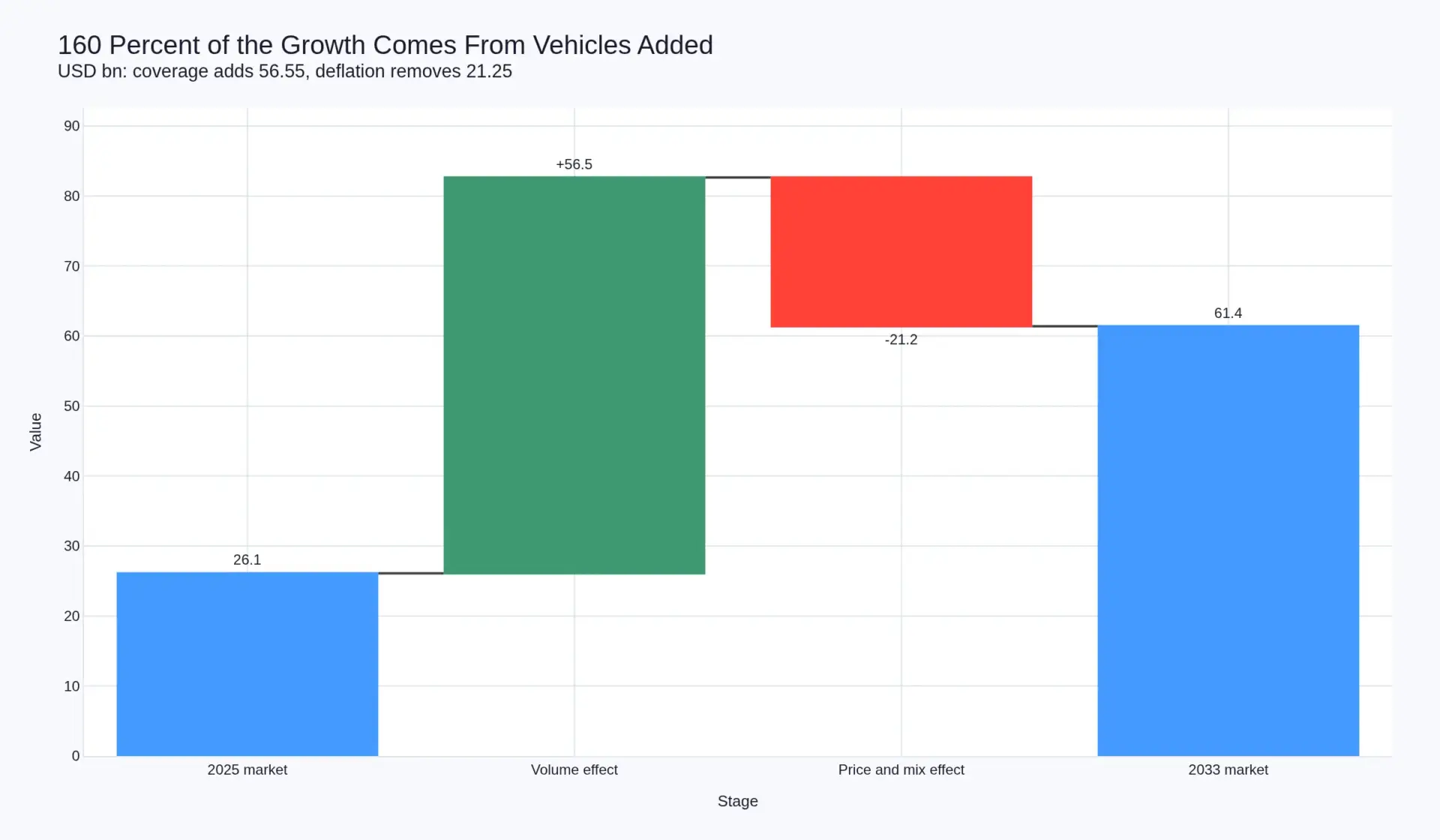
That deflation has several causes — hardware cost collapse, mix shift toward light commercial vehicles and smaller fleets in emerging markets — but statutory data portability belongs on the list from September 2025 onward, and it is the one that cannot be reversed by a product decision.
The uncomfortable symmetry
Here is the part the industry does not say out loud. The same right that lets an independent platform pull data out of a manufacturer’s backend lets a competitor pull data out of the independent platform. The Act is symmetrical. It does not distinguish between a large OEM and a mid-sized telematics provider; both are data holders when someone else’s data passes through them.
So the honest reading is that the Data Act raises the ceiling on this market and lowers the floor under its incumbents. Total subscriptions should rise, because an operator can now assemble a best-of-breed stack without being trapped by whoever fitted the box. Retention should weaken, because assembling that stack is now legally straightforward. Both effects are already visible in the underlying numbers: more vehicles, less money per vehicle.
What the suppliers are doing about it
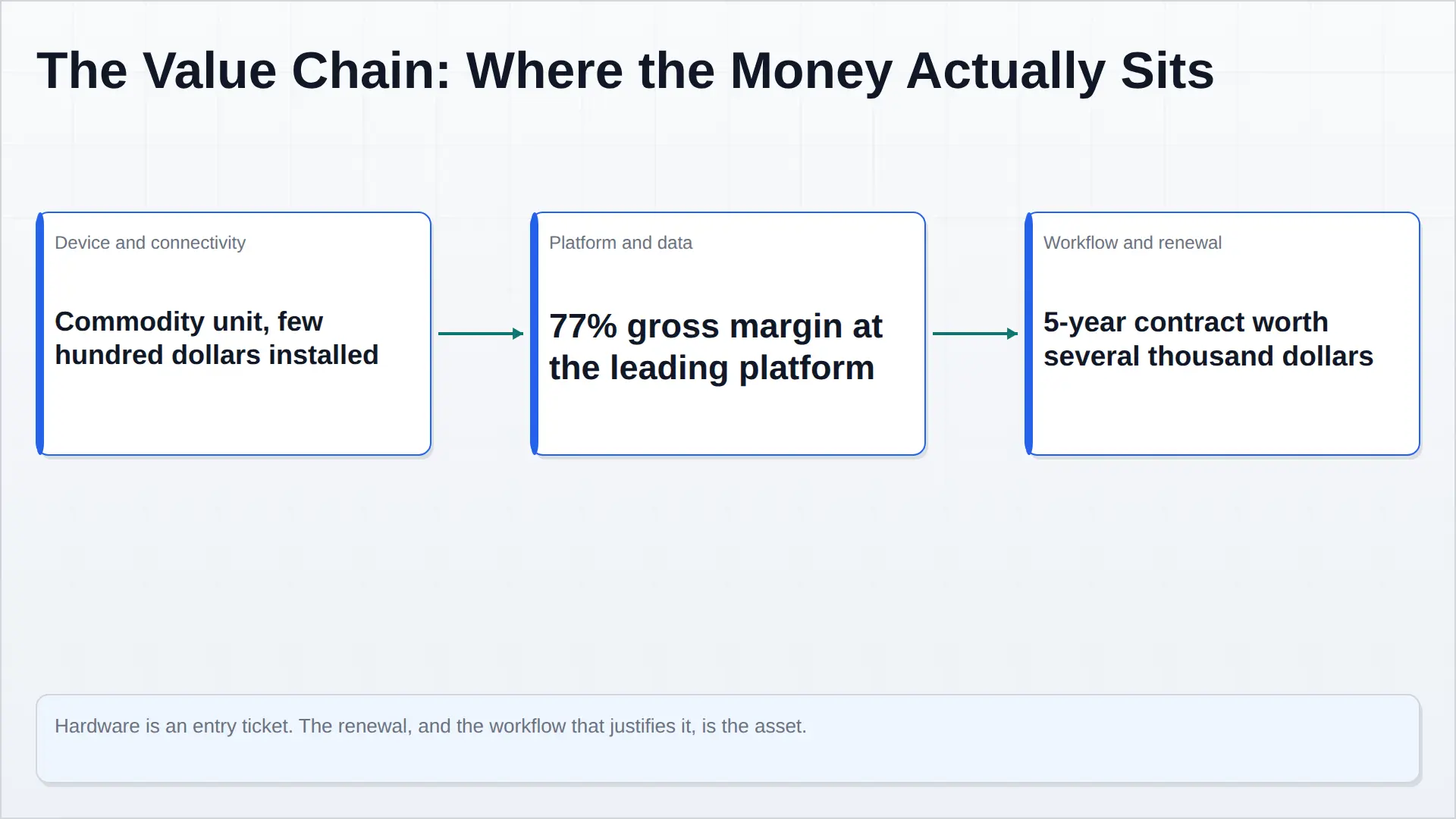
The pure-play camp has been building the answer for several years without calling it that. Samsara closed the year to 31 January 2026 with USD 1,889.9 million of annual recurring revenue growing 30% at a 77% gross margin, and its ARR from customers spending more than USD 100,000 grew 37% — faster than the average. That skew toward large accounts is a retention strategy: the more of an operator’s workflow a platform holds, the less a statutory right to move data actually matters.
Geotab, with more than 5.8 million subscriptions, and Powerfleet, with more than 1.8 million after its combination with MiX Telematics closed on 2 April 2024, are pursuing depth through distribution and vertical specialisation respectively. Trimble goes deeper into carrier operations. Bridgestone‘s Webfleet and Michelin Connected Fleet anchor the software in a tyre relationship, which is a genuinely different kind of stickiness because it is commercial rather than technical.
The manufacturers are taking the opposite route: keep the customer inside a vehicle relationship. Ford Pro reported USD 66.3 billion of revenue and USD 6.8 billion of EBIT in 2025, with 1.3 million paid subscriptions growing 53% and software and physical services at 19% of its EBIT. Daimler Truck is building the same position in heavy trucks. Verizon Connect and Corpay sit outside the argument entirely: one owns the connectivity, the other owns the fuel transaction, and neither needs data exclusivity to keep the account.
What buyers and sellers should do now
For operators, the window between now and the next renewal is worth more than it looks. The statutory right is only useful if it is written into the contract: which data, in what format, at what frequency, through which interface, at what cost, and on what notice. Most agreements in force today were drafted before September 2025 and say none of it. A renewal signed without those terms is a five-year decision taken on a four-year-old legal assumption.
For suppliers, the strategic conclusion is narrow and unavoidable. If the data can leave, the workflow must be worth staying for. That means owning the record that an inspector or an insurer or a warranty claim depends on, being the place where the action is taken rather than only the place where the number is displayed, and pricing on the outcome rather than the pipe. The suppliers who treat the Data Act as a compliance matter to be delegated to legal will discover it was a pricing event.
Companies referenced
Samsara (Q79543668) · Geotab (Q18164878) · Powerfleet (Q15109885) · Trimble (Q2297063) · Bridgestone / Webfleet (Q179433) · Michelin (Q151107) · Ford Motor Company (Q44294) · Daimler Truck (Q1157624) · Verizon Communications (Q467752) · Corpay (Q16838618)
Sources
Regulation (EU) 2023/2854 (Data Act), applicable from 12 September 2025; European Commission guidance C/2025/5026 on access to vehicle data, published 15 September 2025; Samsara fourth quarter and full fiscal year 2026 results, 5 March 2026; Powerfleet and MiX Telematics business combination closing, 2 April 2024; Bridgestone Europe completion of the TomTom Telematics acquisition, 1 April 2019; Ford fourth quarter and full year 2025 earnings; Pheonix Research, Global Fleet Management Market Report, 2026–2033: The Device Is a Commodity and the Renewal Is the Business.
Frequently Asked Questions
Who owns the data a connected truck generates?
Since 12 September 2025 the EU Data Act has given the user of a connected product — in a vehicle, the fleet operator — the right to access the data it generates and to direct it to a third party of the user's choosing. The manufacturer is the data holder, not the owner, and data it already receives under the extended-vehicle concept must be shared at the user's request.
What does the Act not cover?
Only raw and pre-processed data are within scope. Inferred or derived data — the scoring, analytics and model output a supplier builds on top — remain the supplier's. A service also counts as a related service only where bidirectional data exchange affects the operation of the vehicle, and the guidance places pay-how-you-drive insurance and aftermarket analytics outside that definition.
Why does data portability push prices down?
Switching costs in fleet management were built on records, not hardware: driver hours, maintenance history, audit evidence. Data exclusivity was the legal architecture underneath that practical friction. Removing it makes churn easier and renewal pricing more aggressive, which is why the market grows 11.29% while revenue per vehicle falls 3.65% a year.
Does the Act hurt independent suppliers too?
Because the right is symmetrical. The same provision that lets a platform pull data out of a manufacturer's backend lets a competitor pull data out of the platform. It raises the ceiling on the total market by making best-of-breed stacks legal, and lowers the floor under incumbents by making them easy to assemble and easy to leave.