
Editorial Article
The Tube Left in 1947. Radial Took Until 1976 to Win.
The way the tyre industry tells its own history, the decisive event was the argument between radial and bias construction, and it was settled in 1976. The inner tube barely appears. It is treated as a fitting that went away somewhere in the background, a detail of no analytical consequence.
The chronology does not support that. The tube left first — by a wide margin, and for reasons that had nothing to do with carcass construction.
11 May 1947
On that date the B.F. Goodrich Company of Akron, Ohio announced it had developed a tubeless tyre: a tyre that trapped its pressurised air within its own walls, eliminating the inner tube entirely. The announcement was the end of more than three years of engineering. The company reinforced the tyre walls, claimed to have combined the puncture-sealing properties of a tube with easier riding and better pressure retention, and then did what any manufacturer would do with a claim it believes — it put the tyres on a fleet of taxis, on Ohio state police cars, and on high-speed road testing.
The testing held. Patents on the tyre’s various features were granted in 1952. Within three years the tubeless tyre was standard equipment on most new American automobiles; a technology timeline compiled by Modern Tire Dealer dates tubeless-type original equipment on United States cars to 1954.
The contemporary press understood what had happened. The New York Times reported in December 1954 that the buyer of a 1955 automobile could count on at least 25 per cent more mileage, easier tyre changing on a road with a leaky tyre, “and almost no blowouts”. The paper quoted Howard N. Hawkes, vice president and general manager of the tyre division of the United States Rubber Company, calling the general adoption of the tubeless tyre “one of the most far-reaching changes ever to take place in the tyre industry”.
Michelin’s radial arrived in 1948 and was a tubeless design from the outset. The 1976 Council Recommendation that settled radial against bias came twenty-eight years after that, and twenty-two years after the tubeless tyre had become the American default.
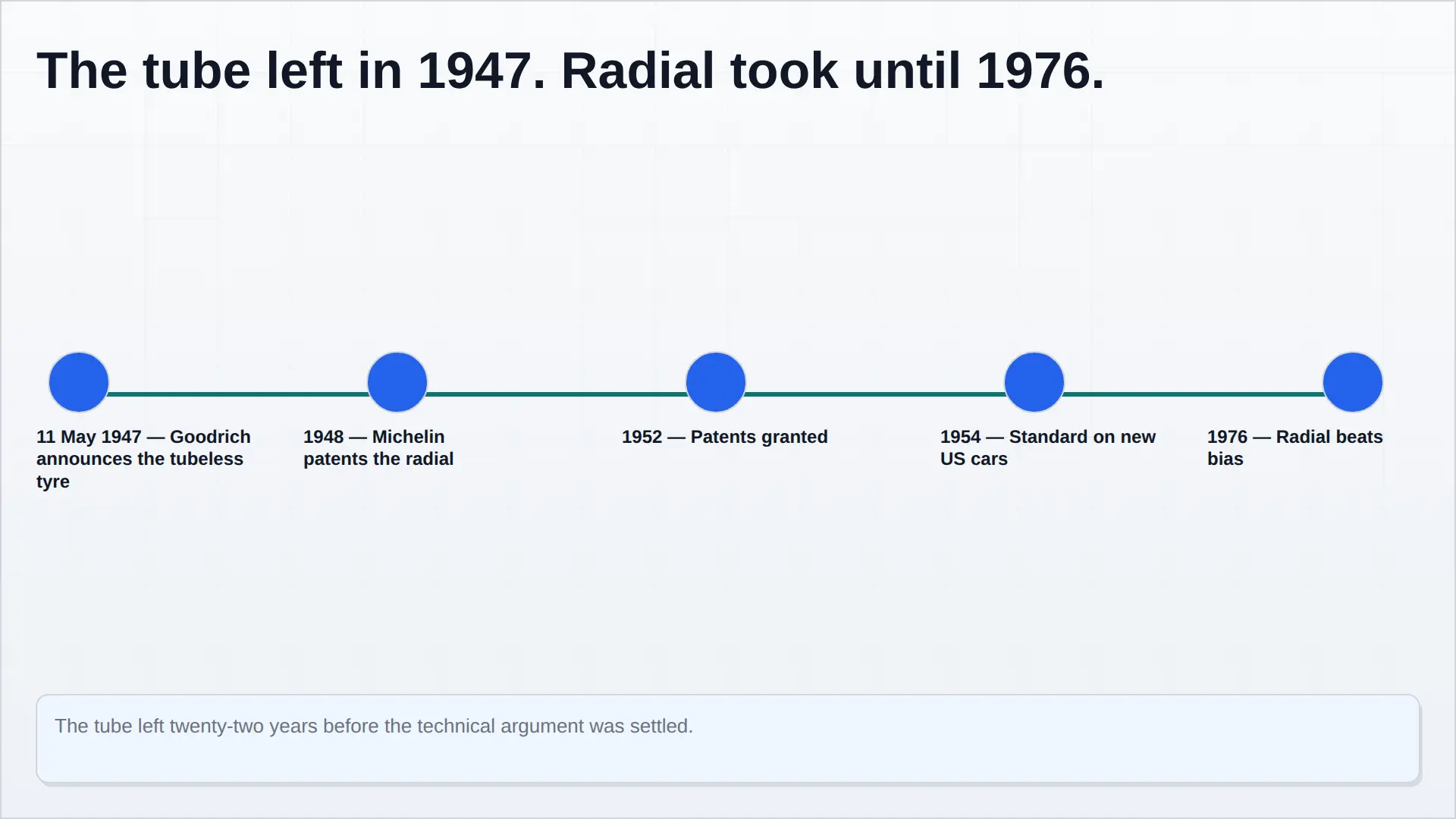
So the industry’s founding decision was not the one that removed the tube. Something else did.
What actually replaced the tube
Not the carcass. The interface.
A tube does two jobs. It holds the air, and it presses outward against the inside of the casing, which helps keep the tyre’s bead seated against the rim. Remove it and both jobs have to be taken over by other components. The air is held by an air-impermeable inner liner, built from halobutyl rubber rather than the general-purpose elastomers used in the carcass. The bead is held by the shape of the wheel.
That second substitution is the one the industry underrates, because it moved the engineering burden off the tyre and onto the rim. The European Tyre and Rim Technical Organisation standardises bead-retention contours on 5° drop-centre rims — the hump, the flat hump, the extended hump, and EH2+ — and the reason they exist is mechanical. Under transverse load, a corner taken quickly is enough, the bead can be pushed axially inward and migrate into the drop-centre well that exists to make mounting possible in the first place. The safety-rim patent literature describes the consequence without diplomacy: the bead leaves its seat, falls into the mounting groove, and the result is almost always a loss of pressure and a loss of steering.
The hump is a physical stop inboard of the bead seat that prevents exactly that. The same patent record notes that these bosses became widespread specifically for passenger assemblies mounted without inner tubes, and that their shapes are standardised through ETRTO.
Which means the tubeless tyre’s actual enabling invention lives on the wheel, not on the tyre. And ETRTO says so, in two sentences that do more analytical work than most commentary on this market. All tubeless tyres must be fitted on air-tight rims, and tubeless radials only on rims with profiles designed for bead retention. And an inner tube must always be fitted with spoked wheels, because that type of wheel is rarely completely airtight.
A wire-spoked wheel is not airtight. The spoke nipples penetrate the rim. That is not a tyre problem and it cannot be solved by a tyre.
What that does to the numbers
The global tubeless tyre market carries USD 186.3 billion in 2025 and reaches USD 289.7 billion in 2033, a CAGR of 5.7 per cent. That rate is, on its own, entirely unmemorable — roughly a point above global tyre market growth and the kind of figure that gets skimmed.
The share arithmetic is the story. Against the construction-defined tyre market in the same segment — USD 362.4 billion rising to USD 521.8 billion, implying 4.6621 per cent a year — tubeless tyres are 51.41 per cent of the base and 55.52 per cent of the 2033 market. A 4.11 point share gain in eight years is the sort of movement that gets called marginal.
It isn’t. The parent market adds USD 159.4 billion of value across those two endpoints. This category adds USD 103.4 billion of it. That is 64.87 per cent of the entire absolute growth, produced by a category starting from 51.41 per cent of the base, growing at 1.217 times the parent’s rate. A market carrying 65 per cent of the growth from 51 per cent of the base is not tracking the tyre industry. It is the tyre industry’s growth.
Two corrections were needed to get those figures right, and they are worth stating because they are the kind of error that travels. The record carried the market at 186.3 with the unit scale set to Million — which would put a global tyre category at USD 186.3 million, a rounding error inside one, in a segment where every sibling record is denominated in billions. And the stated CAGR read 4.7 per cent, which is the rate implied by the radial versus bias record’s own endpoints. Applied here, 4.7 per cent would have produced a 2033 value near USD 269.0 billion, not 289.7. The two endpoints agreed with each other; the rate was the outsider.
One gap is disclosed rather than filled. There is no volume series on this record, because a units figure needs an assumed price per tyre and an assumed C1/C2/C3 mix, and a number manufactured from two assumptions is not evidence. Every growth statement here is a value statement.
The rate is a blend of two speeds
If tubeless were a technology-adoption curve, it would have flattened in the developed world decades ago, and it has. What is still moving is not adoption. It is the replacement of the wheels underneath.
That produces a growth rate that is the weighted average of two very different processes. In vehicle classes where wheels turn over on a normal cycle — passenger cars and, crucially, the two- and three-wheelers now moving to cast alloy wheels — conversion runs at a normal speed and in large numbers. In off-highway, agricultural and industrial applications, a tube is frequently the correct specification rather than a legacy component: ballasting, load distribution, field repairability. Our dealer interviews found nobody in that class expecting conversion, and several describing tubes as the right engineering choice.
So 5.7 per cent is not an adoption curve and it is not a demand curve. It is a scrappage function with a durable remnant underneath it. That is a less satisfying explanation than a single driver would provide, and it is the one the arithmetic supports.
The regulation that is not about tyres
It is routinely said that regulation drove the tubeless transition. In Europe it did not, and the instrument usually cited proves the opposite.
Regulation (EC) No 661/2009, Article 9(2), required that M1 vehicles be equipped with an accurate tyre pressure monitoring system capable of warning the driver of a pressure loss, in the interests of fuel consumption and road safety. It applied to new types from 1 November 2012 and to all new vehicles sold in the European market from 2014. The Commission’s commencement notice described the expected benefit as a significant reduction in the chance of tyre blowouts, which it noted can cause severe roll-over accidents.
That is a pressure mandate. It attaches to the vehicle, not the tyre, and it requires no particular tyre construction. UN Regulation No. 141, the technical regulation behind it, goes further: paragraph 5.1.1 deems a tyre pressure refill system equivalent to a monitoring system where the annex criteria are met, and deems a central tyre inflation system equivalent on the same basis. Where those apply, a monitoring system is not required to be installed at all.
A heavy fleet can therefore comply in full without the architecture a tubeless assembly most naturally supports. The regulation is indifferent to whether a tube exists.
There is an irony in its design. The R141 detection thresholds run on cumulative driving time — for C1 tyres on M1 and N1 vehicles, a twenty per cent pressure loss or a fall to 150 kPa, whichever is higher, flagged within ten minutes for an incident-related loss and within sixty minutes for the general under-inflation case. That is a trend instrument built to catch a slow leak. A slow leak is how a tubeless tyre fails. A tube fails by tear or pinch, and deflates faster than any driving-time clock is designed to measure.
So the one regulatory architecture built around the tubeless tyre’s failure mode never mentions the tube, and never required one to be removed.
The rule that actually binds
What governs this market is not a statute. It is a rim table.
ETRTO’s Standards Manual, with TRA in the United States and JATMA in Japan doing the equivalent work in their markets, determines whether a given tyre may be fitted to a given wheel. That rule has no compliance deadline, carries no penalty, and is enforced by a fitter declining a fitment behind a counter. Which is precisely why conversion runs at the speed of asset turnover: there is no authority with an interest in accelerating it, and no date by which anything must be done.
Why the value-added tyre is always tubeless
The base product here is 1947 technology, and it is genuinely mature. That is why the interesting development work has moved to what the assembly can carry — and all of it requires the tube to be absent.
A sensor that measures pressure, temperature or tread state from inside the assembly needs a stable, sealed surface in contact with the inflation cavity. In a tubeless tyre that surface is the inner liner. In a tube-type assembly the nearest equivalent is the inside of a tube that flexes independently of the casing and is replaced at intervals — a sensor mounted to a consumable, attached to a consumable. A self-supporting run-flat sidewall, which carries load with no pressure at all, would be crushed against the rim by a tube inside it. Self-sealing compounds work because the tyre’s own pressure holds the puncturing object while the compound flows into the injury; in a tube-type assembly there is no sealant layer to put them in.
Connected, sensor-embedded and run-flat tyres together account for USD 35.3 billion on this segment’s own records — 18.95 per cent of this base, stated as an upper bound because a connected tyre may also be a run-flat. The precise figure is less important than the direction: the value-added layer of the tyre industry is being built on an architecture that a tube forecloses.
The economics of removing a component
There is a detail that only shows up at the fitting bay, and it is the most commercially useful thing in the research. On a tubeless assembly a puncture is frequently repairable in place: the tyre holds its own pressure, the injury can be plugged or patched, the wheel goes back on. On a tube-type assembly the injured component is the tube, it is replaced, and it is replaced as a consumable attached to the tyre — which means the residual tube market generates an extra revenue line per tyre change, against a lower tyre price.
Converting an assembly collapses two SKUs into one and removes a labour step. It does not simplify the work; it relocates the skill, to liner quality, bead seating, and a pressure-tight seal that has to be verified before the vehicle leaves. That is why the transition appears in value per tyre rather than in unit counts.
It also explains the competitive structure. When an assembly converts, the purchase does not migrate from one tube-type producer to another. It migrates to a supplier able to meet an OE-type specification. Conversion is a consolidation mechanism, and the eight tier-1 participants in this market grow from it collectively without needing to take share from each other. It is a strange kind of competition: the incumbents’ most valuable asset is something none of them controls — the rate at which the world’s wheels are scrapped.
The tube is not losing a technology fight
It is waiting for wheels.
That reframing matters commercially because it changes what a participant in this market should do. There is no product to launch that converts a spoked wheel. There is no campaign that accelerates a scrappage cycle. There is specification work with vehicle manufacturers, there is liner quality that survives a service life, and there is the sensor architecture that only a converted assembly can carry.
The tube left the developed passenger car in 1947 and was gone from it by 1954. It is still present wherever the wheel was never replaced — and that, rather than the construction argument of 1976, is what the next eight years of this market are actually about.
References
- B.F. Goodrich Company, announcement of the developed tubeless tyre, 11 May 1947; patents on tyre features granted 1952. The New York Times, December 1954, including remarks attributed to Howard N. Hawkes, United States Rubber Company.
- Modern Tire Dealer, passenger tyre technology timeline (tubeless-type tyres as original equipment on United States cars, 1954; radial tyre, Michelin, 1948).
- ETRTO, Recommendations on passenger car tyres, Edition 2, September 2024 — care and maintenance, tyre fitting and removal.
- ETRTO, Standards Manual 2024 — 5° drop-centre rims (Diameter Codes 10–30) and contours for bead retention on 5° drop-centre rims: hump (H), flat hump (FH), extended hump (EH2), EH2+ (R.13–R.17).
- European Patent EP0170085A1, safety rim with an axial bead-retention hump, and tyre-and-wheel assembly using said rim.
- Regulation (EC) No 661/2009, Articles 9(2) and 13, consolidated text; European Commission, “Cars safer from 1 November 2012”, IP/12/1169, 31 October 2012.
- UN Regulation No. 141 (Tyre Pressure Monitoring Systems), 01 series of amendments, paragraphs 5.1.1–5.5 and Annex 3; UN Regulations No. 30, 54 and 75.
- Regulation (EU) 2020/740 on the labelling of tyres.
- Pheonix Research, Global Tubeless Tyres Market Report, Size, Share and Forecast 2026–2033; Global Radial vs Bias Tyres Market Report; Global Low Rolling Resistance Tyres Market Report.
Sources
- B.F. Goodrich tubeless tyre announcement, 11 May 1947; patents granted 1952.
- Modern Tire Dealer passenger tyre technology timeline, which records the tubeless tyre at 1947 and tubeless-type tyres as original equipment on US cars at 1954.
- European Patent EP0170085A1 — Michelin, safety rim with an axial bead-retaining hump, filed 3 July 1985, granted 4 November 1987 — the later confirmation that the rim, not the tyre, was the unresolved half.
- Global Tubeless Tyres Market 2026–2033, Section 3, the chronology chapter.