
Editorial Article
This Market Grows Because Wheels Are Scrapped, Not Because Drivers Choose It
The word used about this market is almost always the wrong one. Tubeless tyres are not displacing tube-type tyres. They are outliving them.
The distinction is not semantic, and the arithmetic shows why. If a technology is displacing another, the displaced thing shrinks. In this market it grows. The tube-type remainder of the construction tyre market is USD 176.1 billion in 2025 and USD 232.1 billion in 2033 — 3.51 per cent a year. It is slower than the tubeless rate of 5.7 per cent, which is why its share falls, but in absolute terms it adds USD 56.0 billion over the period. Nothing is being displaced. Two things are growing at different speeds inside a market that is growing at 4.66 per cent.
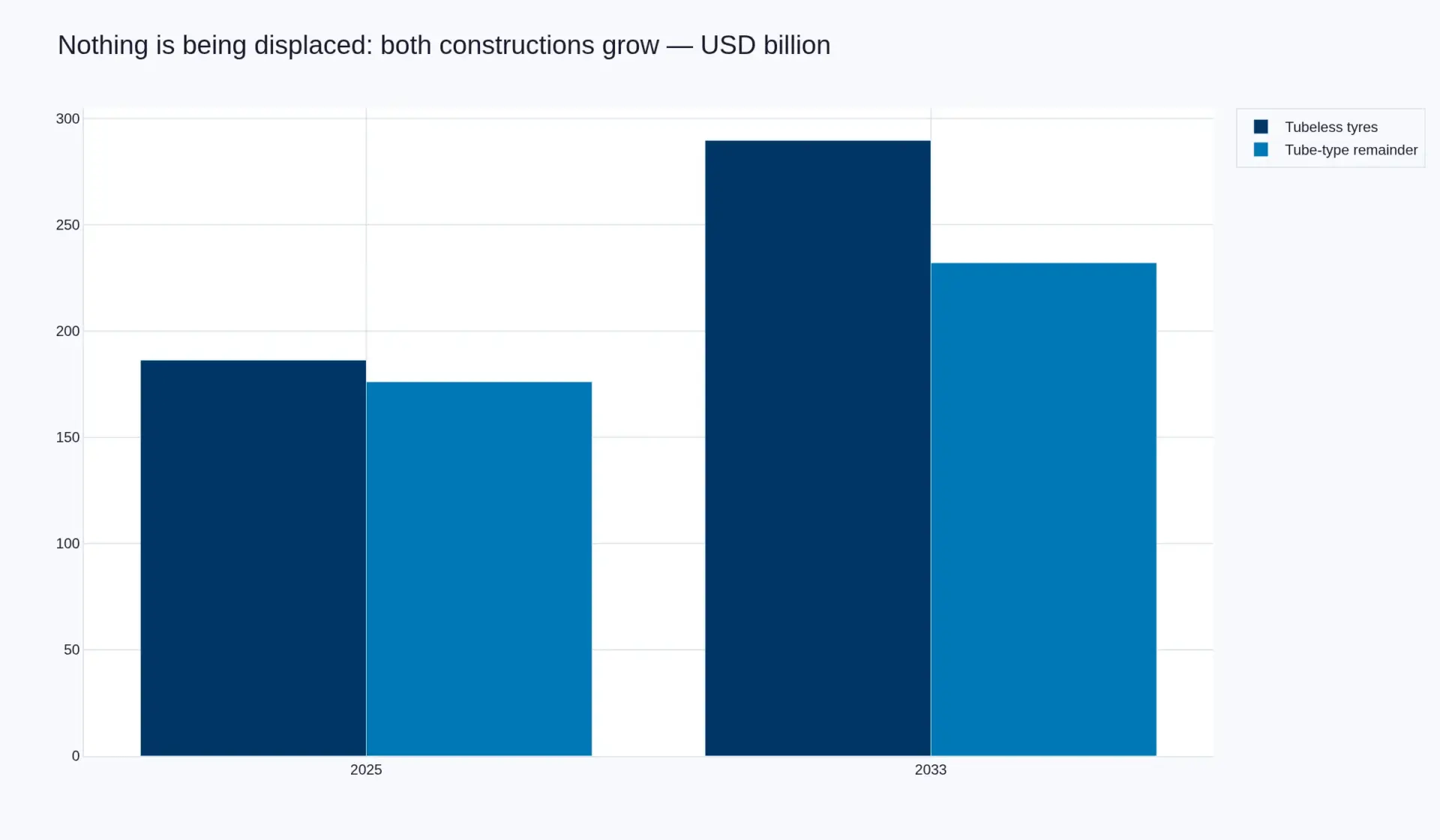
| Construction tyre market | 2025 | 2033 | CAGR |
|---|---|---|---|
| Tubeless | USD 186.3 bn | USD 289.7 bn | 5.67% |
| Tube-type remainder | USD 176.1 bn | USD 232.1 bn | 3.51% |
| Total market | USD 362.4 bn | USD 521.8 bn | 4.66% |
What is actually happening to the residual
A tube-type assembly survives for one reason: the wheel under it cannot hold air. It is not there because the buyer has been persuaded of anything, or because the tyre is cheaper in a way that would change with a marketing budget, or because the channel has failed to communicate. It is there because the rim lacks the bead-retention geometry, and because sealing or replacing that rim costs money at a moment when nobody is being asked to spend it.
So the residual decays at the speed at which wheels leave service. Three paths do that work. A vehicle is scrapped, and its wheels leave with it. A wheel is replaced — often after damage, sometimes as part of a specification change — and the replacement may or may not be airtight. Or the machine is simply kept, which is the common case for a tractor, a reach stacker or a piece of industrial handling equipment, where the economic life is long, the annual hours are low and a working wheel is not a thing anyone replaces for an efficiency argument.
That last path is why the residual holds. Off-highway, agricultural and industrial equipment are not on a replacement cycle that intersects with a 2033 forecast, and those applications are also where the tube-type construction makes operational sense: high load, low speed, field repairability, a wheel that is more likely to be damaged than worn out. The commuter two- and three-wheeler fleet is the other large pool, and its reason is different — a spoked wheel that cannot be sealed cheaply and a buyer who is price-sensitive at the point of sale.
Sticky in both directions
Once a wheel is airtight, nothing pushes it back. There is no cost argument for re-introducing a tube into an assembly that does not need one, and the tubeless repairability advantage only compounds over the life of the vehicle. That stickiness is why the tubeless base never gives ground.
The reverse stickiness is the one forecasts tend to miss. A fleet running tube-type wheels has standardised on them: the tyre stock, the fitting tools, the roadside repair practice, the people who know how to do it. Converting is not the price of one wheel seal; it is a change of practice across a fleet, and the savings arrive as a stream of small amounts at every future service event rather than as one visible number. Most operators do not run that calculation. They replace what they had.
Why this matters for the number
If the growth were adoption, the sensitivity of the 2033 figure would sit in demand — in how quickly buyers can be persuaded, and in whether anything accelerates them. Since the growth is replacement, the sensitivity sits somewhere else entirely: in the size of the vehicle park, in how long vehicles and machines stay in service, and in what wheels OEMs specify on the units that replace them. Those are slower variables, and they are much harder to move with policy or marketing than an adoption curve would be.
It also means the market is not exposed to the risk that usually attaches to a technology transition — that the unconverted audience turns out not to want the product. There is no unconverted audience here in the sense that phrase normally carries. There are wheels that will be replaced and wheels that will not, and the forecast is mostly a statement about the second group.
Which is why the honest description of this market is not a conversion at all. It is a stock turning over, priced at the construction each turn can accept.
Sources
- Global Tubeless Tyres Market 2026–2033, Sections 5 and 7, for the value bridge and the vehicle-class segmentation the residual is drawn from.
- Modern Tire Dealer passenger tyre technology timeline, which dates the tubeless tyre to 1947 and tubeless-type tyres as original equipment on US cars to 1954 — the eight-year gap between the invention and the fleet.
- ETRTO Recommendations on the cases where a tube remains the correct fitment, principally spoked wheels.
- The 3.51 per cent residual growth rate is computed from the same endpoints as the parent series: 362.4 less 186.3 in 2025, and 521.8 less 289.7 in 2033, giving USD 176.1 bn rising to USD 232.1 bn.
Sources
- Global Tubeless Tyres Market 2026–2033, Sections 5 and 7, for the value bridge and the vehicle-class segmentation the residual is drawn from.
- Modern Tire Dealer passenger tyre technology timeline, which dates the tubeless tyre to 1947 and tubeless-type tyres as original equipment on US cars to 1954.
- ETRTO Recommendations on the cases where a tube remains the correct fitment, principally spoked wheels.
- The 3.51 per cent residual growth rate is computed from the same endpoints as the parent series: 362.4 less 186.3 in 2025, and 521.8 less 289.7 in 2033, giving USD 176.1 bn rising to USD 232.1 bn.
Frequently Asked Questions
Is the tube-type tyre market actually shrinking?
No. The tube-type remainder grows from USD 176.1 billion in 2025 to USD 232.1 billion in 2033, at 3.51 per cent a year — slower than tubeless at 5.7 per cent, so its share falls, but still adding USD 56.0 billion in absolute terms. Nothing is being displaced; two components are growing at different speeds.
What makes a wheel leave service, and why does that matter?
Wheels with a bead-retention profile replace wheels without one. That happens when a vehicle is scrapped, when a wheel is replaced after damage or a specification change, or when a machine is kept so long its wheels never turn over inside the forecast window. The last case is why off-highway, agricultural and industrial applications hold the residual.
Why is the market sticky in both directions?
Because the tubeless base never gives ground — there is no cost case for putting a tube back into an airtight assembly — while the tube-type base is held by switching costs rather than preference: tyre stock, fitting tools, repair practice and trained people. Fleet standardisation is stickier than unit economics.
Where does the sensitivity of the 2033 forecast actually sit?
In the size of the vehicle park, in how long machines stay in service, and in what wheels OEMs specify on replacement units. Those move slowly and are largely immune to policy or marketing, which is the opposite of where an adoption-driven forecast would put its sensitivity.