
Global Dengue Vaccine Market Size and Share Analysis 2026-2033
Global Dengue Vaccine Market Forecast Snapshot (2026???2033)
| Metric | Value |
|---|---|
| Market Size (2025) | ?? ?? ?? ?? ?? ?? ?? ?? ?? ?? ?? ?? ?? ?? ?? ?? ?? ?? ?? ?? ?? ?? ?? ?? ?? ?? ?? ?? ?? ?? ?? ?? ?? ?? ?? ?? ?? ?? ?? ?? ?? ?? ?? ?? ??USD 0.82 Billion |
| Market Size (2033) | ?? ?? ?? ?? ?? ?? ?? ?? ?? ?? ?? ?? ?? ?? ?? ?? ?? ?? ?? ?? ?? ?? ?? ?? ?? ?? ?? ?? ?? ?? ?? ?? ?? ?? ?? ?? ?? ?? ?? ?? ?? ?? ?? ?? ??USD 2.15 Billion |
| CAGR (2026???2033) | ?? ?? ?? ?? ?? ?? ?? ?? ?? ?? ?? ?? ?? ?? ?? ?? ?? ?? ?? ?? ?? ?? ?? ?? ?? ?? ?? ?? ?? ?? ?? ?? ?? ?? ?? ?? ?? ?? ?? ?? ?? ?? ?? ?? ?? ?? ?? ?? ?? 12.80% |
| Largest Segment | ?? ?? ?? ?? ?? ?? ?? ?? ?? ?? ?? ?? ?? ?? ?? ?? ?? ?? ?? ?? ?? ?? ?? ?? ?? ?? ?? ?? ?? ?? ?? ?? ?? ?? ?? ?? ?? Live Attenuated Dengue Vaccines |
| Fastest Growing Segment | ?? ?? ?? ?? ?? ?? ?? ?? ?? ?? ?? ?? ?? ?? ?? ?? ?? ?? ?? ?? ?? ?? ?? ?? ?? ?? ?? ?? ?? ?? ?? ?? ?? ?? ?? ?? ?? ?? Tetravalent Dengue Vaccines |
| Leading End-Use Segment | ?? ?? ?? ?? ?? ?? ?? ?? ?? ?? ?? ?? ?? ?? ?? ?? ?? ?? ?? ?? ?? ?? ?? ?? ?? ?? ?? ?? ?? ?? ?? ?? ?? ?? ?? ?? ?? Hospitals & Vaccination Centers |
| Key Trend | Expansion of National Immunization Programs, Advanced Vaccine Development & Rising Public Health Investments |
| Regulatory Influence | WHO Recommendations, National Vaccination Policies & Vaccine Approval Frameworks |
| Future Outlook | Growth Driven by Increasing Dengue Incidence, Expanded Vaccine Access & Ongoing R&D Activities |
Global Dengue Vaccine Market Size & Forecast
The Global Dengue Vaccine Market is expected to witness strong growth during the forecast period from 2026 to 2033. The market was valued at USD 0.82 billion in 2025 and is projected to reach approximately USD 2.15 billion by 2033, registering a CAGR of 12.80%. Market growth is primarily driven by the increasing prevalence of dengue fever, rising public health awareness, growing investments in immunization programs, and the introduction of advanced vaccine candidates. Expanding vaccination coverage in dengue-endemic countries and supportive government initiatives are further accelerating market expansion worldwide.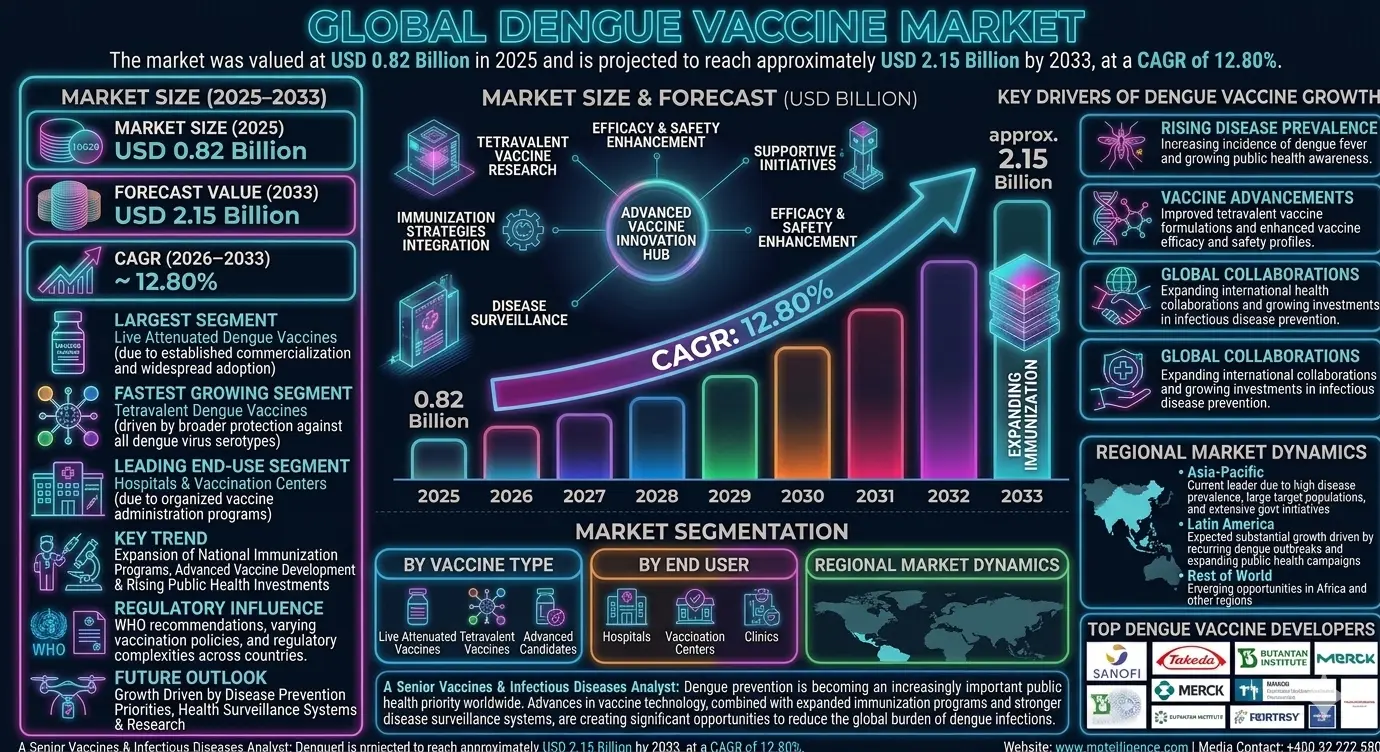
Global Dengue Vaccine Market Overview
The dengue vaccine market comprises vaccines developed to prevent infection from the four major dengue virus serotypes. These vaccines are utilized across hospitals, vaccination centers, government immunization programs, and public health campaigns. Increasing dengue outbreaks across Asia-Pacific, Latin America, and parts of Africa have heightened the importance of preventive vaccination strategies. Technological advancements in vaccine development, coupled with regulatory support from global health organizations, are shaping the future landscape of the market.Structural Drivers of Market Growth
1. Rising Incidence of Dengue Fever Worldwide
The growing frequency and geographic spread of dengue outbreaks are increasing the need for effective preventive vaccination solutions. Market Implications: Governments and healthcare organizations are prioritizing dengue prevention strategies through expanded vaccination programs and public awareness campaigns.2. Expansion of National Immunization Programs
Several countries with high dengue prevalence are integrating dengue vaccines into public health and immunization initiatives. Market Implications: Increased government procurement and large-scale vaccination campaigns are expected to drive long-term demand for dengue vaccines.3. Advancements in Vaccine Research and Development
Continuous innovation in tetravalent vaccines and next-generation vaccine platforms is improving efficacy and safety profiles. Market Implications: Pharmaceutical companies investing in advanced vaccine technologies are expected to strengthen their market position and expand product adoption.4. Growing Global Public Health Investments
International health agencies and governments are increasing investments in infectious disease prevention and vaccination infrastructure. Market Implications: Enhanced healthcare funding is expected to improve vaccine accessibility and support market growth in emerging economies.Market Segmentation Analysis
By Vaccine Type
- Live Attenuated Dengue Vaccines: Largest segment due to established commercialization and widespread adoption in endemic regions.
- Tetravalent Dengue Vaccines: Fastest-growing segment driven by broader protection against all dengue virus serotypes.
- Next-Generation Dengue Vaccines: Emerging category focused on improved efficacy, safety, and long-term immunity.
By Age Group
- Pediatric Population: Major target group due to higher vulnerability in endemic regions.
- Adolescent Population: Increasing vaccination coverage through school-based immunization programs.
- Adult Population: Growing demand driven by public awareness and travel-related vaccination requirements.
By End Use
- Hospitals & Vaccination Centers: Largest segment due to organized vaccine administration and public immunization programs.
- Government Healthcare Facilities: Significant contributor through national vaccination initiatives.
- Community Health Clinics: Expanding role in rural and underserved population coverage.
Regional Market Dynamics
North America
Growing market supported by travel-related vaccination demand, research activities, and increasing awareness regarding mosquito-borne diseases.Europe
Steady growth driven by international travel vaccination requirements and strong vaccine regulatory frameworks.Asia-Pacific
Largest and fastest-growing region due to high dengue prevalence, large target population, and extensive government immunization programs.Latin America
Significant market driven by recurring dengue outbreaks and expanding public health vaccination campaigns.Middle East & Africa
Emerging market supported by increasing disease surveillance initiatives and strengthening healthcare infrastructure.Competitive Landscape
The Global Dengue Vaccine Market is moderately concentrated, with leading pharmaceutical companies and biotechnology firms focusing on vaccine innovation, clinical trials, regulatory approvals, and strategic collaborations to strengthen their market presence. Key Companies Operating in the Market Include:- Takeda Pharmaceutical Company Limited
- Sanofi S.A.
- Merck & Co., Inc.
- GlaxoSmithKline plc
- Pfizer Inc.
- Johnson & Johnson
- Biological E. Limited
- Panacea Biotec Ltd.
- Bharat Biotech International Limited
- Emergent BioSolutions Inc.
Strategic Outlook
The future of the dengue vaccine market will be driven by increasing vaccination coverage, ongoing clinical advancements, and broader public health initiatives aimed at controlling mosquito-borne diseases. Pharmaceutical companies are actively investing in next-generation vaccine platforms that offer improved efficacy across multiple dengue serotypes and age groups. Expanding government partnerships and international health collaborations will further accelerate vaccine deployment in high-risk regions. Technological innovation, stronger disease surveillance systems, and increasing healthcare spending are expected to enhance market accessibility and vaccination rates globally. The growing focus on preventive healthcare and infectious disease preparedness will continue to create substantial opportunities for vaccine manufacturers throughout the forecast period.Final Market Perspective
The Global Dengue Vaccine Market represents a critical component of global infectious disease prevention strategies. Rising dengue incidence, increasing public health investments, and continuous advancements in vaccine technology are supporting sustained market growth. As governments and healthcare organizations prioritize disease prevention and immunization programs, demand for safe, effective, and broadly accessible dengue vaccines is expected to increase significantly. Companies investing in research, innovation, and global vaccine accessibility will be well-positioned to capitalize on long-term opportunities in the evolving dengue vaccine landscape.Table of Contents
Table of Contents
- Executive Summary
- Global Dengue Vaccine Market Snapshot (2026???2033)
- Market Size & Growth Overview
- Key Market Highlights
- Largest & Fastest-Growing Segments
- Leading End-Use Segment Overview
- Key Market Trends in Dengue Prevention & Immunization
- Strategic Outlook Through 2033
- Market Introduction & Overview
- Definition of Dengue Vaccines
- Scope of the Global Dengue Vaccine Market
- Overview of Dengue Virus Serotypes and Disease Burden
- Role of Vaccination in Dengue Prevention Strategies
- Value Chain Analysis of the Dengue Vaccine Ecosystem
- Regulatory Influence (WHO Recommendations, National Vaccination Policies & Vaccine Approval Frameworks)
- Advancements in Dengue Vaccine Development Technologies
- Research Methodology
- Primary Research Approach
- Secondary Research Sources
- Market Size Estimation Methodology
- Forecasting Assumptions (2026???2033)
- Data Validation & Triangulation Process
- Market Dynamics
- Structural Drivers of Market Growth
- Rising Incidence of Dengue Fever Worldwide
- Expansion of National Immunization Programs
- Advancements in Vaccine Research and Development
- Growing Global Public Health Investments
- Market Restraints
- High Development and Regulatory Approval Costs
- Vaccine Safety and Efficacy Concerns
- Limited Vaccine Accessibility in Certain Regions
- Market Opportunities
- Expansion into Emerging Dengue-Endemic Markets
- Development of Next-Generation Tetravalent Vaccines
- Strengthening Public-Private Healthcare Partnerships
- Increasing Investments in Infectious Disease Prevention
- Market Challenges
- Complexity of Multi-Serotype Dengue Protection
- Distribution and Cold Chain Management Challenges
- Public Awareness and Vaccine Acceptance Barriers
- Structural Drivers of Market Growth
- Global Dengue Vaccine Market Size & Forecast (2026???2033)
- Market Revenue Analysis
- CAGR Analysis
- Vaccination Coverage Trends
- Public Health Investment Analysis
- Vaccine Adoption Trends
- Future Market Outlook
- Market Segmentation Analysis (2026???2033)
- By Vaccine Type
- Live Attenuated Dengue Vaccines (Largest Segment)
- Tetravalent Dengue Vaccines (Fastest-Growing Segment)
- Next-Generation Dengue Vaccines
- By Age Group
- Pediatric Population
- Adolescent Population
- Adult Population
- By End Use
- Hospitals & Vaccination Centers (Largest Segment)
- Government Healthcare Facilities
- Community Health Clinics
- By Vaccine Type
- Regional Market Analysis
- North America
- Europe
- Asia-Pacific (Largest & Fastest-Growing Regional Market)
- Latin America
- Middle East & Africa
- Competitive Landscape
- Market Structure & Competitive Analysis
- Key Player Benchmarking
- Strategic Developments
- Vaccine Innovation & Clinical Development Strategies
- Partnerships, Collaborations & Regulatory Approvals
- Company Profiles
- Takeda Pharmaceutical Company Limited
- Sanofi S.A.
- Merck & Co., Inc.
- GlaxoSmithKline plc
- Pfizer Inc.
- Johnson & Johnson
- Biological E. Limited
- Panacea Biotec Ltd.
- Bharat Biotech International Limited
- Emergent BioSolutions Inc.
- Strategic Outlook
- Future of Dengue Immunization Programs
- Advancements in Next-Generation Vaccine Technologies
- Expansion of Global Vaccine Accessibility
- Strengthening Disease Surveillance & Prevention Systems
- Long-Term Market Outlook (2033+)
- Final Market Perspective
- Appendix
- About Pheonix Market Research
- Disclaimer
Competitive Landscape
Global Dengue Vaccine Market Competitive Intensity & Market Structure Overview
The Global Dengue Vaccine Market is moderately concentrated, with a limited number of multinational pharmaceutical companies and biotechnology firms actively engaged in vaccine development, commercialization, and distribution. Competitive intensity is primarily driven by clinical efficacy across all four dengue serotypes, regulatory approvals, safety profiles, immunization coverage strategies, and access to emerging markets.
Companies in this market compete across live attenuated vaccines, tetravalent vaccine platforms, and next-generation recombinant and viral-vector-based vaccine candidates. Strong emphasis on clinical trial outcomes, WHO recommendations, and national immunization program inclusion significantly influences competitive positioning.
The market structure is evolving from traditional vaccine development models toward platform-based innovation, strategic public-private partnerships, and large-scale government procurement-driven distribution systems. Collaboration with global health organizations and national health ministries is becoming a key competitive differentiator.
Global Dengue Vaccine Market Competitive Intensity & Market Structure Current Scenario
Leading Global Dengue Vaccine Market Companies
- Takeda Pharmaceutical Company Limited: A leading player with a focus on tetravalent dengue vaccine development and large-scale global commercialization strategies in endemic regions.
- Sanofi S.A.: One of the earliest developers of dengue vaccines, with established presence in multiple dengue-endemic countries and ongoing portfolio expansion.
- Merck & Co., Inc.: Actively involved in vaccine research and development with a strong focus on infectious disease prevention and immunology innovation.
- GlaxoSmithKline plc: A major vaccine developer leveraging advanced immunology platforms and global distribution networks for infectious disease vaccines.
- Pfizer Inc.: Focused on next-generation vaccine technologies, mRNA platforms, and expansion into emerging infectious disease prevention markets.
- Johnson & Johnson: Engaged in vaccine research and global health initiatives with strong capabilities in large-scale vaccine deployment and public health partnerships.
- Biological E. Limited: A key emerging-market vaccine manufacturer focusing on affordable vaccine production and expanding immunization access in Asia and Africa.
- Panacea Biotec Ltd.: Specializes in vaccine manufacturing and distribution with a strong presence in public immunization programs in developing regions.
- Bharat Biotech International Limited: Focuses on innovative vaccine development and cost-effective solutions for large-scale immunization programs in endemic regions.
- Emergent BioSolutions Inc.: Provides specialized vaccine development and biodefense-related immunization solutions with growing participation in infectious disease markets.
Key Competitive Intensity & Market Structure Drivers
The rising burden of dengue infections across Asia-Pacific, Latin America, and Africa is significantly intensifying competition among vaccine developers and public health stakeholders.
Clinical efficacy across all dengue serotypes remains a key competitive factor, with companies investing heavily in tetravalent vaccine technologies and next-generation platforms.
Regulatory approvals from global health authorities such as WHO and national immunization agencies strongly influence market entry and commercial success.
Expansion of national immunization programs and government procurement initiatives is shaping demand patterns and creating volume-driven competition among manufacturers.
Strategic collaborations between pharmaceutical companies, governments, and global health organizations are becoming critical for large-scale vaccine distribution and adoption.
Strategic Implications of Competitive Intensity & Market Structure
Companies with advanced tetravalent vaccine platforms, strong clinical trial pipelines, and regulatory approvals across multiple regions are expected to maintain competitive leadership.
Investment in scalable vaccine manufacturing, cold-chain logistics, and public-private partnerships is becoming essential for global market expansion.
Firms focusing on affordability, accessibility, and integration into national immunization programs are likely to achieve stronger adoption in emerging markets.
Strategic expansion into endemic regions through government collaborations and global health initiatives is significantly enhancing market penetration opportunities.
Organizations that combine innovation, regulatory compliance, and large-scale distribution capabilities will be best positioned to compete effectively in the evolving dengue vaccine ecosystem.
Global Dengue Vaccine Market Competitive Intensity & Market Structure Forward Outlook
The competitive landscape of the global dengue vaccine market is expected to intensify as next-generation vaccine technologies, including recombinant and platform-based vaccines, advance through clinical development stages.
Future competition will be shaped by improvements in serotype coverage, long-term immunity effectiveness, vaccine safety profiles, and integration into universal immunization programs.
Pharmaceutical companies are expected to increase investments in R&D, global clinical trials, and partnerships with international health organizations to strengthen their market positioning.
Over the forecast period, companies that successfully align scientific innovation with public health policy integration, affordability, and large-scale accessibility will be best positioned to lead the global dengue vaccine market.
Value Chain
Global Dengue Vaccine Market Value Chain & Supply Chain Evolution Overview
The Global Dengue Vaccine Market operates through a highly regulated healthcare value chain involving vaccine research, antigen development, clinical trials, manufacturing, regulatory approvals, distribution, immunization programs, and end-user administration. The market plays a critical role in global infectious disease prevention by supporting vaccination efforts against dengue fever across endemic and high-risk regions.
The value chain is driven by collaboration among pharmaceutical companies, biotechnology firms, contract manufacturing organizations, regulatory agencies, healthcare providers, and public health institutions. Efficient coordination across these stakeholders is essential to ensure vaccine safety, efficacy, accessibility, and large-scale immunization coverage.
As dengue incidence continues to rise globally, the supply chain is evolving toward increased production capacity, stronger cold chain infrastructure, advanced vaccine technologies, and broader public-private partnerships aimed at improving vaccine accessibility and distribution.
Global Dengue Vaccine Market Value Chain & Supply Chain Evolution Current Scenario
Market-Specific Value Chain
- Research & Antigen Discovery: Identification of dengue virus strains, vaccine target development, immunology research, and antigen design for effective protection against multiple serotypes.
- Vaccine Development & Clinical Trials: Preclinical studies, Phase I-IV clinical trials, efficacy evaluation, safety assessments, and vaccine optimization.
- Vaccine Manufacturing: Production of live attenuated vaccines, tetravalent vaccines, formulation processes, quality control, and large-scale vaccine manufacturing.
- Regulatory Review & Approval: Evaluation by national regulatory agencies, WHO prequalification processes, safety monitoring, and market authorization.
- Cold Chain Storage & Logistics: Temperature-controlled transportation, vaccine warehousing, inventory management, and distribution infrastructure.
- Public Health Procurement & Distribution: Government vaccine procurement, international health organization programs, immunization campaigns, and healthcare network distribution.
- Vaccination Administration: Delivery through hospitals, vaccination centers, government healthcare facilities, and community health clinics.
- Post-Vaccination Monitoring: Pharmacovigilance programs, adverse event reporting, surveillance systems, and long-term effectiveness monitoring.
Company-to-Stage Mapping
- Research & Antigen Discovery: Takeda Pharmaceutical Company Limited, Sanofi S.A., Merck & Co., and academic research institutions.
- Vaccine Development & Clinical Trials: Takeda, Sanofi, GlaxoSmithKline plc, Pfizer Inc., Bharat Biotech, and biotechnology research organizations.
- Vaccine Manufacturing: Takeda Pharmaceutical Company Limited, Biological E. Limited, Panacea Biotec Ltd., Bharat Biotech International Limited, and vaccine manufacturing facilities.
- Regulatory Review & Approval: World Health Organization (WHO), U.S. FDA, EMA, national health authorities, and vaccine regulatory agencies.
- Cold Chain Storage & Logistics: Specialized vaccine logistics providers, healthcare distributors, and cold chain management companies.
- Public Health Procurement & Distribution: UNICEF, PAHO, government health ministries, public procurement agencies, and international health organizations.
- Vaccination Administration: Hospitals, vaccination centers, government healthcare facilities, and community health clinics.
- Post-Vaccination Monitoring: Public health agencies, disease surveillance organizations, healthcare providers, and pharmacovigilance authorities.
Key Value Chain & Supply Chain Evolution Signals
- Expansion of National Immunization Programs: Governments are increasingly incorporating dengue vaccines into routine vaccination schedules in endemic regions.
- Growth of Tetravalent Vaccine Development: Manufacturers are focusing on vaccines that provide protection against all four dengue virus serotypes.
- Strengthening of Global Cold Chain Infrastructure: Investments in temperature-controlled logistics are improving vaccine accessibility and distribution efficiency.
- Increasing Public Health Investments: Governments and international organizations are allocating greater resources to dengue prevention initiatives.
- Advancement of Vaccine Technologies: Research efforts are improving vaccine efficacy, safety profiles, and long-term immunity outcomes.
- Expansion of Global Disease Surveillance Networks: Enhanced monitoring systems are supporting targeted vaccination campaigns and outbreak prevention strategies.
Strategic Implications of Value Chain Evolution
- Investment in Advanced Vaccine Platforms: Companies developing next-generation dengue vaccines can strengthen competitive positioning and market penetration.
- Expansion of Manufacturing Capacity: Increasing production capabilities is essential to meet rising global vaccine demand.
- Strengthening Public-Private Partnerships: Collaboration between governments, healthcare agencies, and manufacturers can improve vaccination coverage.
- Enhancement of Cold Chain Capabilities: Reliable vaccine storage and transportation systems are critical for maintaining product quality and accessibility.
- Focus on Regulatory Compliance: Adherence to global vaccine approval standards supports broader commercialization opportunities.
- Expansion into Emerging Markets: Companies targeting high-incidence regions can benefit from increasing public health investments and immunization initiatives.
Global Dengue Vaccine Market Value Chain & Supply Chain Evolution Forward Outlook
- Expansion of tetravalent and next-generation dengue vaccine development programs.
- Increased integration of dengue vaccines into national immunization schedules.
- Growth of vaccine manufacturing capacity across emerging and developed markets.
- Strengthening of global cold chain and vaccine distribution infrastructure.
- Expansion of international public health collaborations and funding programs.
- Advancement of disease surveillance and post-vaccination monitoring systems.
The dengue vaccine value chain is expected to become increasingly integrated, scalable, and innovation-driven as governments and healthcare organizations prioritize infectious disease prevention. Enhanced manufacturing capabilities, regulatory support, and public health partnerships will play a critical role in improving vaccine accessibility worldwide.
Organizations that successfully combine vaccine innovation, production efficiency, regulatory excellence, and global distribution capabilities will be best positioned to capture long-term growth opportunities in the Global Dengue Vaccine Market.
Investment Activity
Global Dengue Vaccine Market Investment & Funding Dynamics Overview (2026???2033)
The Global Dengue Vaccine Market is witnessing increasing investment momentum driven by the rising global burden of dengue fever, expanding national immunization programs, and sustained advancements in vaccine research and development. Pharmaceutical companies, biotechnology firms, government health agencies, and global public health organizations are actively directing capital toward next-generation dengue vaccines, tetravalent vaccine platforms, clinical trials, vaccine manufacturing infrastructure, and cold-chain distribution systems.
Funding activity is increasingly focused on improving vaccine efficacy across all dengue serotypes, expanding immunization coverage in endemic regions, and strengthening large-scale vaccine production capabilities. Significant investments are being made in live attenuated vaccines, tetravalent vaccine candidates, next-generation immunization technologies, and public health vaccination delivery systems.
Additionally, growing financial support from governments and international health organizations is accelerating vaccine accessibility programs, disease surveillance systems, and public health immunization infrastructure, particularly in Asia-Pacific and Latin America where dengue incidence remains high.
Current Investment & Funding Landscape
The current market landscape is characterized by strong public-sector and private-sector collaboration aimed at accelerating vaccine development and distribution. Governments in dengue-endemic regions are increasing procurement budgets for national immunization programs and large-scale vaccination campaigns.
Pharmaceutical and biotech companies are attracting significant R&D funding for clinical trials, serotype-specific vaccine optimization, and next-generation tetravalent vaccine development. Investment is also increasing in biomanufacturing facilities, vaccine scalability solutions, and cold-chain logistics infrastructure.
Strategic partnerships between vaccine developers, global health organizations, research institutes, and public health agencies are further strengthening innovation pipelines and accelerating regulatory approvals across multiple regions.
Key Investment & Funding Dynamics Signals
- Rising demand for tetravalent dengue vaccines is driving R&D-focused investment activity.
- Expansion of national immunization programs is increasing government procurement and funding flows.
- Growing investment in vaccine manufacturing capacity and biopharmaceutical infrastructure is supporting large-scale production.
- Increasing focus on next-generation vaccine platforms with improved efficacy and safety is accelerating innovation funding.
- Rising incidence of dengue outbreaks is boosting investments in preventive healthcare and immunization strategies.
- Global health organizations are increasing funding for disease surveillance, vaccine access, and public health preparedness programs.
- Strategic collaborations between pharma companies, governments, and research institutes are enhancing vaccine development pipelines.
Strategic Implications of Investment & Funding Dynamics
- Companies investing in advanced tetravalent and next-generation dengue vaccines are expected to gain strong long-term market positioning.
- Capital allocation toward vaccine manufacturing scale-up and cold-chain infrastructure will be critical for global distribution efficiency.
- Firms focusing on multi-serotype vaccine efficacy and improved immunization outcomes are likely to attract sustained funding support.
- Strategic partnerships across public health organizations and pharmaceutical companies will accelerate vaccine accessibility in endemic regions.
- Investment in clinical research and real-world efficacy studies will strengthen regulatory approvals and market adoption.
- Government-backed procurement programs will continue to play a major role in market demand stabilization and revenue assurance.
- Organizations aligned with global immunization goals and infectious disease prevention strategies will capture long-term value creation opportunities.
Forward Outlook
Looking ahead, the Global Dengue Vaccine Market is expected to experience sustained investment growth driven by rising dengue incidence, expanded immunization coverage, and continuous advancements in vaccine technology. Capital deployment will increasingly focus on next-generation dengue vaccines, scalable manufacturing systems, global vaccination campaigns, and improved serotype coverage solutions.
Future funding will also be supported by strengthening international collaboration among governments, health agencies, and pharmaceutical companies aimed at improving vaccine access in high-risk regions.
As global public health systems intensify efforts to control mosquito-borne diseases, investment activity will expand across vaccine innovation, biomanufacturing, distribution infrastructure, and immunization program development.
In conclusion, the Global Dengue Vaccine Market represents a high-impact public health investment landscape where vaccine innovation, global immunization expansion, manufacturing scalability, and disease prevention strategies will define future funding priorities and long-term industry growth.
Technology & Innovation
Global Dengue Vaccine Market Technology & Innovation Landscape Overview
The global dengue vaccine market is undergoing significant technological advancement driven by innovations in tetravalent vaccine development, recombinant vaccine platforms, live attenuated vaccine technologies, molecular virology research, and advanced immunization delivery systems. As dengue incidence continues to rise across tropical and subtropical regions, vaccine manufacturers and public health organizations are increasingly focusing on developing safe, effective, and broadly protective vaccination solutions.
Modern dengue vaccine development programs increasingly integrate genetic engineering, viral vector technologies, antigen optimization platforms, immunogenicity enhancement techniques, and advanced clinical trial methodologies to improve vaccine efficacy against all four dengue virus serotypes. These innovations are helping address challenges associated with immune response variability and long-term protection.
The market is also witnessing growing adoption of next-generation vaccine manufacturing technologies, AI-assisted vaccine discovery platforms, cold-chain optimization systems, and scalable biologics production capabilities, enabling faster development, improved vaccine quality, and broader global distribution.
Global Dengue Vaccine Market Technology & Innovation Current Scenario
Current innovation within the dengue vaccine market is primarily focused on multivalent vaccine development, enhanced safety profiles, and expanded immunization coverage. Vaccine developers are working to improve efficacy across diverse populations while reducing the risk of vaccine-associated complications.
Tetravalent vaccine technologies are receiving substantial attention as they provide protection against all four dengue virus serotypes, helping reduce the risk of severe disease and recurrent infections.
Advanced biologics manufacturing platforms are improving production efficiency, quality control, and scalability, allowing manufacturers to meet increasing global vaccine demand.
Clinical research and immunological studies continue to expand understanding of dengue virus behavior, immune response mechanisms, and long-term vaccine effectiveness across different age groups and geographic regions.
Digital health technologies and immunization management systems are increasingly being deployed to support vaccine distribution, patient tracking, adverse event monitoring, and public health surveillance initiatives.
Additionally, international collaborations between pharmaceutical companies, governments, research institutions, and global health organizations are accelerating vaccine development, regulatory approvals, and access programs in dengue-endemic regions.
Key Technology & Innovation Trends in Global Dengue Vaccine Market
- Tetravalent Vaccine Development: Advanced formulations providing protection against all four dengue virus serotypes.
- Live Attenuated Vaccine Platforms: Enhanced vaccine designs improving immunogenicity and long-term protection.
- Recombinant Vaccine Technologies: Genetic engineering approaches supporting next-generation vaccine development.
- AI-Assisted Vaccine Discovery: Accelerating antigen selection, clinical research, and vaccine optimization processes.
- Advanced Biologics Manufacturing: Improving production scalability, quality assurance, and global supply capabilities.
- Immunogenicity Enhancement Technologies: Supporting stronger and more durable immune responses.
- Digital Immunization Management Systems: Enabling vaccination tracking, patient monitoring, and healthcare coordination.
- Cold Chain Optimization Solutions: Enhancing vaccine storage, transportation, and distribution efficiency.
- Global Disease Surveillance Integration: Supporting targeted vaccination strategies and outbreak management.
- Next-Generation Vaccine Research: Focusing on broader efficacy, improved safety profiles, and expanded population coverage.
Strategic Implications of Technology & Innovation
Technological advancements are transforming the dengue vaccine market from a traditional infectious disease prevention segment into a highly research-driven, innovation-focused, and globally coordinated public health ecosystem.
Companies investing in tetravalent vaccine technologies, advanced biologics manufacturing, and next-generation immunization platforms are strengthening their competitive positioning through improved efficacy, safety, and regulatory compliance.
The convergence of biotechnology, artificial intelligence, and immunology research is accelerating vaccine development timelines while improving clinical outcomes and disease prevention capabilities.
Digital monitoring systems and enhanced surveillance infrastructure are supporting more efficient vaccination campaigns, improved patient tracking, and better management of public health programs.
However, challenges including regulatory complexity, vaccine affordability, distribution logistics, varying healthcare infrastructure, and long-term efficacy assessment continue to influence market development and commercialization strategies.
Global Dengue Vaccine Market Technology & Innovation Forward Outlook
The future of the dengue vaccine market is expected to evolve toward next-generation multivalent vaccines, AI-driven vaccine development, highly scalable biologics manufacturing, and integrated global immunization ecosystems.
Emerging innovations include genetically optimized vaccine candidates, precision immunization approaches, predictive outbreak analytics, advanced adjuvant technologies, and digitally connected vaccination programs.
Dengue vaccine adoption is expected to accelerate significantly as governments expand immunization programs, healthcare infrastructure improves, and regulatory approvals support broader vaccine accessibility across endemic regions.
The integration of digital health platforms with vaccination management systems will further enhance disease surveillance, patient engagement, immunization coverage, and public health decision-making.
Overall, the global dengue vaccine market is evolving into a highly coordinated, science-driven ecosystem where biotechnology innovation, vaccine research, digital health infrastructure, and global public health initiatives collectively redefine dengue prevention and disease control strategies worldwide.
Market Risk
Global Dengue Vaccine Market Risk Factors & Disruption Threats Overview
The Global Dengue Vaccine Market operates within a highly regulated public health environment influenced by disease epidemiology, vaccine safety requirements, government immunization strategies, and global healthcare funding. While increasing dengue incidence, expanding vaccination programs, and ongoing vaccine innovation are supporting market growth, the industry faces significant risks related to vaccine efficacy concerns, regulatory complexity, funding constraints, and fluctuating disease outbreak patterns.
A major structural risk is the complexity of developing vaccines that provide consistent protection against all four dengue virus serotypes. Variations in immune response, age-related efficacy differences, and safety considerations continue to present scientific and commercial challenges for vaccine manufacturers.
Another important disruption factor is stringent regulatory oversight governing vaccine approvals, post-market surveillance, and immunization recommendations. Delays in clinical trials, safety evaluations, or regulatory approvals can significantly impact product commercialization timelines and market expansion.
The market is also exposed to public confidence risks, where concerns regarding vaccine safety, adverse event reporting, and misinformation campaigns can influence vaccination uptake and public health program effectiveness.
Additionally, dependence on government procurement programs, international health organizations, and public immunization budgets creates financial exposure to policy shifts, healthcare funding limitations, and changes in vaccination priorities.
Global Dengue Vaccine Market Risk Factors & Disruption Threats Current Scenario
The current market is characterized by growing efforts to expand vaccination coverage in dengue-endemic regions, supported by increasing public health awareness and stronger disease prevention initiatives.
Governments and international healthcare organizations are investing in vaccination campaigns, disease surveillance systems, and outbreak preparedness programs to reduce the burden of dengue infections.
At the same time, vaccine developers continue to focus on improving efficacy profiles, broadening age-group eligibility, and enhancing protection against multiple dengue serotypes through advanced vaccine technologies.
Regulatory agencies remain highly focused on vaccine safety monitoring, clinical effectiveness, and long-term immunization outcomes, influencing approval pathways and market adoption.
Competition is intensifying as pharmaceutical companies and biotechnology firms advance clinical research programs and seek to expand their presence across high-burden dengue regions.
Key Risk Factors & Disruption Threats Signals in Global Dengue Vaccine Market
A major disruption signal is the increasing emphasis on next-generation tetravalent dengue vaccines designed to provide broader and more consistent protection against all dengue virus serotypes.
Another important signal is the expansion of national immunization programs in dengue-endemic countries, creating new opportunities while increasing dependence on public-sector procurement decisions.
The growing integration of advanced disease surveillance systems and predictive epidemiological tools is improving outbreak monitoring and supporting targeted vaccination strategies.
Rising public health investments from governments, international organizations, and global health partnerships are strengthening vaccine accessibility and immunization infrastructure.
Additionally, climate change and the expanding geographic distribution of mosquito vectors are increasing dengue transmission risks, potentially reshaping future vaccination demand patterns.
Strategic Implications of Risk Factors & Disruption Threats in Global Dengue Vaccine Market
Vaccine manufacturers must prioritize clinical research, safety monitoring, and next-generation vaccine development to address evolving efficacy and immunization requirements.
Investment in large-scale production capabilities, supply chain resilience, and global distribution networks will be essential to support expanding vaccination programs and outbreak response efforts.
Companies should strengthen engagement with regulatory authorities, public health agencies, and international organizations to facilitate approvals and improve market access.
Building public confidence through transparent safety communication, educational initiatives, and evidence-based awareness campaigns will be critical for improving vaccine acceptance and coverage rates.
Strategic collaborations with governments, healthcare providers, research institutions, and global health organizations will play a key role in accelerating vaccine deployment and market expansion.
Global Dengue Vaccine Market Risk Factors & Disruption Threats Forward Outlook
Looking ahead to 2026???2033, the Global Dengue Vaccine Market is expected to evolve toward broader immunization coverage, improved vaccine efficacy, and more integrated disease prevention strategies.
Advancements in vaccine technology, including enhanced tetravalent formulations and next-generation immunization platforms, are expected to improve protection and expand eligible patient populations.
Government-supported vaccination programs and international public health partnerships will remain key growth drivers, particularly across Asia-Pacific, Latin America, and emerging healthcare markets.
Improved surveillance systems, digital health infrastructure, and predictive disease monitoring technologies will strengthen outbreak management and vaccination planning capabilities.
Overall, the market will remain strongly growth-oriented but increasingly shaped by vaccine safety requirements, regulatory compliance, public health funding, and scientific innovation. Long-term market leaders will be defined by their ability to deliver safe, effective, scalable, and globally accessible dengue vaccine solutions capable of supporting large-scale disease prevention initiatives.
Regulatory Landscape
Global Dengue Vaccine Market Regulatory & Policy Environment Overview
The regulatory and policy environment governing the Global Dengue Vaccine Market is becoming increasingly important as governments, public health agencies, and international organizations intensify efforts to combat the growing burden of dengue infections. Regulatory frameworks play a critical role in ensuring vaccine safety, efficacy, quality standards, and equitable access while supporting large-scale immunization programs in dengue-endemic regions.
Vaccine manufacturers, biotechnology companies, healthcare providers, public health agencies, and immunization program administrators must comply with comprehensive regulations covering vaccine development, clinical trials, manufacturing practices, product approvals, pharmacovigilance, and distribution requirements. These frameworks are designed to protect public health while facilitating timely access to effective dengue prevention solutions.
Global health organizations, including the World Health Organization (WHO), continue to provide guidance on vaccine recommendations, disease surveillance, immunization strategies, and regulatory harmonization efforts that influence vaccine adoption across multiple countries.
Global Dengue Vaccine Market Regulatory & Policy Environment Current Scenario
The current regulatory environment is characterized by strong oversight of vaccine safety and effectiveness through rigorous clinical evaluation and approval processes. National regulatory authorities require extensive clinical evidence before approving dengue vaccines for public use, particularly due to the complexity of protection across multiple dengue virus serotypes.
WHO recommendations play a significant role in shaping national vaccination policies and procurement decisions. Countries with high dengue prevalence often align immunization strategies with international guidance to improve disease prevention outcomes and public confidence in vaccination programs.
National immunization policies are increasingly supporting dengue vaccine deployment in endemic regions. Governments are expanding public vaccination initiatives, strengthening disease surveillance systems, and integrating dengue prevention into broader public health strategies.
Good Manufacturing Practice (GMP) requirements remain essential throughout the vaccine production process, ensuring product quality, consistency, and safety. Regulatory authorities continue to monitor manufacturing facilities and supply chains to maintain compliance standards.
Post-marketing surveillance and pharmacovigilance programs are also receiving increased attention, enabling health authorities to monitor vaccine performance, identify adverse events, and maintain long-term public trust in immunization programs.
Key Regulatory & Policy Environment Signals in Global Dengue Vaccine Market
- WHO Vaccine Recommendations: Global guidance supporting vaccine utilization strategies, target population identification, and public health implementation frameworks.
- National Vaccination Policies: Government-led immunization programs and vaccination schedules designed to reduce dengue disease burden.
- Vaccine Approval & Licensing Frameworks: Regulatory pathways governing clinical evaluation, safety assessment, efficacy validation, and market authorization.
- Good Manufacturing Practice (GMP) Requirements: Standards ensuring vaccine quality, consistency, production reliability, and supply chain integrity.
- Pharmacovigilance & Post-Market Surveillance: Ongoing monitoring systems for vaccine safety, effectiveness, and adverse event reporting.
- Public Health Funding & Procurement Policies: Government and international funding programs supporting vaccine access and large-scale immunization initiatives.
Strategic Implications of Regulatory & Policy Environment
The evolving regulatory landscape is encouraging vaccine developers to invest heavily in clinical research, safety monitoring, and regulatory compliance throughout the product lifecycle. Regulatory approval remains a critical factor influencing commercialization timelines and market expansion opportunities.
WHO recommendations and national immunization policies are accelerating vaccine adoption in dengue-endemic countries, creating significant opportunities for manufacturers capable of meeting public health requirements and supply demands.
Stringent clinical and manufacturing standards are driving investments in advanced vaccine technologies, quality assurance systems, and global regulatory expertise. Companies with strong regulatory capabilities are expected to gain competitive advantages in international markets.
Government procurement programs and public-sector vaccination initiatives are becoming increasingly important demand drivers, encouraging manufacturers to establish strategic partnerships with healthcare authorities and global health organizations.
As disease surveillance capabilities improve, regulatory agencies are expected to place greater emphasis on real-world effectiveness data, long-term safety monitoring, and evidence-based vaccination policies.
Global Dengue Vaccine Market Regulatory & Policy Environment Forward Outlook
Between 2026 and 2033, the regulatory environment for the global dengue vaccine market is expected to become more coordinated and supportive as governments strengthen infectious disease prevention strategies and expand immunization coverage. Regulatory agencies are likely to continue streamlining vaccine approval pathways while maintaining rigorous safety and efficacy standards.
WHO-led initiatives and international health collaborations are expected to promote greater harmonization of regulatory requirements, facilitating broader vaccine availability across dengue-endemic regions and emerging markets.
National vaccination programs are anticipated to expand further as countries seek to reduce healthcare burdens associated with recurring dengue outbreaks. Public funding mechanisms and procurement initiatives are likely to support wider vaccine accessibility.
Advancements in vaccine technology may lead to updated regulatory frameworks addressing next-generation vaccine platforms, broader age-group indications, and enhanced protection against multiple dengue virus serotypes.
Overall, the future regulatory landscape will be shaped by the convergence of WHO recommendations, national vaccination policies, vaccine approval frameworks, manufacturing quality standards, and pharmacovigilance systems. Companies capable of delivering safe, effective, compliant, and globally accessible dengue vaccines will be best positioned to capitalize on long-term opportunities within the evolving global dengue vaccine market.