
India Rare Earth Magnet Market Report, Size, Share and Forecast 2026–2033
India Rare Earth Magnet Market Forecast Snapshot (2026???2033)
| Metric | Value |
|---|---|
| Market Size (2025) | USD 1.28 Billion |
| Market Size (2033) | USD 3.42 Billion |
| CAGR (2026???2033) | 13.10% |
| Largest Segment | Neodymium-Iron-Boron (NdFeB) Magnets |
| Fastest Growing Segment | Electric Vehicle (EV) Motor Magnets |
| Leading End-Use Segment | Automotive & Electric Mobility |
| Key Trend | Localization of Rare Earth Supply Chains & EV Manufacturing Expansion |
| Regulatory Influence | Critical Mineral Policies, Production-Linked Incentive (PLI) Schemes & Import Substitution Initiatives |
| Future Outlook | Growth Driven by EV Adoption, Renewable Energy Capacity Expansion & Strategic Manufacturing Investments |
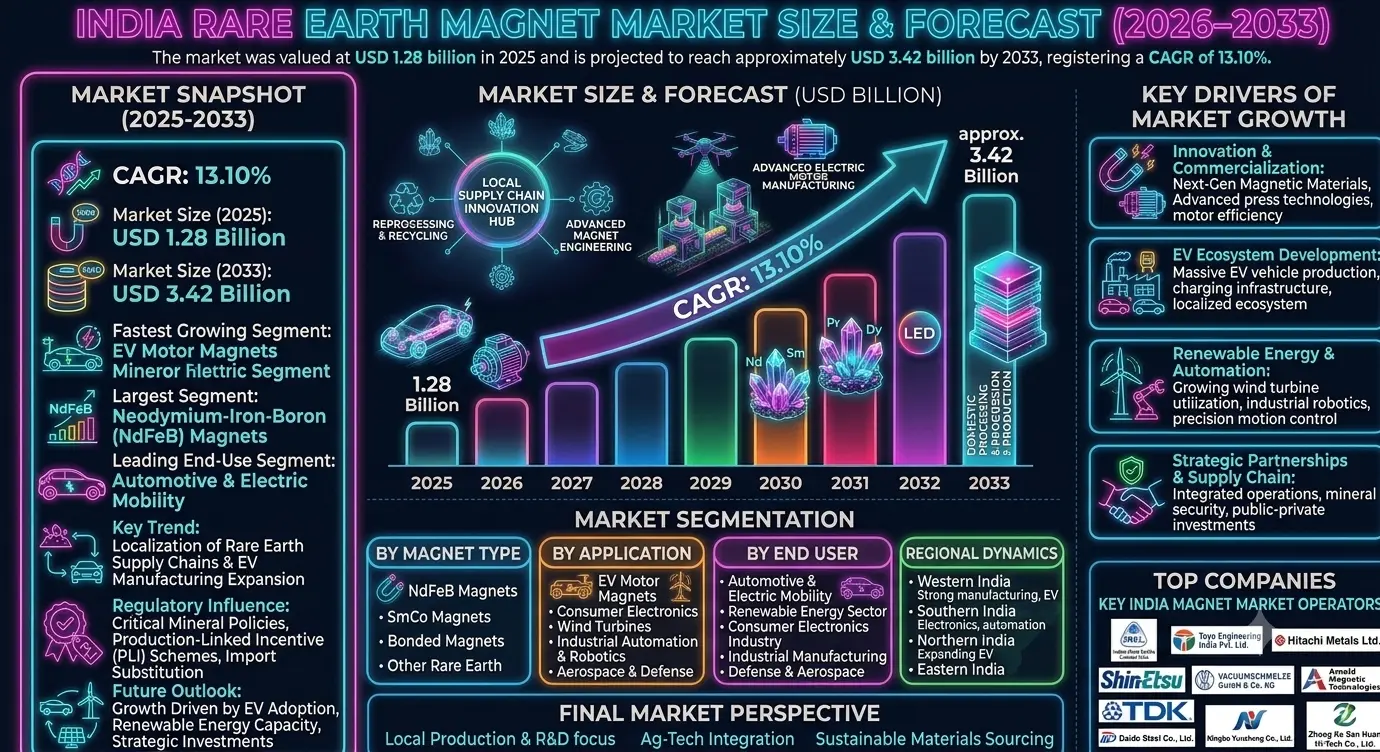
India Rare Earth Magnet Market Size & Forecast
The India Rare Earth Magnet Market is expected to witness robust growth during the forecast period from 2026 to 2033. The market was valued at USD 1.28 billion in 2025 and is projected to reach approximately USD 3.42 billion by 2033, registering a CAGR of 13.10%. The market growth is primarily driven by rising electric vehicle production, increasing renewable energy installations, growing industrial automation, and expanding domestic manufacturing initiatives. Rare earth magnets are critical components in electric motors, wind turbines, consumer electronics, defense systems, robotics, and industrial machinery due to their superior magnetic strength and efficiency. In addition, government initiatives focused on supply chain security, critical mineral development, and domestic manufacturing are supporting long-term market expansion.India Rare Earth Magnet Market Overview
Rare earth magnets are permanent magnets manufactured using rare earth elements such as neodymium, samarium, dysprosium, and praseodymium. These magnets provide significantly higher magnetic performance compared to conventional magnet technologies. The market includes neodymium-iron-boron (NdFeB) magnets, samarium cobalt (SmCo) magnets, bonded rare earth magnets, and customized high-performance magnetic solutions. Rare earth magnets are widely utilized across automotive, renewable energy, consumer electronics, aerospace, defense, industrial equipment, and healthcare applications. The market is transitioning toward localized manufacturing, advanced magnetic materials development, and strategic rare earth processing capabilities.Structural Drivers of Market Growth
1. Innovation and Commercialization Acceleration
Advancements in magnetic material engineering, motor efficiency optimization, and next-generation magnet manufacturing technologies are enhancing product performance. Research efforts are focused on improving magnet durability, reducing critical material dependence, and increasing energy efficiency.Market Implications
Companies investing in advanced magnetic technologies and domestic production capabilities are expected to strengthen market leadership.2. Compliance and Risk Repricing
Government policies promoting critical mineral security, domestic manufacturing, renewable energy adoption, and electric mobility are influencing market dynamics. India is increasingly prioritizing strategic resource independence and supply chain resilience.Market Implications
Firms aligned with national manufacturing initiatives and localization strategies are likely to gain stronger market opportunities.3. Competitive and Value-Chain Reconfiguration
The market is evolving as mining companies, material processors, magnet manufacturers, automotive suppliers, and technology providers strengthen domestic supply chains. Strategic collaborations between rare earth producers and end-use industries are reshaping value-chain economics.Market Implications
Companies focusing on vertically integrated operations and secure raw material sourcing may gain stronger competitive advantages.4. Capital and Capacity Scaling
Increasing investments in EV manufacturing, renewable energy infrastructure, semiconductor production, and advanced manufacturing facilities are supporting market growth. Public and private sector investments are accelerating the development of indigenous rare earth processing capabilities.Market Implications
Organizations scaling production capacity and technology capabilities are expected to capture future opportunities.Market Segmentation Analysis
By Magnet Type
1. Neodymium-Iron-Boron (NdFeB) Magnets
This remains the largest segment due to superior magnetic strength and extensive use in electric motors and electronics.2. Samarium Cobalt (SmCo) Magnets
Strong demand driven by high-temperature and aerospace applications.3. Bonded Rare Earth Magnets
Growing adoption in compact electronic devices and automotive systems.4. Other Rare Earth Magnets
Used in specialized industrial and defense applications.By Application
1. Electric Vehicle (EV) Motor Magnets
Fastest-growing segment driven by rapid EV adoption and domestic vehicle manufacturing expansion.2. Consumer Electronics
Strong demand for smartphones, audio devices, and electronic equipment.3. Wind Turbines
Growing utilization due to renewable energy capacity additions.4. Industrial Automation & Robotics
Increasing adoption for precision motion control systems.5. Aerospace & Defense
Strategic demand for advanced navigation, communication, and weapon systems.By End User
1. Automotive & Electric Mobility
Largest segment due to increasing production of electric vehicles and hybrid vehicles.2. Renewable Energy Sector
Growing demand for wind energy generation systems.3. Consumer Electronics Industry
Significant utilization in compact electronic devices and appliances.4. Industrial Manufacturing
Strong adoption across automation and machinery applications.5. Defense & Aerospace
Increasing deployment in strategic and mission-critical systems.Regional Market Dynamics
Western India
Western India dominates the market due to strong automotive manufacturing clusters, industrial infrastructure, and EV production facilities.Southern India
Southern India remains a major market supported by electronics manufacturing, industrial automation, and renewable energy investments.Northern India
North India is witnessing significant growth due to expanding EV adoption and government-backed manufacturing initiatives.Eastern India
Eastern India offers long-term growth opportunities owing to mineral resources and industrial development programs.Competitive Landscape
The India Rare Earth Magnet Market is moderately competitive with domestic manufacturers, material suppliers, and international companies expanding their regional presence.Key Companies Operating in the Market Include:
- Indian Rare Earths Limited (IREL)
- Toyo Engineering India Pvt. Ltd.
- Hitachi Metals Ltd.
- Shin-Etsu Chemical Co., Ltd.
- VACUUMSCHMELZE GmbH & Co. KG
- Arnold Magnetic Technologies
- TDK Corporation
- Daido Steel Co., Ltd.
- Ningbo Yunsheng Co., Ltd.
- Zhong Ke San Huan Hi-Tech Co., Ltd.
Strategic Outlook
The future of the India Rare Earth Magnet Market will be shaped by domestic rare earth processing capabilities, EV ecosystem development, renewable energy expansion, and strategic manufacturing investments. Advanced material research, recycling technologies, localized supply chains, and high-efficiency motor applications will significantly enhance market opportunities. The rise of electric mobility, industrial automation, and clean energy infrastructure is expected to create strong long-term growth opportunities.Final Market Perspective
The India Rare Earth Magnet Market remains a strategically important segment within the country's advanced manufacturing, clean energy, and mobility ecosystems. Rising demand for high-performance magnetic materials and increasing focus on supply chain localization continue driving long-term market growth. Companies capable of delivering reliable, scalable, and technologically advanced rare earth magnet solutions will be best positioned to capture future opportunities. The convergence of EV adoption, renewable energy deployment, industrial automation, and critical mineral security is expected to redefine the future of India's rare earth magnet industry.Table of Contents
Table of Contents
- 1. Executive Summary
- 1.1 India Rare Earth Magnet Market Snapshot (2026???2033)
- 1.2 Market Size & Growth Overview
- 1.3 Key Market Highlights
- 1.4 Largest & Fastest-Growing Segments
- 1.5 Regional Performance Summary
- 1.6 Competitive Landscape Overview
- 1.7 Strategic Outlook Through 2033
- 2. Market Introduction & Overview
- 2.1 Definition of Rare Earth Magnets
- 2.2 Scope of the India Rare Earth Magnet Market
- 2.3 Evolution of Rare Earth Magnet Technologies
- 2.4 Rare Earth Magnet Value Chain Analysis
- 2.5 Regulatory & Policy Framework
- 2.6 Emerging Trends in Electric Mobility & Renewable Energy
- 2.7 Role of Rare Earth Magnets in Strategic Manufacturing Industries
- 3. Research Methodology
- 3.1 Primary Research Approach
- 3.2 Secondary Research Sources
- 3.3 Market Size Estimation Methodology
- 3.4 Forecasting Assumptions (2026???2033)
- 3.5 Data Validation & Triangulation
- 4. Market Dynamics
- 4.1 Market Drivers
- 4.1.1 Rising Electric Vehicle Production & Adoption
- 4.1.2 Expansion of Renewable Energy Capacity
- 4.1.3 Growing Industrial Automation & Robotics Deployment
- 4.1.4 Government Support for Domestic Manufacturing & Localization
- 4.1.5 Increasing Demand for High-Performance Magnetic Materials
- 4.2 Market Restraints
- 4.2.1 Dependence on Imported Rare Earth Raw Materials
- 4.2.2 High Production & Processing Costs
- 4.2.3 Limited Domestic Rare Earth Processing Infrastructure
- 4.3 Market Opportunities
- 4.3.1 Development of Indigenous Rare Earth Supply Chains
- 4.3.2 Expansion of EV Manufacturing Ecosystem
- 4.3.3 Growth in Wind Energy & Clean Energy Projects
- 4.3.4 Advancements in Magnet Recycling Technologies
- 4.4 Market Challenges
- 4.4.1 Supply Chain Volatility for Critical Minerals
- 4.4.2 Geopolitical Risks in Rare Earth Sourcing
- 4.4.3 Scalability of Domestic Magnet Manufacturing Capacity
- 4.1 Market Drivers
- 5. India Rare Earth Magnet Market Size & Forecast (USD Billion), 2026???2033
- 5.1 Market Revenue Analysis
- 5.2 CAGR Analysis
- 5.3 Demand-Supply Trends
- 5.4 Pricing Analysis
- 5.5 Investment Trends
- 5.6 Future Market Outlook
- 6. Market Segmentation Analysis (USD Billion), 2026???2033
- 6.1 By Magnet Type
- 6.1.1 Neodymium-Iron-Boron (NdFeB) Magnets (Largest Segment)
- 6.1.2 Samarium Cobalt (SmCo) Magnets
- 6.1.3 Bonded Rare Earth Magnets
- 6.1.4 Other Rare Earth Magnets
- 6.2 By Application
- 6.2.1 Electric Vehicle (EV) Motor Magnets (Fastest-Growing Segment)
- 6.2.2 Consumer Electronics
- 6.2.3 Wind Turbines
- 6.2.4 Industrial Automation & Robotics
- 6.2.5 Aerospace & Defense
- 6.3 By End User
- 6.3.1 Automotive & Electric Mobility (Largest Segment)
- 6.3.2 Renewable Energy Sector
- 6.3.3 Consumer Electronics Industry
- 6.3.4 Industrial Manufacturing
- 6.3.5 Defense & Aerospace
- 6.1 By Magnet Type
- 7. Regional Market Analysis
- 7.1 Western India (Largest Market)
- 7.2 Southern India
- 7.3 Northern India
- 7.4 Eastern India
- 8. Competitive Landscape
- 8.1 Market Share Analysis
- 8.2 Competitive Benchmarking
- 8.3 Strategic Developments
- 8.4 Product Innovation & Localization Strategies
- 8.5 Partnerships, Acquisitions & Expansion Analysis
- 9. Company Profiles
- 9.1 Indian Rare Earths Limited (IREL)
- 9.2 Toyo Engineering India Pvt. Ltd.
- 9.3 Hitachi Metals Ltd.
- 9.4 Shin-Etsu Chemical Co., Ltd.
- 9.5 VACUUMSCHMELZE GmbH & Co. KG
- 9.6 Arnold Magnetic Technologies
- 9.7 TDK Corporation
- 9.8 Daido Steel Co., Ltd.
- 9.9 Ningbo Yunsheng Co., Ltd.
- 9.10 Zhong Ke San Huan Hi-Tech Co., Ltd.
- 10. Strategic Intelligence & Pheonix AI Insights
- 10.1 Rare Earth Magnet Demand Forecast Model
- 10.2 EV Manufacturing Opportunity Analysis
- 10.3 Renewable Energy Deployment Tracker
- 10.4 Critical Mineral Supply Chain Assessment
- 10.5 Automated Porter???s Five Forces Analysis
- 11. Future Outlook & Strategic Recommendations
- 11.1 Expansion of Domestic Rare Earth Processing Capabilities
- 11.2 Investment in Advanced Magnet Manufacturing Technologies
- 11.3 Growth Opportunities in EV & Renewable Energy Applications
- 11.4 Strengthening Critical Mineral Supply Chain Security
- 11.5 Long-Term Market Outlook (2033+)
- 12. Appendix
- 13. About Pheonix Market Research
- 14. Disclaimer
Competitive Landscape
India Rare Earth Magnet Market Competitive Intensity & Market Structure Overview
The India rare earth magnet market is moderately concentrated and strategically evolving, driven by increasing domestic demand from electric vehicles (EVs), renewable energy systems, industrial automation, consumer electronics, and defense applications. Competitive intensity is primarily shaped by access to rare earth raw materials, magnet manufacturing capabilities, technological expertise, supply chain integration, and long-term partnerships with end-use industries.
As India seeks to reduce dependence on imported rare earth magnets and strengthen domestic manufacturing, competition is intensifying among local producers, global magnet manufacturers, material processors, and technology providers. Companies are increasingly investing in localization strategies, advanced magnet technologies, and supply chain resilience to capitalize on growing demand across strategic sectors.
The market structure is gradually transitioning from import-dependent sourcing toward a more integrated ecosystem encompassing rare earth mining, processing, magnet production, recycling, and downstream industrial applications. Government support for critical minerals and manufacturing self-sufficiency is accelerating industry transformation.
India Rare Earth Magnet Market Competitive Intensity & Market Structure Current Scenario
Leading Companies Operating in the Market
Indian Rare Earths Limited (IREL): India’s leading rare earth processing company with strategic importance in domestic rare earth resource development and supply chain security.
Hitachi Metals Ltd.: A global leader in high-performance NdFeB magnet technologies, serving automotive, industrial, and electronics applications.
Shin-Etsu Chemical Co., Ltd.: One of the world’s largest rare earth magnet manufacturers with strong expertise in advanced magnetic materials and high-performance applications.
VACUUMSCHMELZE GmbH & Co. KG: A major producer of premium magnetic materials and rare earth magnet solutions for industrial, automotive, and renewable energy sectors.
TDK Corporation: A global electronics and magnetic materials company supplying advanced magnet solutions for automotive and electronic applications.
Daido Steel Co., Ltd.: A key manufacturer of high-performance rare earth magnets used in EVs, industrial equipment, and advanced machinery.
Arnold Magnetic Technologies: Specializes in engineered magnetic solutions for aerospace, defense, industrial, and electric mobility applications.
Ningbo Yunsheng Co., Ltd.: One of the leading global NdFeB magnet manufacturers with extensive production capabilities and international market presence.
Zhong Ke San Huan Hi-Tech Co., Ltd.: A major Chinese rare earth magnet producer focused on advanced permanent magnet technologies and large-scale manufacturing.
Toyo Engineering India Pvt. Ltd.: Active in supporting industrial projects and technology integration within India’s growing rare earth and advanced manufacturing ecosystem.
Key Competitive Intensity & Market Structure Drivers
India’s growing electric vehicle industry is significantly increasing demand for high-performance NdFeB magnets, intensifying competition among manufacturers seeking long-term supply agreements with automotive OEMs.
Government initiatives focused on critical mineral security, domestic manufacturing, and import substitution are encouraging investments in local rare earth processing and magnet production facilities.
Supply chain concentration in global rare earth production remains a key competitive factor, prompting companies to diversify sourcing strategies and strengthen localized manufacturing capabilities.
Technological advancements in magnet design, recycling technologies, and material efficiency are becoming critical differentiators for manufacturers seeking cost optimization and performance enhancement.
Growing adoption of renewable energy systems, particularly wind turbines, is expanding market opportunities and increasing competition among suppliers targeting clean energy applications.
Strategic Implications of Competitive Intensity & Market Structure
Companies with secure access to rare earth raw materials, advanced processing technologies, and vertically integrated manufacturing capabilities are expected to gain significant competitive advantages.
Strategic collaborations between mining companies, magnet manufacturers, automotive OEMs, and renewable energy developers are becoming increasingly important for long-term market positioning.
Investment in recycling technologies and alternative rare earth sourcing solutions is emerging as a critical strategy for reducing supply risks and improving sustainability.
Firms capable of delivering high-performance, cost-efficient, and locally manufactured magnet solutions are likely to benefit from India’s industrial development and self-reliance initiatives.
Expansion of domestic production capacity and advanced research programs will play a vital role in strengthening India’s competitiveness within the global rare earth magnet value chain.
India Rare Earth Magnet Market Competitive Intensity & Market Structure Forward Outlook
The competitive landscape of the India rare earth magnet market is expected to become increasingly innovation-driven as demand from electric mobility, renewable energy, industrial automation, and defense sectors continues to accelerate.
Future competition will be shaped by advancements in magnetic material engineering, localized rare earth processing capabilities, recycling technologies, and high-efficiency motor applications.
Government-backed initiatives aimed at strengthening critical mineral supply chains and reducing import dependency are expected to create new opportunities for domestic manufacturers and international partnerships.
Over the forecast period, companies that successfully combine technological innovation, supply chain security, production scalability, and strategic customer relationships will be best positioned to lead the evolving India rare earth magnet market.
Value Chain
India Rare Earth Magnet Market Value Chain & Supply Chain Evolution Overview
The India Rare Earth Magnet Market is undergoing a significant transformation driven by accelerating electric vehicle (EV) adoption, renewable energy expansion, industrial automation growth, and increasing focus on domestic critical mineral security. The market???s value chain spans rare earth mining, mineral processing, separation and refining, magnet manufacturing, component integration, and deployment across automotive, renewable energy, electronics, and defense industries.
A defining feature of this value chain is the growing emphasis on supply chain localization and import substitution. India is strengthening domestic capabilities across rare earth extraction, processing, and high-performance magnet production to reduce dependence on global supply sources and enhance strategic manufacturing resilience.
Supply chain complexity remains high due to limited rare earth processing infrastructure, dependence on specialized refining technologies, fluctuating raw material availability, environmental compliance requirements, and the need for advanced manufacturing expertise. Market participants must coordinate across mining operators, rare earth processors, magnet manufacturers, automotive OEMs, renewable energy equipment suppliers, and industrial technology providers.
Companies are increasingly investing in advanced magnet manufacturing technologies, recycling initiatives, strategic sourcing partnerships, and localized production facilities to strengthen supply chain security and support growing domestic demand. The value chain is evolving into a technologically advanced, vertically integrated, and strategically important ecosystem supporting India’s clean energy and manufacturing ambitions.
India Rare Earth Magnet Market Value Chain & Supply Chain Evolution Current Scenario
Market-Specific Value Chain
- Rare Earth Mining & Extraction: Exploration, mining, beneficiation, and recovery of rare earth-bearing minerals.
- Processing & Refining: Separation of rare earth oxides, purification, metallization, and production of high-purity rare earth materials.
- Magnet Manufacturing: Production of NdFeB magnets, SmCo magnets, bonded magnets, sintering, machining, coating, and quality testing.
- Component Integration: Integration of magnets into electric motors, generators, sensors, electronics, robotics, and industrial equipment.
- Distribution & Industrial Supply: Supply chain management, industrial distribution networks, OEM procurement systems, and strategic sourcing partnerships.
- End User Deployment: Automotive manufacturers, renewable energy developers, electronics companies, industrial automation firms, and defense organizations.
Company-to-Stage Mapping
- Rare Earth Mining & Extraction: Indian Rare Earths Limited (IREL) and domestic mineral resource developers.
- Processing & Refining: IREL, specialized rare earth processors, and emerging domestic refining facilities.
- Magnet Manufacturing: Hitachi Metals Ltd., Shin-Etsu Chemical Co., Ltd., Ningbo Yunsheng Co., Ltd., Zhong Ke San Huan Hi-Tech Co., Ltd., and regional magnet producers.
- Component Integration: Automotive suppliers, EV motor manufacturers, industrial equipment producers, and electronics companies.
- Distribution & Industrial Supply: Industrial distributors, OEM procurement networks, and specialized materials suppliers.
- End User Deployment: Automotive & electric mobility companies, renewable energy developers, consumer electronics manufacturers, industrial automation providers, and defense organizations.
Key Value Chain & Supply Chain Evolution Signals in India Rare Earth Magnet Market
Localization of Rare Earth Supply Chains
Government-backed initiatives aimed at strengthening domestic mining, refining, and magnet production capabilities are reducing reliance on imports and enhancing supply chain resilience.
Rapid Expansion of EV Manufacturing Ecosystem
Increasing EV production is significantly boosting demand for high-performance NdFeB magnets used in traction motors and advanced vehicle systems.
Growth of Renewable Energy Installations
Expanding wind energy capacity is driving demand for rare earth magnets used in high-efficiency wind turbine generators.
Investment in Advanced Magnet Manufacturing Technologies
Manufacturers are adopting advanced production techniques to improve magnetic performance, durability, and production efficiency.
Strategic Focus on Critical Mineral Security
National policies promoting critical mineral development are encouraging investment in domestic processing and value-added manufacturing.
Emergence of Rare Earth Recycling Ecosystems
Growing interest in magnet recycling and circular economy initiatives is creating alternative sources of critical rare earth materials.
Strategic Implications of Value Chain & Supply Chain Evolution
Investment in Domestic Processing Infrastructure
Companies expanding rare earth refining and processing capabilities can strengthen supply security and improve value-chain control.
Vertical Integration Across the Supply Chain
Integration from raw material sourcing to magnet production and component manufacturing can improve operational efficiency and competitiveness.
Strengthening EV and Renewable Energy Partnerships
Strategic collaborations with automotive OEMs and renewable energy equipment manufacturers can support long-term demand growth.
Expansion of Advanced Manufacturing Capabilities
Investment in high-performance magnet technologies and precision manufacturing can enhance product differentiation and market positioning.
Development of Recycling and Circular Economy Models
Recycling initiatives can improve resource efficiency and reduce dependence on primary raw material imports.
Enhancing Supply Chain Resilience
Diversified sourcing strategies, localized production, and strategic inventory management can reduce supply disruptions and geopolitical risks.
India Rare Earth Magnet Market Value Chain & Supply Chain Evolution Forward Outlook
Looking ahead, the value chain is expected to evolve into a more localized, technologically advanced, and strategically integrated ecosystem supporting India’s ambitions in electric mobility, renewable energy, and advanced manufacturing.
Key Future Developments Include:
- Expansion of domestic rare earth mining, refining, and magnet manufacturing infrastructure.
- Increasing adoption of NdFeB magnets across EVs, industrial automation systems, and renewable energy applications.
- Strengthening of strategic partnerships between material suppliers, OEMs, and technology providers.
- Growth of recycling technologies and circular economy initiatives for rare earth materials.
- Development of advanced high-efficiency magnet technologies with reduced critical material dependency.
- Greater integration of government-supported critical mineral and manufacturing initiatives.
As the market evolves, competitive advantage will increasingly depend on the ability to secure raw materials, develop advanced manufacturing capabilities, establish resilient supply chains, and support high-growth sectors such as electric mobility and renewable energy.
Companies that successfully integrate rare earth processing, magnet manufacturing, technology innovation, and strategic industry partnerships will achieve stronger market positioning, supply chain security, and long-term growth within the India Rare Earth Magnet Market.
Investment Activity
India Rare Earth Magnet Market Investment & Funding Dynamics Overview
The India Rare Earth Magnet Market is witnessing increasing investment activity driven by the rapid expansion of electric vehicle manufacturing, renewable energy installations, industrial automation, and the growing strategic importance of critical minerals. Government agencies, private manufacturers, mining companies, automotive OEMs, renewable energy developers, and institutional investors are actively allocating capital toward rare earth processing facilities, magnet manufacturing plants, supply chain localization initiatives, and advanced material research programs.
Investment momentum is accelerating as India seeks to reduce dependence on imported rare earth magnet supplies and strengthen domestic capabilities across critical mineral value chains. Capital deployment is increasingly focused on NdFeB magnet production, rare earth refining infrastructure, recycling technologies, high-performance magnetic materials, and integrated manufacturing ecosystems.
Additionally, rising investments in electric mobility infrastructure, wind energy projects, semiconductor manufacturing, and strategic industrial development programs are creating substantial long-term opportunities across the India rare earth magnet industry.
India Rare Earth Magnet Market Investment & Funding Dynamics Current Scenario
Currently, the market is attracting significant investments from public and private stakeholders aiming to establish domestic rare earth processing and magnet manufacturing capabilities. Industry participants are investing heavily in advanced production technologies, capacity expansion projects, strategic sourcing partnerships, and localized supply chain development.
The market is benefiting from government-backed initiatives including Production-Linked Incentive (PLI) schemes, critical mineral development policies, import substitution programs, and manufacturing localization strategies, which are encouraging long-term capital commitments.
Furthermore, strategic collaborations among rare earth mining companies, material processors, automotive manufacturers, renewable energy firms, and technology providers are increasing as stakeholders seek to secure reliable access to critical magnetic materials and strengthen domestic value chains.
Key Investment & Funding Dynamics Signals in India Rare Earth Magnet Market
- Rapid growth of electric vehicle manufacturing and battery-powered mobility solutions is driving major investments in rare earth magnet production.
- Expansion of wind energy and renewable power infrastructure is increasing demand for high-performance permanent magnets.
- Government support for critical mineral security and supply chain localization is encouraging capital deployment across the value chain.
- Investments in rare earth processing facilities and domestic refining capabilities are strengthening resource independence.
- Growing adoption of industrial automation, robotics, and precision manufacturing systems is supporting market expansion.
- Strategic partnerships between automotive OEMs, material suppliers, and magnet manufacturers are improving supply chain resilience.
- Increasing focus on rare earth recycling technologies and sustainable material sourcing is creating new investment opportunities.
Strategic Implications of Investment & Funding Dynamics in India Rare Earth Magnet Market
- Continuous investment in rare earth processing infrastructure and magnet manufacturing capacity is essential for reducing import dependence.
- Capital allocation toward localized supply chains, advanced material engineering, and strategic resource development will strengthen market competitiveness.
- Companies developing vertically integrated rare earth ecosystems are expected to achieve stronger long-term market positioning.
- Strategic investments in EV supply chains, renewable energy equipment, and industrial automation applications will accelerate market growth.
- Partnerships and joint ventures will support technology transfer, production scalability, and supply security.
- Compliance with critical mineral policies, manufacturing incentives, and sustainability requirements will continue influencing funding decisions.
- Organizations investing in recycling technologies and alternative material innovation are expected to gain future strategic advantages.
India Rare Earth Magnet Market Investment & Funding Dynamics Forward Outlook
Looking ahead, the India Rare Earth Magnet Market is expected to maintain strong investment momentum driven by accelerating EV adoption, renewable energy capacity additions, industrial modernization, and government efforts to establish strategic mineral independence.
Future capital deployment will increasingly focus on domestic rare earth extraction, advanced refining technologies, high-efficiency magnet manufacturing, recycling infrastructure, and integrated critical mineral ecosystems.
As India strengthens its position within global clean energy and advanced manufacturing supply chains, investment activity is expected to expand across electric mobility, wind energy, industrial automation, semiconductor production, and defense applications.
In conclusion, the India Rare Earth Magnet Market represents a strategically important investment landscape where critical mineral security, EV ecosystem expansion, renewable energy deployment, localized manufacturing, and advanced magnetic technologies will define future funding priorities, competitive dynamics, and long-term industry growth.
Technology & Innovation
India Rare Earth Magnet Market Technology & Innovation Landscape Overview
The India Rare Earth Magnet Market is undergoing rapid technological transformation driven by advancements in magnetic material engineering, rare earth processing technologies, high-efficiency motor systems, recycling innovations, precision manufacturing, and supply-chain localization initiatives. The market reflects a high innovation intensity level, supported by growing electric vehicle production, renewable energy deployment, industrial automation, defense modernization, and government-backed critical mineral development programs.
At the center of this transformation is the increasing adoption of high-performance Neodymium-Iron-Boron (NdFeB) magnets that deliver superior magnetic strength, compact design advantages, and enhanced energy efficiency for electric mobility, wind energy, and advanced industrial applications.
A major innovation area is magnetic material optimization, where manufacturers are developing advanced magnet compositions with improved thermal stability, corrosion resistance, magnetic flux density, and reduced dependence on scarce heavy rare earth elements.
The market is also witnessing advancements in rare earth extraction, separation, refining, and processing technologies aimed at strengthening domestic value chains and reducing import dependency.
Manufacturers are increasingly investing in automated magnet production systems, precision sintering technologies, powder metallurgy advancements, and quality-control automation to improve manufacturing efficiency and product consistency.
Product innovation also includes bonded rare earth magnets, miniaturized magnet solutions, high-temperature-resistant magnetic materials, and customized application-specific magnet designs for emerging industries.
Additionally, sustainability-focused innovation such as rare earth recycling technologies, circular economy initiatives, low-emission processing systems, and resource-efficient manufacturing practices is improving long-term competitiveness.
The convergence of advanced magnetic materials, localized processing technologies, automation, recycling innovation, and strategic supply-chain development is redefining the future technology landscape of the India Rare Earth Magnet Market.
India Rare Earth Magnet Market Technology & Innovation Landscape Current Scenario
Currently, the India Rare Earth Magnet Market demonstrates growing patent activity and increasing commercialization across magnetic materials engineering, domestic processing technologies, EV motor applications, and recycling solutions.
1. Advanced NdFeB Magnet Engineering
High-performance NdFeB magnets are significantly improving motor efficiency, power density, and energy utilization across electric mobility applications.
2. Rare Earth Processing & Refining Technologies
Domestic processing capabilities are expanding to strengthen supply-chain security and reduce import dependence.
3. High-Temperature Magnet Development
Advanced magnet materials designed for demanding automotive, aerospace, and industrial environments are gaining importance.
4. Smart Manufacturing & Automation
Automated production systems and precision quality-control technologies are improving manufacturing scalability and consistency.
5. Magnet Recycling & Circular Economy Solutions
Recovery and reuse of rare earth elements are becoming increasingly important for sustainable supply management.
6. Customized Industrial Magnet Solutions
Application-specific magnet designs are supporting robotics, automation, healthcare equipment, and defense systems.
Key Technology & Innovation Landscape Signals in India Rare Earth Magnet Market
Several innovation signals are shaping the market:
1. Rising Demand from Electric Vehicles
EV motor applications are becoming the primary driver of magnet technology innovation.
2. Localization of Rare Earth Supply Chains
Domestic processing and manufacturing capabilities are expanding rapidly.
3. Development of High-Efficiency Motor Technologies
Advanced magnetic materials are improving motor performance and energy efficiency.
4. Growth of Renewable Energy Applications
Wind turbine installations are increasing demand for high-performance rare earth magnets.
5. Expansion of Rare Earth Recycling Technologies
Sustainable sourcing strategies are gaining stronger industry attention.
6. Industrial Automation & Robotics Adoption
Precision motion-control systems are creating new opportunities for advanced magnet applications.
7. Government Support for Critical Minerals
Strategic policies and incentive programs are accelerating domestic innovation and investment.
Strategic Implications of Technology & Innovation Landscape in India Rare Earth Magnet Market
The evolving innovation landscape is significantly reshaping competition across the market. Companies are increasingly competing on magnetic performance, material efficiency, domestic production capabilities, supply-chain resilience, recycling expertise, and advanced manufacturing technologies.
Manufacturers investing in next-generation magnetic materials, rare earth processing infrastructure, recycling systems, automated production facilities, and application-specific product development are expected to strengthen long-term market positioning.
Strategic collaborations between mining companies, material processors, magnet manufacturers, automotive OEMs, renewable energy developers, research institutions, and government agencies are accelerating commercialization and technology adoption.
The growing convergence of magnetic material science, EV technologies, renewable energy systems, industrial automation, and localized supply-chain development is creating strong long-term differentiation opportunities.
Additionally, regulatory emphasis on critical mineral security, domestic manufacturing expansion, renewable energy deployment, EV adoption, and strategic resource independence is encouraging continuous innovation and capacity development.
India Rare Earth Magnet Market Technology & Innovation Landscape Forward Outlook
Looking ahead to 2026???2033, the India Rare Earth Magnet Market is expected to evolve toward more localized, technologically advanced, and strategically integrated manufacturing ecosystems.
Future technological developments are likely to include:
1. Next-Generation NdFeB Magnet Technologies
Enhanced magnetic strength, thermal stability, and resource efficiency will improve performance across applications.
2. Advanced Rare Earth Processing Infrastructure
Domestic refining and separation technologies will strengthen supply-chain independence.
3. Magnet Recycling & Resource Recovery Systems
Circular economy initiatives will improve sustainability and raw material security.
4. High-Efficiency EV Motor Magnet Solutions
Optimized motor designs will enhance vehicle range and energy utilization.
5. AI-Enabled Manufacturing & Quality Control
Smart production systems will improve consistency, traceability, and scalability.
6. Renewable Energy Magnet Innovations
Advanced wind turbine magnet technologies will support clean energy expansion.
7. Customized High-Performance Magnetic Materials
Specialized solutions for aerospace, defense, robotics, and industrial automation will gain wider adoption.
In conclusion, companies capable of combining advanced magnetic materials, domestic processing expertise, recycling technologies, manufacturing automation, supply-chain localization, and application-specific innovation will be best positioned to lead the future evolution of the India Rare Earth Magnet Market.
Market Risk
India Rare Earth Magnet Market Risk Factors & Disruption Threats Overview
The India Rare Earth Magnet Market plays a strategic role in supporting electric mobility, renewable energy systems, industrial automation, defense technologies, and advanced manufacturing applications. While the market benefits from rising domestic demand, favorable government policies, and increasing investments in local manufacturing, it remains exposed to several structural risks associated with raw material availability, import dependency, geopolitical uncertainties, technological transitions, and supply chain vulnerabilities.
A major structural risk is the limited domestic availability and processing capacity of critical rare earth elements required for high-performance magnet production. Although India possesses rare earth reserves, commercial-scale extraction, separation, and refining capabilities remain under development, creating reliance on imported materials and components.
Another significant disruption factor is global supply concentration. The rare earth value chain remains heavily influenced by a small number of countries controlling mining, processing, and magnet manufacturing activities. Any geopolitical tensions, export restrictions, or trade disputes can significantly impact material availability and pricing.
Price volatility of rare earth elements also presents a substantial market risk. Fluctuations in neodymium, praseodymium, dysprosium, and terbium prices can affect manufacturing costs, profitability, and long-term investment planning across the value chain.
In addition, technological advancements in alternative motor technologies, ferrite magnets, and rare-earth-efficient designs could gradually alter demand patterns, requiring manufacturers to continuously invest in innovation and product development.
India Rare Earth Magnet Market Risk Factors & Disruption Threats Current Scenario
The current market environment is characterized by growing efforts to establish domestic rare earth processing infrastructure while reducing dependence on imported magnets and critical materials.
Electric vehicle manufacturing expansion, renewable energy installations, and industrial automation investments are accelerating demand for high-performance rare earth magnets across multiple industries.
Government initiatives supporting critical mineral security, production-linked incentives (PLI), and domestic manufacturing are encouraging investments throughout the supply chain.
At the same time, manufacturers continue to face challenges associated with raw material sourcing, technology acquisition, environmental compliance requirements, and global pricing fluctuations.
Competition is intensifying as domestic companies, international suppliers, automotive manufacturers, and advanced materials firms seek to strengthen their position within India’s emerging rare earth ecosystem.
Key Risk Factors & Disruption Threats Signals in India Rare Earth Magnet Market
A major disruption signal is the increasing focus on supply chain localization and strategic mineral independence, driving investments in mining, refining, and magnet production capabilities.
Another important signal is the growing emphasis on recycling and circular economy initiatives aimed at recovering rare earth materials from end-of-life electronics, electric vehicles, and industrial equipment.
Rising geopolitical uncertainty surrounding critical mineral supply chains continues to influence procurement strategies and long-term sourcing decisions across the industry.
Technological innovation in magnet efficiency, reduced rare-earth-content designs, and alternative motor architectures is reshaping competitive dynamics and product development priorities.
Increasing environmental and sustainability regulations related to mining, processing, and waste management activities are creating additional compliance requirements for market participants.
Strategic Implications of Risk Factors & Disruption Threats in India Rare Earth Magnet Market
Companies must prioritize supply chain diversification and long-term sourcing agreements to mitigate risks associated with raw material shortages and international market disruptions.
Investment in domestic processing facilities, advanced manufacturing technologies, and rare earth recycling infrastructure will become critical for enhancing supply security and reducing import dependence.
Research and development efforts focused on high-efficiency magnets, material optimization, and next-generation magnetic technologies will be essential for maintaining competitive differentiation.
Strategic partnerships among mining companies, processors, magnet manufacturers, automotive OEMs, and renewable energy developers will increasingly shape industry competitiveness and scalability.
Organizations capable of balancing cost efficiency, technological innovation, sustainability compliance, and supply chain resilience will be better positioned to capture long-term market opportunities.
India Rare Earth Magnet Market Risk Factors & Disruption Threats Forward Outlook
Looking ahead to 2026???2033, the India Rare Earth Magnet Market is expected to experience continued transformation as domestic manufacturing capabilities expand and strategic investments strengthen the country’s critical mineral ecosystem.
Electric vehicles, renewable energy infrastructure, robotics, defense modernization, and advanced industrial applications will remain the primary demand drivers for rare earth magnets.
Government support for localization, critical mineral development, and industrial self-reliance is expected to improve long-term supply chain stability while encouraging private sector investment.
Advancements in recycling technologies, magnet manufacturing processes, and rare earth material recovery systems are likely to enhance resource efficiency and sustainability across the value chain.
Overall, the market is expected to remain a high-growth strategic sector, with long-term success increasingly determined by supply chain security, technological innovation, resource sustainability, and domestic manufacturing competitiveness.
Regulatory Landscape
India Rare Earth Magnet Market Regulatory & Policy Environment Overview
The regulatory and policy environment governing the India Rare Earth Magnet Market is becoming increasingly strategic as the country seeks to strengthen critical mineral security, reduce import dependence, and establish domestic manufacturing capabilities for advanced technologies. Rare earth magnets play a vital role in electric vehicles (EVs), renewable energy systems, defense equipment, industrial automation, electronics, and aerospace applications, making them a key focus area within India???s industrial and economic development agenda.
Rare earth magnet manufacturers, material processors, mining companies, and end-use industries must comply with a range of regulations related to mining operations, environmental protection, industrial manufacturing, foreign trade, critical mineral management, and strategic resource utilization. Policymakers are increasingly focusing on creating a resilient domestic value chain that spans rare earth extraction, processing, magnet production, and downstream manufacturing applications.
The growing emphasis on electric mobility, renewable energy expansion, semiconductor manufacturing, and self-reliance initiatives is encouraging government agencies to introduce supportive policies that enhance domestic production capabilities while ensuring long-term resource sustainability and supply chain security.
India Rare Earth Magnet Market Regulatory & Policy Environment Current Scenario
The current regulatory environment is characterized by increasing government support for critical mineral development, advanced manufacturing, and import substitution initiatives. National policies are encouraging investments in rare earth exploration, mineral processing infrastructure, and value-added manufacturing to strengthen domestic capabilities in strategic sectors.
Production-Linked Incentive (PLI) schemes and broader manufacturing promotion programs are supporting the development of domestic supply chains for electric vehicles, electronics, renewable energy equipment, and advanced industrial technologies, all of which contribute to rising demand for rare earth magnets.
Mining and processing activities remain subject to environmental regulations governing resource extraction, land use, waste management, emissions control, and sustainable development practices. Companies involved in rare earth mining and processing must comply with environmental clearance requirements and operational monitoring frameworks.
Foreign trade policies and import regulations also influence market dynamics, as India continues to evaluate strategies aimed at reducing reliance on imported rare earth materials and finished magnet products. Government agencies are increasingly exploring mechanisms to encourage local sourcing and domestic value addition.
In addition, strategic sector requirements from defense, aerospace, clean energy, and advanced manufacturing industries are reinforcing the importance of reliable rare earth magnet supply chains and encouraging long-term policy support for indigenous production capabilities.
Key Regulatory & Policy Environment Signals in India Rare Earth Magnet Market
- Critical Mineral Development Policies: Government initiatives supporting exploration, extraction, processing, and strategic management of rare earth resources.
- Production-Linked Incentive (PLI) Schemes: Manufacturing incentive programs encouraging domestic production across EVs, electronics, renewable energy, and advanced industrial sectors.
- Import Substitution & Localization Initiatives: Policies aimed at reducing dependence on imported rare earth materials and strengthening indigenous manufacturing capabilities.
- Environmental & Mining Regulations: Compliance requirements governing mineral extraction, resource utilization, environmental protection, and sustainable operational practices.
- Foreign Trade & Strategic Resource Policies: Regulatory frameworks influencing imports, exports, supply chain security, and strategic mineral availability.
- Clean Energy & Electric Mobility Programs: National initiatives accelerating demand for high-performance magnets through renewable energy deployment and EV adoption.
Strategic Implications of Regulatory & Policy Environment
The evolving regulatory framework is encouraging companies to invest in domestic rare earth processing facilities, advanced magnet manufacturing technologies, and vertically integrated supply chain strategies. Regulatory alignment with national industrial objectives is becoming a significant competitive advantage for market participants.
Localization policies are creating opportunities for manufacturers capable of establishing indigenous production capabilities and reducing reliance on imported raw materials and magnet components. Companies with strong domestic partnerships and supply chain networks are expected to benefit from government support programs.
Critical mineral policies are driving investments in exploration, refining, recycling, and alternative sourcing strategies to enhance resource security and long-term supply reliability. Industry participants are increasingly focusing on securing access to strategic raw materials.
Environmental regulations are encouraging the adoption of sustainable mining practices, efficient processing technologies, and responsible resource management approaches that minimize environmental impact while supporting industrial growth.
Meanwhile, growing policy support for electric mobility, renewable energy infrastructure, and advanced manufacturing is strengthening long-term demand fundamentals for rare earth magnet producers and technology providers operating within the Indian market.
India Rare Earth Magnet Market Regulatory & Policy Environment Forward Outlook
Between 2026 and 2033, the regulatory environment for the India Rare Earth Magnet Market is expected to become increasingly focused on supply chain resilience, critical mineral security, and domestic value creation. Policymakers are likely to introduce additional measures supporting local production, strategic resource management, and advanced manufacturing capabilities.
Government initiatives promoting electric vehicles, renewable energy generation, industrial automation, and semiconductor manufacturing are expected to further strengthen demand for rare earth magnets and encourage additional investments across the domestic value chain.
Critical mineral strategies are likely to expand, supporting exploration programs, processing infrastructure development, recycling technologies, and international resource partnerships aimed at securing long-term access to rare earth materials.
Environmental compliance requirements are anticipated to become more sophisticated, encouraging sustainable mining operations, cleaner processing technologies, and improved resource efficiency throughout the industry.
Overall, the future regulatory landscape will be defined by the convergence of critical mineral policies, industrial self-reliance initiatives, clean energy objectives, electric mobility programs, and advanced manufacturing strategies. Companies capable of delivering reliable, scalable, compliant, and technologically advanced rare earth magnet solutions will be best positioned to capitalize on long-term growth opportunities within India’s evolving industrial ecosystem.